

 Home
Home Chiang Mai(




Phanthai Norasing Monument (Wat Narasingh)
Rating: 4/5 (4 votes)
 Search By
  Map
Map 
 Have Map
  No Map
Ang Thong attractions
Attractions in Thailand
Open Days: Daily
Opening Hours: open 24 hours
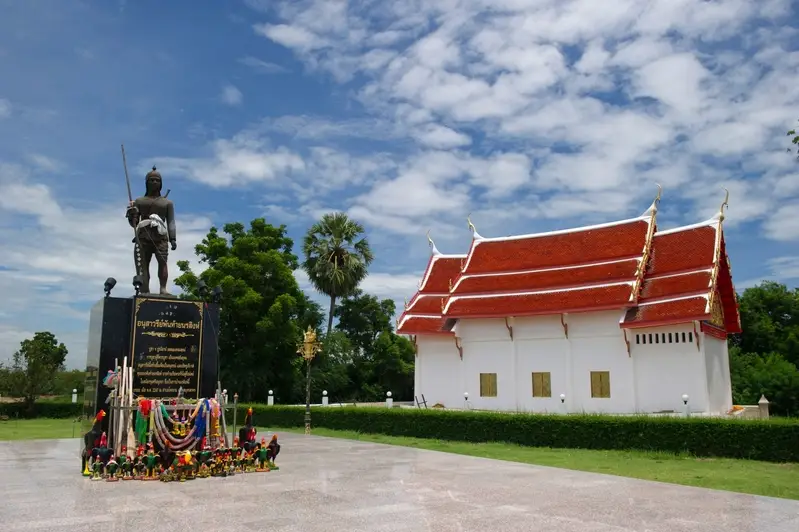
Phanthai Norasing Monument (Wat Narasingh) is a historical attraction in Pa Mok District, Ang Thong Province, created to reaffirm the meaning of “integrity and responsibility in one’s duty” through the well-known story of Phanthai Norasing, who served as the royal barge helmsman during the reign of King Suea. The monument stands within Wat Narasingh, making it an easy stop along the route, and it suits a half-day visit or a connected trip to important temples across Pa Mok and Ang Thong town. Most visitors spend about 30–60 minutes walking around and taking photos (excluding time for making merit and visiting nearby temples).
If you are looking for an “Ang Thong attraction” that can be explained in one sentence, Phanthai Norasing Monument is a direct answer. This is not merely a roadside stop; it is a place where Thai history becomes tangible through the figure of a man holding a “broken prow” in his hands. That image has long served as a visual shorthand for a story many Thais have heard for generations—a story about rules, discipline, and the honor of duty, even when the price is life itself.
The monument is located inside Wat Narasingh, Moo 2, Ban Taphun, Norasing Subdistrict, Pa Mok District, Ang Thong Province, and it was constructed in 1988 (B.E. 2531) to honor Phanthai Norasing as a symbol of loyalty and integrity in Thai society. The site’s strengths are simple: it is easy to reach and it tells its story clearly. Visitors can park, walk in to pay respects, take photos, and grasp the historical context within a short time, before continuing to other cultural landmarks around Pa Mok—an area known for long-established temples and a riverside community atmosphere.
To understand why this monument matters, it helps to return to the person behind the name. Phanthai Norasing, often called simply “Norasing,” was a local from the Norasing area and later received an important appointment as the royal barge helmsman for the vessel known as Ekkachai during the reign of Somdet Phra Sanphet VIII, widely remembered as “King Suea.” The role of a helmsman was far from ordinary. He was responsible for controlling the stern so the royal barge could navigate safely, especially through winding waterways where judgment, skill, and composure were required at all times.
The core story repeatedly emphasized in Thai collective memory is the incident in which the royal barge’s prow struck a tree branch and broke. In the royal court of that era, the “Kot Monthianban” (Palace Law) represented the legal and ceremonial framework that upheld royal authority and the order of state rituals. One crucial principle was that when damage occurred to a royal vessel, the responsible officer would be punished according to the law, even if the event was accidental. This is precisely why Phanthai Norasing became a lasting example: he insisted on accepting the death penalty prescribed by the law in order to preserve the principle of duty and the sanctity of the rules, ensuring society could not interpret the system as something that could be bent at will, even when those in power might have wished to show mercy.
From a modern perspective, the story reflects an extreme form of “accountability culture” that the state and society of the past sought to instill, emphasizing unwavering adherence to a system of order. When retold in classrooms and public spaces, the story becomes a shared language for discussing integrity in one’s role, courage in accepting the consequences of one’s actions, and the determination to keep principles intact as a standard for future generations. Whether one agrees or disagrees with the harshness of such rules, what cannot be denied is the “moral impact” that has kept the story alive in Thailand’s collective memory.
The construction of Phanthai Norasing Monument in Ang Thong in 1988 therefore functions as a “memory anchor” for the community—a place that turns a textbook narrative into a real experience. Visitors see the statue, recognize the broken prow as a symbol, and understand immediately what the site intends to communicate, without the need for a large museum or complex exhibitions. The simplicity of the monument’s design strengthens the clarity of its message: “integrity in duty” and “steadfastness in principle.”
The monument is not presented as an isolated photo spot because it sits within a temple compound, which naturally adds religious and community dimensions to the experience. Many visitors begin by paying respects at the monument, then continue to make merit, worship, or spend a quiet moment inside the temple grounds, where the atmosphere often feels calmer than commercial tourist sites. Because this is a temple setting, basic etiquette matters: dress modestly, keep voices low, respect areas used for religious practice, and avoid taking photos in ways that disturb monks or worshippers.
As a travel experience, another highlight is “storytelling through imagery.” The statue of Phanthai Norasing holding the broken prow creates a meaningful photo on its own. A strong composition is one that includes both the statue and elements of the surrounding temple environment, so the image reads as a real place with context rather than a generic monument shot. Morning and late afternoon typically offer softer light and a more comfortable walking experience. Visitors who enjoy deeper cultural learning can also spend additional time connecting the story to broader historical and social contexts of Thailand’s past.
Beyond the quick stop that many travelers treat as a roadside break, the real charm here lies in “extending the trip” beyond a single check-in photo. Pa Mok and Ang Thong offer a network of significant temples that can be linked within one day, many with distinctive art, architecture, and local narratives. Starting at Phanthai Norasing Monument—a story centered on virtue and discipline—you can continue to nearby temples to experience another dimension of Ang Thong: the character of longstanding temple communities and riverside ways of life that make this province a rewarding cultural destination.
On the community side, the monument has also served as a focal point for remembrance activities honoring Phanthai Norasing in certain periods, showing that the story has not remained confined to books. It continues to function as a local source of pride and a contemporary bridge that brings people together through shared events. When such remembrance activities take place, visitors may also encounter a living local atmosphere—ceremony, gathering, and repeated storytelling that transmits values from one generation to the next.
Getting There Reaching Phanthai Norasing Monument is convenient for travelers with a private car because the destination is in Pa Mok District and connects well with Ang Thong’s main routes. It can be planned as a simple day trip from Bangkok, or combined smoothly with Ayutthaya. For travelers using public transport, there is general route guidance for vans and buses that pass through the Ang Thong–Pa Mok area, which helps with planning connections and timing (once in Pa Mok, local hired transport may be used to reach the temple and monument as appropriate).
In straightforward terms, the reason to visit is clear: Phanthai Norasing Monument is a place that invites both readers and travelers to rethink the word “duty” in a deeper sense than everyday responsibilities. Thai society has long used this story to emphasize that when a person holds a role affecting others, the commitment to principles and accountability matters. Visiting here is therefore not only about photography; it is about encountering a “symbol of virtue” made tangible in the real landscape of an Ang Thong community.
| Place Name | Phanthai Norasing Monument (Inside Wat Narasingh) |
| Address | Wat Narasingh, Moo 2, Ban Taphun, Norasing Subdistrict, Pa Mok District, Ang Thong 14130, Thailand |
| Place Summary | A historical memorial honoring Phanthai Norasing’s integrity, ideal for a short cultural stop to learn the story and take meaningful photos within a temple setting. |
| Highlights | Statue of Phanthai Norasing holding a broken prow (key historical symbol), easy roadside access, convenient for linking a Pa Mok–Ang Thong temple route. |
| Period | Monument built in 1988 (B.E. 2531), linked to an Ayutthaya-era royal narrative during King Suea’s reign. |
| Key Evidence | The monument is located within Wat Narasingh and is recorded as built in B.E. 2531 (1988). |
| Name Origin | Named after “Phanthai Norasing,” the royal barge helmsman remembered for integrity and accountability in duty. |
| Travel | Easy by private car (Pa Mok area connects well with Ang Thong–Ayutthaya routes); by public transport, plan via vans/buses through Ang Thong–Pa Mok and continue with local transport as needed. |
| Current Status | Open to visitors |
| Facilities | Parking area within the temple grounds (site-dependent), restrooms and merit-making areas (subject to the temple’s daily arrangement). |
| Fees | No verified fee information (temple-area visits are commonly free; donations are optional). |
| Caretaker / Abbot | - |
| Nearby Tourist Attractions (Approx. Distance) | 1) Wat Kunchon Chatikaram (Wat Chang) – approx. 3 km 2) Wat Prasat – approx. 4 km 3) Wat Lat Khao – approx. 5 km 4) Wat Pa Mok Worawihan (Luang Pho To) – approx. 8 km 5) Ang Thong Town Center (Government Office / Main Market Area) – approx. 15 km |
| Popular Restaurants Nearby (Approx. Distance + Phone) | 1) Krua Kai Chon (Pa Mok) – approx. 2 km – 035-662576, 085-424-4760 2) Suan Ahan Phae Rim Nam Pa Mok – approx. 7 km – 062-9362249 3) Ban Rak Nam (Pa Mok) – approx. 9 km – 095-263-9493 4) Khong Aroi by Lung Lung – approx. 12 km – 080-9322331, 095-2107108 5) Kuay Teow Khai Luak (Ang Thong) – approx. 16 km – 090-9843739 |
| Popular Accommodations Nearby (Approx. Distance + Phone) | 1) Jirawan Homestay (Ban Bang Sadet) – approx. 8 km – 081-9126933 2) Bualuang Boutique Resort (Ang Thong Town) – approx. 18 km – 081-4958884, 035-949850 3) Ratchaphruek DC Resort Ang Thong – approx. 17 km – 080-1933277, 035-610800 4) Rim Chon Resort (Ang Thong) – approx. 19 km – 035-611527 5) Homestay Ban Bang Sadet (Contact Host) – approx. 8 km – 081-9126933 |
Frequently Asked Questions (FAQ)
Q: What time is Phanthai Norasing Monument open to visitors?
A: It is open daily for 24 hours, so you can visit during the day or in the evening.
Q: Is there an entrance fee?
A: There is no verified fee information. Temple-area visits are commonly free, and donations are optional if you wish to make merit.
Q: How long should I plan to spend here?
A: For a walk-around visit and photos, plan about 30–60 minutes. If you also make merit and explore the temple grounds, allow about 60–90 minutes.
Q: Is this place suitable for children or families?
A: Yes. It is a clear, visual way to learn a Thai historical story. Families should dress modestly and observe temple etiquette.
Q: What should I wear when visiting a monument inside a temple?
A: Dress modestly, avoid overly short or tight clothing, keep noise low, and respect areas used for religious practice to avoid disturbing monks and worshippers.
Q: If I plan a one-day trip, where should I go next nearby?
A: Recommended nearby stops include Wat Kunchon Chatikaram (Wat Chang), Wat Prasat, Wat Lat Khao, and Wat Pa Mok Worawihan (Luang Pho To), all in the same area and easy to connect by road.
 Phanthai Norasing Monument (Wat Narasingh) Map
 Category:
  Group:
  Tag: ●Phanthai Norasing Monument (Wat Narasingh)●phanthai norasing monument ●ang thong attractions ●pa mok attractions ●wat narasingh ●thai history landmark ●one day trip ang thong ●cultural tourism thailand ●temple visit ang thong ●road trip ayutthaya ang thong ●thai virtue story Last Update: 3 DayAgo
Comment
 Nearby Attractions
| Keyword (Advance) |
 Region
|
 Muang Ang Thong(
 Copyright 2012,