
 Home
Home North(
 Chiang Mai(


Wat Chaiyo Worawihan (Wat Ket Chaiyo)
Rating: 4/5 (4 votes)
 Search By
  Map
Map 
 Have Map
  No Map
Ang Thong attractions
Attractions in Thailand
Open Days: Daily
Opening Hours: 07:00 – 17:00
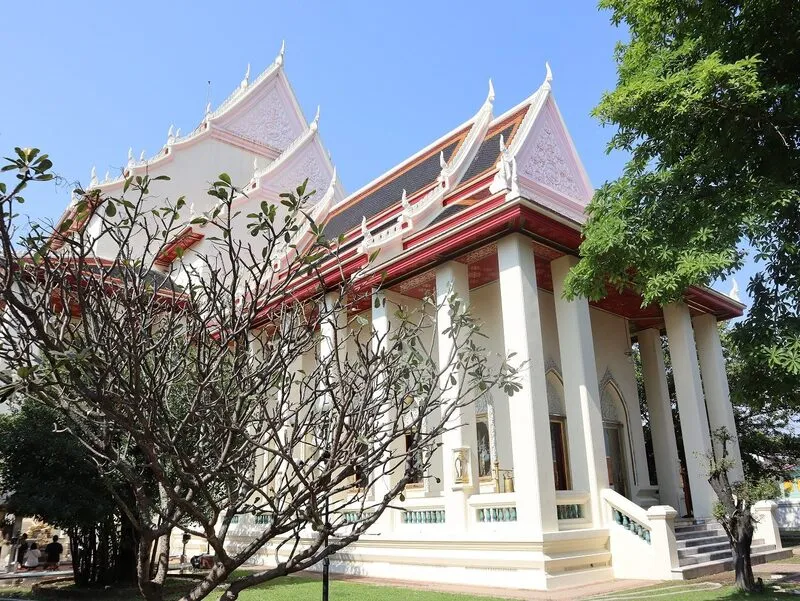
Wat Chaiyo Worawihan (Wat Ket Chaiyo), Ang Thong Province is one of the must-visit destinations for pilgrims and cultural travelers in Ang Thong. This temple is a second-class royal monastery (Worawihan) and enshrines “Phra Maha Phutthaphim” (Luang Pho To), a monumental Buddha image revered for generations. For travelers with limited time, this is a one-stop visit where you can pay respects to a grand Buddha image inside a strikingly tall viharn, admire the ubosot oriented toward the Chao Phraya River, view mural paintings depicting the Buddha’s life created by artisans of King Rama V’s era, and experience the atmosphere of a major Central Thai temple that is easy to access from the main road.
The temple is located in Chaiyo District, Ang Thong Province, along the Ang Thong–Sing Buri route, on the western bank of the Chao Phraya River. This setting gives the visit a slightly different character from typical temples, because several key structures are positioned to face the great river corridor of Central Thailand. Upon arrival, you will notice the open, airy grounds, the layout designed to accommodate large numbers of devotees, and the unmistakable presence of a “major temple” that serves both as a spiritual center and a year-round destination for visitors from many places — especially on weekends and during major merit-making events when worshippers come specifically to apply gold leaf and pay homage to Luang Pho To.
What makes Wat Chaiyo Worawihan stand out is not only the sheer scale of its principal Buddha image, but also the historical depth that connects the temple to pivotal periods in early-to-mid Rattanakosin Thailand. The temple was originally a community temple, and the exact date of its founding is not clearly recorded. Its significance became especially pronounced during the reign of King Rama IV, when Somdet Phra Phutthachan (To Phrommarangsi) of Wat Rakang Kositaram, Thonburi, traveled here and created a large seated Buddha image in the meditation posture outdoors on the temple grounds. This marked the beginning of the temple’s rise as a regionally important sacred site that has continued to attract devotees without interruption.
Later, during the reign of King Rama V, Wat Chaiyo Worawihan became even more prominent. King Chulalongkorn visited to worship and, in 1887 (B.E. 2430), granted royal patronage for restoration and renovation. However, the temple’s history from this period also includes a well-remembered event: vibrations during foundation work for the viharn caused the original Luang Pho To image to collapse. The incident was not only a material loss; it also reflects the engineering limitations of the time when compared with the ambitious plan to construct a massive viharn for large crowds of worshippers. With royal faith and support, a new Luang Pho To was commissioned, modeled after the Luang Pho To at Wat Kalayanamitr, and was bestowed the name “Phra Maha Phutthaphim”. It has since become one of Ang Thong’s most important and widely recognized sacred images.
People often speak about Phra Maha Phutthaphim in terms of its overwhelming scale — the kind that makes you instinctively tilt your head upward — and the sense of calm fulfillment that comes from standing inside the same viharn as the principal image. According to commonly cited local travel references and historical narratives, the statue is described as approximately 8 wa 6 inches across the lap, and 11 wa 1 sok 7 inches high to the top of the halo. These dimensions emphasize that this is not a merely “large” Buddha image, but a landmark-scale symbol of faith and a spiritual anchor for communities throughout the Central Plains. Inside the viharn, you can also see how the space is organized to welcome many worshippers at once, including areas for walking in an orderly flow, applying gold leaf where appropriate, offering flowers and incense, and sitting quietly at a respectful distance without disturbing others.
Another layer of interest at Wat Chaiyo Worawihan is the relationship between its architecture and the riverside landscape of the Chao Phraya River. Some important structures — especially the ubosot — are described as facing toward the river, a feature seen in many significant Central Thai temples that historically grew alongside water routes. In earlier times, rivers were not only natural resources but also main highways, economic lifelines, and pathways of faith. Many people traveled to temples by boat, so an ubosot oriented toward the river carried symbolic meaning: the sacred space opened itself to visitors arriving by water and visibly expressed community devotion even before reaching the shore. Today, most visitors arrive by car, but the beauty of riverside-oriented architecture still gives Wat Chaiyo a distinctly Central Thai charm.
As you walk from the viharn to the ubosot, you will encounter another highlight worth taking your time with: mural paintings inside the ubosot that depict episodes from the Buddha’s life and are often described as the work of artisans from King Rama V’s era. The value of such murals is not only in their colors but also in how they serve as a “visual language of the period,” reflecting beliefs, artistic taste, and narrative style at a time when Siam was adapting to modernity. Looking closely, you may notice details beyond the main scenes — backgrounds, communities, figures, clothing, and compositional structure — which together show that a temple is not only a place for ritual, but also a space where society produces meaning through the combined forces of art and religion.
Beyond Luang Pho To and the murals, the viharn that faces the Chao Phraya River also contains a large statue of Somdet Phra Phutthachan (To Phrommarangsi), said to have been completed in 1894 (B.E. 2437). In widely circulated historical accounts, this statue represents the “initiator” of the temple’s modern prominence, since Wat Chaiyo Worawihan is strongly associated with Somdet To in the public imagination — both as a revered senior monk with enduring influence in Thai society and as a key figure connected to the creation of the large Buddha image that later developed into today’s Phra Maha Phutthaphim. For travelers interested in Thai religious culture, the history of amulets, and devotional traditions of the Central region, this is a meaningful point to pay respects and capture memorable photos.
To experience Wat Chaiyo Worawihan “fully” without feeling rushed, a simple viewing order works well. Begin by paying respects to Phra Maha Phutthaphim inside the main viharn, as it is the heart of the temple and the primary reason most people visit. Next, visit the statue of Somdet To or the designated devotional area, then continue to the ubosot to admire the murals and the refined Thai architectural details characteristic of a royal temple. After exploring the interiors, walk outside to absorb the overall atmosphere and take in the river-oriented setting, which still conveys the essence of a Central Thai “riverside community” even today. Following this flow allows your visit to combine devotion, art appreciation, and landscape in a single trip.
In terms of faith and practice, many visitors come to Wat Chaiyo Worawihan to pray for family well-being, career progress, and life stability, because worshipping Luang Pho To at a major provincial temple is widely seen as a direct way to strengthen one’s spirit and find peace of mind. Typical practices include paying respects, applying gold leaf (where the temple provides designated areas), offering flowers and incense, and making donations according to one’s means. The key to visiting a major temple like this is etiquette: dress modestly, maintain calm and respectful behavior, avoid loud conversation in worship areas, and be mindful not to disturb elderly devotees or families who come with sincere intention.
If you want to see Wat Chaiyo Worawihan at its liveliest, visiting during the annual merit-making period is a strong choice. The temple is known for hosting worship events and activities connected to devotion to Luang Pho To and commemoration of Somdet To. Based on commonly promoted tourism event information, these periods may include worship ceremonies, gold-leaf application to Phra Maha Phutthaphim, ritual bathing of Buddha images, water-blessing traditions for elders, and cultural elements such as sand pagoda-building contests and local performances. In this atmosphere, you are not only visiting a temple; you are also witnessing community cooperation, local commerce, and the living relationship between people and the temple as a social heart of Central Thai life — something that is much harder to feel on an ordinary weekday.
For photographers, Wat Chaiyo Worawihan offers both “grand and majestic” angles and “quiet and detailed” moments. The grand views come from standing before the viharn and capturing its towering proportions, while the detailed moments involve photographing Thai decorative elements around the ubosot and documenting the mural paintings without flash to help preserve the pigments and surface (always follow temple rules and staff guidance). The best light is usually early morning or late afternoon, when sunlight is softer and enhances the dimension of Thai ornamentation, while also making the walk more comfortable in the heat.
Another advantage of visiting Wat Chaiyo Worawihan is how easily it can anchor a one-day itinerary that links Ang Thong’s famous temples, since many significant religious and craft destinations lie within short driving distances. If you begin your morning at Wat Chaiyo, you can continue to Wat Pa Mok Worawihan (known for its revered reclining Buddha), or Wat Khun Inthapramun (also associated with an important reclining Buddha image), and finish at Wat Muang, whose massive Luang Pho Yai statue is a widely recognized landmark. This itinerary lets you experience a royal temple, historic temples, and a major landmark temple all in one day without needing to travel far outside the province.
Getting There: If you are driving from Bangkok, a convenient route is to take Asia Highway (Highway 32) northward, then connect into Ang Thong and continue toward Chaiyo District along the Ang Thong–Sing Buri route (commonly associated with Highway 309 along certain connecting stretches). The temple is close to the main road and there are local signs, making navigation straightforward with a map app. From Ang Thong town, follow the Ang Thong–Sing Buri road toward Chaiyo; the overall drive from the town area is relatively short, ideal for a quick worship stop and an unhurried walk to appreciate the art and atmosphere. If traveling by public transport, a practical approach is to take a van or bus to Ang Thong town first, then continue by local transport toward Chaiyo District. Allow extra time for vehicle schedules and last-mile connections, since the temple is along a main route but not a large public-transport terminal destination.
Overall, Wat Chaiyo Worawihan offers a “complete” experience for anyone who loves Central Thai culture. You can worship Phra Maha Phutthaphim, one of the province’s most important symbols of faith; follow a historical timeline that connects the temple to King Rama IV and King Rama V through construction and restoration narratives; admire Buddha-life murals that reflect the artistic sensibilities of Rama V’s era; and see the temple’s role as a community gathering place through annual merit-making events and traditions. If you are looking for a major temple that is easy to reach yet rich in history, craftsmanship, and riverside atmosphere, Wat Chaiyo Worawihan is well worth placing firmly on your travel map.
| Place Name | Wat Chaiyo Worawihan (Wat Ket Chaiyo) |
| Address | 21 Moo 3, Chaiyo Subdistrict, Chaiyo District, Ang Thong 14140, Thailand |
| Place Summary | A second-class royal monastery and a major spiritual landmark of Ang Thong, best known for Phra Maha Phutthaphim (Luang Pho To) housed in a grand viharn, an ubosot facing the Chao Phraya River, and Rama V-era Buddha-life murals. |
| Key Highlights | Phra Maha Phutthaphim (Luang Pho To), the towering main viharn, Thai-style ubosot facing the Chao Phraya River, Rama V-era Buddha-life murals, and the statue of Somdet Phra Phutthachan (To Phrommarangsi). |
| History And Era | Originally a community temple (exact founding date not clearly recorded). Gained prominence in King Rama IV’s reign through Somdet To’s role, and was restored in King Rama V’s reign (B.E. 2430/1887), including reconstruction of Luang Pho To and the royal bestowal of the name “Phra Maha Phutthaphim.” |
| Key Evidence | Phra Maha Phutthaphim (Luang Pho To) enshrined in the main viharn; Buddha-life murals in the ubosot (Rama V-era artisans); widely cited restoration and reconstruction narratives from King Rama V’s period. |
| Name Origin / Alternate Names | Known as “Wat Chaiyo Worawihan” and “Wat Ket Chaiyo,” a key temple of Chaiyo District, Ang Thong. |
| Open Days | Daily |
| Opening Hours | 07:00 – 17:00 |
| Abbot / Current Caretaker | Phra Wachirawethi (Abbot of Wat Chaiyo Worawihan) |
| Contact Number | 081-295-4433 |
| Fees | No entrance fee found (donations welcomed). |
| Facilities | Parking area, worship spaces inside the viharn, areas for offerings and donations, and access to the ubosot and mural viewing (subject to temple rules). |
| Transportation | Drive from Bangkok via Asia Highway (Hwy 32) and connect into Ang Thong, then continue toward Chaiyo along the Ang Thong–Sing Buri route; from Ang Thong town, drive toward Chaiyo on the same route (the temple is near the main road). |
| Current Status | Open for worship and cultural visits. |
| Nearby Tourist Attractions (Approx. Distance) | 1) Wat Pa Mok Worawihan — 17 km 2) Wat Khun Inthapramun — 23 km 3) Wat Muang (Luang Pho Yai) — 32 km 4) Sala Chao Rong Thong Market / Riverside Community Area (Ang Thong town zone) — 16 km 5) Bang Chao Cha Basketry Craft Village — 35 km |
| Popular Restaurants Nearby (Approx. Distance + Phone) | 1) Pae Lung Chao — 4 km — 081-467-3099 2) Pomm Cafe — 7 km — 085-125-5925 3) Rungaroon Fishing Park — 9 km — 036-538-452 4) Brighter Day’s Cafe & Bistro — 12 km — 082-556-2266 5) Steak Khun In (Branch 2) — 18 km — 095-961-5465 |
| Popular Accommodations Nearby (Approx. Distance + Phone) | 1) Parinda Resort — 3 km — 089-771-7305 2) Rungaroon Resort — 9 km — 088-460-5150 3) Kan Bua Resort — 9 km — 089-855-4000 4) Baan Chid Chon Resort, Sing Buri — 12 km — 081-852-0648 5) Ruen Kwan Kaew Resort — 18 km — 088-981-6054 |
Frequently Asked Questions (FAQ)
Q: Where is Wat Chaiyo Worawihan located?
A: The temple is located at 21 Moo 3, Chaiyo Subdistrict, Chaiyo District, Ang Thong 14140. It lies near the Ang Thong–Sing Buri route and on the western bank of the Chao Phraya River.
Q: What is the main highlight of Wat Chaiyo Worawihan?
A: The key highlight is Phra Maha Phutthaphim (Luang Pho To) housed in a grand viharn, along with the ubosot facing the Chao Phraya River and Rama V-era murals depicting the Buddha’s life.
Q: How is Wat Chaiyo Worawihan connected to Somdet Phra Phutthachan (To Phrommarangsi)?
A: The temple rose to prominence during King Rama IV’s reign through Somdet To’s role in creating a large Buddha image on the temple grounds, and there is also a statue of Somdet To inside the viharn for worship.
Q: What is the most convenient way to travel from Bangkok to Wat Chaiyo Worawihan?
A: Many travelers drive via Asia Highway (Highway 32), connect into Ang Thong, and continue toward Chaiyo along the Ang Thong–Sing Buri route. The temple is close to the main road and easy to reach using map navigation.
Q: What time does Wat Chaiyo Worawihan open, and is there an entrance fee?
A: It is generally open daily from 07:00 – 17:00, and no entrance fee is indicated (donations welcomed).
Q: How much time should I allocate for visiting Wat Chaiyo Worawihan?
A: For the main worship points and highlights, plan about 45–90 minutes. If you want to spend more time with the murals and walk around the grounds, allow 1–2 hours.
 Wat Chaiyo Worawihan (Wat Ket Chaiyo) Map
 Category:
  Group:
  Tag: ●Wat Chaiyo Worawihan (Wat Ket Chaiyo)●wat chaiyo worawihan ●wat ket chaiyo ●luang pho to chaiyo ●phra maha phutthaphim ●ang thong temple ●things to do in ang thong ●chaiyo district ●thai riverside temple ●mural painting thailand ●temple festival ang thong Last Update: 3 WeekAgo
Comment
 Nearby Attractions
| Keyword (Advance) |
 Facebook Fanpage
 Region
 Art, Culture and Heritage
 Landmarks and Memorials(
 Royal Palace(
 Art, Craft Centres, Tradition(
 Museums(
 Historical Houses and The Ancient City(
 Educational Places
 Educational Gardens, Farm(
 Other religious and spiritural sites(
 Research and Development
 Royal Project(
 Suburban Living
 Village, Community(
 Local Market(
 Floating Market(
 Nature and Wildlife
 River, Canal(
 Other natural attractions(
 Entertainment and Agricultural
 Farm, Parks, Gardens and Ecotourism(
 Outdoor and Adventure Activities(
 Shopping
 Shopping and Night Market(
 Travel Articles, Recipes
 Travel Review, Food Review(
 Central Thai Cuisine, Central Thai food recipes(
 Copyright 2012,