
 Home
Home North(
 Chiang Mai(


Wat Suwan Sawetariyaram (Wat Kuti)
Rating: 3.2/5 (6 votes)
 Search By
  Map
Map 
 Have Map
  No Map
Ang Thong attractions
Attractions in Thailand
Open Days: Daily
Opening Hours: 07:30 – 17:00
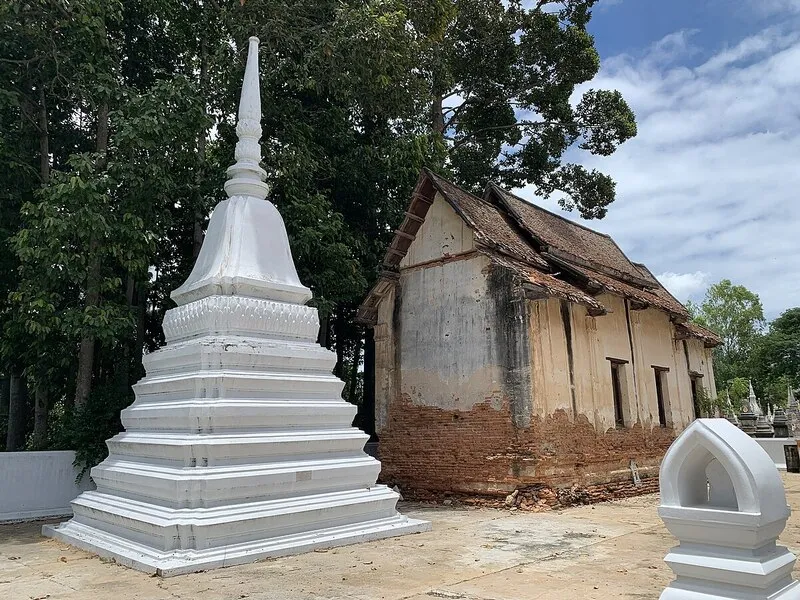
Wat Suwan Sawetariyaram (Wat Kuti), Ang Thong is a local Buddhist temple under the Mahanikaya order, located in Talat Kruat Subdistrict, Mueang Ang Thong District, Ang Thong Province. This temple suits visitors who want both “merit-making and worship” and “an art-and-history experience read through the walls of the ordination hall” because it houses a large Reclining Buddha as its signature landmark. The architecture reflects a graceful blend of Thai aesthetics with Western influence crafted by local artisans, and the mural paintings convey artistic taste from the early-to-mid Rattanakosin period—a time when Siam increasingly embraced Western ways of seeing the world while still standing firmly on the foundations of Thai Buddhist belief and sacred art.
Local residents call this temple “Wat Kuti.” In a temple context, the word “kuti” refers to monks’ living quarters. Using such a vivid, everyday name reflects how naturally close the temple is to the community. For people in Thailand’s central river plains, a temple is not only a place for rituals; it is a hub for education, merit-making, community meetings, and mutual support on life’s important days—from auspicious ceremonies to times of loss. Wat Suwan Sawetariyaram therefore carries the meaning of a true “community temple,” living alongside local people for generations and remaining active today.
Historically, Wat Suwan Sawetariyaram was established on March 6, 1858 (B.E. 2401), during the reign of King Rama IV. This era marked a period of transition in Siamese society in many respects—governance, trade, and the growing influence of external ideas. Temples founded in this period often reveal the era’s “modernity” through subtle craftsmanship: the proportions of buildings, the emphasis on strengthening and improving the ordination hall, and mural paintings that introduce greater depth, light-and-shadow, and atmosphere—features less emphasized in earlier mural traditions.
Later, in 1869 (B.E. 2412), the temple received royal consecration of the boundary for the ordination hall (wisungkhamsima), formally defining the sacred precinct according to monastic discipline. With an officially established boundary, major ecclesiastical rites—such as monk ordination—can be conducted in full compliance with Buddhist practice. From that point onward, Wat Suwan Sawetariyaram underwent restorations and improvements to the ordination hall and related structures, alongside the creation of mural paintings that have become one of the temple’s enduring charms for visitors interested in art and culture.
What makes a visit here instantly memorable is the Reclining Buddha enshrined inside the viharn. The image is approximately 10 wah in length, and when you stand close, you can sense the intention to create a principal icon worthy of the community’s faith. A key highlight is the Buddha’s footprint, rendered with refined curving grooves and lines. This detail invites viewers to pause and gradually read meaning through the patterning. In Thai art, the “Buddha’s footprint” is not merely decoration; it symbolizes recollection of the Buddha’s virtues and the presence of the Dhamma in the human world. The delicacy of the lines thus mirrors merit-making done with steady mindfulness and careful intent.
The viharn that houses the Reclining Buddha is also architecturally engaging because it reflects the skill of local craftsmen who dared to blend certain Western elements into a Thai aesthetic framework. The most visible example is the use of Western-style arches, which make the interior feel airy and dimensional, giving a sense of “contemporary” design for its time. Yet Thai elements—such as the overall proportions, the balanced openings, and the calm atmosphere suitable for worship—remain carefully controlled to preserve a distinctly Thai sacred mood. This blend prevents the building from feeling out of place; instead, it becomes “evidence of a transitional era” that tells its story without needing lengthy explanation.
The ordination hall is another space where art lovers should spend more time than usual. The mural paintings inside stand out on nearly every side. These murals date to the Rattanakosin period around the reigns of King Rama IV to King Rama V, when Thai mural art began adopting more Western approaches to pictorial space. A clear marker is the shading of trees and clouds and the creation of scenes with a more lifelike atmosphere. The murals do more than serve religious teaching; they act as a “window into their era,” revealing how people of that time perceived the world, understood Dhamma, and defined beauty. They are best read slowly and sequentially, like an illustrated manuscript that allows later generations to glimpse historical ways of thinking.
After spending enough time inside the ordination hall, you may feel that the murals are not only “beautiful artworks” but also carefully arranged to help people remain grounded in mindfulness and faith. Depictions of the Buddha’s life, Jataka tales, and moral scenes typical of Thai temples aim to prompt quiet reflection on one’s own actions. Some scenes emphasize serenity; others warn about defilements; others convey the meaning of karmic results. Taking time with these paintings can therefore feel like merit-making with both eyes and heart. And for visitors who come specifically for art, observing small details—the brushwork, color choices, and compositional planning—highlights the mastery of local artisans who, despite limited tools compared to today, created murals that remain vivid and deeply meaningful.
Beyond the Reclining Buddha and the murals, Wat Suwan Sawetariyaram also features an interesting chedi and stucco Buddha images. Particularly notable is a Buddha head made of Ayutthaya-style sandstone, brought here from Wat Pho Thanon, which is now abandoned. Stories like this add historical depth to the temple, reflecting how communities “preserve the old” by relocating valuable components into living spaces of worship. This is not merely reuse; it is an extension of faith and a way to keep sacred art active in the real world rather than leaving it silent within the ruins of its original site.
Seen as a community space, Wat Suwan Sawetariyaram also plays an educational role, as it includes a primary school building within the temple grounds. This reflects a long-standing Thai tradition in which temples served as early centers of local learning. Children in the community grow up alongside the temple—through merit-making on observance days, participating in Buddhist holy-day activities, and learning basic social values such as paying respect, honoring elders, and supporting communal work. These lived experiences make the temple more than a tourist spot; it becomes a place that quietly and continuously builds cultural capital for the community.
From a visitor’s perspective, this temple rewards an intentional visit rather than a rushed stop. Its appeal lies in calm detail rather than grand spectacle. If you come in the morning, you will find pleasant light and cooler air, with chances to observe local life—people dropping by for short but sincere acts of merit-making. In the late afternoon toward evening, the atmosphere softens, ideal for walking around the buildings and resting the mind after paying respects to the Reclining Buddha. For those who enjoy documentary-style photography, you can capture architecture, ornamentation, and community life without heavy staging.
Getting There Wat Suwan Sawetariyaram can be reached in several ways. If you drive from Ang Thong town, take Ang Thong–Chaiyo Road (Highway 309) toward Talat Kruat Subdistrict and follow local signage to the temple. For public transport, you can take local songthaews that pass through Talat Kruat or hire a taxi/chartered vehicle from Ang Thong bus terminal to the temple. It is wise to plan extra time for parking and walking into the grounds, and to spend time inside the ordination hall respectfully—many visitors come here primarily for worship, so maintaining a quiet atmosphere is a form of mutual respect.
If you are traveling from Bangkok as a day trip, driving is generally convenient. Travel time is typically about 1.5–2.5 hours depending on your starting point and traffic. A helpful approach is to plan your itinerary carefully, because Ang Thong Province has many important temples and cultural attractions scattered across the area. You can make Wat Suwan Sawetariyaram one of the day’s core stops and then continue to nearby sites to gain a broader view of local Buddhist art in one trip, such as Wat Ton Son, Wat Ang Thong Worawihan, Wat Khun Inthapramun, or the Ang Thong City Pillar Shrine. This creates a connected narrative and makes the journey more worthwhile.
When visiting the temple, dress modestly and keep your voice low inside the ordination hall and viharn—especially near mural paintings. Avoid touching or leaning against painted walls, as humidity and pressure can affect pigments and surface texture. If you plan to take photos, use settings that do not disturb others and avoid flash in mural areas to help preserve the paintings over time. These small practices contribute to keeping the temple’s beauty and meaning intact in real, practical ways.
At a deeper level, Wat Suwan Sawetariyaram is an example of a local temple that holds both “religious value” and “cultural value” within one space. The Reclining Buddha anchors faith, the murals function as an era’s visual record, and the viharn and ordination hall stand as evidence of local craftsmanship during a time when Thai art was opening itself to new influences. Meanwhile, the temple’s educational and community roles keep it alive as a lived place rather than a static monument. This is not a temple that dazzles through sheer scale; it invites calm, and it leaves visitors with the feeling of returning to the authentic “roots” of Thai culture.
For those who want to understand the temple more deeply, try walking slowly. Begin by paying respects to the principal Buddha images and the Reclining Buddha, then move to observe the footprint details and architectural elements of the viharn. After that, step into the ordination hall and read the murals gradually, wall by wall. This method clarifies the relationship between “faith” and “art.” Then, outside, observe the chedi and stucco Buddha images to see the community’s approach to building sacred structures in earlier times. Ultimately, what stays with you may not be the ability to recall every detail by name, but the calm understanding of how a single temple can hold history, art, and everyday community life within the same space.
| Name | Wat Suwan Sawetariyaram (Wat Kuti) |
| Address | Talat Kruat Subdistrict, Mueang Ang Thong District, Ang Thong 14000, Thailand |
| Place Summary | A local Mahanikaya temple in Talat Kruat, notable for its Reclining Buddha and Rattanakosin-era mural paintings influenced by Western techniques. |
| Highlights | Reclining Buddha (approx. 10 wah), finely carved footprint with curved grooves, viharn with Western-style arches blended into Thai design, Rattanakosin murals (Rama IV–V) with Western-influenced shading and atmosphere. |
| Period | Founded in 1858 (B.E. 2401, Rama IV) and developed further during the Rama IV–V period. |
| Key Evidence | Reclining Buddha in the viharn, mural paintings in the ordination hall, Ayutthaya-style sandstone Buddha head relocated from Wat Pho Thanon (now abandoned). |
| Name Origin | Locals call it “Wat Kuti”; “kuti” means monks’ living quarters. |
| Abbot / Temple Steward (Latest) | Phra Khru Suwan Kitjaporn |
| Open Days & Hours | Daily, 07:30 – 17:00 |
| Fees | No admission fee |
| Facilities | On-site parking, worship/rest areas, restrooms (availability may vary by temple activities and events). |
| Travel | By car: Take Highway 309 (Ang Thong–Chaiyo) into Talat Kruat and follow local signs; Public transport: songthaews through Talat Kruat or a hired vehicle from Ang Thong bus terminal. |
| Current Status | Open for visits and merit-making during stated hours (avoid ceremony periods if you want a quieter mural-viewing experience). |
| Contact Number | 035-613-504 |
| Nearby Tourist Attractions (Driving Distance) | 1) Wat Ton Son – 2.46 km 2) Wat Ang Thong Worawihan – 2.88 km 3) Ang Thong City Pillar Shrine – 3.12 km 4) Wat Khun Inthapramun – 4.59 km 5) Wat Tha It – 5.59 km |
| Popular Restaurants Nearby (Driving Distance + Phone) | 1) Krua Pa Aed – approx. 4 km – 096-112-2000 2) Mueang Ang Thong Restaurant – approx. 6 km – 081-587-4428 3) Pad Thai Wat Thong Khung – approx. 7 km – 082-233-3887 4) Kuay Teow Thang Khong – approx. 7 km – 065-275-1898 5) Ang Thong Restaurant – approx. 6 km – 081-495-0158 |
| Popular Accommodations Nearby (Driving Distance + Phone) | 1) Suphorn Grand Hotel – approx. 6 km – 081-551-2828 2) Ang Thong Hotel – approx. 6 km – 035-611-667 3) Bualuang Boutique Resort – approx. 7 km – 081-495-8884 4) Bualuang Hotel – approx. 6 km – 035-611-116 5) Ratchaphruek DC Resort – approx. 7 km – 064-786-8263 |
Frequently Asked Questions (FAQ)
Q: Is Wat Suwan Sawetariyaram (Wat Kuti) open every day?
A: Yes. It is open daily, with stated hours of 07:30 – 17:00.
Q: What is the temple’s most important highlight?
A: The Reclining Buddha (about 10 wah in length) with its distinctive footprint details, and the ordination-hall murals reflecting Rama IV–V era artistry influenced by Western techniques.
Q: How much time should I plan for a visit?
A: A general visit for worship and a quick walk-through takes about 30–60 minutes. If you want to study the murals and craftsmanship, plan for about 60–90 minutes.
Q: When is the best time to photograph and view the murals?
A: Morning offers comfortable weather and beautiful light for architecture. Late afternoon feels softer and calmer, ideal for a quiet walk and time to rest after worship.
Q: What dress code and etiquette should visitors follow inside the viharn and ordination hall?
A: Dress modestly, keep noise low, avoid touching or leaning on painted walls, and avoid flash photography near murals to help preserve the artwork.
Q: Where should I go next to make a one-day cultural route worthwhile?
A: Nearby options include Wat Ton Son, Wat Ang Thong Worawihan, the Ang Thong City Pillar Shrine, Wat Khun Inthapramun, and Wat Tha It.
 Wat Suwan Sawetariyaram (Wat Kuti) Map
 Category:
  Group:
  Tag: ●Wat Suwan Sawetariyaram (Wat Kuti)●wat suwan sawetariyaram ●wat kuti ang thong ●ang thong temple ●reclining buddha ang thong ●mural painting thailand temple ●things to do in ang thong ●temple hopping ang thong ●cultural tourism thailand ●buddhist temple central thailand ●day trip ang thong Last Update: 3 WeekAgo
Comment
 Nearby Attractions
| Keyword (Advance) |
 Facebook Fanpage
 Region
 Art, Culture and Heritage
 Landmarks and Memorials(
 Royal Palace(
 Art, Craft Centres, Tradition(
 Museums(
 Historical Houses and The Ancient City(
 Educational Places
 Educational Gardens, Farm(
 Other religious and spiritural sites(
 Research and Development
 Royal Project(
 Suburban Living
 Village, Community(
 Local Market(
 Floating Market(
 Nature and Wildlife
 River, Canal(
 Other natural attractions(
 Entertainment and Agricultural
 Farm, Parks, Gardens and Ecotourism(
 Outdoor and Adventure Activities(
 Shopping
 Shopping and Night Market(
 Travel Articles, Recipes
 Travel Review, Food Review(
 Central Thai Cuisine, Central Thai food recipes(
 Copyright 2012,