

 Home
Home Chiang Mai(




Wat Chai Mongkhon
Rating: 4.5/5 (4 votes)
 Search By
  Map
Map 
 Have Map
  No Map
Ang Thong attractions
Attractions in Thailand
Open Days: daily
Opening Hours: 08:00 – 17:00
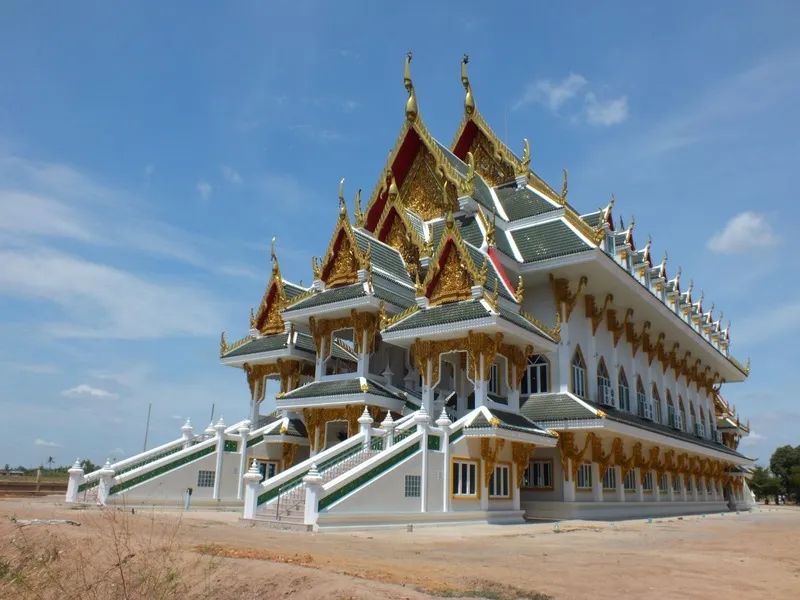
Wat Chai Mongkhon, Ang Thong is an old temple in the provincial town area with a distinctive “local story” that runs from its name to the art inside its ordination hall. The temple is said to have been established around 1857 (B.E. 2400), during the late reign of King Rama IV, and it grew alongside communities of the Chao Phraya river basin—where life was intertwined with boats, markets, and temples as centers of faith, relationships, and social gathering. When people think of temples in Ang Thong, many imagine grand complexes or famous giant Buddha images. Wat Chai Mongkhon, however, stands out as a temple that truly “tells a story”: from the origin of its name, linked to traditional village rowing races, to its contemporary mural paintings that make a visit to the hall more than an act of worship—it becomes a way to read art and ideas of the present layered over the enduring foundations of Thai tradition.
Seen through a cultural lens, a Thai temple is not only a place for religious rites; it is also a space where a community’s “history” is preserved—both in visible forms and through collective memory. Wat Chai Mongkhon reflects this clearly. The name “Chai Mongkhon” was not chosen simply for its pleasant sound; it is explained as being connected to boat rowing competitions in earlier times—a local sport long associated with riverside societies. Old race routes were tied to temples and key community landmarks, and the finish line was said to be linked to Wat Sanam Chai, the starting point of the competition. The image of rowing boats cutting through the current, the cheers of the crowd, and the decisive moment of victory or defeat became a story embedded in the place. Over time, it was distilled into a temple name that conveys both “victory” and “auspiciousness.” In this sense, the name functions like a community blessing, affirming the temple as a spiritual refuge and a symbol of success, safety, and well-being for local people.
In terms of its establishment, the late reign of King Rama IV was a period when Thai society was moving through significant changes—greater foreign contact, clearer forms of urban administration, and expanding riverside trade communities. Ang Thong, in particular, was shaped continuously by waterways as major transport routes. Many communities settled along rivers and canals, and building a temple in that era was both an expression of faith and an affirmation of communal identity. A temple did not belong to one person; it belonged to “all of us” who shared labor and devotion—creating a place for merit-making, communal kitchens, festivals, and the life ceremonies that mark a person’s journey from birth to death. Viewed this way, Wat Chai Mongkhon becomes evidence of social cohesion in Ang Thong, from a time when communities relied strongly on shared networks and collective support.
Once you enter the temple grounds, the feature that deserves the most time is the “ordination hall,” because it is often described as a highlight not to miss—especially the mural paintings inside, which have been newly created in recent times. What makes them compelling is the artist’s choice to blend contemporary visual language and technique with traditional Thai conventions, producing images that feel both familiar and strikingly new. The familiarity lies in the continuing Buddhist themes and recognizably Thai composition—ornamental patterns, symbolic elements, and traditional gestures. The freshness, meanwhile, comes from color choices, the handling of light and shadow, and a more realistic rendering of figures—revealing facial detail, posture, and texture. This approach gives the murals a vivid presence, making viewers feel as though the images are “alive” and the storytelling more immediate and relatable.
One reason the murals at Wat Chai Mongkhon attract attention is the way they “reconfigure composition” in a distinctive manner. For example, celestial beings are painted in a single row above the windows, unlike the more common convention of multiple stacked rows used to create grandeur in many Thai halls. Keeping it to one row opens the wall space and allows the viewer’s eyes to “read the emptiness” with intention—like a musical pause that does not silence the melody but makes the original notes clearer. Another notable point is the wall opposite the principal Buddha image. In many Thai mural traditions, this area often depicts the Buddha’s victory over Mara to emphasize overcoming obstacles and defilements. Here, the artist instead chooses to portray the Buddha seated upon the throne. This shifts the viewer’s experience from “watching a struggle” to “witnessing the calm after victory”—not emphasizing conflict, but emphasizing the state of triumph born from stillness and awakening. In that sense, it resonates meaningfully with the temple’s name, “Chai Mongkhon,” in a spiritual and philosophical way.
Reading the murals at Wat Chai Mongkhon can be rewarding. At a glance, you may simply notice beauty and novelty. But with careful attention, you can sense how the artist raises questions about tradition without breaking it. The core foundations of Thai art and Buddhist themes remain respected, yet the perspective is “shifted” into a contemporary register. Stronger light-and-shadow work deepens the scenes, refined tonal contrasts guide the mood, and realistic depiction helps viewers connect more directly with the human dimension of the stories. As a result, the hall becomes more than a ritual space—it becomes a living classroom of art, where people learn simply by standing quietly and allowing the images to unfold their meaning.
From another angle, Wat Chai Mongkhon also reflects social change in a tangible way. Introducing contemporary mural art into a sacred setting shows that “Thai temples are still evolving” rather than remaining fixed in the past. Many temples today serve multiple roles at once: spiritual centers, venues for community events and merit-making, educational spaces, and places that support key life milestones. As public spaces, they must communicate with multiple generations. Contemporary murals help younger visitors feel that the hall is not distant, while also showing older visitors that Thai artistic heritage can continue to develop without abandoning its roots. In this way, the temple becomes a bridge across time—linking the past as a foundation of faith with the present’s need for new visual language.
For visitors who want a complete experience, it helps to approach Wat Chai Mongkhon by giving the ordination hall time and rhythm. Begin with a quiet moment of respect, then walk slowly along each wall, without rushing, and observe what the artist emphasizes—where light seems to fall, where facial details are heightened, or where composition is intentionally spacious. This is not art meant to be “seen quickly”; it is meant to be “spent time with.” Photography is usually possible as long as it does not disturb others. Avoid flash, and maintain proper etiquette in a sacred place: dress modestly, speak softly, and be mindful near the principal Buddha image. If you hope for the best photos, morning or late afternoon light often appears gentler and can make the mural colors feel more dimensional.
Getting There is straightforward because Wat Chai Mongkhon is located in Ang Thong’s town area. From Bangkok by car, a common route runs north via Ayutthaya and continues to Ang Thong. Once you enter Ang Thong town, follow signs toward “Thesaban Road” and head to Thesaban 5 Road, where the temple is situated. If you do not have a private vehicle, you can travel by bus to Ang Thong town and then take a local taxi or a songthaew to reach the Thesaban 5 area. One advantage of basing your trip in town is that you can plan an easy, continuous itinerary—stopping by local markets, finding classic Ang Thong eateries, or visiting other temples and heritage sites in the province within a single day by using the town center as your hub and branching out from there.
To make your visit more meaningful, consider viewing Wat Chai Mongkhon through the idea of “victory” on multiple levels. First is victory in local memory, rooted in the rowing-race story that gives the temple name its life. Second is the victory of Thai art itself—proving that tradition and contemporaneity can move forward together. Third is inner victory, reflected in the hall’s compositional choices that guide viewers toward calm rather than confrontation. Finally, there is communal victory: a community that continues to sustain the temple as shared space for merit-making, festivals, faith, and everyday social support. In this sense, the temple is not merely a tourist stop; it is a place that helps you understand Ang Thong through devotion and art at the same time.
If you enjoy Thai art, want to see how temple mural painting evolves in the modern era, or simply want a short trip that offers both tranquility and inspiration, Wat Chai Mongkhon is worth visiting with intention. There is no need to rush. Walk slowly, view the murals in full, then step back into town to find something delicious to eat. You will come away with vivid impressions of contemporary art in a sacred space, and with a riverside community story that makes the name “Chai Mongkhon” more than a beautiful phrase—it becomes a name with origins, people, and a real town behind it.
| Name | Wat Chai Mongkhon |
| Address | Thesaban 5 Road, Talat Luang Subdistrict, Mueang Ang Thong District, Ang Thong 14000, Thailand |
| Overview | An old town-area temple in Ang Thong known for its contemporary murals inside the ordination hall, blending Thai tradition with realistic modern techniques, and for a local naming story linked to village rowing races. |
| Highlights | 1) Newly painted contemporary-style murals in the ordination hall 2) A distinctive composition that reinterprets tradition while respecting Thai roots 3) A meaningful local-origin story behind the name “Chai Mongkhon” |
| Period | Established around 1857 (B.E. 2400), late King Rama IV era |
| Key Evidence | The newly created murals in the ordination hall, often referenced as a case study of blending classic Thai aesthetics with modern artistic techniques. |
| Name Origin | Local accounts connect the name to traditional rowing races in earlier times, associated with the moment of winning/finishing, hence “Chai Mongkhon” to convey victory and auspiciousness. |
| Abbot / Current Caretaker | Phra Khru Wiset Chaiwat |
| Travel | By car: enter Ang Thong town and head to Thesaban 5 Road (Talat Luang). By public transport: bus to Ang Thong town, then taxi/songthaew to the Thesaban 5 area. |
| Current Status | Open for worship and visits during opening hours. |
| Contact Number | 035-611-780 |
| Nearby Attractions (Approx. Distance) | 1) Wat Ang Thong Worawihan – 2 km 2) Kham Yat Royal Residence – 9 km 3) Wat Khun Inthapramun – 12 km 4) Wat Muang – 16 km 5) Baan Hoon Lek (Ang Thong) – 18 km |
| Popular Restaurants Nearby (Approx. Distance + Phone) | 1) Lek Ban Ro – 2 km – 035-612-070 2) Niramit – 7 km – 035-631-052, 081-852-4777 3) Ruen Rub Kwan – 6 km – 061-997-8987 4) Bok Tor – 5 km – 065-275-1898 5) Pad Thai Wat Thong Khung – 14 km – 082-233-3887 |
| Popular Accommodations Nearby (Approx. Distance + Phone) | 1) Suphorn Grand Hotel (Ang Thong) – 3 km – 081-551-2828 2) Bualuang Hotel (Ang Thong) – 5 km – 035-611-116, 080-922-4040 3) Bualuang Boutique Resort – 6 km – 035-949-850 4) MOR MOR Resort (Ang Thong) – 9 km – 085-698-3681 5) Rim Chon Resort (Ang Thong) – 8 km – 035-611-527 |
Frequently Asked Questions (FAQ)
Q: What is Wat Chai Mongkhon in Ang Thong best known for?
A: It is best known for the ordination hall and its newly painted contemporary-style murals that blend classic Thai traditions with modern techniques, creating depth and rich meaning.
Q: When was Wat Chai Mongkhon established?
A: It is said to have been established around 1857 (B.E. 2400), during the late reign of King Rama IV.
Q: Why is it called “Wat Chai Mongkhon”?
A: Local accounts link the name to traditional village rowing races in earlier times, associated with winning/finishing, so the name conveys both victory and auspiciousness.
Q: What is the easiest way to get to Wat Chai Mongkhon?
A: The easiest way is to drive into Ang Thong town and head to Thesaban 5 Road (Talat Luang). Without a car, take a bus to Ang Thong town and then a local taxi or songthaew to the area.
Q: How should visitors behave when viewing the murals inside the ordination hall?
A: Dress modestly, speak softly, avoid using flash, do not disturb worshippers, and be mindful near the principal Buddha image to respect the sacred space.
Q: Can I plan a one-day itinerary near Wat Chai Mongkhon?
A: Yes. You can base yourself in Ang Thong town and continue to places such as Kham Yat Royal Residence, Wat Khun Inthapramun, or Wat Muang depending on your time.
 Wat Chai Mongkhon Map
 Category:
  Group:
  Tag: ●Wat Chai Mongkhon●wat chai mongkhon ang thong ●chai mongkhon temple ang thong ●temple mural painting thailand ●modern thai temple murals ●ang thong attractions ●ang thong day trip ●temples in ang thong ●thailand cultural temple ●thai buddhist temple art ●things to do in ang thong Last Update: 1 DayAgo
Comment
 Nearby Attractions
| Keyword (Advance) |
 Facebook Fanpage
 Region
 Art, Culture and Heritage
 Landmarks and Memorials(
 Royal Palace(
 Art, Craft Centres, Tradition(
 Museums(
 Historical Houses and The Ancient City(
 Educational Places
 Educational Gardens, Farm(
 Other religious and spiritural sites(
 Research and Development
 Royal Project(
 Suburban Living
 Village, Community(
 Local Market(
 Floating Market(
 Nature and Wildlife
 River, Canal(
 Other natural attractions(
 Entertainment and Agricultural
 Farm, Parks, Gardens and Ecotourism(
 Outdoor and Adventure Activities(
 Shopping
 Shopping and Night Market(
 Travel Articles, Recipes
 Travel Review, Food Review(
 Central Thai Cuisine, Central Thai food recipes(
 Copyright 2012,