

 Home
Home Chiang Mai(




Tham Kaeo Cave
Rating: 4/5 (5 votes)
 Search By
  Map
Map 
 Have Map
  No Map
Prachuap Khiri Khan attractions
Attractions in Thailand
Open Days: Every day
Opening Hours: 08.00 – 16.30
Tham Kaeo Cave is one of the natural attractions with a distinctive charm in Prachuap Khiri Khan Province. It is located in the Bang Pu area within Khao Sam Roi Yot National Park and is another destination that nature lovers should not overlook. If Phraya Nakhon Cave is remembered for its grandeur and the Kuha Karuhas Pavilion, then Tham Kaeo is known for the close-up experience of exploring a limestone cave in a raw, quiet atmosphere filled with the intricate beauty of stalactites and stalagmites that are especially impressive when seen in person.
Tham Kaeo lies along the same route as Phraya Nakhon Cave, but it is reached about 3 kilometers earlier. It is located on the southern side of the Hub Chan mountain range in the Bang Pu area of Khao Sam Roi Yot National Park, a coastal limestone mountain zone that is one of the most distinctive landscapes in the lower central and upper southern regions of Thailand. The special character of this area comes from its large limestone mountains, which alternate with wetlands, seashores, and coastal communities, creating a landscape that is both beautiful and highly significant in geological terms.
When people talk about attractions in Sam Roi Yot, many think of Phraya Nakhon Cave first. In reality, however, the Bang Pu area and the nearby mountain range also contain several other interesting caves, and Tham Kaeo is one of the most talked about among nature travelers. This is because the experience here is quite different. It is not simply a matter of climbing up to see one highlight, but rather an experience of entering darkness inside the cave, using flashlights to find the way, observing rock crevices, pits, stone pillars, and the reflective sparkle on the rock surfaces that gives this cave its name.
Tham Kaeo is a limestone cave formed through natural processes over millions of years. Naturally weakly acidic rainwater gradually seeps through the limestone layers and dissolves the rock little by little. As this process continues over a long period, it creates cavities, caves, underground waterways, and karst landforms, all of which are clearly found in the Sam Roi Yot area. Inside the cave cavities, where mineral-rich water drips continuously, calcite slowly accumulates and forms stalactites, stalagmites, stone pillars, flowstone curtains, and travertine features that give the cave its distinctive beauty.
The most important highlight of Tham Kaeo is the shimmering quality of the rock surfaces inside the cave when illuminated by light. Some of the stalactites and stalagmites look as if they are covered with glass flakes or crystal scales. When flashlight beams strike these surfaces, they reflect fine sparkling light, creating a breathtaking atmosphere unlike that of most other caves. It is this characteristic that gave the cave the name “Tham Kaeo,” or “Crystal Cave,” a name that is easy to remember and clearly reflects the place’s defining feature.
As for the history of Tham Kaeo, local stories say that a wandering monk once entered the forest in search of a place for meditation and discovered the cave entrance. Later, a man named Bai, whose surname is not clearly recorded, became lost inside the cave and came across the beautiful stalactites and stalagmites within. During the rainy season in particular, the rock surfaces become moist and their sparkle becomes especially vivid. This story gives Tham Kaeo not only the character of a natural attraction, but also a sense of discovery and a shared memory preserved by local people.
The area around Tham Kaeo is also highly notable from a geological perspective because it is a well-developed karst landscape. The limestone here is soluble in water, which has created rough, uneven rock surfaces full of pits, fissures, and cavities that have gradually developed into cave systems and underground waterways. Tham Kaeo is therefore not only a cave attraction, but also a natural classroom for anyone interested in limestone topography and the evolution of the earth’s crust.
Geological information indicates that the limestone around Tham Kaeo contains fossils such as fusulinids and brachiopods, dating to the Middle Permian period, approximately 253 million years ago. In some sections, shale and sandstone layers are also interbedded. These details reflect that the Sam Roi Yot area was once a shallow marine environment before later uplift, erosion, and geological transformation turned it into the limestone mountains and cave systems visible today.
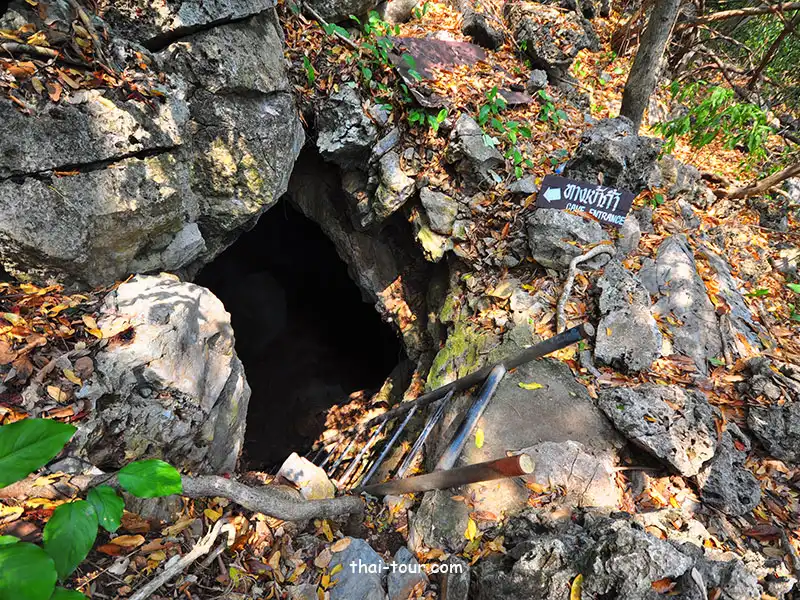
The physical nature of Tham Kaeo makes a visit here very different from caves that are easy to walk through. Although the distance from the foot of the hill to the cave entrance is not very far, with an uphill walk of about 128 meters, the conditions change immediately once inside. The interior is very dark, with pits, deep rock crevices, and some sections of the path being narrow or steep, so a high level of caution is required. Visitors should wear sneakers or shoes with good grip and should avoid entering the cave without an official guide.
The reason a guide is recommended is not only for convenience, but directly for safety. The cave interior is more complex than it appears from outside. Some sections can easily confuse visitors, and arrow markers are provided inside to indicate the proper entrance and exit directions. Visitors should follow these arrows only and should never stray off the marked route, as doing so may lead to getting lost or injured by rock crevices and uneven ground inside the cave.
Another point that should be emphasized is the use of flashlights. Tham Kaeo should never be entered with only one shared light source, because the deeper one goes, the darkness becomes so intense that visibility without artificial light is almost impossible. The best recommendation is for each person to carry a separate flashlight so everyone can help illuminate the path, the floor, and the cave walls safely. At the same time, the flashlight beam is exactly what reveals the cave’s true beauty. When the light shines onto the mineral-coated rock surfaces, they sparkle in a way that is the cave’s most distinctive feature.
Inside Tham Kaeo there are abundant cave deposits, including stalactites, stalagmites, stone pillars, and flowstone formations. Some rocks appear in curtain-like shapes, some as columns, and others as walls resembling frozen waterfalls. Seeing these forms under flashlight beams creates a very interesting interplay of light and shadow. For this reason, many travelers feel that Tham Kaeo offers a closer and more authentic experience of a limestone cave than a typical scenic landmark destination.
The atmosphere of visiting Tham Kaeo is very different from going to a beach or a viewpoint, because it truly feels like an exploration. From the point where the route branches off from the road to Phraya Nakhon Cave, visitors enter a smaller road and then gradually walk uphill toward the cave entrance. Once inside, the brightness of the outside world is replaced by another kind of world that is quiet, cool, and filled with rock surfaces shaped by nature over hundreds and thousands of years. This makes Tham Kaeo especially suitable for people who are not simply looking for a beautiful photo spot, but want the experience of actually being inside a cave.
In terms of ecology, Tham Kaeo is also home to certain living creatures adapted to darkness and humidity, such as bats, insects, and some small animals. Even if visitors do not notice them all, these creatures are an important part of the cave ecosystem and one reason why tourism here must be approached with care. Visitors should avoid making excessive noise, leaving litter, or damaging the fragile natural environment inside the cave.
Getting There From Bangkok, visitors can drive through Phetchaburi, Cha-am, and Hua Hin before taking Highway 3219 toward Sam Roi Yot District. At around kilometer marker 286.5, turn into the Khao Sam Roi Yot National Park area. Then continue along the rural road PCH.4020 following signs toward Phraya Nakhon Cave. At the intersection where the left road goes to Phraya Nakhon Cave and the right road goes to Wat Hub Ta Khot, turn left and continue for about 1 kilometer until you see the sign for Tham Kaeo. From there, turn in and follow the paved road for another approximately 1 kilometer, then walk uphill to the cave entrance.
Even though the overall distance is not especially long compared with other natural attractions in the province, Tham Kaeo is not a place that should be visited in a hurry. Visitors should allow enough time to contact the staff, prepare flashlights, and move carefully inside the cave. If arriving too late in the morning, there may not be enough time left for a proper exploration, while arriving in the late afternoon may make the return trip more difficult to manage before dark.
The best time to visit Tham Kaeo can be considered in two ways. If the priority is easier walking and reduced risk from slippery ground, the dry season or a rain-free day is preferable. However, when it comes to the cave’s visual beauty, many people feel that the rainy season or periods of higher humidity make the rock surfaces appear more sparkling. Even so, the rainy season also brings greater slipperiness and moisture, so visitors should balance beauty and safety and plan according to actual weather conditions on the day of travel.
Tham Kaeo is most suitable for travelers who enjoy hiking, nature, and routes that are not as easy as fully developed walkways. It is ideal for people willing to take their time, walk slowly, shine their lights carefully, and observe the details of the rocks one section at a time. However, elderly visitors or those with knee problems, balance difficulties, or medical conditions that may be affected by narrow, steep, and dark pathways should consider carefully before entering.
In terms of trip planning, Tham Kaeo can be combined very well with Phraya Nakhon Cave, since they are on the same route and within the same Bang Pu area. Travelers with a full day available can plan a trip that starts with easier natural attractions such as the beach or viewpoints before continuing into the cave. Alternatively, for those who want a cave-focused day trip, Tham Kaeo can be the main destination, followed by Phraya Nakhon Cave, or visits to Wat Bang Pu and Tham Nam Thip to add more variety through nature, history, and local community life.
Tham Kaeo is therefore not just another natural attraction in Sam Roi Yot. It is a destination that reveals another side of Prachuap Khiri Khan, one defined not by the sea or beachfront resorts, but by a world beneath the mountains that is dark, quiet, and filled with beauty shaped over centuries and millennia. If you want a cave exploration experience that feels more serious and immersive, and would like to see stalactites and stalagmites sparkling like crystal scales under flashlight beams, Tham Kaeo is truly one of the destinations that deserves a place in your travel plan.
| Place Name | Tham Kaeo |
| Location | Bang Pu Village, Khao Sam Roi Yot National Park, Sam Roi Yot Subdistrict, Sam Roi Yot District, Prachuap Khiri Khan Province |
| Place Summary | A limestone cave in Khao Sam Roi Yot National Park, known for its many stalactites and stalagmites and for the sparkling effect of its rock surfaces under flashlight beams. |
| Highlights | Crystal-like stalactites and stalagmites, stone pillars inside the cave, the dramatic atmosphere of a real cave, and the guided exploration experience. |
| Open Days | Every day |
| Opening Hours | 08.00 – 16.30 |
| Entrance Fee | Covered by the Khao Sam Roi Yot National Park day-entry ticket: Thai adults 40 baht, Thai children 20 baht / Foreign adults 200 baht, foreign children 100 baht |
| Getting There | From Hua Hin, take Highway 3219 toward Sam Roi Yot, then turn into Khao Sam Roi Yot National Park around kilometer marker 286.5. Use rural road PCH.4020 toward Bang Pu and the same route as Phraya Nakhon Cave. From there, turn toward Tham Kaeo and walk uphill about 128 meters. |
| Cautions | The interior is very dark, with pits, deep rock crevices, and some narrow or steep sections. A local guide is recommended, along with sneakers and one flashlight per person. |
| National Park Contact | 032-821568 |
| Nearby Attractions | 1) Phraya Nakhon Cave – 3 km 2) Laem Sala Beach – 4 km 3) Wat Bang Pu – 3 km 4) Tham Nam Thip Cave – 3 km 5) Khao Sam Roi Yot National Park (Visitor Center / Headquarters) – 16 km |
| Nearby Restaurants | 1) Krua Lung Sawai Seafood – 10 km – 032-821-323 2) Jae Maew Seafood Sam Roi Yot – 11 km – 032-821-002 3) Krua Chom Talay Sam Roi Yot – 12 km – 032-821-167 4) Krua Ban Pu – 3 km – 032-821-555 5) Khao Daeng Seafood Restaurant – 15 km – 032-821-223 |
| Nearby Accommodations | 1) Dolphin Bay Resort – 12 km – 032-559-609 2) Sam Roi Yod Holiday Resort – 13 km – 032-559-344 3) Blue Beach Resort – 12 km – 032-559-401 4) Beach Box Resort – 11 km – 032-559-124 5) Long Beach Inn – 12 km – 032-559-168 |
Frequently Asked Questions (FAQ)
Q: Where is Tham Kaeo located?
A: Tham Kaeo is located in the Bang Pu area within Khao Sam Roi Yot National Park, Sam Roi Yot Subdistrict, Sam Roi Yot District, Prachuap Khiri Khan Province.
Q: Is a local guide necessary for visiting Tham Kaeo?
A: Yes, a local guide is strongly recommended because the cave interior is very dark, with pits, deep rock crevices, and some sections that are quite narrow and steep.
Q: What is the main highlight of Tham Kaeo?
A: The highlight is the sparkling stalactites and stalagmites that glitter under flashlight beams, resembling crystal flakes or tiny diamonds, which is also the origin of the cave’s name.
Q: What should visitors prepare before exploring Tham Kaeo?
A: Visitors should prepare sneakers or shoes with good grip, drinking water, and a flashlight. It is recommended that each person carry their own flashlight for safety.
Q: Is Tham Kaeo close to Phraya Nakhon Cave?
A: Yes. Tham Kaeo is on the same route as Phraya Nakhon Cave and is reached about 3 kilometers earlier.
Q: When is the best time to visit Tham Kaeo?
A: Daytime on a clear-weather day is best, so the route is safer and there is enough time to complete the visit and return before dark.
 Tham Kaeo Cave Map
 Category:
  Group:
  Tag: ●Tham Kaeo Cave●tham kaeo ●tham kaeo sam roi yot ●tham kaeo prachuap khiri khan ●sam roi yot cave ●cave in sam roi yot national park ●prachuap khiri khan cave ●bang pu cave ●nature attractions sam roi yot ●cave near phraya nakhon cave ●things to do sam roi yot Last Update: 9 HourAgo
Comment
 Nearby Attractions
| Keyword (Advance) |
 Region
|
 Muang Prachuap Khiri Khan(
 Copyright 2012,