
lovethailand home >Central Travel Attractions
>Prachuap Khiri Khan Travel Attractions >Sam Roi Yot
>Sila Loi
> Wat Nong Ya Plong
TL;DR: Wat Nong Ya Plong is located at 147 Ban Nong Ya Plong, Moo 4, Sila Loi Subdistrict, Sam Roi Yot District, Prachuap Khiri Khan Province, open Open daily, hours 06:00 – 18:00.
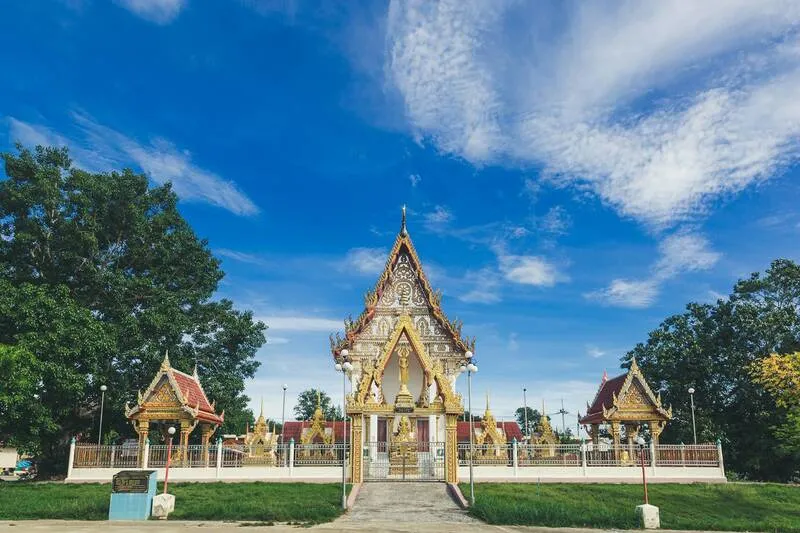
Wat Nong Ya Plong
Open Days: Open daily
Opening Hours: 06:00 – 18:00
Wat Nong Ya Plong is a temple located in Sila Loi Subdistrict, Sam Roi Yot District, Prachuap Khiri Khan Province, one of the naturally beautiful areas in the upper southern part of Thailand. This temple is a village temple under the Mahanikaya sect and has long served as the spiritual center of the Ban Nong Ya Plong community and nearby areas for many decades. With its peaceful atmosphere, surrounded by mountains and nature, the temple is not only a place for religious ceremonies, but also a place where people can come to rest their minds, practice meditation, and learn the teachings of Buddhism in a meaningful way.
Wat Nong Ya Plong is located at 147 Ban Nong Ya Plong, Rural Highway Road, Moo 4, Sila Loi Subdistrict, Sam Roi Yot District, Prachuap Khiri Khan Province. The temple covers a total area of 9 rai, 3 ngan, and 75 square wah. The site has a distinctive setting near a mountain range. Its northern and eastern boundaries adjoin private land, while its southern and western sides border the mountain. This gives the temple a quiet and shaded atmosphere, making it well suited to merit-making, meditation practice, and spiritual relaxation.
The natural setting of Wat Nong Ya Plong is one of the main features that distinguishes it from other temples in the Sam Roi Yot area. The mountain behind the temple helps create a calm and cool atmosphere. As visitors enter the temple grounds, they can immediately feel the silence, hear the wind passing through the trees, and enjoy views of the still-abundant natural landscape. This makes the temple especially suitable for those seeking peace and mental comfort through meditation and religious practice.
In addition to being a place for Buddhist ceremonies, Wat Nong Ya Plong also plays an important role as a cultural and community center for Ban Nong Ya Plong. Local residents regularly gather here for religious activities such as merit-making on important Buddhist holy days, listening to Dhamma teachings, funeral rites, and other social activities connected with the temple. As a result, the temple holds great significance in the daily life of the community.
The history of Wat Nong Ya Plong is closely tied to the cooperation of local villagers who wanted to establish a place for meditation practice and religious ceremonies. Originally, the area was the site of Khao Hiang Monastic Residence, which arose from the community’s wish to provide a place for monks to reside during the rains retreat and practice meditation. Later, the villagers worked together to develop the monastic residence into an officially established temple.
An important figure in the founding of Wat Nong Ya Plong was Mrs. Leng Wisetsombat, a community leader in the area and a devoted supporter of Buddhism. Mrs. Leng initiated the idea of establishing a monastic residence so that monks could stay there during the rains retreat and spread Buddhist teachings to local residents.
Later, in 1985, local residents joined together to donate money to purchase the land from Mr. Prachak Phutthaupatam in order to use it as the site for establishing the temple. After the necessary procedures were completed, Wat Nong Ya Plong was officially granted permission to be established as a temple on June 13, 1986. This marked an important beginning in the temple’s development.
After receiving official permission to become a temple, the villagers and monks continued to develop Wat Nong Ya Plong steadily. Various temple buildings were constructed for religious activities and to support those who came to practice meditation. These buildings have become important parts of the temple as it stands today.
One of the most important structures in the temple is the ordination hall, which was built in 1990. It is a large reinforced concrete building measuring approximately 25 meters wide and 50 meters long. Inside the ordination hall is the principal Buddha image, designed in the style of a replica of Luang Pho Wat Rai Khing, a revered Buddha image highly respected by local residents.
In addition to the ordination hall, Wat Nong Ya Plong also has a sermon hall used for religious ceremonies and community activities. The sermon hall measures approximately 10 meters wide and 28 meters long. It was built in 1977 and continues to serve as an important venue for various temple activities to this day.
Within the temple there is also a chanting hall used for chanting ceremonies and other religious functions. This chanting hall measures approximately 10 meters wide and 14 meters long. It was also built in 1977 and continues to be used regularly by monks and local residents for religious observances.
Wat Nong Ya Plong also has 3 monks’ residences, which are half-concrete and half-wooden buildings used as living quarters for the monks residing at the temple. There is also a vihara measuring approximately 7 meters wide and 28 meters long, built in 1974, which is used for enshrining Buddha images and conducting religious ceremonies.
In addition, there is a multipurpose pavilion measuring approximately 10 meters wide and 30 meters long, built in 1987, to support various temple activities such as merit-making events, traditional ceremonies, and community gatherings. The temple also has a funeral pavilion, a kitchen building, and a crematorium used for religious rites and important community ceremonies.
Wat Nong Ya Plong also plays an important role in education. Within the temple grounds there is a Dhamma studies school, which was opened in 1987. This school helps promote Buddhist education for monks and novices, while also allowing local residents to learn Buddhist principles and teachings correctly and systematically.
At present, Wat Nong Ya Plong has Phra Maha Boonchu Kittiyano as its abbot. He is a monk respected by local residents and plays an important role in caring for the temple, as well as promoting Buddhist activities and community programs on an ongoing basis.
Visitors who come to Wat Nong Ya Plong will experience the peaceful and natural atmosphere of the Sam Roi Yot area. The temple is therefore well suited to those who wish to make merit, pay respect to sacred images, practice meditation, or simply rest their minds from the busyness of daily life. It can also serve as a worthwhile stop during a trip around Sam Roi Yot and Prachuap Khiri Khan Province.
Wat Nong Ya Plong can therefore be seen as a place that reflects the faith of the local community and the importance of Buddhism in the everyday life of the people in the area. Although it is not a very large temple, it holds deep meaning for both local residents and visitors. It is not only a place for religious ceremonies, but also a place that helps bring peace and emotional well-being to those who come here.
Getting There to Wat Nong Ya Plong is convenient via routes from Sam Roi Yot District or Pran Buri District. Once you enter Sila Loi Subdistrict, continue toward Ban Nong Ya Plong, then follow the Rural Highway Road and local community signposts to the temple. Visitors traveling by private car can take the route from Hua Hin toward Sam Roi Yot, which usually takes around 40–50 minutes.
| Place Name | Wat Nong Ya Plong |
| Address | 147 Ban Nong Ya Plong, Moo 4, Sila Loi Subdistrict, Sam Roi Yot District, Prachuap Khiri Khan Province |
| Place Summary | A village temple in Sam Roi Yot with a peaceful atmosphere, surrounded by mountains, serving as a religious and community center for Ban Nong Ya Plong |
| Highlights | A quiet mountain-side setting, a principal Buddha image modeled after Luang Pho Wat Rai Khing, and its role as a center for community activities |
| Abbot | Phra Maha Boonchu Kittiyano |
| Nearby Tourist Attractions | 1. Khao Sam Roi Yot National Park – 12 km 2. Phraya Nakhon Cave – 18 km 3. Sam Roi Yot Beach – 15 km 4. Khao Daeng Viewpoint – 10 km 5. Laem Sala Beach – 20 km |
| Popular Restaurants Nearby | 1. Krua Baan Khao Daeng – 10 km, Tel. 081-981-5254 2. Je Kiew Seafood – 15 km, Tel. 032-536144 3. Pla Too Seafood – 14 km, Tel. 081-1716317 4. Krua Lung Muek – 12 km, Tel. 081-9440302 5. Krua Chai Lay – 16 km, Tel. 081-1719155 |
| Popular Accommodations Nearby | 1. Dolphin Bay Resort – 15 km, Tel. 032-559099 2. Sam Roi Yot Beach Resort – 16 km, Tel. 032-559091 3. Long Beach Inn – 16 km, Tel. 032-559333 4. Namaste Resort – 14 km, Tel. 032-559067 5. The Beach Village Resort – 18 km, Tel. 032-559345 |
Frequently Asked Questions (FAQ)
Q: Where is Wat Nong Ya Plong located?
A: The temple is located in Sila Loi Subdistrict, Sam Roi Yot District, Prachuap Khiri Khan Province.
Q: In what year was Wat Nong Ya Plong officially established?
A: The temple was officially established on June 13, 1986.
Q: What is the principal Buddha image of Wat Nong Ya Plong?
A: The principal Buddha image inside the ordination hall is modeled after Luang Pho Wat Rai Khing.
Q: Is Wat Nong Ya Plong suitable for meditation practice?
A: Yes. It is very suitable because the temple is located in a quiet area with a natural atmosphere.
Q: What tourist attractions are located near Wat Nong Ya Plong?
A: There are several important attractions nearby, including Khao Sam Roi Yot National Park, Phraya Nakhon Cave, and Sam Roi Yot Beach.
 Category: ●Places of Worship
 Group: ●Temple
 Last Update : 2 MonthAgo
 Click to Access the Navigation Map GPS
 Art, Culture and Heritage
 Historical Sites and Monuments(
 Landmarks and Memorials(
 Royal Palace(
 Art, Craft Centres, Tradition(
 Art Gallery(
 Educational Places
 Museum for Study(
 Educational Gardens, Farm(
 University
 Other religious and spiritural sites(
 Research and Development
 Royal Project(
 Suburban Living
 Village, Community(
 Local Market(
 Floating Market(
 Nature and Wildlife
 National Parks and Marine Reserves(
 Mountain (Doi)(
 Dam, Reservoir, Lake(
 Waterfalls(
 Caves(
 River, Canal(
 Bays and Beaches(
 Islands(
 Other natural attractions(
 Entertainment and Agricultural
 Animal camps and shows(
 Farm, Parks, Gardens and Ecotourism(
 Waterpark(
 Outdoor and Adventure Activities(
 Shopping
 Shopping and Night Market(
 Travel Articles, Recipes
 Travel Review, Food Review(


