
lovethailand home >Central Travel Attractions >Phetchaburi Travel Attractions >Muang Phetchaburi >Tha Rap > Mon Khang Tradition (Tak Bat Phra Roi)
TL;DR: Mon Khang Tradition (Tak Bat Phra Roi), open Held annually around the end of Buddhist Lent (based on the lunar calendar, hours The main rite usually begins at dawn – late morning (please check the host.
Mon Khang Tradition (Tak Bat Phra Roi)
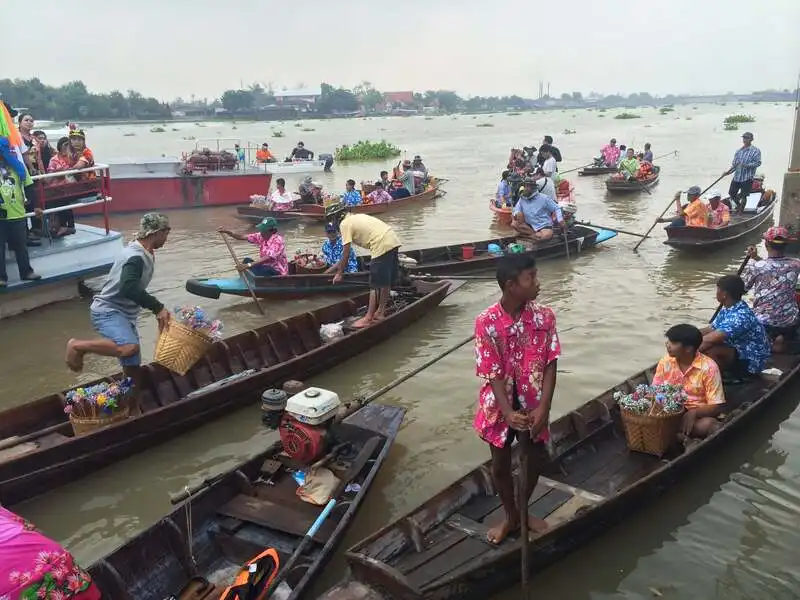
Open Days: Held annually around the end of Buddhist Lent (based on the lunar calendar, Month 11)
Opening Hours: The main rite usually begins at dawn – late morning (please check the host temple’s schedule for that year)
Mon Khang is the signature image of a post-Lent merit-making tradition deeply rooted in the riverside Mon way of life, especially along the Chao Phraya River basin. On the festival days, the community gathers to offer alms in a grand ceremony commonly known as “Tak Bat Phra Roi,” inviting a large number of monks (typically 100 or more) to receive offerings from devotees who prepare food and necessities with great care. The atmosphere then expands into a scene of collective devotion and coordination, from processions and volunteer support to the orderly flow that allows the rite to proceed with dignity.
Put simply, Mon Khang is both a “merit festival” and a “community festival” that takes place after the end of Buddhist Lent, when monks have completed the Pavarana ceremony. Local people regard this period as highly auspicious, suitable for major merit-making to bless themselves and their families. At the same time, it is when the community’s vitality returns after the rainy season and the more restrictive Lent period. What makes Mon Khang especially compelling is its close bond with the river and with a “journey of faith” that moves through different temples, each taking turns to host the event.
In terms of naming, cultural studies explain that “Mon Khang” (sometimes also called “Mon Khlang” in some areas) is linked to lively scenes of Mon people gathering and engaging in festive boat-related social life after Lent. Once religious obligations are fulfilled, social activities naturally follow: people regroup, paddle boats, visit one another, and work together to stage large-scale merit-making. In this sense, “Mon Khang” is not only the name of an event, but also the name of a seasonal rhythm – a time when people return to one another during an important moment of the year.
Looking back through the lens of local history, many Mon communities settled along rivers and canals. Temples therefore became more than places for religious rites; they functioned as full community centers – bringing people together, transmitting traditions, and organizing resources and labor for large festivals. Mon Khang thus tends to thrive in places where the temple–community relationship remains strong and where a shared memory of Mon traditions continues to be actively inherited.
What most people remember about Mon Khang is the “Tak Bat Phra Roi” rite: a major alms offering during the end-of-Lent season in which a large monastic assembly is invited to receive offerings. Organizing such an event requires detailed division of responsibilities within the community, from preparing the riverbank or alms-giving area, managing the sequence of offerings, ensuring safety, assisting elders and children, to communicating clearly so participants know how to place offerings properly, keeping the ceremony orderly and respectful.
In its riverside heritage, “Tak Bat Phra Roi” is often associated with alms giving by water, using boats in a procession and arranging a sequence so that the many monks can receive offerings smoothly. Over time, some areas have adapted the format to suit changing environments and safety needs, such as moving to temple courtyards or controlled riverbank zones. Yet regardless of format, the essence remains the same: a heartfelt, large-scale merit-making after Lent, and the principle that this merit-making is “a community’s work,” not the task of any single person.
Another feature that distinguishes Mon Khang from ordinary merit events is the custom of rotating the host role among multiple temples. In many areas, temples agree on hosting dates and announce them in advance, allowing devotees to join the tradition across several days and locations. While the core rite may be similar, each temple and community often expresses unique details – the cadence of the ceremony, the layout of the space, the style of offerings commonly prepared, and the ways local groups participate.
Temples commonly mentioned in the context of rotating hosts include Wat Makham, Wat Hong Pathumawas, Wat Samlae, Wat Bua Luang, Wat Bot, Wat Phai Lom, Wat Kai Tia, Wat Bang Na, Wat Bo Thong, Wat Dao Rueang, Wat Bang Pho, Wat Ban Phrao, Wat Chai Sitthawas, Wat Sadet, and Wat Pho Luean. The underlying idea is to distribute hosting responsibilities among many temples, helping sustain the tradition collectively while strengthening the network of Mon communities across the area.
In belief and meaning, post-Lent merit-making is widely regarded as a “major festival with great merit” because monks have observed strict discipline throughout the Lent retreat. People therefore set their hearts on making a substantial offering to a large monastic assembly, and they often see it as a meaningful way to begin the late-year season with auspiciousness. Participation also becomes informal education: children observe how offerings are prepared, how elders organize and cooperate, how etiquette in the temple is practiced, and how a single tradition requires wide collaboration to remain alive.
Getting There To experience Mon Khang and Tak Bat Phra Roi in the most authentic atmosphere, begin by checking which temple is hosting on which date for that year, since the tradition’s defining feature is the rotation among temples. Once you know the host temple, plan to arrive early in the morning to secure a place politely without disturbing others. If traveling by private car, allow extra time for parking and walking into the temple grounds. If using public transport or taxis, specify the temple name and a clear drop-off point. It is also wise to bring drinking water and comfortable footwear, as you may need to walk from parking areas to the ceremony zone.
For visitors unfamiliar with large-scale merit ceremonies, modest dress and orderly placement of offerings are essential. If temple staff or volunteers guide participants to place offerings in designated areas, following their instructions helps ensure that the large monastic assembly can receive offerings continuously without disruption. Photography can be done respectfully: avoid blocking the monks’ path, avoid using flash, and do not push cameras or phones too close. This is a sacred religious rite, not simply a tourist photo spot.
Seen beyond its lively atmosphere, Mon Khang is a key social mechanism that keeps tradition from being confined to books; it remains “alive” in real places. Each year involves communication, scheduling, preparation meetings, and the passing down of know-how. Community members practice cooperation, learn how to host, and reaffirm their identity gently through shared merit-making. Even if waterways change, lifestyles shift, or local populations decline, the core of Mon Khang can endure as long as people believe that collective merit and shared memory still matter.
Ultimately, Mon Khang teaches more than the act of offering alms. It teaches “togetherness” and “respect” – toward the monks, toward fellow participants, and toward the community that safeguards the tradition. When visitors understand this rhythm, they see Mon Khang in a fuller sense: not merely a festival, but a contemporary lesson in orderly coexistence, sincere faith, and a community spirit that still truly lives.
| Place Summary | Mon Khang Tradition (Tak Bat Phra Roi) – a post-Lent merit festival of riverside Mon communities in the Chao Phraya basin, featuring rotating host temples |
| Key Highlights | Tak Bat Phra Roi with 100+ monks, dawn merit-making atmosphere, Mon cultural identity and riverside lifestyle, multi-day rotation across temples |
| Period | End of Buddhist Lent, Lunar Month 11; commonly described as continuing during Waning Day 1 – Waning Day 15 of Month 11 (varies by host temple and year) |
| Key Evidence | Cultural studies describe Tak Bat Phra Roi during Waning Day 1 – 15 of Lunar Month 11 and cite examples of rotating host temples, explaining the term “Mon Khang/Mon Khlang” |
| Reference Area / Address | Riverside Mon communities in the Chao Phraya basin (commonly referenced examples: Sam Khok District and Mueang District, Pathum Thani Province) |
| Example Temple (For Current Abbot / Caretaker) | Wat Hong Pathumawas (Pathum Thani reference area) – Abbot/Caretaker: Phra Khru Pathum Worakhun (please verify the temple’s announcement/page before traveling) |
| Current Status | A living tradition still held across multiple temples within Mon community networks; the format may be adapted to local conditions (e.g., water-based or temple-courtyard arrangements) |
| Nearby Tourist Attractions (With Distance) | 1) Dream World (Approx. 25 km) Tel. 0-2577-8666 2) National Science Museum (NSM) (Approx. 30 km) Tel. 0-2577-9999 3) Future Park Rangsit (Approx. 25 km) Tel. 0-2520-1111 Ext. 8 4) Riverdale Marina (Approx. 20 km) Tel. 062-597-1875 5) Bangkok Golf Club (Approx. 15 km) Tel. 0-2501-2828 |
| Popular Restaurants Nearby (With Distance + Phone) | 1) Kru Juk Riverside Restaurant (Approx. 5 km) Tel. 086-500-2145 2) Mae Nam Restaurant, Pathum Thani (Approx. 12 km) Tel. 02-581-6749 3) Ban Kieng Nam, Chao Sai (Approx. 6 km) Tel. 083-806-3860 4) Khrua Rim Nam Thai Ko (Approx. 8 km) Tel. 086-522-6599 5) Kham Saneh Restaurant (Approx. 7 km) Tel. 084-262-8791 |
| Popular Accommodations Nearby (With Distance + Phone) | 1) Tinidee Hotel Bangkok Golf Club (Approx. 15 km) Tel. +66 2 147 5858 2) Bangkok Golf Spa Resort (Approx. 15 km) Tel. 66 2-963-9777 3) The Idle Hotel & Residence (Approx. 20 km) Tel. +66 2-908-8077 4) PP@Hotel Rangsit (Approx. 30 km) Tel. 098-831-8944 5) The Idle Hotel & Residence (Alternate Contact) (Approx. 20 km) Tel. +66 61-419-7253 |
Frequently Asked Questions (FAQ)
Q: What is Mon Khang?
A: Mon Khang is a post-Lent merit-making tradition of riverside Mon communities, centered on a major alms-offering rite and a strong sense of communal gathering, often associated with river life and rotation among multiple temples.
Q: What does “Tak Bat Phra Roi” mean?
A: It refers to a major alms-offering ceremony during the end-of-Lent season that invites a large monastic assembly (commonly 100 monks or more) to receive offerings, requiring careful community organization.
Q: When exactly is Mon Khang held?
A: It is based on Lunar Month 11 around the end of Buddhist Lent. Many areas describe the period as Waning Day 1 – Waning Day 15 of Month 11, but the exact date should be confirmed with the host temple for that year.
Q: Why is the event hosted by different temples?
A: Rotating hosts helps distribute responsibilities, strengthens participation across communities, and allows devotees to join merit-making on multiple days at different temples.
Q: How should visitors behave when attending?
A: Dress modestly, arrive before the ceremony begins, place offerings in designated areas, avoid blocking the monks’ path, take photos respectfully, and follow guidance from temple staff or volunteers.
Q: Can children and elderly people attend?
A: Yes. Choose less crowded areas, allow extra time to walk in and out, bring water and necessary medication, and pay special attention to safety if any part of the ceremony takes place near water.
 Category: ●Art, Culture and Heritage
 Group: ●Art, Craft Centres, Tradition
Last Update : 7 MonthAgo
 Last Update : 7 MonthAgo
Recommend

 Historical Sites and Monuments(1)
 Landmarks and Memorials(1)
 Royal Palace(2)
Art, Craft Centres, Tradition(8)
Royal Palace(2)
Art, Craft Centres, Tradition(8)
 Museums(1)
 Educational Places
 Educational Gardens, Farm(4)
 Places of Worship
 Temple(72)
 Other Sacred Sites(6)
 Research and Development
 Royal Project(6)
 Suburban Living
 Village, Community(10)
 Floating Market(1)
 Nature and Wildlife
 National Parks and Marine Reserves(4)
 Mountain (Doi)(3)
 Dam, Reservoir, Lake(3)
 Waterfalls(5)
 Hot Springs(1)
 Caves(13)
 River, Canal(1)
 Bays and Beaches(11)
 Islands(1)
 Other natural attractions(10)
 Entertainment and Agricultural
 Farms, Parks and Ecotourism(3)
 Theater(1)
 Outdoor and Adventure Activities(1)
 Travel Articles, Recipes
 Travel Review, Food Review(2)


