

 Home
Home Chiang Mai(




Wat Nong Khuang
Rating: 3.7/5 (12 votes)
 Search By
  Map
Map 
 Have Map
  No Map
Phetchaburi attractions
Attractions in Thailand
Open Days: Daily
Opening Hours: 08:00 – 17:00
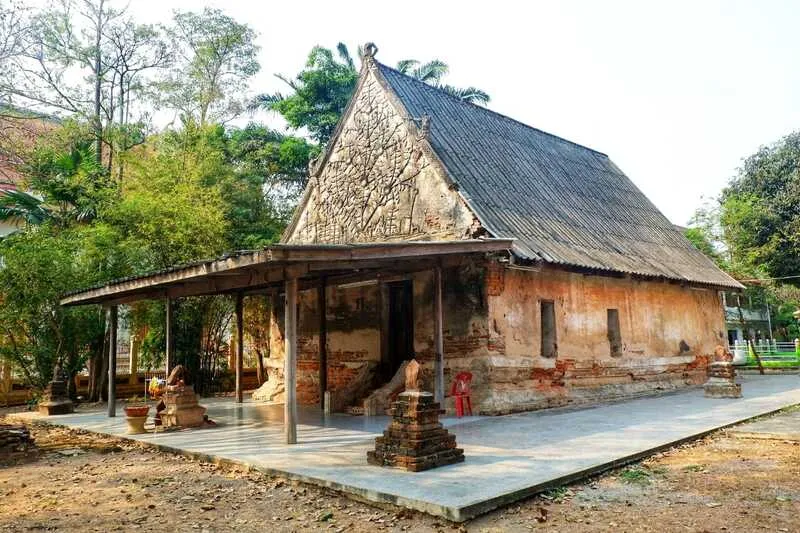
Wat Nong Khuang is a community temple under the Maha Nikaya order, located in Ton Maphrao Subdistrict, Mueang Phetchaburi District, Phetchaburi Province. If you think of Phetchaburi as an old town rich in craftsmanship and religious art, a local temple like Wat Nong Khuang may not be the first name most travelers search for in the same way they do the city’s headline landmarks. Its appeal, however, lies precisely in its everyday reality: this is a living temple where local people still make merit, attend ceremonies, and care for their sacred spaces continuously. At the same time, it preserves tangible traces of temple artistry that can make architecture enthusiasts pause, especially the old ordination hall whose blended design reflects both historical taste and the refined hands of local craftsmen.
Ton Maphrao sits along the urban and community corridor of Mueang Phetchaburi, so reaching the temple is generally convenient compared with temples deeper in rural areas. For that reason, Wat Nong Khuang naturally functions as a center of faith and local relationships. For cultural travelers, the visit feels different from formally curated attractions because the atmosphere is usually simple, unhurried, and quietly intimate, encouraging you to “read the place” through buildings, sacred objects, and craftsmanship up close. The calm environment also helps you focus on the stucco details and architectural composition without the constant crowds that can overwhelm some of the better-known sites in the town center.
In terms of history, the exact founding date of Wat Nong Khuang is not clearly recorded, but the surviving built evidence suggests the temple may date to the late Ayutthaya period or the early Rattanakosin era, a timeframe during which many temples in central Thailand were built and repeatedly restored. The shaping of temple buildings during these eras often involved a mix of influences from court artisans, city-based craftsmen, and local builders, depending on resources and community networks. Official records also mark important milestones in the temple’s modern administrative status, including its formal establishment in 1941 and the royal granting of the boundary for the ordination hall (wisungkhamsima) in 1968, which clarifies the legally recognized sacred precinct for monastic rites and reflects the temple’s development within Thailand’s modern religious framework.
Another point that strengthens Wat Nong Khuang’s conservation value is the old ordination hall area, which has been designated as an archaeological/heritage zone with a defined boundary of approximately 1 rai 49 square wah. This designation reinforces that the ordination hall and its related precinct are not only functional religious structures but also significant evidence of local art and architecture worthy of careful stewardship at the city level. Knowing this context before you walk around can shift your perspective from simply visiting a temple to make merit to also learning how local craftsmanship has been carried forward in Phetchaburi.
The core highlight of Wat Nong Khuang is the old ordination hall. The building is described as approximately 8 meters wide and 13 meters long. One notable aspect often mentioned is the influence of Western-style architecture. In the broader picture of Thai temple building from late Ayutthaya through early Rattanakosin and into later modernization, you can see gradual changes in proportion, structure, and decorative preferences as restorations and new constructions incorporated newer ideas, particularly in urban areas with stronger trade connections. The relatively tall, two-tiered singha base, the supporting moldings, and certain compositional choices may reflect an effort to create a more imposing, sturdy, and orderly appearance in keeping with later tastes.
Yet the true charm of the old ordination hall is not simply the label of “Western influence.” Its aesthetic core remains Thai craftsmanship, especially the gable, decorative roofline elements, and finely executed stucco work. The chofa finials are described as human or deity-like figures, while the central gable area features kinnari motifs on both sides. These details create the feeling of narrative temple art that is not merely decorative but also carries the worldview of Himmapan imagery and Buddhist-Hindu symbolic traditions long embedded in Thai temple design. Standing at a comfortable viewing distance and slowly tracing the lines of the relief work helps you notice the artisan’s rhythm, making the forms feel alive rather than rigid and giving the composition a sense of richness without looking overly crowded.
What often keeps visitors and art lovers lingering is the density of stucco detail and ornamentation described across multiple sides of the building. On the eastern side, there is stucco decoration enhanced with embedded glazed ceramic ware, a technique found in various Thai temple contexts, especially where ceramics were accessible through trade and local circulation. This is not only for sparkle; it adds surface depth, catches light, and strengthens the visual contrast of the stucco lines. If you choose your timing well, you may notice how the relief seems to change character with the angle of sunlight, bringing the craftsmanship into sharper relief in the morning or late afternoon.
Equally distinctive is the western side, described as featuring the mythical makkaliphon motif, where the fruit appears as female forms, sometimes only legs, sometimes half bodies, alongside an image of Garuda admiring the makkaliphon tree. The composition also includes various animals, with the lower register representing the Himmapan forest. For those familiar with Thai mythic imagery, Himmapan is a liminal realm between human and divine worlds, filled with symbolic creatures and moral contrasts. When artisans place makkaliphon stories and Garuda imagery within a Himmapan setting, the work becomes more than “beautiful”; it becomes a story-space that invites interpretation through beliefs, moral symbolism, and the aesthetic preferences of the period.
Beyond the ordination hall itself, the site is described as having two small satellite chedis outside the hall. This strengthens the sense of a complete sacred precinct rather than a single isolated building. When walking around, it helps to view the temple layout as a whole, not only the main structure, because important impressions often appear when you circle the building, look back at angles, and notice how the base proportions, open space, and decorative narratives relate to the everyday use of a living community temple.
To make the visit worthwhile, it is best to slow down and observe rather than rush for quick photos. Stucco relief and ceramic-inlay surfaces take time for the eye to separate and understand. Photography should avoid touching the stucco directly, and you should be mindful not to disturb worshippers. If you want close detail, use optical zoom or a longer lens instead of moving too close to fragile surfaces. Approaching the site with this care is not only respectful; it also helps preserve vulnerable heritage materials so the temple’s artistry can endure.
From a trip-planning perspective, Phetchaburi offers many places to learn about history, architecture, and traditional craftsmanship. Including Wat Nong Khuang works well for travelers who want to see the “craft layer” scattered among local temples and then connect to the city’s larger heritage landmarks. Planning the day this way keeps Phetchaburi from being reduced to a single famous stop and instead reveals it as a town with multiple levels of artistic heritage, from major monuments to community temples that quietly preserve distinctive local beauty.
Getting There Wat Nong Khuang is easy to reach from central Phetchaburi. Most visitors come by private car or local taxi services. If you are starting from the downtown area or Phetchaburi Railway Station, set your route toward Ton Maphrao Subdistrict and follow local roads into the temple area, which is generally accessible by standard vehicles. Drive carefully and slow down near the temple because it is a community zone where residents, children, and elders may be nearby. Dress respectfully for a temple visit and keep your voice low, especially if ceremonies or community activities are taking place.
| Place Name | Wat Nong Khuang |
| Address | 114 Ban Na Pho, Phetkasem Road, Moo 1, Ton Maphrao Subdistrict, Mueang Phetchaburi District, Phetchaburi 76000, Thailand |
| Place Summary | A living community temple in Ton Maphrao known for its old ordination hall with blended architectural character, fine stucco craftsmanship, and mythic narrative motifs such as the Himmapan forest, kinnari, makkaliphon, and Garuda, reflecting Phetchaburi’s local artisan heritage. |
| Key Highlights | Old ordination hall, tall two-tier singha base, refined gable and roofline stucco, chofa finials in human/deity form, kinnari motifs, ceramic-inlay decoration, makkaliphon and Himmapan narrative reliefs, two satellite chedis near the hall |
| Abbot | Phra Palad Yothin Thanavamso |
| Nearby Tourist Attractions | 1) Phra Nakhon Khiri (Khao Wang) ~4 km 2) Phra Ram Ratchaniwet (Ban Puen Palace) ~6 km 3) Wat Mahathat Worawihan ~5 km 4) Wat Yai Suwannaram Worawihan ~5 km 5) Wat Khao Bandai It ~7 km |
| Popular Restaurants Nearby | 1) Cosmic Cafe Cable Car ~9.2 km Tel. 065-678-8156 2) Nam Tien Restaurant (Nhamtien) ~9 km Tel. 032-425-121 3) Makin Tom Yum (Makin – Tom Yum Chambo To) ~8.1 km Tel. 089-969-6166 4) Mae Laab Khao Chae ~9.9 km Tel. 087-170-8384 5) Ko Yuan Red Pork Noodles (Ded Duang) ~9.6 km Tel. 032-412-061 |
| Popular Accommodations Nearby | 1) Save Zone Hotel ~5.4 km Tel. 084-106-3397 2) Royal Diamond Hotel ~5.5 km Tel. 032-411-061 3) The Home Khao Luang ~5.9 km Tel. 086-327-0871 4) Baan Kiang Wang Place ~6.1 km Tel. 082-527-7752 5) WIIN Phetchaburi ~5.8 km |
Frequently Asked Questions (FAQ)
Q: Where is Wat Nong Khuang located?
A: Wat Nong Khuang is in Ton Maphrao Subdistrict, Mueang Phetchaburi District, Phetchaburi Province, Thailand, and it is generally easy to reach from central Phetchaburi.
Q: When was Wat Nong Khuang built?
A: The exact founding year is unclear, but the existing structures suggest a late Ayutthaya or early Rattanakosin origin. Official milestones include the temple’s formal establishment in 1941 and the granting of the ordination hall boundary (wisungkhamsima) in 1968.
Q: What is the main highlight for visitors interested in art and architecture?
A: The old ordination hall is the key highlight, featuring a tall two-tier singha base, refined stucco ornamentation, ceramic-inlay details, and narrative motifs such as kinnari, makkaliphon, Garuda, and Himmapan imagery.
Q: What is the best time of day to visit?
A: Morning to late morning is usually ideal for comfortable temperatures and lighting that helps reveal stucco depth. Visitors should remain respectful if ceremonies or community activities are underway.
Q: Are there any etiquette rules when viewing the old ordination hall and stucco details?
A: Dress modestly, keep your voice low, avoid touching stucco surfaces, and do not disturb worshippers. If you take photos, use zoom rather than moving too close to fragile relief work.
Q: Can I combine Wat Nong Khuang with other attractions in a one-day itinerary?
A: Yes. You can pair the temple with major Phetchaburi heritage stops such as Khao Wang, Ban Puen Palace, and important city-center temples to build a richer cultural day trip.
 Wat Nong Khuang Map
 Category:
  Group:
  Tag: ●Wat Nong Khuang●wat nong khuang ●temples in phetchaburi ●old ordination hall phetchaburi ●phetchaburi cultural trip ●thai temple stucco art ●things to do in phetchaburi ●heritage sites phetchaburi ●phetchaburi temple architecture ●travel phetchaburi thailand ●near khao wang attractions Last Update: 3 WeekAgo
Comment
 Nearby Attractions
| Keyword (Advance) |
 Region
|
 Muang Phetchaburi(
 Copyright 2012,