
 Home
Home North(
 Chiang Mai(


Wat Khao Phrom Cha-Ngae
Rating: 2.6/5 (22 votes)
 Search By
  Map
Map 
 Have Map
  No Map
Phetchaburi attractions
Attractions in Thailand
Open Days: Daily
Opening Hours: 06.00 – 18.00
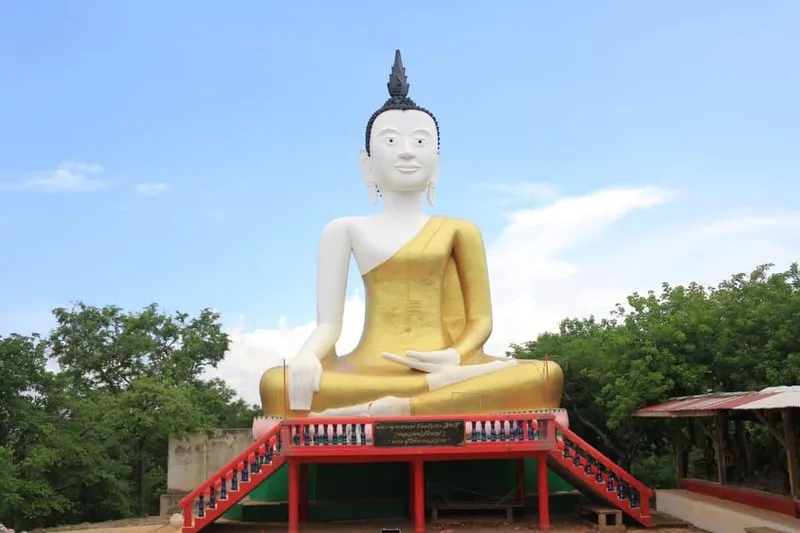
Wat Khao Phrom Cha-Ngae sits on a hilltop in Moo 6, Ban Nong Chang Tai, Tham Rong Subdistrict, Ban Lat District, Phetchaburi Province. This is a community (Rat) temple under the Mahanikaya order, long known locally as a “hilltop temple” that can be seen from far away. The reason is its large Buddha image enshrined high on the summit, a landmark that has become part of the visual memory of the Phetkasem Road corridor between Ban Lat and Tha Yang for people who regularly drive through Phetchaburi. Because of this, the temple holds a dual role: it remains a living religious center for everyday community life, while also attracting visitors as a viewpoint that opens a wide panorama and often makes first-time visitors think, “Now I understand why people want to come back.”
The charm of Wat Khao Phrom Cha-Ngae begins with the “experience of ascending the hill.” Visiting here is not like turning into a side lane and parking at a city temple gate. Instead, you gradually climb to higher ground where the view slowly expands with each bend. Along the way, you sense the unpretentious character of rural Phetchaburi: scattered homes, shade from trees, and the breeze that moves differently along the ridge. Once you reach the top, you immediately feel how a “hilltop temple” differs from a “lowland temple” — it is open, airy, quiet, and it subtly slows the pace of your thoughts. It is well suited to paying respects, meditating, or simply standing still and letting the landscape settle your mind before returning to everyday life.
In terms of its historical profile, Wat Khao Phrom Cha-Ngae has key status records that reflect its continuity within Thailand’s monastic system. The temple is recorded as having been established in 1852 (B.E. 2395) and granted Wisungkhamsima in 1854 (B.E. 2397), indicating that by the mid-19th century it had taken formal shape, including the consecrated boundary associated with monastic rites in the ubosot. This means the temple is not merely a temporary gathering place of faith, but a long-standing religious institution with an established framework of administration and practice, closely aligned with the settlement history of the communities around the hill.
When visitors speak about the temple’s “heart,” what most people remember first is not the layout or the names of buildings, but the large Buddha image on the summit. It was created with a dignified presence typical of major Thai Buddha images: balanced proportions, calm facial lines, and a posture that naturally inspires reverence. Locals commonly explain that its design was inspired by Phra Mongkhon Bophit, the renowned large Buddha image of Ayutthaya. This design connection matters because it helps us understand the community’s thinking — why they chose to draw inspiration from a nationally celebrated Buddha image and place that aesthetic on a hilltop in Phetchaburi. The intention is to make this summit Buddha image both a long-term center of faith and a lasting symbol of the area — a visible anchor for the heart, giving people a sense that they have come to “meet” something greater than the everyday concerns they carry.
On a deeper cultural level, building a “large Buddha image” on higher ground often holds meaning beyond visual impact. In Thai cultural imagination, positioning a Buddha image on a hill or summit frequently conveys spiritual elevation and a protective, reassuring presence over the surrounding landscape. In other words, communities often want the sacred to be both “visible” and “reachable” at once, which is why a summit is chosen. When that idea is combined with inspiration drawn from Phra Mongkhon Bophit — a Buddha image widely recognized across Thailand — the summit Buddha image at Wat Khao Phrom Cha-Ngae becomes a symbol that naturally bridges “local faith” and “shared public faith.” Visitors who have seen Phra Mongkhon Bophit may feel an immediate familiarity and a quicker sense of reverence, while local residents take pride in having a grand, dignified Buddha image associated with their own home landscape.
Another compelling dimension of the summit Buddha image is its “navigational role” in both physical and symbolic terms. Physically, the image helps travelers identify the temple’s location from a distance, especially those driving along Phetkasem Road who spot the Buddha image standing out against the hillside. Symbolically, it functions like a gentle marker that makes people more inclined to “stop by” to make merit or pay respects, because seeing it creates a feeling of having a clear and worthy destination. This is why many hilltop temples in Thailand feature a prominent central Buddha image — not merely for grandeur, but to make faith feel “touchable” and to draw people back into connection with Buddhism in a natural, everyday way.
On Khao Phrom Cha-Ngae, beyond the worship area, the “viewpoint” is another highlight that motivates many visitors to come up in person. Standing on higher ground and looking out over Ban Lat offers a different understanding of Phetchaburi: you can see how communities spread across the plains, sense the breadth of agricultural land, trace the main routes linking town centers to districts, and notice the relationship between “hills” and “lowlands” that shapes local life in this part of western Thailand. In the morning, the air feels soft and cool, making it ideal for paying respects at the start of the day. In the late afternoon, warm light often makes the view look gentle and particularly beautiful, appealing to those who want to rest their eyes and let time slow down before descending.
Wat Khao Phrom Cha-Ngae is also a living temple in the most literal sense — not just a scenic stop — because it has many monks and novices residing here, reflecting an active and continuous religious life. The temple’s rhythm includes community merit-making, alms rounds, meal offerings, and the ongoing work of maintaining a hilltop religious site that requires cooperation between the monastic community and local devotees. At many times, the temple serves as a social refuge for nearby residents as well, offering a place to gather, dedicate merit, and calm the mind during difficult periods of life.
In present-day administration, Wat Khao Phrom Cha-Ngae is overseen by its abbot. Published local information identifies the current abbot as “Phra Khru Samu Ram Passavaro.” The role of an abbot at a hilltop temple like this typically extends beyond routine religious duties to include managing safety on higher terrain, organizing order during festivals and merit events (including annual gold-leaf application events), and coordinating with the community on maintaining both the access route and public areas so that the summit remains welcoming for worshippers throughout the year.
Another way to see how the temple lives with its community is through the local merit events that take place in real time. Wat Khao Phrom Cha-Ngae is known for annual activities such as gold-leaf application events, a type of merit tradition found in many parts of Thailand but expressed differently depending on local context. These events ensure the temple is not only a quiet place for individual worship, but also a space where people reunite as devotees, exchange support, and collectively care for the religious place they feel connected to. In this sense, annual merit events function as a social mechanism that keeps faith embedded in daily life and helps younger generations learn rituals and temple etiquette through genuine participation rather than only through stories.
In contemporary cultural life, the temple is also remembered through local goods that accompany merit-making. One frequently mentioned example is the making of “khao lam” (bamboo sticky rice), produced to support temple maintenance and activities. Seeing khao lam prepared in the temple context helps outsiders understand that rural religious sites are not separated from everyday life; they often connect with community economics and practical forms of collective support. People do not help only through direct donations, but also by purchasing locally made items linked to temple life, creating circulation and participation in a way that feels accessible — a sense of “I can help too” without needing to begin with a large donation.
For visitors who want to understand Wat Khao Phrom Cha-Ngae more deeply than a simple “stop, worship, and leave,” one approach is to observe the “rhythm of space” — which areas are ceremonial, which are public, and which should remain especially quiet. Hilltop temples often face practical challenges such as limited space and safety concerns for elderly visitors or children, so it is best to walk carefully, avoid risky edges, and keep the area orderly, particularly near the Buddha image and viewpoint zones where people tend to gather for photos. Respecting these small details helps cultural travel remain high-quality and allows the temple to welcome visitors without disrupting monastic life or the community’s routines.
Paying respects to the large summit Buddha image, when done with understanding, becomes more than making wishes. It can be a practice of calming the mind through being in a place that truly “pulls you away from noise.” Many visitors notice that the hilltop breeze and open sky naturally soften restless thoughts. This is a clear value the temple offers to city residents or long-distance travelers: not only a beautiful photo, but a rare “breathing space” within ordinary life.
Viewed as a cultural destination, Wat Khao Phrom Cha-Ngae suits those who prefer places with meaning rather than staged beauty. It suits people who want to see a temple where monks and novices genuinely reside, people who want to experience Phetchaburi in a quieter, more local dimension beyond the famous city landmarks, and those who enjoy ascending to higher ground to find a calm viewpoint anchored by a large Buddha image that centers the feeling of reverence and ease.
To enjoy a complete visit, it is worth allowing at least 1 – 2 hours for worship, walking the grounds, pausing for views, and letting the atmosphere work gently on the mind. If you visit during merit events or festivals, extra time becomes even more important because the summit area naturally has limitations due to its terrain. Visiting without rushing helps you see details of hilltop temple life more clearly — the pace of moving up and down, the relationship between people and place, and the calm that appears when you choose to simply “stay” for a moment instead of hurrying to the next stop.
Getting There Wat Khao Phrom Cha-Ngae is convenient to reach by private car. A key reference is Phetkasem Road (Highway 4) along the Tha Yang – Phetchaburi stretch. The entrance to the temple is directly off Phetkasem Road. After turning in, you drive approximately 800 meters to reach the temple area, then continue upward along the internal route to the summit. If you are traveling from Tha Yang toward Phetchaburi town, it is advisable to slow down as you approach the entrance so you can turn safely and enter the temple road with care.
| Place Summary | A hilltop temple in Ban Lat, Phetchaburi, known for its prominent large Buddha image and a panoramic viewpoint, suitable for worship and scenic relaxation. |
| Address | Moo 6, Ban Nong Chang Tai, Tham Rong Subdistrict, Ban Lat District, Phetchaburi, Thailand |
| Key Highlights | A large hilltop Buddha image visible from afar, a wide panoramic viewpoint over the Ban Lat – Tha Yang area, and a calm, open hilltop-temple atmosphere. |
| Abbot / Temple Steward | Phra Khru Samu Ram Passavaro |
| Popular Accommodations Nearby | 1) Blue Mansion Thayang (≈4.6 km) Tel. 032-444-826 2) Super Highway (≈8.4 km) Tel. 097-189-9159 3) Mai Thong Thara (≈8.9 km) Tel. 087-148-0887 4) Ban Hom Din Klin Na (≈9.3 km) Tel. 061-723-6362 5) Pimchanok Resort (≈9.8 km) Tel. 090-959-5522 |
| Nearby Tourist Attractions | 1) Wat Tha Krathiam (≈2.2 km) 2) Thirawan Traditional Desserts House (≈2.3 km) 3) Suan Tan Lung Thanom (≈2.7 km) 4) Tha Yang Market (≈4.3 km) 5) Ton Tan Cultural Lane, Ban Lat District (≈6.5 km) |
| Popular Restaurants Nearby | 1) Chomnat Khanom Thai (≈1 km) Tel. 087-148-0887 2) Coffee Chill By Nai-In (≈1.3 km) Tel. 081-919-2444 3) Mae Kim Lang (≈1.6 km) Tel. 087-829-1663 4) Tamnua Krua Pa Thayang (≈9.3 km) Tel. 083-436-6333 5) Ban Pu Pen 2 Phetchaburi (Laem Phak Bia Branch) (≈18 km) Tel. 088-194-4172 |
Frequently Asked Questions (FAQ)
Q: Where is Wat Khao Phrom Cha-Ngae located?
A: It is located in Moo 6, Ban Nong Chang Tai, Tham Rong Subdistrict, Ban Lat District, Phetchaburi Province. It is a hilltop temple known for its large Buddha image visible from a distance.
Q: What are the key highlights of Wat Khao Phrom Cha-Ngae?
A: The temple’s key highlights are its prominent large hilltop Buddha image and a panoramic viewpoint overlooking the Ban Lat – Tha Yang area, along with a calm, open atmosphere suitable for worship and quiet reflection.
Q: What is the origin or inspiration behind the large Buddha image?
A: Locals commonly explain that its design draws inspiration from Phra Mongkhon Bophit, the famous large Buddha image of Ayutthaya, giving the summit Buddha a dignified form and making it a powerful symbol of local faith.
Q: Who is the current abbot of Wat Khao Phrom Cha-Ngae?
A: Phra Khru Samu Ram Passavaro.
Q: What is the easiest way to get to Wat Khao Phrom Cha-Ngae?
A: The easiest way is by private car via Phetkasem Road (Highway 4). Turn into the temple entrance from the highway, drive about 800 meters to reach the temple area, then continue upward to the summit along the internal route.
Q: How much time should I plan for a visit?
A: Plan at least 1 – 2 hours to worship, walk around, and enjoy the views without rushing. If you visit during festivals or merit events, allow extra time due to increased visitors and limited space on the hilltop.
 Wat Khao Phrom Cha-Ngae Map
 Category:
  Group:
  Tag: ●Wat Khao Phrom Cha-Ngae●wat khao phrom cha-ngae ●khao phrom cha-ngae temple ●ban lat phetchaburi temple ●big buddha phetchaburi ●viewpoint in phetchaburi ●temples in phetchaburi ●things to do in ban lat ●cultural travel phetchaburi ●buddhist temple on hill ●day trip phetchaburi Last Update: 1 MonthAgo
Comment
 Nearby Attractions
| Keyword (Advance) |
 Facebook Fanpage
 Region
 Art, Culture and Heritage
 Historical Sites and Monuments(
 Landmarks and Memorials(
 Royal Palace(
 Art, Craft Centres, Tradition(
 Museums(
 Educational Places
 Educational Gardens, Farm(
 University
 Other religious and spiritural sites(
 Research and Development
 Royal Project(
 Suburban Living
 Village, Community(
 Floating Market(
 Nature and Wildlife
 National Parks and Marine Reserves(
 Mountain (Doi)(
 Dam, Reservoir, Lake(
 Waterfalls(
 Hot Springs(
 Caves(
 River, Canal(
 Bays and Beaches(
 Islands(
 Other natural attractions(
 Entertainment and Agricultural
 Farm, Parks, Gardens and Ecotourism(
 Theater(
 Outdoor and Adventure Activities(
 Travel Articles, Recipes
 Travel Review, Food Review(
 Copyright 2012,