

 Home
Home Chiang Mai(




Wat Pho Loi
Rating: 3/5 (24 votes)
 Search By
  Map
Map 
 Have Map
  No Map
Phetchaburi attractions
Attractions in Thailand
Open Days: Daily
Opening Hours: 06.00 – 18.00
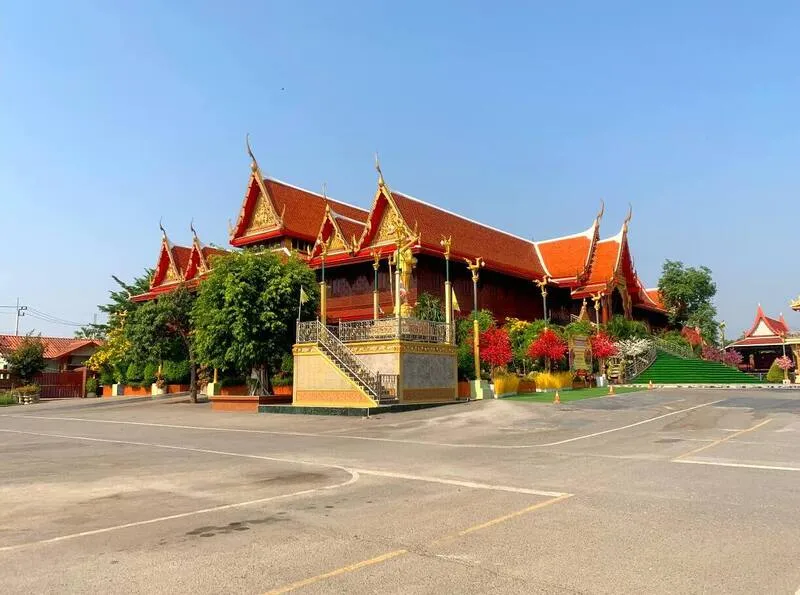
Wat Pho Loi is located in Nong Kapu Subdistrict, Ban Lat District, Phetchaburi Province, along a local road that residents use for everyday travel. This temple is a community (Rat) temple under the Mahanikaya order and has long served as a spiritual anchor closely tied to both daily life and local cultural identity. It is especially known for the “Hae Sakalat” tradition—locally referred to as “Salak Hab”—which has become a signature cultural image of Ban Lat in the eyes of Phetchaburi locals and visitors from nearby provinces, because it showcases real community participation, real preparation, and the collective strength of a community that still preserves a living traditional form.
In terms of the site’s history, the temple’s official status records indicate an establishment year of 1861 (B.E. 2404) and the granting of Wisungkhamsima (the formal boundary for an ordination hall) in 1882 (B.E. 2425). These details reflect the continuity of religious-site development and community organization within the Buddhist way of life during the early-to-mid Rattanakosin period. As a result, the temple is not only a place for religious rites, but also a social mechanism that helps structure relationships among local people—from gathering for merit-making and public activities to safeguarding traditions that depend on collective cooperation.
What stands out about Wat Pho Loi is its role as a “temple of the community” in a tangible sense. People in the area do not come only on Buddhist holy days or major festivals; they come to make merit, offer alms, dedicate merit, take part in village activities, coordinate merit events, and help prepare annual traditions throughout the year. The relationship between the temple and the community is therefore mutual and supportive: the temple serves as a spiritual center, while the community provides the energy that sustains and nurtures the temple as a living institution aligned with local ways of life.
Overall, the temple grounds convey a calm, simple, natural atmosphere typical of a traditional community temple. Rather than focusing on grand architectural spectacle for photography or display, the space reflects practical religious use. Key structures such as the ubosot (ordination hall), the sermon hall, and public areas are actively used both on ordinary days and during major merit events. A common scene is elderly residents coming to pay respects and make merit, families bringing children to learn temple etiquette, and groups of villagers working together to prepare offerings for community ceremonies at times set by the local calendar.
The cultural heart of Wat Pho Loi is the “Hab Salakapat (Salak Hab)” tradition—a form of alms-giving to the monastic community presented in a distinctly local way. Villagers prepare sets of offerings and necessities arranged as shoulder-yokes (hab), decorated with care. Some emphasize aesthetic beauty in the presentation of offerings, while others focus on completeness and usefulness for monks and temple activities. These are then carried in an organized procession into the temple and followed by a lottery-style distribution ritual to determine which set is offered to which monk. The event blends faith, ritual structure, and community festivity into a single harmonious occasion.
What gives the Salak Hab event at Wat Pho Loi real cultural weight is not only the number of hab sets or the lively atmosphere, but the participatory process that begins at the household level. Many villagers prepare well in advance and naturally divide responsibilities according to individual strengths. Some focus on traditional sweets and local foods, others skilled in craftwork contribute baskets or supporting materials, and some groups create ceremonial money trees and communal merit offerings. When the day arrives, the community becomes visibly unified, from morning until the ceremony concludes—a concrete image of solidarity, not merely a story in documents.
During the Salakapat merit event, several elements help visitors understand local culture more easily. The procession is orderly, participants often gather by village groups, hab offerings are arranged systematically, and the atmosphere is open to outsiders who wish to join in respectful participation without feeling out of place. This makes the tradition a clear example of a “living cultural classroom” because visitors can witness ritual practice, belief systems, collective labor, and the local aesthetic sensibility of Phetchaburi within a single context.
From a cultural-travel perspective, Wat Pho Loi suits visitors who want to experience a community temple that still plays an active role in people’s lives, rather than functioning solely as a check-in spot. On regular days, the atmosphere is quiet and appropriate for worship, merit-making, and unhurried reflection. During the Salak Hab period, visitors can see the dimensions of a major merit event that demonstrates community strength and immediately understand why many people in Phetchaburi value this tradition so highly.
When visiting for worship or community activities, it is best to follow local temple etiquette: dress modestly, keep a respectful volume within religious areas, honor ceremonial spaces, and follow guidance from staff or local residents on event days. The Salak Hab tradition involves shared space and procession routes with large crowds, so small acts of cooperation from visitors help the event proceed smoothly and retain its traditional beauty.
In terms of administration and governance, Wat Pho Loi has an abbot responsible for supervising religious affairs and coordinating with the community. Published listings identify the current abbot as “Phra Khru Wisit Watchara Thamma (Yuang)” which aligns with the temple’s role in managing both Buddhist duties and the ongoing preservation of the community’s signature annual tradition.
Getting There Wat Pho Loi is best reached by private car. From Phetchaburi city, travel toward Ban Lat District and enter Nong Kapu Subdistrict. The temple is located within the community along route Por Bor. 3004. Using navigation apps and searching “Wat Pho Loi Ban Lat Phetchaburi” will generally lead you directly to the destination. If you travel during the Salak Hab event period, allow extra time due to increased visitors and ceremonial activities in the area.
| Place Summary | A community (Rat) temple in Nong Kapu Subdistrict, Ban Lat District, serving as a religious and cultural center and a key venue for the Hab Salakapat (Salak Hab) tradition. |
| Address | Por Bor. 3004 Road, Nong Kapu Subdistrict, Ban Lat District, Phetchaburi 76150, Thailand |
| Key Highlights | Hab Salakapat (Salak Hab) tradition and a living community-temple role sustained throughout the year. |
| Abbot / Temple Steward | Phra Khru Wisit Watchara Thamma (Yuang) |
| Popular Accommodations Nearby | 1) Super Highway (≈9.9 km) Tel. 081-912-3660 2) Mai Thong Thara (≈9.2 km) Tel. 087-148-0887 3) Ban Din Resort (≈8.9 km) Tel. 032-424-865 4) Ken Inn Phetchaburi (≈8.8 km) Tel. 032-471-505 5) A+ Hometel (≈11 km) Tel. 082-879-2656 |
| Nearby Tourist Attractions | 1) Ton Tan Cultural Lane, Ban Lat District (≈3.1 km) 2) Suan Tan Lung Thanom (≈7.3 km) 3) Wat Khao Bandai It (≈9.1 km) 4) Robinson Lifestyle Phetchaburi (≈9.8 km) 5) Riverside Market at Wat Thong Nopphakhun (≈8.8 km) |
| Popular Restaurants Nearby | 1) Suan Ahan Lan Aroi (≈9.4 km) Tel. 088-594-9878, 082-251-7016 2) Ban Thai Pran Cafe’ De Pun (≈8.6 km) Tel. 099-153-1616 3) Rachen “Khai Nuea” (≈9.4 km) Tel. 081-942-2488 4) Pad Thai Tha Yang (Branch 1) (≈10 km) Tel. 032-461-268 5) Dim Sum Nueng Sot Phetchaburi (Branch 2) (≈9.9 km) Tel. 093-367-3999 |
Frequently Asked Questions (FAQ)
Q: Why is Wat Pho Loi important to the Nong Kapu community?
A: The temple functions as a spiritual anchor and a community activity hub used for religious rites, merit events, and cultural traditions throughout the year, especially the Hab Salakapat (Salak Hab) merit tradition.
Q: What is the Hab Salakapat (Salak Hab) tradition at Wat Pho Loi?
A: It is a merit-making tradition in which villagers prepare offerings and necessities arranged as shoulder-yokes (hab), join a procession into the temple, and then conduct a lottery-style distribution ritual to present offerings to monks, reflecting faith, unity, and local identity.
Q: When is the Hab Salakapat event usually held?
A: It is held as an annual merit event according to the temple and community schedule, and the exact date may vary by year.
Q: Who is the current abbot of Wat Pho Loi?
A: Phra Khru Wisit Watchara Thamma (Yuang).
Q: How should visitors prepare when visiting Wat Pho Loi for worship or community events?
A: Dress modestly, keep a respectful volume, honor ceremonial areas, and follow guidance from temple staff or local residents, especially during event days when crowds and processions are active.
Q: What type of travel experience is Wat Pho Loi best suited for?
A: It is well suited for cultural travel and community-life learning, because it is an active community temple and a key venue for the living Hab Salakapat tradition.
 Wat Pho Loi Map
 Category:
  Group:
  Tag: ●Wat Pho Loi●wat pho loi ●wat pho loi phetchaburi ●wat pho loi ban lat ●ban lat temple ●phetchaburi temple ●nong kapu subdistrict ●hab salakapat ●salak hab tradition ●cultural tourism phetchaburi ●thai merit-making tradition Last Update: 5 DayAgo
Comment
 Nearby Attractions
| Keyword (Advance) |
 Region
|
 Muang Phetchaburi(
 Copyright 2012,