

 Home
Home Chiang Mai(




Hup Sabu Waterfall
Rating: 2.4/5 (19 votes)
 Search By
  Map
Map 
 Have Map
  No Map
Phetchaburi attractions
Attractions in Thailand
Open Days: Seasonal / depends on natural conditions (check weather and trail conditions before visiting)
Opening Hours: Recommended 08:00 – 17:00
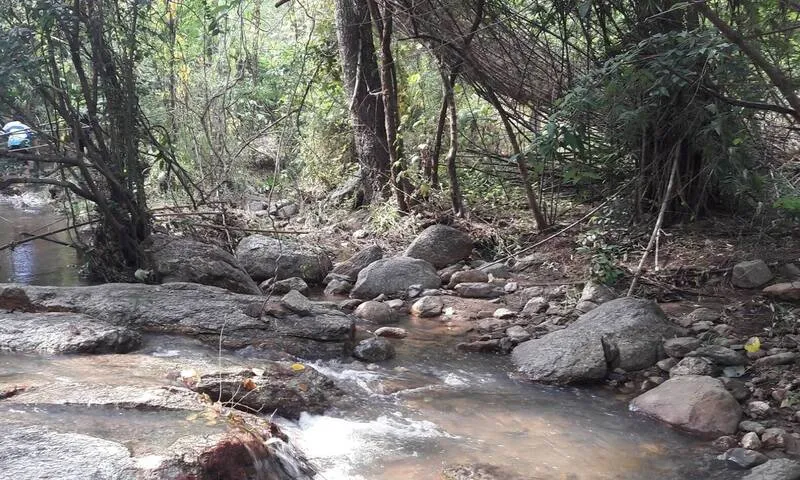
Hup Sabu Waterfall (Phetchaburi) is a small, hidden waterfall inside the Tung Faek valley area in Cha-am District, Phetchaburi. Tucked within a mosaic of dry dipterocarp forest and mixed deciduous woodland, this inland landscape sits noticeably higher than the well-known coastal strip of Cha-am. The plateau-and-valley terrain here is often described locally as a “grassland basin” ringed by low mountains, with an average elevation around 500 metres above sea level. That uplift, combined with forest cover and a more sheltered valley microclimate, creates a cooler, quieter nature experience than the beaches only a short drive away.
Hup Sabu Waterfall is not a tall, dramatic cascade designed for postcard-scale spectacle. Its appeal is subtler and more intimate: the sound of water moving over layered rock, the soft green shade of the forest corridor, and the sense that the place is still governed by seasonal rhythms rather than fixed tourist infrastructure. During the rainy season and the late rainy season, the flow becomes most photogenic as water threads through the streambed and drops gently over natural steps, forming small pools and slick rock shelves. In the dry months, the same stream often quiets down, turning the visit into a forest walk where the idea of “waterfall” is as much about the watershed as it is about visible water.
A distinctive feature of this area is the community practice of building small rock-check dams along sections of the stream. These are simple, low structures made by arranging stones to slow down water flow. In practical terms, the dams help reduce erosive runoff during heavy rains, increase infiltration into the soil, and maintain moisture in the surrounding forest during drier periods. In ecological terms, that slower-moving water supports a more stable riparian strip, giving plants, insects, amphibians, and small animals better conditions to persist through seasonal swings.
The broader Tung Faek valley landscape is often characterised by extensive stands of vetiver grass across open areas, which is one reason local people refer to it as “Tung Faek.” In the rainy season, another highlight is the bloom of a local “krachiao” (Siam tulip-like) herbaceous plant found across parts of the basin. Notably, the krachiao in this area is described as a short-stem variety, visually distinct from the taller, more famous Siam tulip fields associated with Chaiyaphum. When conditions are right, patches of purple-pink flowers appear against the green of grassland and forest edges, giving the valley a seasonal colour that rewards slow walking and careful photography.
The forest composition around the waterfall includes a mix of important native hardwoods and bamboo species. Visitors may hear local references to trees such as makha, rang, takhian, pradu, teng, and tabaek, along with bamboo like phai nuan and phai ruak. Groundcover plants and medicinal herbs are also common, especially in shaded, moister pockets near the stream. Even when wildlife is not easily seen, the habitat signals biodiversity: bird calls in the canopy, insect life around wet rocks, and the subtle tracks and foraging signs that appear along quiet sections of trail.
Another key viewpoint in the wider area is a natural rock platform known locally as “Pha Dam.” On clear days, it opens a wide coastal panorama, letting you see the long line of the Cha-am shoreline from an inland mountain setting. The contrast is part of the charm: you can spend the morning in upland forest shade and still look out toward the sea, understanding how closely connected these ecosystems are through water, wind, and seasonal weather patterns.
Environmentally, the Tung Faek valley can be read as a transitional ecosystem between inland uplands and the coastal plain. This “ecotone” character often increases biodiversity because plant communities overlap: drought-tolerant species from drier forest zones can occur near species that prefer higher moisture where streams, seepages, or shaded gullies hold humidity longer. The result is not just a checklist of species, but a landscape that changes quickly across short distances—open grassland to woodland, rocky ridges to riparian shade, sun-baked slopes to damp stream edges.
The waterfall’s stream system plays a central role in local water cycles. Rainfall that lands on higher ground infiltrates through soil and fractured rock, feeding shallow groundwater before emerging as small springs and tributaries. That slow-release hydrology is what allows parts of the stream to remain alive through the year, even when visible flow decreases. When heavy rains arrive, the same network can shift rapidly into a high-energy system, moving sediment and reshaping microhabitats along the channel. In this setting, simple rock-check dams function as a community-scale hydrological tool: they reduce peak flow speed, encourage sediment to settle in controlled places, and increase the time water spends in the catchment, which supports forest moisture and reduces downstream flash impacts.
From an ecological perspective, the Hup Sabu stream corridor acts as a local biodiversity “node”—a small but important anchor point where water concentrates life. Amphibians and aquatic insects depend on wet surfaces and shallow pools. Small reptiles, mammals, and birds use the corridor for drinking, feeding, and movement through the forest. Although sightings of large fauna such as serow or leopard are not typical for most visitors today, the landscape still matters as part of broader forest connectivity in the region. Maintaining that connectivity—through intact habitat, reduced disturbance, and careful visitor behaviour—is one of the quiet but crucial conservation values of places like this.
Climate variability also shapes the visitor experience and the ecosystem’s resilience. Changes in the timing and intensity of the monsoon can alter how long the waterfall runs with attractive flow, how quickly trails become slippery, and how vegetation responds across the season. In years when rains arrive late or fall in concentrated bursts, streams can swing between scarcity and sudden surges. In that context, ongoing community maintenance of small dams, as well as basic watershed protection (limiting activities that disturb headwaters, streambanks, and fragile slopes), becomes a practical strategy for sustaining both nature and local livelihoods downstream that rely on stable water availability.
Local voices commonly emphasise that upstream forests are directly linked to water security for agriculture and daily life below. That is why visiting Hup Sabu Waterfall works best when framed as low-impact nature travel rather than mass recreation. A “Leave No Trace” approach is particularly relevant here: stay on existing paths where possible, avoid trampling streamside vegetation, do not remove plants or rocks, keep noise low, and carry all waste out. Even small actions matter in narrow riparian zones because these areas recover slowly once compacted or eroded.
If the goal is to strengthen eco-tourism quality, the direction is clear: focus on safety and conservation basics rather than heavy development. Practical measures include encouraging visits during suitable conditions, clarifying walking routes to reduce off-trail damage, limiting numbers during sensitive periods if necessary, and using simple interpretive signage to explain watershed functions, local plant communities, and the purpose of rock-check dams. Done well, Hup Sabu can function not only as a place to rest in nature, but also as a compact outdoor classroom for understanding headwater ecosystems in Phetchaburi.
Getting There The most common approach is from Phetkasem Road (Highway 4) via the Huai Ta Paed junction (the same general direction used for routes toward Chang Hua Man Royal Project). From the junction, drive inland for roughly 7 km to reach the access area for the Hup Sabu Waterfall zone and nearby nature routes. This road is also popular with cyclists because it is comparatively quiet, scenic, and shaded in sections, and it passes points of interest such as local reservoirs and parks along the way. Because conditions can change quickly in the rainy season, allow extra time and drive cautiously on wet surfaces.
| Name | Hup Sabu Waterfall |
| Address | Tung Faek Valley Area, Huai Sai Nuea Subdistrict, Cha-am District, Phetchaburi, Thailand |
| Location | Inland Cha-am (Tung Faek valley zone), Phetchaburi |
| Characteristics | Small natural waterfall in forested uplands; best during rainy season and late rainy season; stream supported by community rock-check dams; nearby seasonal wildflowers (local krachiao) and scenic viewpoints |
| Period | Most scenic in the rainy season and late rainy season (typically around July – October; conditions vary each year) |
| Key Evidence | Headwater stream corridor, mixed forest habitat, rock-check dams supporting moisture retention and reduced erosion, biodiversity supported by riparian microhabitats |
| Name Origin | “Hup” commonly refers to a hollow/valley; “Sabu” is used locally as the waterfall’s place name in this valley area |
| Travel | From Phetkasem Road (Highway 4), enter via Huai Ta Paed junction (route toward Chang Hua Man area) and continue inland about 7 km to the access zone |
| Current Status | Nature-based area; conditions depend on season and weather (check before travelling) |
| Nearby Tourist Attractions With Distance | 1) Chang Hua Man Royal Project (Approx. 8 km) 2) Huai Ta Paed Reservoir (Approx. 5 km) 3) Phu Wai Reservoir (Approx. 3 km) 4) Nang Phanthurat Mountain (Approx. 18 km) 5) Cha-am Beach Area (Approx. 20–22 km) |
| Popular Restaurants Nearby | 1) Baan Rai Nam Ing (Approx. 12 km) – 088-454-0330 2) Krua Kai Muk (Cha-am Pier Area) (Approx. 22–24 km) – 088-918-4443 3) Krua Med Sai (Cha-am Area) (Approx. 22–24 km) – 089-800-2299 4) Krua Jea Nong Seafood (Bo Kiea Shoreline, Cha-am) (Approx. 25 km) – 081-986-0916 5) Rimpha Chomview (Approx. 20 km) – 096-797-8397 |
| Popular Accommodations Nearby | 1) Rai Hub Kapong Maleehuana (Approx. 12 km) – 095-340-0035 2) Cha-am Fishing Park Resort & Restaurant (Approx. 18 km) – 097-037-1172 3) Springfield@Sea Resort & Spa (Approx. 24 km) – 032-709-300 4) Veranda Resort & Villas Hua Hin Cha Am (Approx. 26 km) – 032-709-000 5) Dusit Thani Hua Hin (Approx. 28 km) – 032-520-009 |
| Facilities | Natural trails and stream areas; facilities vary by season and local conditions (prepare water, non-slip shoes, and rain protection in wet months) |
Frequently Asked Questions (FAQ)
Q: When is the best time to visit Hup Sabu Waterfall?
A: The rainy season through the late rainy season is best, when the stream flow is most scenic and the forest is at its greenest.
Q: Is there an official entrance fee?
A: There is no widely published official fee for general access; conditions can vary by season and local arrangements, so it is best to check before travelling.
Q: Can I cycle to the waterfall area?
A: Yes. The inland road from the Huai Ta Paed junction is popular among cyclists because it is scenic and generally less congested than coastal routes.
Q: Is it suitable for children?
A: It can be, but close supervision is necessary, especially in the rainy season when rocks and paths can be slippery.
Q: Are there viewpoints nearby?
A: Yes. The broader area includes viewpoints such as “Pha Dam,” where you may see sweeping coastal views toward Cha-am on clear days.
 Hup Sabu Waterfall Map
 Category:
  Group:
  Tag: ●Hup Sabu Waterfall●hup sabu waterfall ●hup sabu waterfall phetchaburi ●cha am nature attraction ●tung faek valley cha am ●pha dam viewpoint cha am ●phetchaburi hidden waterfall ●rainy season travel cha am ●eco tourism phetchaburi ●cycling route cha am ●waterfall near bangkok Last Update: 2 DayAgo
Comment
 Nearby Attractions
| Keyword (Advance) |
 Facebook Fanpage
 Region
 Art, Culture and Heritage
 Historical Sites and Monuments(
 Landmarks and Memorials(
 Royal Palace(
 Art, Craft Centres, Tradition(
 Museums(
 Educational Places
 Educational Gardens, Farm(
 University
 Places of Worship
 Temple(
 Other religious and spiritural sites(
 Research and Development
 Royal Project(
 Suburban Living
 Village, Community(
 Floating Market(
 National Parks and Marine Reserves(
 Mountain (Doi)(
 Dam, Reservoir, Lake(
 Hot Springs(
 Caves(
 River, Canal(
 Bays and Beaches(
 Islands(
 Other natural attractions(
 Entertainment and Agricultural
 Zoos and Aquariums(
 Farm, Parks, Gardens and Ecotourism(
 Waterpark(
 Theater(
 Outdoor and Adventure Activities(
 Travel Articles, Recipes
 Travel Review, Food Review(
 Copyright 2012,