

 Home
Home Chiang Mai(




Wat Bandai Thong
Rating: 4/5 (9 votes)
 Search By
  Map
Map 
 Have Map
  No Map
Phetchaburi attractions
Attractions in Thailand
Open Days: Daily
Opening Hours: 08:00–17:00
Wat Bandai Thong in Phetchaburi Province is one of the long-established temples in the Phetchaburi River basin, with a history extending back to the late Ayutthaya period. The temple was founded in 1732 (B.E. 2275) during the reign of King Borommakot. It stands along the Phetchaburi River at a section locally known as a “sharp bend” or “nam hak,” where the current once ran fast and made river travel hazardous in the past. The choice of this location reflects the close relationship between the temple, the community, and the river—an enduring core of local life in Phetchaburi since ancient times.
In the late Ayutthaya era, Phetchaburi played an important role as a western frontier city and a regional center of religion, trade, and the arts—especially woodworking and traditional Thai architecture. Many temples were built along the Phetchaburi River to serve communities that depended on water-based transportation. Wat Bandai Thong therefore functioned not only as a religious site, but also as a social, cultural, and spiritual hub for people in the Ban Pho and Ban Kum areas over many generations.
Historical accounts state that Wat Bandai Thong was established in 1732 (B.E. 2275), corresponding to the early years of King Borommakot’s reign. He is widely recognized for revitalizing Buddhism and supporting the arts in the late Ayutthaya period. Temples founded during this time often reflect both political stability and deep faith among local communities and patrons. In this sense, Wat Bandai Thong provides valuable evidence for understanding the development of religious architecture in Phetchaburi during the late Ayutthaya era.
Wat Bandai Thong is located at No. 56, Ban Pho, Village No. 5, Ban Kum Subdistrict, Mueang Phetchaburi District, Phetchaburi Province. It belongs to the Mahanikai monastic order. The temple land covers approximately 25 rai and 2 ngan. Its boundaries are distinctive: to the west it borders the Phetchaburi–Ban Laem highway, while the north, south, and east sides directly border the Phetchaburi River, giving the temple a riverside landscape that is increasingly rare today.
The temple’s setting is at a sharp bend of the Phetchaburi River—an area where strong currents historically undercut the riverbank and formed whirlpools. During the flood season in earlier times, this was considered a dangerous point for boats, and capsizing incidents reportedly occurred repeatedly. Locals called such bends “nam hak.” Later, during the reign of King Rama IV of the Rattanakosin period, a shortcut canal was excavated in front of Wat Bandai Thong to reduce the dangers posed by the swift current. This adjustment to the river landscape helped improve safety around the temple and supported continued settlement along the river.
Today, after the construction of Kaeng Krachan Dam upstream on the Phetchaburi River, the problem of strong currents at sharp bends has decreased significantly. Even so, traces of the natural landscape and the community’s memory of the river remain visible in the temple’s layout and architectural features, allowing visitors to understand the area’s environmental and historical context more deeply.
Considering the overall layout and structures, Wat Bandai Thong includes a complete range of religious and functional buildings, such as the ordination hall (ubosot), sermon hall (sala kan parian), monks’ quarters, a Thai-style riverside pavilion, a rest pavilion, and a cluster of traditional Thai houses. These are arranged in harmony with the river line and surrounding terrain. Such a layout clearly reflects the traditional Thai architectural principle of living in balance with nature.
The present ordination hall was built in 1980 (B.E. 2523). Constructed of brick and mortar, it was designed to blend with the older temple context. Inside, a seated Buddha image in the meditation posture serves as the principal image. Although this ubosot is a later construction, its design aims to remain understated and to avoid overshadowing the temple’s older artistic and architectural values.
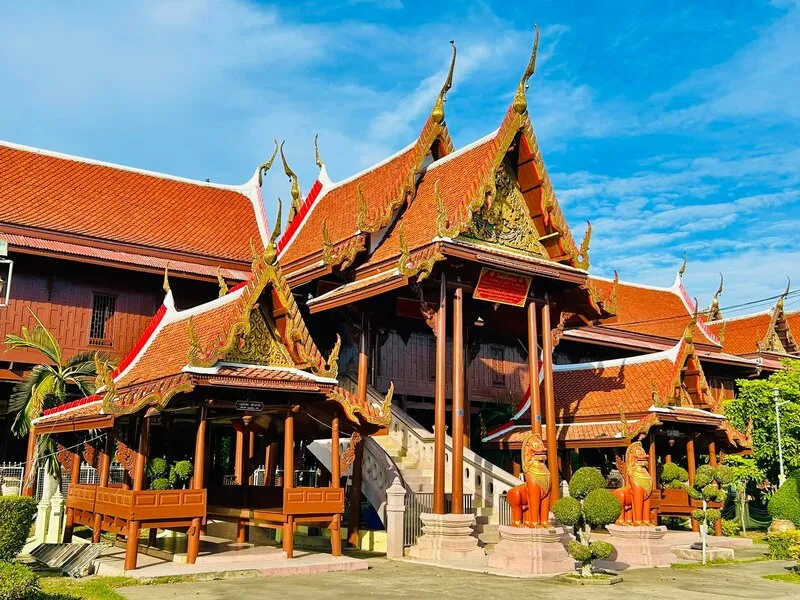
The heart of Wat Bandai Thong lies in its cluster of traditional Thai houses and the monks’ wooden quarters, which provide a beautiful example of central Thai timber architecture. The monks’ quarters feature posts on all sides and “kantuan na tak-taen” brackets supporting the eaves, demonstrating refined design and craftsmanship. The wooden structures are raised on high stilts to protect against floods and to improve ventilation—well suited to a riverside environment.
The temple’s Thai house cluster is arranged as a group of connected buildings linked by raised verandas and wooden walkways, forming flexible spaces that support both monastic life and community activities. This arrangement reflects the practical wisdom of Thai spatial planning, balancing usability with aesthetic harmony.
Another striking artistic feature of Wat Bandai Thong is its roof finials—chofa and bai raka—and its gable panels, all characterized by graceful lines and a distinctive late Ayutthaya artistic identity. The chofa and bai raka are proportioned to appear slender rather than heavy, matching the wooden structures and the riverside setting. The gable designs on various buildings display the meticulous skill for which Phetchaburi craftsmen are renowned.
The Thai-style riverside pavilion is another key element reflecting the temple’s relationship with the river. Historically, such pavilions were not merely boat landings; they also served as places for rest, gathering, and religious and social activities within the community. At Wat Bandai Thong, the rest pavilion and the sermon hall continue to preserve traditional Thai architectural forms, harmonizing well with the surrounding Thai houses.
For several centuries, Wat Bandai Thong has served as the spiritual center for the riverside community of Phetchaburi, supporting religious life, education, and culture. Merit-making ceremonies, ordinations, seasonal offerings, and community events have long revolved around the temple. Although times have changed, this role has continued into the present.
At present, Wat Bandai Thong is led by Phra Khru Siri Phatcharanu-yok as the abbot. He plays an important role in caring for the temple and in preserving its traditional artistic and architectural character amid modern development. The continued presence of the Thai house cluster and other architectural features makes Wat Bandai Thong an important learning site for those interested in Thai architecture and the local history of Phetchaburi.
Getting There Wat Bandai Thong is located along the Phetchaburi–Ban Laem road in Ban Kum Subdistrict, Mueang Phetchaburi District. It is easily reached by private car from Phetchaburi town in a short time. Parking is available within the temple grounds, and the site also connects historically to river travel via the Phetchaburi River.
| Site Summary | A late Ayutthaya–period temple on the banks of the Phetchaburi River |
| Key Highlights | Traditional Thai house cluster, wooden monks’ quarters, graceful chofa and bai raka, and a riverside landscape at a sharp river bend |
| Custodian / Abbot | Phra Khru Siri Phatcharanu-yok |
| Nearby Attractions | 1) Phra Nakhon Khiri (Khao Wang) – 3 km 2) Wat Mahathat Worawihan – 2.5 km 3) Wat Yai Suwannaram – 2 km 4) Phetchaburi Old Town Community – 2.5 km 5) Phetchaburi River (Old Town Section) – 0 km |
| Nearby Restaurants | 1) Mae Orn Khao Chae – 2.8 km Tel. 032-425-111 2) Jek Meng Local Cuisine – 2.5 km Tel. 032-410-789 3) Rabiang Rim Nam Restaurant – 3 km Tel. 032-427-222 4) Lung Nom Poo Pen – 2.7 km Tel. 081-234-5678 5) Phetchaburi Phochana – 3 km Tel. 032-428-456 |
| Nearby Accommodations | 1) Royal Diamond Hotel – 3.2 km Tel. 032-412-345 2) Sun Hotel Phetchaburi – 3 km Tel. 032-425-678 3) Sweet Dreams Guesthouse – 2.8 km Tel. 081-567-8901 4) Banthai Guesthouse – 2.5 km Tel. 032-409-876 5) Alinda Resort – 4.5 km Tel. 032-471-234 |
Frequently Asked Questions (FAQ)
Q: During which period was Wat Bandai Thong established?
A: Wat Bandai Thong was founded in the late Ayutthaya period, in 1732 (B.E. 2275) during the reign of King Borommakot.
Q: What are the main architectural highlights of Wat Bandai Thong?
A: The temple is known for its traditional Thai house cluster, wooden monks’ quarters, graceful chofa and bai raka, and delicate gable designs reflecting late Ayutthaya artistry.
Q: Why is Wat Bandai Thong located at a sharp bend of the river?
A: In the past, rivers served as primary transport routes, so temples were often established along the water. Although currents here were once strong, a shortcut canal was later excavated to reduce the danger.
Q: Does Wat Bandai Thong still have resident monks?
A: Yes. The temple continues to have resident monks and remains under the care of its abbot.
Q: What is the best time to visit Wat Bandai Thong?
A: Morning to afternoon is ideal for viewing the wooden architecture and enjoying the riverside atmosphere.
 Wat Bandai Thong Map
 Category:
  Group:
  Tag: ●Wat Bandai Thong●wat bandai thong phetchaburi ●ancient temple phetchaburi ●ayutthaya period temple thailand ●traditional thai wooden houses ●chofa bai raka architecture ●thai gable design ●riverside temple thailand ●phetchaburi river bend ●rama iv canal excavation ●cultural attractions phetchaburi Last Update: 1 MonthAgo
Comment
 Nearby Attractions
| Keyword (Advance) |
 Facebook Fanpage
 Region
 Art, Culture and Heritage
 Historical Sites and Monuments(
 Landmarks and Memorials(
 Royal Palace(
 Art, Craft Centres, Tradition(
 Museums(
 Educational Places
 Educational Gardens, Farm(
 University
 Other religious and spiritural sites(
 Research and Development
 Royal Project(
 Suburban Living
 Village, Community(
 Floating Market(
 Nature and Wildlife
 National Parks and Marine Reserves(
 Mountain (Doi)(
 Dam, Reservoir, Lake(
 Waterfalls(
 Hot Springs(
 Caves(
 River, Canal(
 Bays and Beaches(
 Islands(
 Other natural attractions(
 Entertainment and Agricultural
 Farm, Parks, Gardens and Ecotourism(
 Theater(
 Outdoor and Adventure Activities(
 Travel Articles, Recipes
 Travel Review, Food Review(
 Copyright 2012,