
 Home
Home North(
 Chiang Mai(


Khao I Bit
Rating: 5/5 (1 votes)
 Search By
  Map
Map
 Have Map
  No Map
Phetchaburi attractions
Attractions in Thailand
Open Days: Please Check With The Site Manager Before Visiting (Private Area)
Opening Hours: Please Check With The Site Manager Before Visiting
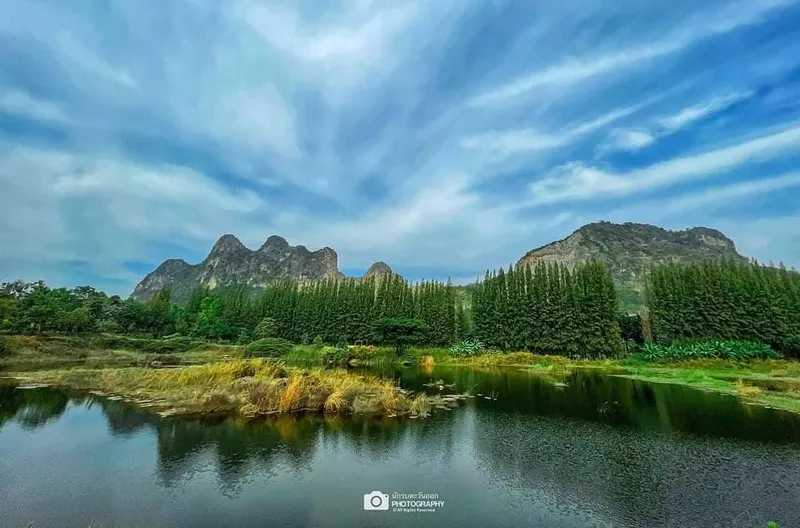
Khao I Bit (Nong Chumphon Nuea Subdistrict, Khao Yoi District, Phetchaburi) is a nature photography spot known for a large reservoir framed by rows of pine trees and limestone mountains. The overall scenery often feels like “Thailand’s Switzerland.” Because the area lies within a quarry/stone-crushing zone on private land, visitors should respect site rules, prioritize safety, and stay only within permitted areas.
Khao I Bit is frequently mentioned among nature lovers and photographers in Phetchaburi because the first impression is strikingly clear: a glassy, still reservoir in the foreground, orderly pines as a leading frame, and a rugged limestone mountain range as the backdrop. The scene looks like it belongs on a postcard, which is why people keep calling it “Thailand’s Switzerland.” In some angles, the mood—mountain, water, and forest layered into one frame—has even been compared to Yosemite in the U.S., in the sense that it makes you pause and press the shutter again and again without noticing.
The charm of Khao I Bit lies in its naturally “composed” elements. Water creates negative space that gives the eyes a place to rest, the pines become leading lines, and the mountains serve as the dominant mass that adds grandeur. When there is light morning mist, or when late-afternoon sunlight begins to fall at an angle, the entire frame changes character immediately—shifting from calm clarity to a softer, deeper, film-like atmosphere. This is why many photographers recommend visiting in the early morning or late afternoon. The light is more flattering, the temperature is more comfortable, and you can explore for angles without fighting the midday heat.
The most important point to understand is that Khao I Bit sits within a quarry/industrial concession on private land, so it is not a public tourist site with unconditional access. If you enter to take photos, do so with etiquette and restraint: keep noise down, do not disturb people working in the area, never leave trash, avoid damaging vegetation, and do not enter zones that are not open to visitors. Locations like this can be riskier than typical tourist attractions—there may be dirt roads, stone dust, steep gradients, and, at certain times, operational vehicles or machinery. Even if your intention is “just photography,” the land still has its own real-world function.
Another key detail is that the summit of Khao I Bit is generally not open to visitors, because the route has not been developed for public safety. A responsible visit should remain within the areas that are clearly permitted and manageable in terms of risk. This destination is best approached as a place to enjoy the overall panorama and capture the atmosphere, rather than expecting a full-on summit hike. If you enjoy light exploration, focus on refining your compositions around the reservoir—use the pines as foreground framing, wait for calmer water when the wind drops, or time your shots for angled sunlight that adds depth to the cliff faces and ridgelines. These choices typically deliver better results than forcing your way into restricted zones.
In terms of landscape context, Khao I Bit is part of the limestone terrain of the Khao Yoi area. Limestone ranges in western Thailand and the peninsula are significant in geological terms, reflecting long processes of sedimentation and ancient marine life over hundreds of millions of years. A karst landscape can create distinctive cliffs, cavities, caves, and sharp ridge forms. This is why Khao I Bit is not only “beautiful scenery” but also a naturally sculpted backdrop that appears crisp and dramatic in photographs—especially when paired with water and pine lines that amplify the sense of scale.
For photography timing, arriving early in the morning helps you capture softer light and gentler shadows before the sun becomes harsh. The water surface is often calmer, the chance of light mist is higher, and the light direction can add dimension to the pines and mountain textures. Late afternoon is ideal for warmer tones, golden light, and longer shadows that make photos feel more narrative. In either case, plan extra time to walk and test multiple positions. At Khao I Bit, the best frame is rarely confined to a single viewpoint—small shifts in position can quickly improve the balance of water, pines, and mountain, while minimizing distractions in the background.
For practical shooting tips, phone users should tap to meter for the sky or mountain surface to avoid blown highlights, then lift shadows later if needed. Camera users will often find 24–35 mm useful for wide environmental frames, while 50–85 mm works well to compress perspective, making the pine line and mountain appear closer together for a more dramatic look. If you want a cleaner, smoother water surface, try slower shutter speeds on a tripod during softer light—this can make the reservoir look calmer and more refined.
One more reason Khao I Bit is appealing is that it can connect naturally with a “Khao Yoi–Phetchaburi Town–Coastal” day trip. You can start with sunrise or morning photography at Khao I Bit, continue to Khao Yoi cave temples to add cultural depth, head into Phetchaburi town for Phra Nakhon Khiri (Khao Wang), and finish with seafood or seaside cafés in the Ban Laem/Cha-am area. With good timing, you can combine nature, caves, heritage, and coastal food into one day without rushing excessively.
That said, what makes Khao I Bit truly enjoyable for people seeking quiet is the silence and the fact that it remains a working landscape for locals and operators. The best way to visit is “lightly”—respect the place, keep the atmosphere intact, and avoid turning a calm spot into a noisy check-in. No matter how beautiful the view is, once the atmosphere is damaged, the special feeling disappears. The beauty of Khao I Bit is something visitors help preserve through etiquette, caution, and an understanding of the site’s real context.
Getting There If you drive, start from Phetchaburi town or Khao Yoi District and head toward Nong Chumphon Nuea Subdistrict. Use Phetkasem Road (Highway 4) as the main connector, then continue on local roads following local signs or commonly used map pins toward the Khao I Bit area. Drive slowly once you enter local dirt/gravel sections, watch for dust and uneven surfaces, and prepare basic essentials such as water, a hat, and comfortable shoes. Some photo angles require short walks to refine compositions along the reservoir edge.
| Place Name | Khao I Bit — Nong Chumphon Nuea Subdistrict, Khao Yoi District, Phetchaburi |
| Address | Nong Chumphon Nuea Subdistrict, Khao Yoi District, Phetchaburi (Private Quarry/Industrial Zone) |
| Highlights | Large reservoir with limestone mountains and pine lines creating a “Thailand’s Switzerland” vibe; best for nature photography in the morning and late afternoon |
| Site Type | Private Land / Industrial Concession; enter only permitted areas and prioritize safety |
| Best Time To Visit | Morning and Late Afternoon (Soft Light, Comfortable Weather, Better Photo Mood) |
| Current Status | Photography is allowed in some areas; please follow the site manager’s rules and do not attempt summit access if not permitted |
| Nearby Attractions (Distance) | 1) Wat Tham Khao Yoi — 12 km 2) Tham Khao Luang — 30 km 3) Phra Nakhon Khiri (Khao Wang) — 28 km 4) Hat Chao Samran — 55 km 5) Bang Ta Boon (Ban Laem) — 48 km |
| Popular Restaurants Nearby (Distance + Phone) | 1) Krua Lung Noi (Khao Yoi) — 18 km — 098-446-0297 2) Krua Tanot (Phetchaburi) — 32 km — 082-252-4990 3) Baan Talay Seafood (Ban Laem) — 52 km — 085-405-2856 4) Krua Khun Noi (Cha-am) — 30 km — 081-364-9608 5) Rabieng Rimnam (Phetchaburi) — 31 km — 032-425-707 |
| Popular Accommodations Nearby (Distance + Phone) | 1) Sun Hotel Phetchaburi — 30 km — 032-400-000, 085-832-8282 2) Royal Diamond Hotel Phetchaburi — 30 km — 032-411-061 3) Springfield @ Sea Resort & Spa (Cha-am) — 65 km — 032-709-300, 083-314-1672 4) Mida De Sea Hua Hin (Cha-am) — 70 km — 032-771-976, 081-981-3508 5) Nana Resort Kaeng Krachan — 75 km — 032-706-139 |
| Contact (If Available) | Phet Smuth (1970) Ltd., Part. — 032-565-080 |
Frequently Asked Questions (FAQ)
Q: Where is Khao I Bit located?
A: Khao I Bit is in Nong Chumphon Nuea Subdistrict, Khao Yoi District, Phetchaburi. It is known for a reservoir view framed by pine lines and limestone mountains.
Q: Is Khao I Bit free to enter?
A: The area is private land, so access rules may vary depending on the site manager’s policy at that time. Check in advance and follow all instructions strictly.
Q: What time is best for photos at Khao I Bit?
A: Early morning and late afternoon are best because the light is softer, the air is cooler, and the overall mood is more photogenic.
Q: Can visitors hike to the summit of Khao I Bit?
A: The summit is generally not open to visitors because the route has not been developed for public safety. Stay only in permitted areas.
Q: What should I prepare before visiting Khao I Bit?
A: Wear comfortable shoes, bring water and sun protection, drive carefully on local dirt/gravel sections, and keep noise low because the site is private and may be a working area.
Q: What else can I combine with Khao I Bit in a one-day trip?
A: You can continue to Khao Yoi cave temples, visit Tham Khao Luang, explore Phra Nakhon Khiri (Khao Wang) in Phetchaburi town, and end with coastal food in the Ban Laem or Cha-am area.
 Khao I Bit Map
 Category:
  Group:
  Tag: ●Khao I Bit●khao i bit phetchaburi ●khao i bit khao yoi ●phetchaburi nature attractions ●phetchaburi photo spot ●thailand switzerland phetchaburi ●khao i bit reservoir ●khao yoi attractions ●khao yoi day trip ●limestone mountain lake thailand ●scenic spots in phetchaburi Last Update: 2 MonthAgo
Comment
 Nearby Attractions
| Keyword (Advance) |
 Region
|
 Muang Phetchaburi(
 Copyright 2012,