

 Home
Home Chiang Mai(




Phetchaburi Salt Fields (Na Klua)
Rating: 3.5/5 (4 votes)
 Search By
  Map
Map 
 Have Map
  No Map
Phetchaburi attractions
Attractions in Thailand
Open Days: Open all year round (the main salt production season is approximately December – April, when activities are most visible)
Opening Hours: Recommended between 07:00 – 18:30 (avoid intense midday heat and be cautious of traffic along the coastal road)
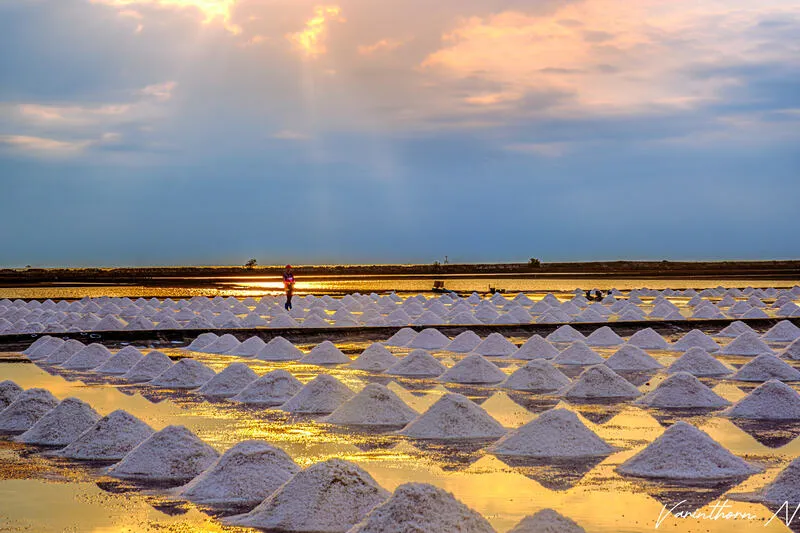
Phetchaburi Salt Fields (Ban Laem – Bang Khun Sai Route) The salt fields of Phetchaburi reflect the long-standing coastal way of life along the Gulf of Thailand. Most of the salt farms are spread along both sides of the coastal road SS.2021, which connects Haad Chao Samran to Ban Laem District and continues toward Bang Khun Sai. Located about 8 kilometers from Haad Chao Samran, the route reveals vast salt pans arranged in geometric plots that shimmer under the sunlight. The scenery is distinctly different from sandy beaches, offering a unique coastal landscape shaped by human ingenuity and natural forces.
The uniqueness of Phetchaburi’s salt fields comes from the coastal terrain, which consists of mudflats and a sea level suitable for natural evaporation. The Ban Laem area benefits from sediment carried by the Phetchaburi River and deposited at the river mouth, forming flat coastal land ideal for salt farming. Consistent sea breezes and strong sunlight from late year to early summer accelerate evaporation, making Phetchaburi one of Thailand’s significant sea salt production areas.
Historical evidence suggests that salt farming in Ban Laem dates back several generations, particularly during the early to mid-Rattanakosin period. Before refrigeration became common, sea salt was essential for food preservation and daily consumption, making it a strategic commodity. Trade routes transporting salt from Phetchaburi to central Thailand played a vital economic role. Salt farming was therefore not just an occupation, but a social structure that shaped families and coastal communities.
The traditional salt-making process begins with preparing and leveling the fields. Seawater is pumped into holding ponds and gradually transferred through a series of ponds to increase salinity before reaching the crystallization beds. As sunlight and wind evaporate the water, white salt crystals form. Farmers rake the salt into small pyramid-shaped piles in the middle of the pans. These white mounds against the wide sky have become an iconic image of Ban Laem. The main production season typically runs from December to April, when rainfall is low and sunshine is strong, creating ideal conditions for crystallization.
Driving along SS.2021, visitors will find scenic viewpoints and designated parking areas at intervals. Some spots provide informational signs explaining the salt-making process. Travelers can stop to take photos, enjoy the sea breeze, and appreciate the open coastal landscape. Early morning and late afternoon are the best times for photography, as the light beautifully reflects on the water-filled pans. During harvesting periods, visitors may witness real working scenes, offering a dynamic and culturally rich experience.
The way of life of salt farmers clearly reflects the relationship between humans and nature. Salt production requires understanding the rhythm of wind, sunlight, and tidal conditions. Even minor miscalculations can affect the quality of the crystals. Farmers therefore accumulate knowledge through years of continuous practice. While some modern technology is now used, traditional methods are still preserved because they ensure consistent and high-quality results.
Beyond economic value, salt fields also serve environmental functions. Coastal wetlands and salt pond embankments provide resting grounds for shorebirds, particularly during migration seasons. The stretch between Bang Khun Sai and Ban Laem is considered ecologically important. Balancing salt production with environmental conservation has become a key concern for local communities and relevant authorities.
For visitors, the Phetchaburi salt fields are ideal for those interested in local livelihoods, photography, and community-based tourism. Travelers should respect private property, avoid stepping onto salt pans without permission, and exercise caution when parking along the roadside, as traffic continues along this route.
Getting There From Haad Chao Samran, drive back to the main traffic light intersection and turn left toward Ban Laem District. Follow the coastal road SS.2021 for approximately 8 kilometers. The salt fields will appear along both sides of the road. This route continues and connects to Rama II Road, with clear directional signs along the way. Traveling by private car is the most convenient option.
| Name | Salt Fields, Ban Laem – Bang Khun Sai, Phetchaburi Province |
| Location | Coastal Road SS.2021, between Haad Chao Samran and Ban Laem District, Phetchaburi |
| Landscape | Coastal salt pans + Wetland ecosystem + Scenic viewpoints |
| Highlights | Authentic salt farming process + White salt mounds + Reflective coastal scenery |
| Production Season | Approximately December – April |
| Activities | Observe salt harvesting, Photography, Community lifestyle study |
| Current Status | Active community salt production area, roadside viewing available |
| Nearby Attractions | 1) Haad Chao Samran – 8 km 2) Bang Khun Sai – 10 km 3) Laem Lueat – 9 km 4) Laem Phak Bia – 15 km 5) Wat Khao Takhrao – 12 km |
Frequently Asked Questions (FAQ)
Q: Where are the Phetchaburi salt fields located?
A: They are located along Coastal Road SS.2021 between Haad Chao Samran and Ban Laem District in Phetchaburi Province.
Q: When is the best time to visit?
A: December to April is the best period to see active salt production.
Q: Is there an entrance fee?
A: No. The salt fields are community production areas that can be viewed from the roadside free of charge.
Q: Is it suitable for children?
A: Yes, for educational purposes, but supervision is necessary as the area is close to the road.
Q: What should visitors prepare?
A: Bring sun protection such as hats and water, and be cautious when parking along the roadside.
 Phetchaburi Salt Fields (Na Klua) Map
 Category:
  Group:
  Tag: ●Phetchaburi Salt Fields (Na Klua)●salt farm phetchaburi ●ban laem salt farm ●thailand sea salt farm ●phetchaburi salt field ●salt farm route ss2021 ●ban khun sai salt field ●salt farming thailand ●coastal salt farm thailand ●phetchaburi coastal attraction Last Update: 2 DayAgo
Comment
 Nearby Attractions
| Keyword (Advance) |
 Facebook Fanpage
 Region
 Art, Culture and Heritage
 Historical Sites and Monuments(
 Landmarks and Memorials(
 Royal Palace(
 Art, Craft Centres, Tradition(
 Museums(
 Educational Places
 Educational Gardens, Farm(
 University
 Places of Worship
 Temple(
 Other religious and spiritural sites(
 Research and Development
 Royal Project(
 Floating Market(
 Nature and Wildlife
 National Parks and Marine Reserves(
 Mountain (Doi)(
 Dam, Reservoir, Lake(
 Waterfalls(
 Hot Springs(
 Caves(
 River, Canal(
 Bays and Beaches(
 Islands(
 Other natural attractions(
 Entertainment and Agricultural
 Zoos and Aquariums(
 Farm, Parks, Gardens and Ecotourism(
 Waterpark(
 Theater(
 Outdoor and Adventure Activities(
 Travel Articles, Recipes
 Travel Review, Food Review(
 Copyright 2012,