
 Home
Home North(
 Chiang Mai(


Wat Sai Thong
Rating: 3/5 (8 votes)
 Search By
  Map
Map 
 Have Map
  No Map
Phetchaburi attractions
Attractions in Thailand
Open Days: Daily
Opening Hours: Recommended to call the temple before visiting
Wat Sai Thong, Phetchaburi is located in Bang Khun Sai Subdistrict, Ban Laem District, Phetchaburi Province. This local temple belongs to the Mahanikaya order and stands within the coastal landscape of Ban Laem, long intertwined with “salt farms – fishing communities – irrigation canals – seaside routes.” Temples in settings like this matter not only as places for Buddhist rites, but as genuine “community anchors” where local people gather, support one another during merit-making events, and pass down shared memory through rituals and sacred objects that the community truly reveres.
Wat Sai Thong was officially established in 1898 and received its royal boundary charter (Wisungkhamsima) on August 25, 1998. On a historical timeline, this places the temple clearly within the modern era. Yet Wat Sai Thong should not be seen as entirely “new,” because certain artistic traces suggest that the sacred landscape here may be older than the formal establishment date. In particular, the temple’s boundary stones (sema) are believed to date back as far as the Ayutthaya period, and the chedi forms reflect styles popular from the late Ayutthaya era through the early Rattanakosin period. These details make Wat Sai Thong compelling as a coastal community temple: it has been built, repaired, and expanded in step with the community’s growth, preserving layers of time in its fine-grained details rather than in grand scale.
The key to visiting Wat Sai Thong “with meaning” is not to look for urban monumentality, but to walk slowly and read the temple through the elements that reveal themselves gradually: the restored older ordination hall, the reddish sandstone sema that are plain yet distinctive with a raised ridge running down the center, the newer ordination hall that supports contemporary religious functions, and the row of chedi in front of the ordination area that reflects central Thai aesthetics during a period of transition between eras. Once you begin to sense the “sequence of change,” the temple stops being a static place and becomes a living space shaped by everyday community use across generations.
The temple’s principal structures begin with the older ordination hall, oriented to the east and already restored. Its significance goes beyond being a ceremonial building; it is where visitors can connect directly with the sema stones. At Wat Sai Thong, the sema are carved from reddish sandstone, with smooth surfaces and no decorative patterns, but featuring a raised central ridge. This understated form feels strikingly old and restrained. Seen up close, it becomes clear that sema are not minor details: they mark sacred boundaries and can speak to the age and artistic lineage of a ritual space more than most visitors expect.
Next is the newer ordination hall, built to serve the temple’s present-day role. It measures 33 meters wide and 12.5 meters long and was constructed in 1990. This building enables the temple to conduct ceremonies, host merit-making events, and manage sangha activities more systematically. It also shows how a coastal community temple, when supported by shared faith, can develop functional infrastructure without losing local identity—because the new hall coexists with the older hall and sema in a way that allows “old and new” to remain in dialogue.
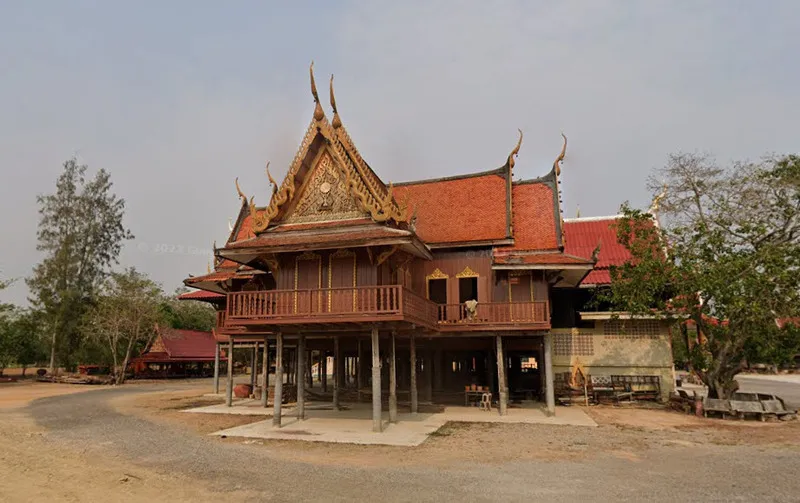
The sermon hall (sala kan parian) measures 36 meters wide and 21 meters long and was built in 1960 as a raised wooden structure. It is especially charming as an example of vernacular temple architecture, since halls like this are often the community’s most-used “central space”—for offering meals to monks, community meetings, kathin and pha pa ceremonies, and activities involving youth and local learning. Together with the chanting hall, measuring 5.5 meters wide and 21 meters long and built in 1971 as another wooden building, the image of Wat Sai Thong becomes clearer: the temple preserves timber structures as the heart of its atmosphere, while using reinforced concrete elsewhere where durability and maintenance are key.
In the monastic residential zone, the temple has seven wooden monk quarters (kuti), consistent with its role as a continuously inhabited community temple. The viharn measures 14 meters wide and 20 meters long and is built in reinforced concrete. There are also two reinforced-concrete funeral pavilions (sala bamphen kuson). This combination tells a logical development story: spaces that must accommodate large gatherings and major rites are built for strength and practicality, while areas that carry the temple’s traditional ambiance and community texture retain wooden forms so the place does not lose its local character.
Another feature that gives Wat Sai Thong a strong identity is the row of chedi positioned in front of the ordination hall. These are five ornate chedi with a “twelve-cornered recessed” profile on singha bases. This type of form is commonly found in central Thai art from the late Ayutthaya era through the early Rattanakosin period. The recessed corners create visual depth and refinement, while the singha base provides a grounded, dignified presence. As a group, the five chedi also structure the visitor’s movement naturally: many people pause at the chedi first and then proceed into the ordination area, a rhythm that aligns closely with respectful temple visiting.
When it comes to community temples, visitors often expect a monumental main Buddha image or spectacular murals. At Wat Sai Thong, however, the charm lies more in “sacred objects given meaning by the community.” Several important devotional objects are preserved here, including a small Chiang Saen-style gold Buddha image with a lap width of 5 inches. Although small, it reflects a tradition of intimate devotional objects—items that can be offered, cared for, and passed forward through faith—and such pieces often feel closer to local people than grand-scale artworks. Another striking object is a gold Thep Norrasingh set represented as four antique Chinese-style lion figures, made with a gold alloy. This detail hints at Chinese artistic influence along coastal trade communities, and also aligns with beliefs in lions as protectors of sacred places.
The temple also houses Buddha images from different periods and a statue of Luang Pho Pu depicted in the ascetic “chi-phram” style. Together, these elements show how Wat Sai Thong gathers multiple layers of devotion: Theravada Buddhist practice at the center of formal rites, alongside local belief systems preserved as community memory. Visiting and paying respect here is not only about lighting incense; it also involves understanding how a community defines and sustains what it holds sacred through use, storytelling, and continuity.
What makes Wat Sai Thong especially compatible with travel in Ban Laem is the surrounding “salt-farm and coastal” context. Bang Khun Sai is home to many livelihoods connected to the sea, fishing, and coastal environments. In different seasons, the landscape offers distinct beauty—morning light reflecting on salt pans, or evening sea breezes that make a slow walk around the temple feel effortless. The temple becomes a calm pause that fits a travel rhythm of “slow, but rich in detail,” ideal for visitors who want to experience Phetchaburi beyond the city zone or the Khao Wang area.
In contemporary community life, Wat Sai Thong also functions as a gathering place for periodic communal activities, consistent with the role of rural Thai temples as village commons. Visiting on an event day makes it clear that the temple is not designed for sightseeing alone; it remains a living space where people meet, share food, and make merit in an everyday, natural way. If you want to experience that atmosphere, it is best to check with the temple or local community ahead of time so your visit aligns with activity periods.
To experience the temple most fully, begin by paying respect within the ordination area, then step out to observe the sema and the five chedi in front. After that, move to the raised wooden sermon hall and the wooden chanting hall to absorb the vernacular architecture that defines the temple’s character. Finally, finish at the viharn or the areas where key devotional objects are enshrined. This sequence lets the temple’s narrative arrange itself naturally: from the “core ritual space” to “artistic evidence,” and then to “community life”—the three pillars that give Wat Sai Thong its identity.
When visiting, dress modestly, especially if you plan to enter the ordination hall or viharn. Keep your voice low in ceremonial areas, avoid crossing restricted monastic zones marked by signs, and ask permission before photographing rituals or monks at close range. These practices make cultural travel genuinely compatible with community life and are essential when writing about and visiting local temples respectfully.
Getting There If traveling by private car, head to Ban Laem District in Phetchaburi Province, then follow local routes within Bang Khun Sai Subdistrict to reach the temple. The Ban Laem coastal zone offers multiple route options, including shoreline roads and embankment paths between salt pans, which makes it easy to plan a continuous coastal itinerary. Upon arrival, park in the designated areas within the temple grounds and explore the older ordination hall, the newer ordination hall, the five chedi, and the key wooden structures at an unhurried pace.
For a well-balanced one-day plan, Wat Sai Thong works best as a “starting point” for a coastal culture route, followed by salt-farm scenery or environmental learning spots in the Ban Laem – Laem Phak Bia area, then seafood dining and an overnight stay near Chao Samran Beach or nearby zones. This itinerary delivers faith, local livelihood, and nature in one coherent route without the need to drive back into the city mid-trip.
| Place Summary | A coastal community temple in Ban Laem with layered history suggested by sema stones and chedi forms, ideal for culture, local life, and photography |
| Place Name | Wat Sai Thong |
| Address | Moo 4, Bang Khun Sai Subdistrict, Ban Laem District, Phetchaburi 76110 |
| Contact Number | 032-481-992 |
| Affiliation | Mahanikaya Order |
| Period | Established in 1898; art evidence suggests links to Ayutthaya, with chedi styles popular from late Ayutthaya to early Rattanakosin |
| Key Evidence | Plain reddish sandstone sema with a raised central ridge; five ornate chedi with twelve-cornered recessed profiles on singha bases |
| Highlights | Restored older ordination hall and historic sema; newer ordination hall built in 1990; raised wooden sermon hall; five chedi in front of the ordination area |
| Important Sacred Objects | Small Chiang Saen-style gold Buddha image (5-inch lap width), gold Thep Norrasingh set (four antique Chinese-style lions), statue of Luang Pho Pu (chi-phram ascetic depiction) |
| Abbot / Current Steward | Phra Athikan Chalo Punnyakaro |
| Facilities | On-site parking, ceremonial areas, sermon hall, funeral pavilions |
| Nearby Tourist Attractions (Approx. Distance) | 1. Ban Laem salt-farm community zone – 6 km 2. Coastal viewpoint area / Ban Bang Kaeo zone – 18 km 3. Laem Phak Bia Environmental Research & Development Project – 20 km 4. Chao Samran Beach – 25 km 5. Phra Nakhon Khiri (Khao Wang), Phetchaburi City – 38 km |
| Popular Restaurants Nearby (Approx. Distance + Phone) | 1. Manorah Restaurant – 4 km – 063-796-2622 2. Krua Halal Toi Yi Ban – 5 km – 087-007-1644 3. Ban Pu Pen 2 (Laem Phak Bia Branch) – 22 km – 088-194-4172 4. Baan Talay Restaurant (Laem Phak Bia) – 22 km – 085-405-2856 5. Sand Beach Club (Chao Samran Beach) – 25 km – 096-098-7980 6. Ja Daeng Seafood – 25 km – 099-483-3407 |
| Popular Accommodations Nearby (Approx. Distance + Phone) | 1. i tara resort & spa – 24 km – 032-478-301, 088-874-7474 2. seaman resort – 25 km – 081-846-1327 3. sea sky beach resort – 25 km – 032-478-431 4. eco moment beach resort – 25 km – 032-770-555, 083-198-4477 5. fisherman's resort – 28 km – 032-478-020, 086-300-4510 |
Frequently Asked Questions (FAQ)
Q: When was Wat Sai Thong officially established?
A: Wat Sai Thong was officially established in 1898.
Q: When did the temple receive its royal boundary charter (Wisungkhamsima)?
A: The temple received Wisungkhamsima on August 25, 1998.
Q: What evidence suggests the temple site may relate to older historical layers such as the Ayutthaya period?
A: The key evidence is the sema stones believed to date back to Ayutthaya, along with chedi forms popular from late Ayutthaya to early Rattanakosin.
Q: What are the must-see highlights when walking around the temple?
A: The restored older ordination hall and historic sema, the five chedi in front of the ordination area, the raised wooden sermon hall, and the temple’s key devotional objects.
Q: Which sacred objects are especially distinctive at Wat Sai Thong?
A: The small Chiang Saen-style gold Buddha image, the gold Thep Norrasingh set (four antique Chinese-style lions), and the statue of Luang Pho Pu depicted in the chi-phram ascetic style.
Q: How can I contact the temple before visiting?
A: You can call Wat Sai Thong at 032-481-992.
 Wat Sai Thong Map
 Category:
  Group:
  Tag: ●Wat Sai Thong●wat sai thong ●wat sai thong phetchaburi ●ban laem temple ●bang khun sai temple ●phetchaburi temples ●coastal temple thailand ●ayutthaya period sema ●twelve-cornered chedi ●thai buddhist temple ●things to do ban laem Last Update: 1 MonthAgo
Comment
 Nearby Attractions
| Keyword (Advance) |
 Region
|
 Muang Phetchaburi(
 Copyright 2012,