
 Home
Home North(
 Chiang Mai(


Wat Nai Klang
Rating: 2.4/5 (17 votes)
 Search By
  Map
Map 
 Have Map
  No Map
Phetchaburi attractions
Attractions in Thailand
Open Days: Daily
Opening Hours: 08:00 – 17:00
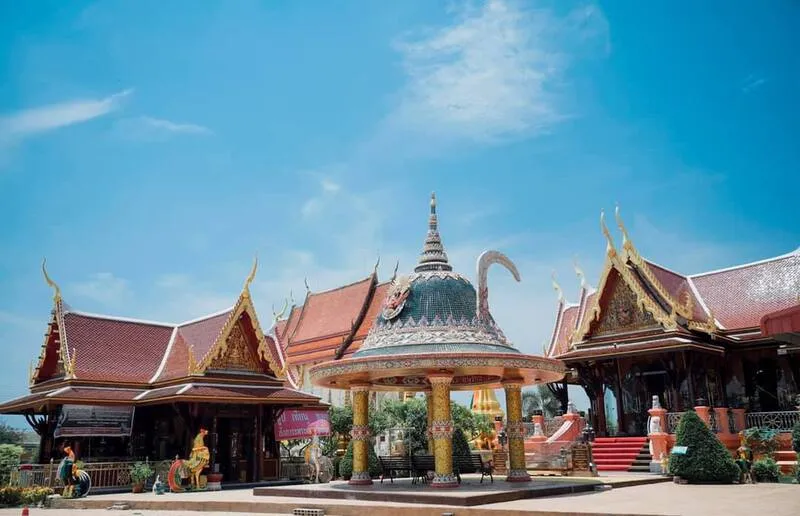
Wat Nai Klang is located at 217 Moo 3, Ban Laem Subdistrict, Ban Laem District, Phetchaburi Province. It is a royal-affiliated temple under the Maha Nikaya order with a long historical foundation dating back to the late Ayutthaya period, continuing through the Thonburi era and into early Rattanakosin. The temple is not merely a place for religious ceremonies; it serves as a historical and cultural center of the Ban Laem community, reflecting the transformation of the Phetchaburi River estuary in terms of society, economy, and local traditions.
Wat Nai Klang was established in 1762 (B.E. 2305). Originally known as “Wat Klang Sanam Chan,” it was situated in what was formerly called Bang Krok Subdistrict before the area was officially renamed Ban Laem. Historically, the temple once held the status of a royal monastery during the Thonburi period. However, after falling out of official records, it became a private temple. This transition illustrates the administrative evolution of the Thai Sangha during a significant historical shift and positions Wat Nai Klang as a temple layered with historical depth.
The temple grounds cover 41 rai, 2 ngan, and 96 square wah under Sor Kor 1 document no. 26. Its eastern boundary adjoins Ban Laem Hospital and residential areas, the western side borders the Phetchaburi River, while the northern and southern sides connect to local villages. Additionally, the temple holds one plot of monastic land (23 rai, 2 ngan, 44 square wah) under land title deed no. 4914. Its riverside location gives Wat Nai Klang a peaceful atmosphere and a strong connection to the fishing and river-based trading lifestyle that has historically defined Ban Laem.
The temple’s monastic buildings reflect architectural development from the late Rattanakosin period to the modern era. The ordination hall (ubosot), measuring 8 meters wide and 22.5 meters long, was constructed in 1972 (B.E. 2515) as a reinforced concrete structure in traditional Thai style. The sermon hall (sala kan parian) is a raised single-storey Thai-style building. The prayer hall was built in 1966 (B.E. 2509) as a semi-concrete, semi-wooden Thai-style structure. The viharn was completed in 1987 (B.E. 2530), and the funeral pavilion is made of reinforced concrete. Four wooden monks’ residences remain within the compound, preserving the character of a traditional community temple.
An important aspect of Wat Nai Klang’s continuity is its educational role. The temple has operated a Dhamma Studies School (Phra Pariyatti Tham Department) since 1967 (B.E. 2510), serving as a center for Buddhist learning at the local level. It provides religious education for monks and novices and plays a vital role in sustaining Buddhism within the Ban Laem community.
Wat Nai Klang received royal permission for its consecrated boundary (wisungkhamsima), measuring 20 meters wide and 40 meters long. The granting of this boundary confirms the temple’s formal status within the Thai monastic system and reflects sustained community support for religious development.
Currently, Wat Nai Klang is led by Phra Maha Woraphan Varapanyo, who serves as the abbot as of 2025 (B.E. 2568). Having verifiable and up-to-date administrative information enhances the temple’s credibility as a religious and community institution.
The surrounding atmosphere of Wat Nai Klang clearly reflects riverside life along the Phetchaburi River. Visitors can experience the tranquility of flowing water alongside the authentic rhythm of Ban Laem village life. A walk around the temple reveals the deep relationship between the temple and the community, encompassing religion, education, and cultural activities.
Getting There Wat Nai Klang is easily accessible by private car. Simply search “Wat Nai Klang Ban Laem Phetchaburi” in navigation apps. The temple is located near the Phetchaburi River and Ban Laem Hospital, making it easy to identify. It can also be included in a one-day trip exploring Ban Laem’s coastal and cultural attractions.
| Summary | Historic temple established in 1762, formerly Wat Klang Sanam Chan, once a royal monastery during the Thonburi period and now a central spiritual hub of Ban Laem. |
| Address | 217 Moo 3, Ban Laem Subdistrict, Ban Laem District, Phetchaburi Province, Thailand |
| Highlights | Thonburi-era historical roots, riverside setting along Phetchaburi River, Buddhist Dhamma Studies School. |
| Abbot | Phra Maha Woraphan Varapanyo |
| Nearby Accommodations | 1) Bang Taboon Riverside Homestay (≈12 km) Tel. +66 81 375 2321 2) Maleelai Homestay (≈12 km) Tel. +66 81 587 5958 3) Samphao Ngern Homestay (≈13 km) Tel. +66 96 579 1551 4) Banburi Resort (≈12 km) Tel. +66 86 364 3536 5) Ban Mai Chai Len Resort (≈35 km) Tel. +66 34 764 789 |
| Nearby Attractions | 1) Ao Bang Taboon (≈12 km) 2) Wat Khao Takhrao (≈15 km) 3) Laem Phak Bia (≈25 km) 4) Wat Ton Son (≈10 km) 5) Wat Khao Yi San (≈18 km) |
| Nearby Restaurants | 1) Bang Taboon Seafood Restaurant (≈12 km) Tel. +66 81 375 2321 2) Krua Ya Riw (≈12 km) Tel. +66 81 587 5958 3) Ban Laem Seafood Restaurant (≈8 km) Tel. +66 32 481 094 4) Ban Laem Noodle Shop (≈8 km) Tel. +66 32 481 094 5) Riverside Coffee Ban Laem (≈8 km) Tel. +66 32 481 094 |
Frequently Asked Questions (FAQ)
Q: When was Wat Nai Klang established?
A: The temple was established in 1762 (B.E. 2305) and was originally named Wat Klang Sanam Chan.
Q: Was Wat Nai Klang ever a royal monastery?
A: Yes, it was formerly a royal monastery during the Thonburi period before later becoming a private temple.
Q: Who is the current abbot of Wat Nai Klang?
A: The current abbot is Phra Maha Woraphan Varapanyo (as of 2025).
Q: Does the temple provide religious education?
A: Yes, it operates a Dhamma Studies School that has been active since 1967.
Q: How can visitors reach Wat Nai Klang?
A: Visitors can travel by private car and search for “Wat Nai Klang Ban Laem Phetchaburi” in navigation applications for easy access.
 Wat Nai Klang Map
 Category:
  Group:
  Tag: ●Wat Nai Klang●wat nai klang ban laem ●wat nai klang phetchaburi ●ban laem temple ●riverside temple phetchaburi ●historic temple ban laem ●thonburi period temple thailand ●phetchaburi temples ●buddhist temple ban laem ●wat nai klang history ●travel ban laem phetchaburi Last Update: 1 MonthAgo
Comment
 Nearby Attractions
| Keyword (Advance) |
 Facebook Fanpage
 Region
 Art, Culture and Heritage
 Historical Sites and Monuments(
 Landmarks and Memorials(
 Royal Palace(
 Art, Craft Centres, Tradition(
 Museums(
 Educational Places
 Educational Gardens, Farm(
 University
 Other religious and spiritural sites(
 Research and Development
 Royal Project(
 Suburban Living
 Village, Community(
 Floating Market(
 Nature and Wildlife
 National Parks and Marine Reserves(
 Mountain (Doi)(
 Dam, Reservoir, Lake(
 Waterfalls(
 Hot Springs(
 Caves(
 River, Canal(
 Bays and Beaches(
 Islands(
 Other natural attractions(
 Entertainment and Agricultural
 Farm, Parks, Gardens and Ecotourism(
 Theater(
 Outdoor and Adventure Activities(
 Travel Articles, Recipes
 Travel Review, Food Review(
 Copyright 2012,