
 Home
Home North(
 Chiang Mai(


Wat Chor Muang
Rating: 2.3/5 (15 votes)
 Search By
  Map
Map 
 Have Map
  No Map
Phetchaburi attractions
Attractions in Thailand
Open Days: Daily
Opening Hours: 06:00 – 18:00
Wat Chor Muang is one of the key temples in the rural area of Nong Krachet Subdistrict, Ban Lat District, Phetchaburi Province. It is located at No. 107, Ban Nong Hoi, Moo 5, and belongs to the Mahanikaya order. The temple stands out in terms of history, religion, and its relationship with the community landscape. It was once abandoned for more than a century before being restored and continuously developed, eventually becoming an important spiritual center for the local community today.
The temple grounds cover a total area of 20 rai and 36 square wah. The surrounding area is a flat agricultural community. The northern, eastern, and western boundaries adjoin private land, while the southern boundary borders a natural stream. This kind of terrain was highly significant for settlement in the past because the stream served as a water source for agriculture, daily consumption, and as a key element of the cultural landscape. As a result, the temple sits within a natural and community context that supports peaceful religious practice.
According to local accounts and available information, Wat Chor Muang had been abandoned for more than 100 years, with no resident monks and no continuous religious ceremonies. Later, an important piece of evidence was discovered: sandstone boundary stones (bai sema), a type of religious art that aligns with the Ayutthaya period. These finds are archaeologically significant because they indicate that this area once functioned as a legitimate temple site under monastic discipline in the past, and formed part of the network of temples along the Phetchaburi river basin during the Ayutthaya era.
The temple’s later abandonment may reflect changes in the community, transportation routes, or settlement patterns in Ban Nong Hoi and Nong Krachet Subdistrict—a phenomenon commonly found in the history of rural Thai temples. Many temples declined when communities relocated or when newer temples emerged nearby. However, the continued presence of bai sema ensured that Wat Chor Muang was not entirely erased from the community’s memory.
A major turning point came in 2511 BE when Phra Athikan Mon Thammavaro, known locally as “Luang Pho Mon,” who was then residing at Wat Nong Mai Lueang, recognized the religious and historical value of this abandoned temple site. He began restoration work, relying primarily on local faith and cooperation. In the early phase, the revival progressed gradually—starting with land preparation, building basic monastic structures, and establishing continuous monastic residence.
As a result of these efforts, Wat Chor Muang was officially established on 18 September 2518 BE. This marked the “revival” of an abandoned temple into a fully recognized temple within Thailand’s Sangha system. Restoration in this sense was not only about constructing buildings, but also about rebuilding the relationship between temple and community, which has long been the core of rural Thai Buddhist life.
Later, the temple received Wisungkham Sima on 6 April 2542 BE. The Wisungkham Sima boundary measures 29 meters wide and 49 meters long. This royal grant is a crucial milestone confirming the temple’s complete status, allowing it to conduct major monastic acts, such as ordination, in accordance with Buddhist discipline, and reinforcing the temple’s role as the religious center of Nong Krachet Subdistrict.
The monastic buildings at Wat Chor Muang reflect the temple’s post-restoration development. The ordination hall (Ubosot) is reinforced concrete, 8 meters wide and 22 meters long, built in 2530 BE, and decorated with Thai-style stucco relief patterns. Inside, the principal Buddha image is in the Mara-Vijaya posture, symbolizing the Buddha’s victory over Mara and, in spiritual terms, triumph over defilements and obstacles.
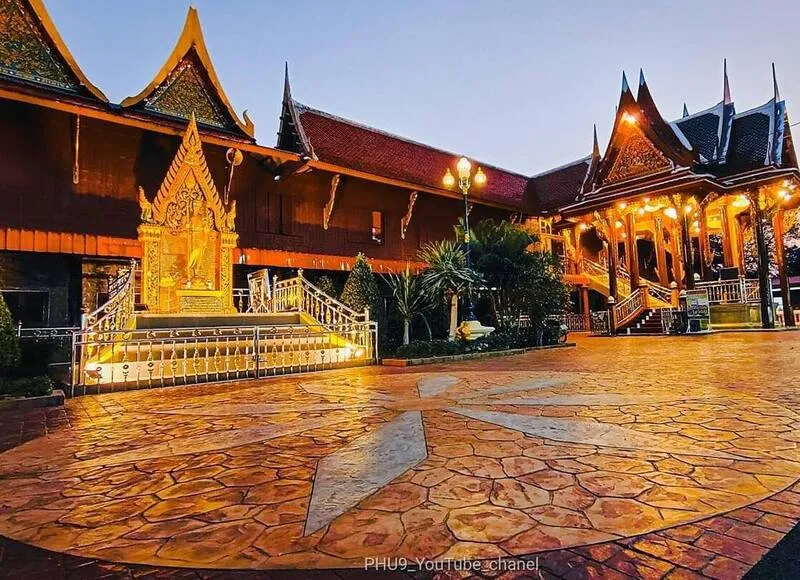
The chanting hall is a Thai-style wooden structure measuring 18 meters wide and 68 meters long, serving as an important space for daily chanting, prayers, and religious activities for both monks and laypeople. The wooden construction creates a calm, simple atmosphere that suits a rural temple setting. The monks’ quarters include 3 Thai-style wooden kuti buildings, constructed in 2526 BE, supporting monastic residence within the temple.
In addition, there is a multi-purpose pavilion, a 2-storey Thai-style reinforced-concrete building measuring 20 meters wide, built in 2536 BE. It is used for community activities, merit-making events, festivals, and meetings. The temple also has 1 funeral pavilion and a bell tower, both of which function as important elements in ritual practice and Buddhist symbolism.
In terms of “the temple and the community landscape,” Wat Chor Muang plays a clearly defined role as the center of Ban Nong Hoi—not only religiously, but also socially and culturally. The temple hosts merit-making events, funerals, ordinations, and public community activities. The temple grounds and the multi-purpose pavilion act as gathering spaces for the village during important moments. This relationship reflects the traditional rural Thai pattern in which a temple is not separated from daily life, but is tightly integrated into the community’s social structure.
When compared with other restored temples in Phetchaburi Province, Wat Chor Muang shares common features of revival temples: using archaeological evidence as a starting point, relying on community faith, and developing in a gradual, step-by-step manner. However, what distinguishes Wat Chor Muang is that it still preserves a distinctly rural temple atmosphere. Rather than focusing on commercial development or large-scale tourism, it emphasizes its role as the religious and spiritual heart of the community.
In administration, Wat Chor Muang has a continuous line of abbots: the 1st Phra Mon Thammavaro (2512–2522 BE), the 2nd Phra Prasong Sumangkhalo (2522–2525 BE), and the 3rd Phra Khru Piya Watcharakhun (2526 BE–present), who has played an important role in establishing strong foundations and developing the temple in both religious activities and management.
The temple also has an educational role through its Phra Pariyatti Dhamma School (Dhamma Division), opened in 2526 BE, to promote Buddhist studies for monks and novices in the area. This supports the preservation of Buddhist teachings alongside the rural community way of life in Phetchaburi.
Getting There Visiting Wat Chor Muang is convenient by private car. From Phetchaburi town, travel toward Ban Lat District, then continue into Nong Krachet Subdistrict and Ban Nong Hoi village. Using navigation maps can make access easier, especially for travelers who are unfamiliar with rural routes in the area.
| Place Summary | A temple revived from more than 100 years of abandonment, supported by Ayutthaya-period sandstone bai sema evidence, now serving as the religious and community center of Nong Krachet Subdistrict. |
| Address | 107 Ban Nong Hoi, Moo 5, Nong Krachet Subdistrict, Ban Lat District, Phetchaburi |
| Current Abbot (Latest) | Phra Khru Piya Watcharakhun |
| Highlights | Revived from an abandoned temple, Ayutthaya-period sandstone bai sema, stucco-decorated Ubosot, Thai-style wooden chanting hall |
| Nearby Tourist Attractions | 1) Phra Nakhon Khiri (Khao Wang) – 15 km 2) Wat Mahathat Worawihan – 14 km 3) Wat Khao Bandai It – 12 km 4) Tham Khao Luang – 18 km 5) Phra Ram Ratchaniwet – 20 km |
| Nearby Restaurants | 1) Krua Tanote – 8 km Tel. 082-252-4990 2) Krua Kamnan Chob – 9 km Tel. 065-942-6496 3) PENN Palmyra & Chill – 10 km Tel. 087-487-8464 4) Ban Lat Riverside Restaurant – 6 km 5) Suan Ahan Lan Aroi – 15 km Tel. 088-594-9878 |
| Nearby Accommodations | 1) Super Resort Phetchaburi – 14 km Tel. 080-009-8883 2) Kane Inn Phetchaburi – 15 km Tel. 089-116-4557 3) Ton Tan Resort – 15 km Tel. 032-490-088 4) Maithong Riverside – 18 km Tel. 095-978-2914 5) Wang Bua Resort – 22 km Tel. 081-135-8497 |
Frequently Asked Questions (FAQ)
Q: When was Wat Chor Muang officially established?
A: Wat Chor Muang was officially established on 18 September 2518 BE, after having been abandoned for more than 100 years.
Q: How is Wat Chor Muang connected to the Ayutthaya period?
A: Sandstone bai sema believed to date to the Ayutthaya era were discovered, serving as important archaeological evidence of the temple’s historical roots.
Q: Who is the current abbot of Wat Chor Muang?
A: The current abbot is Phra Khru Piya Watcharakhun, serving since 2526 BE.
Q: What role does Wat Chor Muang play in the local community?
A: The temple is a center for religious activities, merit-making events, funerals, and public community gatherings in Ban Nong Hoi.
Q: How can I get to Wat Chor Muang?
A: Drive from Phetchaburi town toward Ban Lat District, then continue into Nong Krachet Subdistrict and Ban Nong Hoi village. Navigation maps are helpful, especially for visitors unfamiliar with rural routes.
 Wat Chor Muang Map
 Category:
  Group:
  Tag: ●Wat Chor Muang●wat chor muang ●wat chor muang phetchaburi ●wat chor muang ban lat ●nong krachet temple ●ban nong hoi temple ●restored temple thailand ●ayutthaya boundary stones ●wisungkham sima thailand ●temples in phetchaburi ●things to do in ban lat Last Update: 1 MonthAgo
Comment
 Nearby Attractions
| Keyword (Advance) |
 Region
|
 Muang Phetchaburi(
 Copyright 2012,