
 Home
Home North(
 Chiang Mai(


Wat Rat Bamrung (Wat Sai Khan)
Rating: 3.4/5 (5 votes)
 Search By
  Map
Map 
 Have Map
  No Map
Phetchaburi attractions
Attractions in Thailand
Open Days: Daily
Opening Hours: 06:00 – 18:00
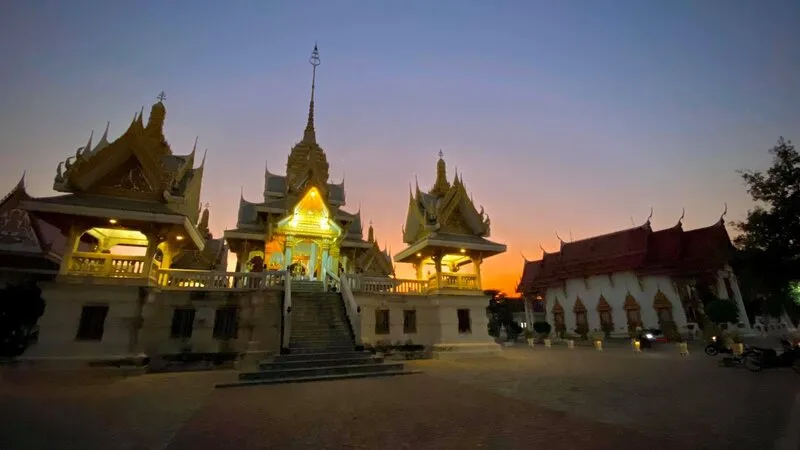
Wat Rat Bamrung (Wat Sai Khan) is located at 137 Sai Khan Village, Moo 3, Tha Yang Subdistrict, Tha Yang District, Phetchaburi Province. This is a local Buddhist temple under the Mahanikaya order that has grown alongside the Tha Yang community for generations. For local residents, the temple is both a spiritual anchor and a shared public space used in everyday life, from giving alms, listening to sermons, and chanting, to major merit-making events such as ordinations, Kathina and Pha Pa ceremonies, and memorial rites dedicated to departed loved ones. Its character as a true community temple gives the place a calm, simple, and sincere atmosphere, and visitors often feel a sacredness that is not separate from daily life but deeply woven into it.
The Sai Khan area and the wider Tha Yang Subdistrict retain a semi-rural landscape of homes, farmland, and local roads connecting villages to the district center and nearby areas. This quiet local setting makes Wat Rat Bamrung ideal for those who want to make merit without rushing, spend time in the stillness of a temple, pray and pay respects with focus, or experience a side of Phetchaburi beyond the well-known old town or Cha-am seaside. Visiting a community temple like this is not simply “seeing a place,” but understanding local roots through the temple, historically the most important social structure of Thai village life.
The temple’s founding dates to the early 20th century. Wat Rat Bamrung was established in 1910 (B.E. 2453) and received Wisungkhamsima in 1918 (B.E. 2461). Wisungkhamsima is especially significant within the monastic institution because it formally designates the consecrated boundary for key ecclesiastical rites in accordance with the Vinaya, particularly ordinations. Receiving Wisungkhamsima during that period reflects a community with the readiness, faith, and stable organization needed for the temple to serve as an official Buddhist center for the area. In the social context of that era, temples often functioned as educational centers, spiritual centers, and a shared space where communal strength gathered in every important season of life. Wat Rat Bamrung became part of the community framework that helped people live together with a clear moral and cultural anchor through ethics, tradition, and public merit-making.
The temple grounds cover approximately 8 rai. This size is typical of community temples that grow from local faith, offering enough space for core religious buildings such as the ordination hall, a sermon hall, monks’ quarters, and open areas for public activities. Over time, the layout can be adapted for practical community use, including large merit-making events, festival kitchens and alms-giving, temporary parking during major ceremonies, and orderly arrangements for rituals that require structure. A community temple that is not overly large also feels accessible to visitors, allowing people to notice details of maintenance, cleanliness, and the careful organization of spaces that support public benefit.
The key religious structures include the ordination hall (Ubosot), measuring 15 meters wide and 20 meters long, built in 1910 (B.E. 2453) as a reinforced-concrete structure. The Ubosot is the ritual heart of the temple, used for the most formal monastic ceremonies and religious observances, and it is also where Buddhist devotees respectfully pay homage and pray. Because this Ubosot dates back to the year of the temple’s establishment, it serves as a tangible witness of time, allowing visitors to read local history through architecture, materials, and the practical way the community continues to use the space. In many villages, a solid and enduring Ubosot also symbolizes collective effort, requiring sustained labor, donations, and cooperation before becoming a lasting reality.
The sermon hall (Sala Kan Parian) measures 12 meters wide and 26 meters long, built in 1968 (B.E. 2511) as a half-concrete, half-timber structure. This hall most clearly reflects the “living pulse” of the temple because it functions as an all-purpose space for merit-making ceremonies, community meetings, sermons, funeral chanting, communal meals for monks, and various forms of public charity. The half-concrete, half-timber style is common in mid-20th-century local temples, when communities upgraded building durability while preserving ventilation, openness, and comfort in the Central Thai climate. For this reason, the sermon hall often becomes both a ceremonial space and a social space at the same time, a place the community feels it co-owns and uses to strengthen relationships in every significant moment of village life.
The temple has 6 monks’ residences (kuti): 4 wooden houses and 2 half-concrete, half-timber houses. These quarters are tied to the monks’ daily routine and therefore express the simplicity and moderation typical of community temples. The mix of building types also shows practical development across different periods and resources, emphasizing real usability, easy upkeep, and alignment with the community’s capacity. The temple also has 1 merit-making pavilion (Sala Bamphen Kuson), built in reinforced concrete, supporting memorial rites and ceremonies dedicated to the deceased. This role is central to local temples, as the temple provides a structured, meaningful religious process that helps comfort families and guide the community through loss.
A key sacred focus is the principal Buddha image enshrined in the Ubosot, which serves as the devotional center for worshippers. While detailed art-historical descriptions may not be as widely publicized as those of major temples in Phetchaburi city, the value of a community temple is not defined by external fame. Its strength lies in living faith that continues in daily practice. A temple that is actively used and continuously cared for shows a clear relationship between temple and community, from offerings of flowers and candles, to cleanliness and orderly grounds, to the collective effort behind merit-making events. For visitors, seeing a temple that feels genuinely alive, with locals regularly coming to make merit, makes the experience more meaningful than simply taking photos, because it is direct contact with living village Buddhism.
The temple’s monastic administration has been passed down in sequence, with names recorded in local history. These include Phra Yaem Sukhato (serving from the early period), followed by Phra Chek, Phra Rot, Phra To, Phra Ruam, Phra Athikan Sophin (2001, B.E. 2544), and Phra Athikan Chum Suphavato (2002, B.E. 2545). In community temples, leadership matters because the abbot functions as a religious leader, a community activity coordinator, and a steward of temple resources for the benefit of monks and laypeople. A strong community temple typically comes from cooperation between the monastic community, local leaders, and residents, ensuring that religious duties and social roles move forward together in a balanced way.
Beyond its religious and social roles, Wat Rat Bamrung also connects with education through a primary school area of 1 rai. The close relationship between temple and school is a familiar feature of Thai communities: the temple supports moral cultivation and local cultural values, while the school builds modern knowledge and skills. When these spaces are linked, the community benefits from both learning and value formation for children and youth, reinforcing the temple’s role as more than a ceremonial site and positioning it as a supportive space for community development in a wider sense.
For visitors coming to pay respects and make merit, Wat Rat Bamrung is well-suited to a simple, focused visit. Many begin by paying homage to the principal Buddha image in the Ubosot, setting an intention in calm silence, then walking the grounds to observe how different structures reflect the temple’s development across time. Community temples often offer a different perspective from large city temples because the practical use of space is more visible: how areas are arranged for rituals, how buildings are maintained, how the courtyard is organized for merit-making events, and how spaces support public charity. Many visitors feel that such temples are genuinely accessible and distinctly local, with an unforced sincerity that is the core charm of cultural travel rooted in calmness rather than spectacle.
Temple etiquette helps preserve an appropriate sacred atmosphere. Visitors should dress modestly, avoid loud conversation, and avoid disturbing monks during routine duties or rest. If a ceremony is taking place in the hall or Ubosot, walk respectfully and avoid crossing close in front of the main Buddha image. Avoid inappropriate photography, especially during chanting or significant rites. If you wish to make merit, practical offerings such as donations for utilities, support for community charity, or contributions to temple activities are meaningful ways to help a community temple maintain its grounds and continue its work sustainably.
Getting There to Wat Rat Bamrung (Wat Sai Khan) is best by private car or local hired transport. Start from Tha Yang District center and follow local roads into Sai Khan Village. As you approach the village, look for local signs to the temple or ask nearby residents, who are usually able to give clear directions. The temple area generally accommodates parking as appropriate, especially on days without major events. During festivals or large ceremonies, allow extra time and follow the temple’s on-site traffic and parking arrangements for safety and convenience.
If you are planning a serious Phetchaburi itinerary, Wat Rat Bamrung can be a well-placed stop along your route because Tha Yang connects smoothly to Phetchaburi city zones, Cha-am, and nature destinations such as Kaeng Krachan. Visiting a community temple adds a reflective cultural and merit-making dimension before continuing to major attractions or well-known restaurants in Tha Yang and Phetchaburi city. With a balanced plan, you can experience both the calm of temple life and the enjoyment of travel within a single day.
| Place Summary | A long-established community temple in Tha Yang District, founded in 1910 (B.E. 2453), with the Ubosot and sermon hall serving as the core religious spaces; ideal for merit-making and experiencing a calm local atmosphere. |
| Address | 137 Sai Khan Village, Moo 3, Tha Yang Subdistrict, Tha Yang District, Phetchaburi 76130, Thailand |
| Highlights | A Mahanikaya community temple with a calm local character; a long history; an Ubosot built in the founding year; and a strong role as a center for merit-making traditions and village ceremonies. |
| Contact Number | Tel. 032-588-365 |
| Getting There | Best by private car or local hired transport; start from Tha Yang District center and follow local roads into Sai Khan Village. |
| Current Status | Open for merit-making and religious activities |
| Nearby Tourist Attractions | 1) Wat Wibun Prachasarn (Wat Tha Krathiam) ~2 km 2) Merit-Making Funeral Pavilion, Wat Tha Krathiam ~2 km 3) Wat Thammaram ~5 km 4) Phra Nakhon Khiri (Khao Wang) Historical Park ~20 km 5) Wat Mahathat Worawihan (Phetchaburi) ~20 km |
| Popular Restaurants Nearby | 1) Pad Thai Tha Yang ~10 km Tel. 032-461-268 2) Ja Ae Restaurant (Tha Yang) ~10 km Tel. 032-437-230 3) Rabiang Rim Nam (Phetchaburi) ~20 km Tel. 032-425-707 4) Alex Seafood (Cha-am) ~35 km Tel. 081-373-5940 5) Playwan (Tha Sa-Ne) ~25 km Tel. 032-491-560 |
| Popular Accommodations Nearby | 1) Suan Petch Riverview Resort (Tha Yang) ~18 km Tel. 081-981-8405 2) The Canal Garden Resort (Tha Yang) ~15 km Tel. 032-596-299 3) Green View Resort (Tha Yang) ~12 km Tel. 081-009-8424 4) Royal Diamond Hotel (Phetchaburi City) ~20 km Tel. 032-411-061 5) The Canal Garden Resort (Alternate Mobile) ~15 km Tel. 092-186-4114 |
Frequently Asked Questions (FAQ)
Q: When was Wat Rat Bamrung (Wat Sai Khan) founded?
A: The temple was founded in 1910 (B.E. 2453) and received Wisungkhamsima in 1918 (B.E. 2461).
Q: Where is Wat Rat Bamrung located?
A: It is located at 137 Sai Khan Village, Moo 3, Tha Yang Subdistrict, Tha Yang District, Phetchaburi Province.
Q: Which monastic order does the temple belong to?
A: It is a local temple under the Mahanikaya order.
Q: What are the temple’s key buildings?
A: Key structures include the Ubosot built in 1910 (B.E. 2453), the sermon hall built in 1968 (B.E. 2511), monks’ residences, and a merit-making pavilion for memorial rites.
Q: Is it convenient to reach Wat Rat Bamrung?
A: Yes. The easiest way is by private car or local hired transport from Tha Yang District center to Sai Khan Village.
Q: What contact number should I use to reach the temple?
A: Tel. 032-588-365
 Wat Rat Bamrung (Wat Sai Khan) Map
 Category:
  Group:
  Tag: ●Wat Rat Bamrung (Wat Sai Khan)●wat rat bamrung ●wat sai khan ●tha yang temple ●phetchaburi temple ●buddhist temple tha yang ●merit making phetchaburi ●cultural travel phetchaburi ●temple tour thailand ●local temple thailand Last Update: 1 MonthAgo
Comment
 Nearby Attractions
| Keyword (Advance) |
 Facebook Fanpage
 Region
 Art, Culture and Heritage
 Historical Sites and Monuments(
 Landmarks and Memorials(
 Royal Palace(
 Art, Craft Centres, Tradition(
 Museums(
 Educational Places
 Educational Gardens, Farm(
 University
 Other religious and spiritural sites(
 Research and Development
 Royal Project(
 Suburban Living
 Village, Community(
 Floating Market(
 Nature and Wildlife
 National Parks and Marine Reserves(
 Mountain (Doi)(
 Dam, Reservoir, Lake(
 Waterfalls(
 Hot Springs(
 Caves(
 River, Canal(
 Bays and Beaches(
 Islands(
 Other natural attractions(
 Entertainment and Agricultural
 Farm, Parks, Gardens and Ecotourism(
 Theater(
 Outdoor and Adventure Activities(
 Travel Articles, Recipes
 Travel Review, Food Review(
 Copyright 2012,