
 Home
Home North(
 Chiang Mai(


Wat Nong Chok
Rating: 2.7/5 (19 votes)
 Search By
  Map
Map 
 Have Map
  No Map
Phetchaburi attractions
Attractions in Thailand
Open Days: Daily
Opening Hours: 06:00 – 18:00
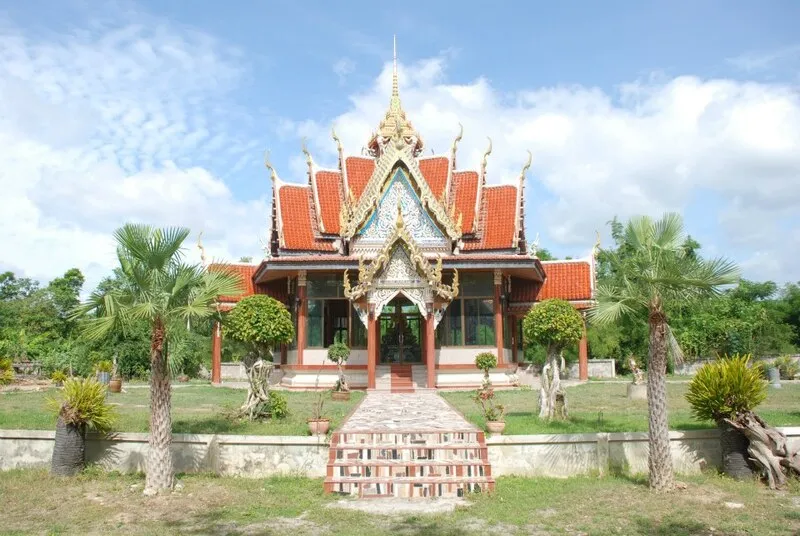
Wat Nong Chok is located at 136 Nong Chok Village, Moo 6, Nong Chok Subdistrict, Tha Yang District, Phetchaburi Province. It is a local temple under the Mahanikaya sect with a long-standing history and a continuous role in the life of the Tha Yang community. The temple is not only a place for Buddhist religious practices but also serves as a spiritual center, an educational hub, and a public space for social activities for residents of Nong Chok Village and nearby communities for more than a century.
The surroundings of Wat Nong Chok reflect the rural landscape of Phetchaburi Province, characterized by agricultural land, village homes, and public water sources that sustain local livelihoods. The temple’s boundaries are clearly defined: the northern and western sides border private land, the southern side borders a public stream, and the eastern side borders a public irrigation canal. This geographical setting highlights the close relationship between the temple and natural resources, which have long formed the foundation of agricultural communities in both the past and present.
Wat Nong Chok was established in 1892 (B.E. 2435) during the late reign of King Chulalongkorn (Rama V), a period of significant transition in Thai society in terms of governance, economy, and transportation. The founding of the temple during this era held deeper meaning than simply creating a religious site; it functioned as an important mechanism for strengthening spiritual security and social cohesion within the local community. Wat Nong Chok thus emerged from the shared faith of villagers who worked together to build a temple as a spiritual refuge and a center for religious activities.
Later, Wat Nong Chok received a royal grant of Wisungkhamsima in 1936 (B.E. 2479), marking a significant milestone in the temple’s history. This royal boundary enabled the temple to conduct ordination ceremonies in accordance with the Buddhist monastic code and formally confirmed its status within Thailand’s ecclesiastical administration. Beyond its legal significance, the Wisungkhamsima reflects the recognition and stability of the temple in the eyes of both society and the state during that period.
The temple occupies a total land area of 14 rai, with legal documentation under Chanote Title Deed No. 10256. In addition, the temple holds two plots of monastic land (thoranisong) totaling 5 rai 1 ngan 80 square wah. These lands are essential resources supporting temple activities, including the development of monastic buildings, the organization of religious events, and the provision of public-benefit activities for the community. The existence of monastic land underscores the temple’s long-term stability and its ability to remain self-reliant in accordance with the traditional model of rural Thai temples.
The monastic buildings within Wat Nong Chok are diverse and reflect the temple’s development across different periods. The ubosot is a reinforced concrete structure measuring 10 meters wide and 20 meters long, serving as the venue for important monastic ceremonies. The sermon hall (sala kanparian), built in 1997 (B.E. 2540), is a two-story reinforced concrete building measuring 12 meters by 15 meters and is used for religious activities, meetings, and community merit-making events.
The chanting hall was constructed in 1960 (B.E. 2503), measuring 16 meters wide and 12 meters long, and is used for chanting, daily prayers, and religious activities requiring a calm atmosphere. The viharn is a large structure measuring 26 meters wide and 76 meters long, reflecting the expansion of the temple in response to a growing number of lay Buddhists in the area. The temple also includes twelve monks’ residences (kuti), built as half-concrete, half-wooden structures that illustrate the simple monastic lifestyle typical of rural temples.
The multipurpose pavilion, built in 1995 (B.E. 2538), measures 12 meters wide and 24 meters long and is used for public activities, merit-making ceremonies, traditional festivals, and community events. In addition, the temple has one funeral pavilion used for funeral rites and merit-making ceremonies dedicated to the deceased. Together, these structures clearly demonstrate Wat Nong Chok’s role as a true center of social life within the local community.
The administration and governance of Wat Nong Chok have continued uninterrupted since its establishment, with abbots serving successively over time. These include Phra Pan, Phra Sen, Phra Yu, Phra Phan, Phra Thong, Phra Khru Wapi Thammakhunrakorn (Plaek), Phra Thongdi, Phra Khru Yanphet Run (Aew), and the current abbot, Phra Khru Wisit Rangkhuṇ, who has held the position since 1992 (B.E. 2535). Each abbot has played an important role in developing the temple in terms of physical infrastructure, education, and close cooperation with the local community.
In the field of education, Wat Nong Chok has offered a Buddhist scripture school (Phra Pariyatti Dhamma School) since 1949 (B.E. 2492), providing monks and novices with systematic study of Buddhist teachings. This school plays a vital role in preserving and transmitting religious knowledge and serves as a training ground for qualified monks who contribute to both the local community and surrounding areas.
Getting There is convenient by private car. From Phetchaburi town, travel toward Tha Yang District and then follow local roads into Nong Chok Subdistrict, where directional signs are clearly posted. Private transportation is the most suitable option, as the surrounding area is rural and the temple provides on-site parking for visitors.
With a history dating back to the late 19th century, comprehensive monastic facilities, and an enduring role as both a religious and community center, Wat Nong Chok is one of the important temples in Tha Yang District. It is especially suitable for visitors interested in local history, community life, and cultural travel that emphasizes peace, simplicity, and authenticity.
| Name | Wat Nong Chok |
| Address | 136 Nong Chok Village, Moo 6, Nong Chok Subdistrict, Tha Yang District, Phetchaburi Province |
| Highlights | A historic temple founded in 1892, serving as a religious and community center in rural Tha Yang |
| Current Abbot | Phra Khru Wisit Rangkhuṇ |
| Nearby Tourist Attractions | 1) Phra Nakhon Khiri (Khao Wang) ~23 km 2) Wat Mahathat Worawihan ~22 km 3) Cha-am Beach ~19 km 4) Phetchaburi Riverside Market ~21 km 5) Kaeng Krachan National Park ~47 km |
| Popular Restaurants Nearby | 1) Baan Suan Tha Yang Restaurant ~9 km Tel. 032-234567 2) Krua Lung Daeng, Phetchaburi ~16 km Tel. 032-123456 3) Rim Nam Phet Restaurant ~22 km Tel. 032-567890 4) Krua Talay Cha-am ~19 km Tel. 032-345678 5) Phetchaburi Curry Rice Shop ~21 km Tel. 032-456789 |
| Popular Accommodations Nearby | 1) Royal Diamond Hotel, Phetchaburi ~23 km Tel. 032-400707 2) Cha-am Grand Resort ~19 km Tel. 032-471234 3) Phetchaburi Inn ~21 km Tel. 032-123890 4) Baan Suan Resort Tha Yang ~11 km Tel. 032-223344 5) Eco Coast Hotel Cha-am ~20 km Tel. 032-334455 |
Frequently Asked Questions (FAQ)
Q: When was Wat Nong Chok established?
A: Wat Nong Chok was founded in 1892 (B.E. 2435) and received a royal Wisungkhamsima in 1936 (B.E. 2479).
Q: Which district is Wat Nong Chok located in?
A: The temple is located in Tha Yang District, Phetchaburi Province.
Q: Who is the current abbot of Wat Nong Chok?
A: The current abbot is Phra Khru Wisit Rangkhuṇ.
Q: What role does Wat Nong Chok play in the local community?
A: The temple serves as a religious, educational, and social center for the Nong Chok community.
Q: Is it convenient to travel to Wat Nong Chok?
A: Yes, it is most convenient to visit by private car from Phetchaburi town or Tha Yang District.
 Wat Nong Chok Map
 Category:
  Group:
  Tag: ●Wat Nong Chok●wat nong chok ●wat nong chok phetchaburi ●wat nong chok tha yang ●temple in tha yang district ●phetchaburi temples ●historic temple phetchaburi ●rural thai temple ●history of wat nong chok ●visiting wat nong chok Last Update: 1 MonthAgo
Comment
 Nearby Attractions
| Keyword (Advance) |
 Facebook Fanpage
 Region
 Art, Culture and Heritage
 Historical Sites and Monuments(
 Landmarks and Memorials(
 Royal Palace(
 Art, Craft Centres, Tradition(
 Museums(
 Educational Places
 Educational Gardens, Farm(
 University
 Other religious and spiritural sites(
 Research and Development
 Royal Project(
 Suburban Living
 Village, Community(
 Floating Market(
 Nature and Wildlife
 National Parks and Marine Reserves(
 Mountain (Doi)(
 Dam, Reservoir, Lake(
 Waterfalls(
 Hot Springs(
 Caves(
 River, Canal(
 Bays and Beaches(
 Islands(
 Other natural attractions(
 Entertainment and Agricultural
 Farm, Parks, Gardens and Ecotourism(
 Theater(
 Outdoor and Adventure Activities(
 Travel Articles, Recipes
 Travel Review, Food Review(
 Copyright 2012,