
 Home
Home North(
 Chiang Mai(


Wat Huai Sai Tai
Rating: 2.8/5 (16 votes)
 Search By
  Map
Map 
 Have Map
  No Map
Phetchaburi attractions
Attractions in Thailand
Open Days: Please check with the temple before you go
Opening Hours: Please check with the temple before you go
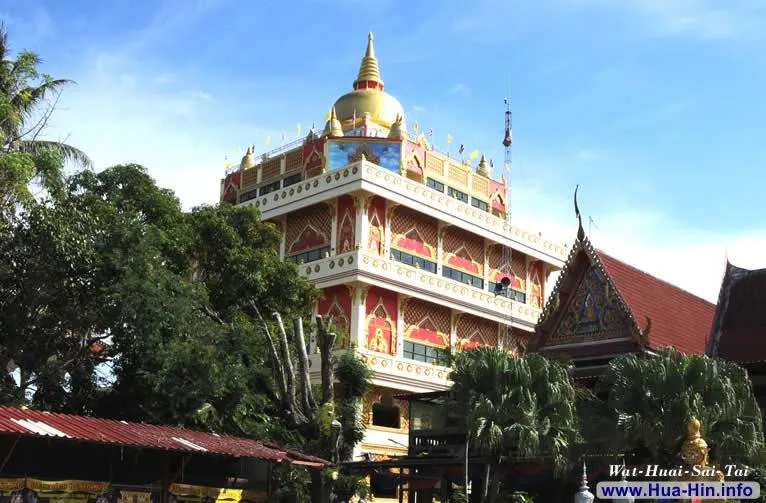
Wat Huai Sai Tai is located at 1310 Ban Huai Sai Tai, Chomphon Road, Cha-am Subdistrict, Cha-am District, Phetchaburi Province. It belongs to the Mahanikaya order and plays a clear role as a “community temple” for the inland Cha-am area. The temple grounds cover approximately 31 rai and 68 square wah, and the northern and western boundaries adjoin public roads, which makes access convenient for local residents as well as travelers passing through main routes. From a cultural travel perspective, Wat Huai Sai Tai is not a commercially staged attraction; it is a living place of faith that has grown alongside its community. The temple has a complete set of functional monastic buildings for monks and visitors, and a distinctive feature is the Guanyin (Guan Im) shrine, together with Thai-style reinforced-concrete buildings developed in a systematic phase during the late 20th-century Buddhist era.
For many people, “Huai Sai” is often associated with learning areas related to development and water-resource management around Cha-am–Hua Hin. For residents of Ban Huai Sai Tai, however, the temple is something more tangible: it is the community’s everyday center. It is where people gather naturally across generations, where merit-making and traditional ceremonies are held, and where key life events—funerals, ordinations, and community rites—take place. The temple’s significance does not come from grand scale or spectacle, but from sustained real-world use and the social relationships the temple continually supports.
Wat Huai Sai Tai was officially established in 1995 and received royal consecration of its ordination boundary (wisungkhamsima) in 1996. This period corresponds to a time when many temples in the region expanded in response to community growth and practical needs for formal monastic rites. A key point is that although the “official establishment” year is clear in records, the foundations of local faith often begin earlier—typically through communal merit-making, a small monastic presence, or an initial practice area—before evolving into a formally administered temple. In this way, Wat Huai Sai Tai reflects the development pattern of many contemporary Central Thai community temples, both in land management, building construction, and the establishment of temple-based education.
The temple’s monastic architecture is characterized by the use of Thai-style reinforced concrete as its primary construction approach. The ordination hall (ubosot) is approximately 12 meters wide and was built in 1991. It follows a Thai architectural profile while emphasizing permanence and stability, suitable for major monastic ceremonies. Choosing reinforced concrete in that era aligns with modern temple-building trends aimed at durability, lower long-term maintenance compared to wooden structures, and practical performance in the hot-humid coastal climate of Phetchaburi, where buildings must withstand intense sun and seasonal rainfall.
The chanting hall is described as approximately 25 meters wide and was also built in 1991, suggesting a coordinated effort to complete core structures within the same development phase. Functionally, the chanting hall is a daily gathering space for monks and laypeople, supporting chanting, listening to Dhamma talks, and activities that require a calm atmosphere more than an “all-purpose pavilion.” This is the kind of building that gives a temple continuous rhythm beyond major festival days and large merit-making events.
The temple’s vihara is approximately 7 meters wide and 25 meters long and was built in 1989. The all-purpose pavilion measures about 7 meters by 25 meters and was built in 1991, alongside three monk residences (kuti) constructed as concrete buildings. Together, these structures provide a complete functional base for monastic life and community activities. In particular, the all-purpose pavilion is often the most shared space between temple and community—hosting everything from small family gatherings to village-scale merit ceremonies—so the relationship between temple and community is continually sustained through these everyday, usable spaces.
One element that distinguishes Wat Huai Sai Tai from many community temples in the same area is the presence of a Guanyin (Guan Im) shrine, along with a three-gabled vihara, a bell tower, and a waterside pavilion. Guanyin shrines have become increasingly common within contemporary Thai temples across many provinces, reflecting cross-cultural devotion coexisting within Thai society—especially in tourism areas or places with higher population movement such as Cha-am–Hua Hin. Many visitors stop to pay respects for peace of mind and blessings related to health, family, and work. Temples that can harmoniously accommodate multiple devotional traditions often become more flexible communal spaces, accessible to a wider range of people.
Another important highlight is the principal Buddha image in the ordination hall, in the Mara-Vijaya posture. It is described as approximately 100 inches across the lap and 168 inches in height. This is a notable size for a community temple, giving the ordination hall a clear visual identity. For worshippers, the image conveys a sense of calm and dignity within the main monastic-rite space. The principal Buddha image is not only an artistic symbol but also the focal point for merit-making, offerings, and significant community ceremonies, which means the “ubosot” is more than a single building—it is where the community anchors shared religious meaning and collective memory.
Regarding the wisungkhamsima, the consecrated boundary is recorded as approximately 41 meters wide and 66 meters long. This helps clarify the temple’s status within the Sangha administration and the completeness of its formal rite space. Having a wisungkhamsima means that major monastic ceremonies can be conducted properly according to the Vinaya within the designated boundary, and it also reflects the community’s capacity to organize land and secure formal recognition through the established administrative process.
In terms of administration, records list two abbots: the first, Phra Noi (serving during 1967–1988), and the second, Phra Khru Chanwatcharaphon (serving thereafter). In addition, the current abbot is recorded as “Phra Maha Uthai Uthayo.”
On education, Wat Huai Sai Tai opened a monastic Dhamma studies school (Phra Pariyatti Dhamma, Dhamma division) in 1995 and later established a Pali division in 1997. This is an important indicator that the temple’s role extends beyond rituals and ceremonies; it also functions as a serious learning center for monks. Especially in areas where monks are expected to hold strong knowledge of the Vinaya and communicate effectively with contemporary society, temple-based education becomes a “knowledge infrastructure” that supports the quality of local monastic life and contributes to building verifiable religious value through an organized system.
As a travel stop, Wat Huai Sai Tai sits in Cha-am—widely known as a seaside destination—but Cha-am’s character goes beyond the beach. Along the same routes, visitors can find environmental learning sites, royal-initiative areas, historical places, and community temples that represent “inland Cha-am,” another side of the same town. Wat Huai Sai Tai is therefore suitable for a half-day or one-day itinerary that connects “worship–food–sightseeing–stay” within the same zone without long drives.
When visiting a temple of this type, etiquette should remain the priority: dress respectfully, keep noise to a minimum, and avoid disturbing monks’ daily routines. If entering the ordination hall, remove shoes and follow the temple’s guidance. Be mindful about photography in certain zones, especially during ceremonies or when people are practicing. Respect for the place and its people makes the visit smoother and helps preserve the calm atmosphere that is one of the temple’s core values.
Getting There Wat Huai Sai Tai is easy to reach by car. Use Phetkasem Road (Highway 4) into Cha-am District, then head to Chomphon Road in the Ban Huai Sai Tai area. The temple is at 1310 Chomphon Road. In general, it is not difficult to locate because the surrounding area connects to multiple roads and one boundary of the temple adjoins a road. For navigation apps, search “Wat Huai Sai Tai Cha-am,” and check traffic conditions during weekends and holiday periods because Cha-am can become congested at peak tourist times.
For timing, morning or late morning is usually most comfortable, as the weather is cooler and suitable for walking around the temple grounds. If you plan to continue to a cafe or nearby restaurants, late morning to afternoon works well. Early evening is also suitable for a brief merit-making stop before heading to the Cha-am seaside area. Because temple hours may vary depending on temple activities or festival periods, it is best to confirm the day and time directly with the temple before you go.
Beyond the temple itself, the surrounding area offers stops that can round out a day trip, such as outlet shopping, historical sites like Mrigadayavan Palace, and light stroll options along nearby beaches, as well as family-oriented and environmental attractions in the area. Planning a route that links “worship–food–sightseeing–stay” within one zone is straightforward and helps visitors see a more complete picture of Cha-am rather than focusing only on the sea.
Food options are also abundant around the nearby camp area and the Cha-am–north Hua Hin corridor, so visitors do not need to worry about meals. Seafood lovers have many choices, ranging from simple local places to tourist-oriented restaurants. If you want a cafe stop between destinations, there are also convenient options along the main road that connects Cha-am and Hua Hin, where services are dense and access is easy.
| Place Summary | A community temple in Ban Huai Sai Tai, Cha-am District, featuring a complete set of Thai-style reinforced-concrete buildings (ordination hall, chanting hall, vihara, and all-purpose pavilion). Notable elements include a Guanyin (Guan Im) shrine, a bell tower, and a waterside pavilion, alongside a clear role in monastic education. |
| Address | 1310 Ban Huai Sai Tai, Chomphon Road, Cha-am Subdistrict, Cha-am District, Phetchaburi Province |
| Key Highlights | Thai-style reinforced-concrete religious buildings (built around 1989–1991), Guanyin (Guan Im) shrine, waterside pavilion and bell tower, principal Buddha image in Mara-Vijaya posture (100-inch lap width, 168-inch height), and monastic education (Dhamma/Pali divisions). |
| Current Abbot | Phra Maha Uthai Uthayo |
| Temple Contact Number | 032-442-090 ext. 2 |
| Visiting Status | Generally open for worship (please confirm the exact day and time with the temple before you go) |
| Fees | No fee information provided (typically open for worship as usual) |
| Nearby Tourist Attractions | 1) FN Outlet HuaHin – 0.9 km 2) King Naresuan the Great Monument – 1.4 km 3) Hat Thasani – 1.5 km 4) Huai Sai Wildlife Breeding Station (Huai Sai Zoo Area) – 3.3 km 5) Mrigadayavan Palace – 3.7 km |
| Popular Restaurants Nearby | 1) Khrua Huai Sai – 0.3 km – 088-860-3898, 032-442-413 2) Chom View Seafood – 0.6 km – 087-854-2255 3) Zaab E-Lee (in front of Naresuan Camp) – 1.3 km – 097-061-7537 4) Khrua Jae Nong Seafood – 1.6 km – 081-860-3377 5) Little Sea Cafe Cha-am – 1.6 km – 086-981-5326 |
| Popular Accommodations Nearby | 1) Mida De Sea Hua Hin – 1.2 km – 032-771-976 2) Ace of Hua Hin Resort – 1.4 km – 032-421-777 3) Devasom Hua Hin Resort – 1.7 km – 032-442-789 4) Dusit Thani Hua Hin – 1.9 km – 032-520-009 5) Aviyana Hua Hin – 3 km – 032-512-311 |
Frequently Asked Questions (FAQ)
Q: Where is Wat Huai Sai Tai located?
A: It is located at 1310 Ban Huai Sai Tai, Chomphon Road, Cha-am Subdistrict, Cha-am District, Phetchaburi Province.
Q: Which monastic order does Wat Huai Sai Tai belong to?
A: It belongs to the Mahanikaya order.
Q: What makes Wat Huai Sai Tai distinctive?
A: Its distinctive features include Thai-style reinforced-concrete buildings developed systematically around 1989–1991, a Guanyin (Guan Im) shrine, a waterside pavilion and bell tower, and a notably large principal Buddha image in Mara-Vijaya posture.
Q: Does the temple have an educational role?
A: Yes. It has monastic education programs, including Dhamma studies and a Pali division, supporting structured learning for monks in the area.
Q: Has Wat Huai Sai Tai received a consecrated ordination boundary (wisungkhamsima)?
A: Yes. The temple received royal consecration of its wisungkhamsima, with recorded boundary dimensions provided in publicly available information.
Q: What is the easiest way to get to Wat Huai Sai Tai?
A: Drive via Phetkasem Road (Highway 4) into Cha-am, then head to Chomphon Road in the Ban Huai Sai Tai area. Using a navigation app and searching “Wat Huai Sai Tai” is recommended.
Q: What can I visit after Wat Huai Sai Tai nearby?
A: You can continue to FN Outlet HuaHin, Mrigadayavan Palace, the Huai Sai wildlife station area, or spend time at nearby Cha-am beaches within the same trip.
 Tel: 032442090, 032442091
 Mobile: 0800175552, 0818562062
 Wat Huai Sai Tai Map
 Category:
  Group:
  Tag: ●Wat Huai Sai Tai●wat huai sai tai ●cha-am temple ●phetchaburi temple ●things to do in cha-am ●cha-am attractions ●cha-am restaurants ●hotels near cha-am ●guanyin shrine thailand ●thai temple architecture ●buddhist education center Last Update: 1 MonthAgo
Comment
 Nearby Attractions
| Keyword (Advance) |
 Facebook Fanpage
 Region
 Art, Culture and Heritage
 Historical Sites and Monuments(
 Landmarks and Memorials(
 Royal Palace(
 Art, Craft Centres, Tradition(
 Museums(
 Educational Places
 Educational Gardens, Farm(
 University
 Other religious and spiritural sites(
 Research and Development
 Royal Project(
 Suburban Living
 Village, Community(
 Floating Market(
 Nature and Wildlife
 National Parks and Marine Reserves(
 Mountain (Doi)(
 Dam, Reservoir, Lake(
 Waterfalls(
 Hot Springs(
 Caves(
 River, Canal(
 Bays and Beaches(
 Islands(
 Other natural attractions(
 Entertainment and Agricultural
 Farm, Parks, Gardens and Ecotourism(
 Theater(
 Outdoor and Adventure Activities(
 Travel Articles, Recipes
 Travel Review, Food Review(
 Copyright 2012,