
 Home
Home North(
 Chiang Mai(


Wat Phu Phlu
Rating: 2.9/5 (8 votes)
 Search By
  Map
Map
 Have Map
  No Map
Phetchaburi attractions
Attractions in Thailand
Open Days: Daily
Opening Hours: 07:00 – 18:00
Wat Phu Phlu, Phetchaburi is located at 7/2 Moo 3, Yang Nam Klat Tai Subdistrict, Nong Ya Plong District, Phetchaburi Province. It is a local temple under the Mahanikai order that has grown through the community’s faith and collective effort. The temple carries the unmistakable character of a rural community monastery—active every day, grounded in real practice, and continuously serving as a shared space for merit-making, chanting, annual religious events, and Buddhist education through a Dhamma studies program. In this sense, Wat Phu Phlu is not merely a venue for ceremonies; it is a living center where local life has stayed connected for decades.
The temple stands within Yang Nam Klat Tai, an area where canals, agricultural land, and communities dispersed along local roads directly shape the rhythm of everyday life. The boundaries of the temple reflect this rural landscape: to the north it borders a canal; to the south it borders farmland owned by Mr. Phairat Buapmuean; to the east it borders farmland owned by Mrs. Niam Mangmee; and to the west it borders public land. These boundaries make it clear that Wat Phu Phlu sits amid working land and a genuine community ecosystem. As a result, the temple functions as a true “common point” that households can reach easily, whether they come to make merit on Buddhist holy days, attend major merit-making festivals, or join village activities that require a shared public space.
In terms of land status and ownership, Wat Phu Phlu has an official temple landholding of 25 rai 2 ngan 28 square wah, with the land owned by the temple. It also has one plot of monastic land (thorani song) totaling 1 rai 12 ngan. Details like these matter because they indicate the institutional stability of the temple at the community level. When a temple’s landholding is clear and legally secured, it can consistently develop utilities, construct and maintain buildings, and organize spaces that support both monastics and lay visitors. The temple does not operate on a temporary basis; it can plan its land use to serve resident monks, practitioners, and the wider community during large-scale events in a sustained and practical way.
Wat Phu Phlu was officially established on 19 November 1984 (B.E. 2527). The principal initiator was Luang Pho Phim, Sanyajitto (Phra Khru Thammarat Phirom), who began developing temple structures on land that had been donated. The founding of a temple in this manner typically reflects strong community solidarity, because transforming an empty plot into a functioning temple requires faith, labor, building materials, and shared local management. Over time, the temple becomes more than a place; it becomes a collective memory of those who helped build it, maintain it, and pass on its role so that it continues to serve the community across generations.
Another key milestone was the granting of a Wisungkhamsima (ordination boundary) on 18 January 1988 (B.E. 2531). This status enables the temple to properly support important Buddhist rites, especially ordinations and formal ecclesiastical acts that must be conducted correctly under monastic discipline. Once a temple receives a Wisungkhamsima, the community tends to perceive it as more secure and formally established, because it can carry out essential Sangha functions fully and sustain the transmission of Buddhism at the local level.
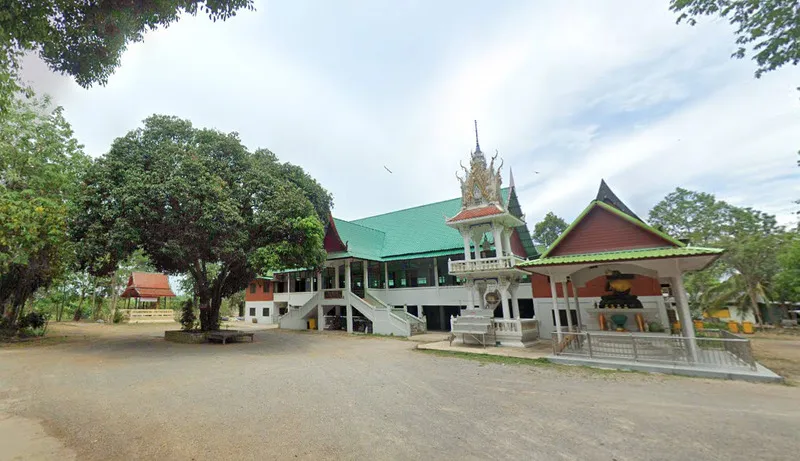
The temple’s buildings reflect a steady, step-by-step development typical of a growing community monastery. The main ordination hall (Ubosot) measures 20 meters wide and 40 meters long. Built in 1986 (B.E. 2529), it is reinforced concrete. By nature, an Ubosot is the most solemn and disciplined ritual space within a temple. Having a large Ubosot in a local temple often indicates the capacity to host major merit-making events and rites attended by people across the subdistrict—including ordinations, memorial merit-making ceremonies, chanting services, and other life-transition rituals that the entire community participates in.
Next is the sermon hall (Sala Kan Parian), also 20 meters wide and 40 meters long, built in 1993 (B.E. 2536) and likewise reinforced concrete. In a community temple, the sermon hall is far more than a multipurpose building. It is where the “life of the community” meets in a tangible way: listening to sermons, offering alms during festivals, holding meetings to organize merit-making events, setting up communal food offerings, and providing a place where elders and families can pause and rest on holy days. From a cultural travel perspective, this is the kind of space that helps visitors understand how a community actually uses a temple and how the temple continuously works with people in everyday life.
What adds another layer of atmosphere beyond modern concrete structures is the wooden chanting hall, 9 meters wide and 40 meters long, built in 1985 (B.E. 2528). Wooden buildings in community temples naturally feel calm and warm—through the scent of wood, the texture of the material, and the softer emotional tone of the space. A chanting hall is where sound and stillness work together: the cadence of chanting, the bell, or the quiet that appears when people set their minds on practice. Having a wooden building that remains in real use gives Wat Phu Phlu a simple beauty that invites the mind to slow down.
The temple also includes four monks’ quarters (kuti), all wooden buildings; one merit-making pavilion (sala bamphen kuson) built in reinforced concrete; as well as a kitchen and restroom facilities. Together, these structures show that Wat Phu Phlu has been developed for practical, everyday use rather than existing only as a symbolic space. Community merit-making events require kitchens, hospitality systems, and areas that can support large gatherings—especially during Kathin, Pha Pa, ordinations, and funeral merit-making rites, when villagers come together in large numbers. When a temple has adequate facilities, events can run smoothly, and the community’s faith is supported by an appropriate physical setting.
A vital dimension of Wat Phu Phlu is education. The temple has a Dhamma studies school (Phra Pariyatti Dhamma, Dhamma Division), opened in 1984 (B.E. 2527), the same year the temple was established. This reflects a clear intention: the temple was founded not only as a place for making merit, but as a “place that builds people” through Dhamma learning and discipline. In a rural context, having a Dhamma program at the temple allows local residents to access Buddhist education close to home, fostering learning communities, knowledge transmission, and a sustained culture of merit-making and practice aligned with local life.
In terms of administration and leadership, Wat Phu Phlu has had a clear succession of abbots. The first was Phra Khru Thammarat Phirom (1984–1990, B.E. 2527–2533). The second was Phra Khru Phisan Prachathon (1991–1995, B.E. 2534–2538). The third was Phra Sumu Chao-on Kittisaro. The fourth and current abbot is Phra Sumu Chut Sukhito (1998–present, B.E. 2541–present). Such continuity matters to a community because it gives the temple consistent direction, supports ongoing building care, and ensures that religious activities and public community events are organized with clear responsibility.
Viewed through the lens of community culture, Wat Phu Phlu serves as a genuine “central stage” for religious and communal events throughout the year. Kathin and Pha Pa seasons are when people gather most vibrantly—coordinating the venue, preparing communal kitchens, setting up food offerings, and dividing responsibilities in the way strong rural communities naturally do. Meanwhile, Buddhist holy days and weekly observances keep the temple’s role steady: helping people pause from daily burdens, reset their lives through merit-making, listening to Dhamma, and chanting in a shared rhythm that supports both individual and collective well-being.
For travelers interested in temples and living culture, Wat Phu Phlu is appealing precisely because it is a temple used in real life. Visitors do not encounter a scene arranged for tourism; they encounter a sincere place of faith woven into everyday community life—from the calm atmosphere of the chanting hall to the sermon hall that supports large gatherings during merit-making events. If you prefer temples that are simple yet well-equipped, and that tell a story of community development, Wat Phu Phlu shows how a modern-era temple can still have strong roots through collective effort and real, ongoing use.
Getting There Wat Phu Phlu is located in Yang Nam Klat Tai Subdistrict, Nong Ya Plong District, Phetchaburi Province. The most practical way to visit is by private car. Travel into Nong Ya Plong District, then continue toward Yang Nam Klat Tai and follow local village signs to the temple’s address. Once you enter the community zone, drive carefully, as local roads are shared with residents and agricultural vehicles. Upon arrival, you can park within the temple grounds and walk in to pay respects conveniently.
If you plan a full-day trip, Wat Phu Phlu can be a strong starting point for a “Nong Ya Plong–Kaeng Krachan–Phetchaburi town” itinerary. This area connects to multiple nature and leisure destinations, including reservoirs, viewpoints, mountain routes, and zones near Kaeng Krachan National Park. Beginning the day at the temple adds a calm, grounded rhythm—making merit and setting the tone—before continuing on to natural attractions or local food stops in the surrounding area.
| Place Summary | A Mahanikai community temple in Yang Nam Klat Tai, established on 19 November 1984 (B.E. 2527). It has fully functional buildings including the Ubosot, sermon hall, a wooden chanting hall, and a Dhamma studies school opened in 1984. The temple received a Wisungkhamsima on 18 January 1988. |
| Address | 7/2 Moo 3, Yang Nam Klat Tai Subdistrict, Nong Ya Plong District, Phetchaburi |
| Abbot (Latest) | Phra Sumu Chut Sukhito (1998 – Present) |
| Key Highlights | A community-built rural temple; large reinforced-concrete Ubosot (1986); sermon hall supporting major merit-making events (1993); wooden chanting hall (1985); Dhamma studies school opened in 1984 |
| Period / Timeline | Established 1984; Ubosot 1986; chanting hall 1985; sermon hall 1993; Wisungkhamsima 1988 |
| Key Evidence / Notable Elements | Official establishment and Wisungkhamsima dates; documented construction years of main buildings; the temple’s Dhamma studies program and educational role |
| Name Origin | “Phu Phlu” is the temple name used locally and reflects the area’s local identity within Yang Nam Klat Tai and its rural community setting. |
| Annual Traditions / Activities | Kathin, Pha Pa, ordinations, Buddhist holy-day merit-making, and seasonal community merit-making activities |
| Facilities | Parking area, restrooms, large sermon hall, kitchen area, merit-making pavilion |
| Fees | No admission fee (donations welcomed) |
| Travel | Drive into Nong Ya Plong District, continue to Yang Nam Klat Tai, then follow local signs to the temple address (private car recommended). |
| Current Status | Open for worship and merit-making as usual |
| Nearby Tourist Attractions (Approx. Distance) | 1) Kwangchow Floating Market – approx. 12 km 2) Nong Ya Plong Reservoir – approx. 18 km 3) Kaeng Krachan Dam – approx. 45 km 4) Kaeng Krachan National Park (Entrance / Service Area) – approx. 55 km 5) Phra Nakhon Khiri (Khao Wang), Phetchaburi – approx. 65 km |
| Popular Restaurants Nearby (Approx. Distance + Phone) | 1) Benyiam Restaurant (Nong Ya Plong) – approx. 10 km – 089-040-6339 2) Phi Mi Kaprao Yak (Nong Ya Plong) – approx. 11 km – 095-962-6236 3) Tran Cafe – approx. 12 km – 088-636-3445 4) Chai Hat Restaurant (Kaeng Krachan) – approx. 50 km – 032-459-762 5) Haeo Hua Pla Hotpot (Kaeng Krachan) – approx. 52 km – 080-617-8287 |
| Popular Accommodations Nearby (Approx. Distance + Phone) | 1) 289 Hill Farm & Resort (Nong Ya Plong) – approx. 20 km – 093-310-1111 2) Nattaphon Resort (Kaeng Krachan) – approx. 50 km – 084-455-7699 3) Chez Nous Boutique Resort (Hat Chao Samran) – approx. 80 km – 032-478-620 4) Eco Moment Beach Resort (Hat Chao Samran) – approx. 80 km – 092-496-6646 5) Capstone Resort (Hat Chao Samran) – approx. 80 km – 032-770-648 |
Frequently Asked Questions (FAQ)
Q: When was Wat Phu Phlu established?
A: Wat Phu Phlu was established on 19 November 1984 (B.E. 2527) and developed through the faith and collective effort of the Yang Nam Klat Tai community.
Q: When did the temple receive its Wisungkhamsima?
A: Wat Phu Phlu received its Wisungkhamsima on 18 January 1988 (B.E. 2531).
Q: What are the temple’s main buildings?
A: The temple includes the Ubosot (1986), the sermon hall (1993), and a wooden chanting hall (1985), along with monks’ quarters, a merit-making pavilion, a kitchen area, and facilities that support large community events.
Q: Who is the current abbot of Wat Phu Phlu?
A: The current abbot is Phra Sumu Chut Sukhito (1998 – present).
Q: Does the temple provide Buddhist education?
A: Yes. Wat Phu Phlu has a Dhamma studies school (Phra Pariyatti Dhamma, Dhamma Division) that has been open since 1984.
Q: What kind of visit is Wat Phu Phlu best for?
A: It is ideal for a calm, respectful temple visit and for experiencing a living community monastery. You can also plan a connected day trip to Kwangchow Floating Market, Nong Ya Plong Reservoir, or the Kaeng Krachan area.
 Wat Phu Phlu Map
 Category:
  Group:
  Tag: ●Wat Phu Phlu●wat phu phlu ●wat in phetchaburi ●nong ya plong temple ●yang nam klat tai temple ●phetchaburi travel ●thai temple travel ●buddhist temple thailand ●visungkhamsima ●dhamma school ●things to do in phetchaburi Last Update: 2 MonthAgo
Comment
 Nearby Attractions
| Keyword (Advance) |
 Region
|
 Muang Phetchaburi(
 Copyright 2012,