
 Home
Home North(
 Chiang Mai(


Wat Kuti
Rating: 3.8/5 (4 votes)
 Search By
  Map
Map 
 Have Map
  No Map
Phetchaburi attractions
Attractions in Thailand
Open Days: Daily
Opening Hours: 07:00 – 17:00
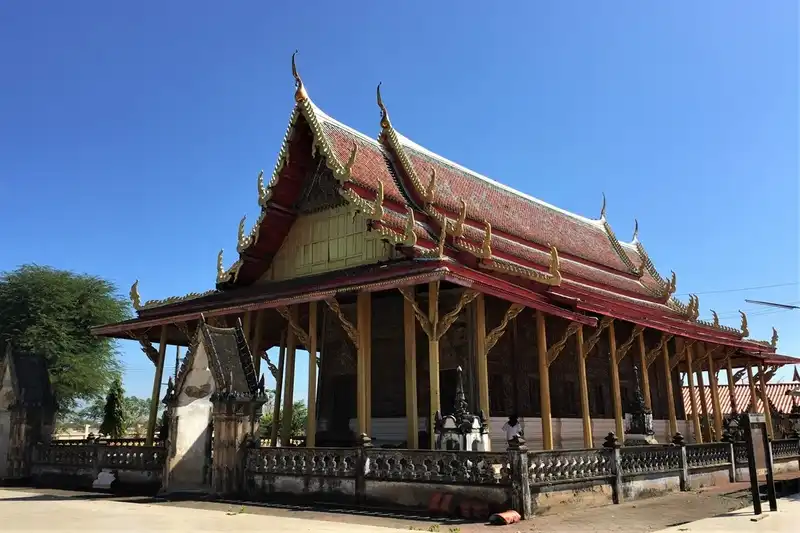
Wat Kudi (Wat Kudi Bang Khem) is located in Bang Khem Subdistrict, Khao Yoi District, Phetchaburi Province. It is an old temple best known for its “entirely teak-wood ubosot (ordination hall)” and the exquisite carved Jataka narratives that wrap around the building. The craftsmanship is widely regarded as rare in Thailand because it does not only depict the Ten Great Jatakas and the Maha Vessantara Jataka, but also incorporates episodes from “Journey to the West (ไซอิ๋ว)” within a Thai-Buddhist framework. The result is a cultural-learning space where visitors can truly walk, observe, and interpret the stories from every angle of the ubosot.
From a travel perspective, Wat Kudi is an ideal destination for those seeking a deeper side of Phetchaburi. It is not simply a temple for paying respects; it feels like an open-air museum that records the community’s ideas, beliefs, and aesthetic sensibilities of its era in a carefully structured teak-wood narrative. Many visitors come specifically to admire the carvings on the ubosot’s exterior, which include major Buddhist stories such as the 13 chapters of the Maha Vessantara Jataka and multiple Ten Great Jataka episodes. The inclusion of Journey to the West adds a charming element that often brings a smile, while also highlighting the ability of local master artisans to “distill narratives” into art that harmonizes naturally with the sacred temple setting.
Wat Kudi sits along Highway No. 4 (Phetkasem Road), roughly 6 kilometers before the turnoff to the Khao Yoi District Office. This makes it convenient for travelers driving the Bangkok – Phetchaburi route or continuing toward Hua Hin who want an easy half-day stop or a comfortable day trip. In seasons when Phetchaburi weather is milder, walking around the ubosot becomes even more enjoyable, as shifting light and shadow enhance the depth and dimension of the carved reliefs.
What makes Wat Kudi different from other wooden temples is not merely that it has a teak ubosot, but the concept behind its artistic direction. The creators intended the ubosot’s exterior walls to function as a “walkable textbook” for both locals and visitors. Even those who are not confident readers can still “learn Jataka stories through images,” because the carvings are arranged in sequences that can be followed panel by panel, similar to reading mural paintings. The difference is that these narratives are moved to the exterior and expressed through sculpted teak relief instead of painted lines and color.
Overall, Wat Kudi is a significant example of how Central Thai and Northeastern Thai (Isan) artistic concepts can be blended seamlessly. In particular, it reflects the “sim” tradition — Isan-style ordination halls where Buddhist stories and Jataka narratives are commonly told around the building through paintings or decorative storytelling. When this narrative concept merges with Phetchaburi’s renowned craftsmanship, it becomes a teak-wood ubosot that tells Buddhist stories “all around,” with a large number of carved panels. One complete walk is therefore not just passing by, but actively “reading” while walking.
Regarding construction history, information attributed to Thailand’s Fine Arts Department notes that Phra Khru Kasem Suttakhun (Luang Pho Chum) directed the construction of the current teak ubosot in B.E. 2473 (1930), replacing an older, deteriorated structure. This was a key turning point that has defined Wat Kudi’s identity to the present day. The rebuild focused not only on structural durability, but also on “artistic language,” turning the building itself into a medium for teaching Dhamma.
Looking closely at the carvings, you will find Jataka episodes familiar to many Thais, such as Prince Temiya (the Mute), Bhuridatta, Nemi Raja, Suvannasama, and Chandakumara, alongside the 13 chapters of the Maha Vessantara Jataka. This set of narratives is closely tied to Thailand’s “Maha Chat Sermon” tradition. Placing these stories around the ubosot is therefore not only about beauty; it suggests that the temple is a “community gathering space” during major merit-making festivals, and that the Maha Vessantara narrative serves as a shared moral lesson received collectively through ritual.
Another highlight many visitors come to see is the ubosot’s gables. The eastern gable is carved with a royal emblem associated with the reign of King Rama IV, while the western rear features a carved one-baht coin with the royal coat of arms associated with King Rama V. These details help anchor the artwork in its historical context and connect the visit to Siamese history through symbols of the state and monarchy, reflecting how religion, society, and governance were “interwoven” within temple art in a subtle yet meaningful way.
The ubosot doors are also worth time and attention. Their openwork vine motifs and deep, meticulous carving demonstrate master-level Thai woodcraft. The “openwork” structure creates strong light-and-shadow effects; as sunlight hits the surface, it emphasizes contours and texture, making the wood patterns feel alive. This is a particular charm of woodcarving that photographs rarely capture in full. Seeing it in person reveals the density of detail and the force of the artisan’s hand.
In terms of interpretation, the presence of Journey to the West alongside Buddhist Jataka narratives is a frequent question. It may appear unusual because it is Chinese literature rather than a strictly canonical Buddhist set. Yet in the Thai social context, Chinese stories and beliefs have long blended into Thai culture, especially in Central Thailand where trade and travel were prominent. Including Journey to the West in a temple setting may therefore reflect the era’s tastes, local popularity, and a cultural strategy: using familiar and entertaining storytelling as a “bridge” that draws people to the temple first, and then guides them toward deeper moral teachings through the Jataka narratives.
To experience Wat Kudi fully, it helps to walk around the ubosot slowly in two rounds. The first round is for “overall orientation” — identifying what each panel depicts and noting scenes you want to revisit. The second round is for “close reading” — observing characters, gestures, clothing, and scene elements such as trees, clouds, waves, or animals. These small details often provide clues for identifying each episode. If you are unsure which story a panel represents, taking photos and comparing them later with chapter names can help you gain both visual enjoyment and learning from a single visit.
Another useful approach is to connect the images to stories many people already recognize. For example, the Maha Vessantara Jataka often features unmistakable scenes — acts of giving, the character Chuchok, or family separation — all emphasizing the virtue of generosity and the endurance of moral purpose. The Ten Great Jatakas highlight different perfections (barami), such as renunciation, loving-kindness, patience, and truthfulness. When viewed through this lens, the carvings become more than “beautiful”; they become reminders that these virtues remain relevant to everyday life in any era.
Within Phetchaburi, Wat Kudi also resonates with the province’s long-standing reputation for craftsmanship — from stucco relief and major temples to refined woodwork in artisan communities. A large-scale carved teak ubosot is another piece of evidence that “Phetchaburi is a city of artisans” not merely as a slogan, but as a living heritage that can still be experienced today.
However, the value of Wat Kudi is not limited to art alone. It is also a place of collective community memory, tied to ordinations, funerals, merit-making festivals, and local rituals. When a temple has such a distinctive ubosot, local pride tends to deepen because it becomes the “face” of the community — something outsiders travel specifically to see. Maintaining a teak ubosot is therefore not only the temple’s responsibility, but a shared concern of the wider community that wants this cultural heritage to endure.
Today, Wat Kudi is overseen by its current abbot, and the most recently updated temple-directory information lists the abbot as Phra Thammathorn Chaiyana Chayanando. Including the current caretaker as a named entity strengthens article credibility and supports verification, which is important when building content to compete for Top 1 visibility.
Interview Themes: The Meaning Behind the Carved Jataka Narratives (A narrative guide based on common explanations from monks and local residents) To help readers understand the “Jataka stories on teak” as more than visual beauty, the key ideas that monks and local residents often share with visitors can be organized into the following interview-style themes.
Theme 1: Why carve Jataka stories around the ubosot? A common explanation is that “Jatakas are close to everyday life.” They speak about human choices, endurance, sacrifice, and consequences. Placing them around a sacred building is like placing moral lessons around a spiritual center, so that as people come for ceremonies or merit-making, they also pass through reflections that nurture the mind.
Theme 2: What does the Maha Vessantara Jataka teach modern readers? The point often emphasized is “generosity (dana parami).” It does not mean giving until you suffer, but giving with wisdom — giving that creates opportunity for others, and giving that harms neither others nor yourself. Seen this way, the Maha Vessantara narrative becomes a practical framework for sharing and responsibility across generations.
Theme 3: How do the Ten Great Jatakas help people understand “perfections (barami)”? Locals often explain that virtues do not appear from a single good thought; they are trained repeatedly. Patience (khanti) is mindful endurance, not surrender. Loving-kindness (metta) is goodwill with boundaries, not limitless tolerance of harm. Carving the stories in episodes makes the idea of training the mind more concrete and easier to grasp.
Theme 4: How did Journey to the West end up on an ordination hall? A natural local view is that Journey to the West is a familiar and entertaining story. In earlier times, the enjoyment of a popular narrative could serve as a “bridge” that drew people to the temple. Those who came for Journey to the West would also encounter the Jataka stories, and some might then become interested in Dhamma. In this sense, its inclusion is both a trace of the era and a cultural technique that broadens a temple’s reach.
Theme 5: What is the main takeaway for visitors? The message is often summarized as: goodness has many forms. There are many perfections and many ways to train the heart. Visiting a temple does not have to be only about asking for blessings; it can also be a chance to “question oneself” — which virtue you want to practice today, and what small step you can begin with in daily life.
For visiting, it is recommended to allow at least 45–90 minutes if you want to examine the carvings carefully. There are many panels and dense details, and during busy times there may be multiple visitors at once. Walking slowly and allowing space for others to take photos helps keep the atmosphere calm, as is appropriate for a temple, and turns the visit into genuine “learning” rather than a rushed check-in.
For dress and etiquette, wear modest clothing and avoid loud noise around the teak ubosot, as it is a structure that should be treated with care. If you want close-up photos, avoid touching or leaning on the carved wood to reduce long-term wear.
Getting There Wat Kudi is located along Highway No. 4 (Phetkasem Road) in Bang Khem Subdistrict, Khao Yoi District, Phetchaburi Province. A commonly cited landmark is that it is about 6 kilometers before the turnoff to the Khao Yoi District Office. If driving south from Bangkok, once you enter Khao Yoi District, look for signs for Bang Khem and the temple along the main road, then turn in following local signage. Parking is generally available within the temple grounds in designated areas.
| Place Summary | An old temple in Phetchaburi featuring a fully teak-wood ubosot and rare carved narrative panels of Buddhist Jatakas (Maha Chat / Ten Great Jatakas), including Journey to the West. |
| Address | Bang Khem Subdistrict, Khao Yoi District, Phetchaburi 76140, Thailand |
| Highlights | 1) A fully teak-wood ubosot (built in B.E. 2473 / 1930) 2) Carvings of the 13 chapters of the Maha Vessantara Jataka and multiple Ten Great Jataka episodes 3) Journey to the West carvings integrated with Thai-Buddhist storytelling 4) Gable symbols referencing the reigns of King Rama IV and King Rama V 5) Master-level openwork vine-pattern doors with deep carving |
| Abbot (Latest) | Phra Thammathorn Chaiyana Chayanando |
| Nearby Accommodations | 1) Sawang Resort Golf Club & Hotel – approx. 0.63 km. 2) SB Inn (Phetchaburi) – approx. 1.15 km. Tel. 092-273-5094 3) Baan Suan Om Suk – approx. 14.12 km. Tel. 080-961-1992 4) Gala Canal Resort – approx. 15.11 km. Tel. 082-334-4887 5) Baan Suan Kamnan Montri – approx. 17.12 km. Tel. 081-324-7928 |
| Nearby Tourist Attractions | 1) Khao Yoi Cave – approx. 6 km. 2) Wat Phra That Sirichai (Wat Yang) – approx. 12 km. 3) Thai Song Dam Cultural Center – approx. 10 km. 4) Phra Nakhon Khiri (Khao Wang) – approx. 25 km. 5) Phetchaburi Night Market / Old Town Area – approx. 25 km. |
| Nearby Restaurants | 1) Baan Tiwa Restaurant – approx. 6 km. Tel. 092-894-4518 2) Le Mae Cafe & Restaurant – approx. 7 km. Tel. 095-251-9447 3) Khao Kaeng Mae Luan – approx. 9 km. Tel. 032-562-384 4) Floating Boat Noodles (Klang Nam) – approx. 9 km. Tel. 032-439-808 5) Phet Phoem Phon Restaurant (Phetchaburi) – approx. 18 km. Tel. 086-846-7230 |
Frequently Asked Questions (FAQ)
Q: Where is Wat Kudi (Wat Kudi Bang Khem) located in Phetchaburi?
A: It is in Bang Khem Subdistrict, Khao Yoi District, Phetchaburi, along Highway No. 4 (Phetkasem Road), about 6 kilometers before the turnoff to the Khao Yoi District Office.
Q: When was Wat Kudi’s teak ubosot built?
A: The current teak ubosot was directed for construction in B.E. 2473 (1930) by Phra Khru Kasem Suttakhun (Luang Pho Chum).
Q: What stories are carved around the ubosot?
A: The carvings depict the 13 chapters of the Maha Vessantara Jataka, multiple Ten Great Jataka episodes, and also include Journey to the West, which gives the temple a distinctive identity.
Q: Why does Journey to the West appear alongside Buddhist Jatakas?
A: It is often interpreted as a familiar story used to draw interest and invite people into the temple, then guide them toward deeper moral teachings through the Jataka narratives. It also reflects Thai–Chinese cultural blending in Central Thailand.
Q: Who is the current abbot of Wat Kudi?
A: The most recently updated temple-directory information lists the abbot as Phra Thammathorn Chaiyana Chayanando.
Q: How much time should I plan for visiting?
A: Allow about 45–90 minutes if you want to study the carved panels carefully and take photos without rushing.
 Wat Kuti Map
 Category:
  Group:
  Tag: ●Wat Kuti●wat kudi ●wat kudi bang khem ●khao yoi temple ●phetchaburi teak wood ubosot ●teak wood ordination hall thailand ●jataka carvings thailand ●maha vessantara jataka carvings ●ten great jatakas ●cultural travel phetchaburi ●hidden gems phetchaburi
Last Update: 1 MonthAgo
Tag: ●Wat Kuti●wat kudi ●wat kudi bang khem ●khao yoi temple ●phetchaburi teak wood ubosot ●teak wood ordination hall thailand ●jataka carvings thailand ●maha vessantara jataka carvings ●ten great jatakas ●cultural travel phetchaburi ●hidden gems phetchaburi
Last Update: 1 MonthAgo
Comment
 Nearby Attractions
| Keyword (Advance) |
 Facebook Fanpage
 Region
 Art, Culture and Heritage
 Historical Sites and Monuments(
 Landmarks and Memorials(
 Royal Palace(
 Art, Craft Centres, Tradition(
 Museums(
 Educational Places
 Educational Gardens, Farm(
 University
 Other religious and spiritural sites(
 Research and Development
 Royal Project(
 Suburban Living
 Village, Community(
 Floating Market(
 Nature and Wildlife
 National Parks and Marine Reserves(
 Mountain (Doi)(
 Dam, Reservoir, Lake(
 Waterfalls(
 Hot Springs(
 Caves(
 River, Canal(
 Bays and Beaches(
 Islands(
 Other natural attractions(
 Entertainment and Agricultural
 Farm, Parks, Gardens and Ecotourism(
 Theater(
 Outdoor and Adventure Activities(
 Travel Articles, Recipes
 Travel Review, Food Review(
 Copyright 2012,