
 Home
Home North(
 Chiang Mai(


Tham Khao Luang Cave
Rating: 3.4/5 (5 votes)
 Search By
  Map
Map 
 Have Map
  No Map
Phetchaburi attractions
Attractions in Thailand
Open Days: Daily
Opening Hours: Mon–Fri 08:00 – 16:00, Sat–Sun 08:00 – 17:00
Tham Khao Luang Cave (Mueang Phetchaburi District, Phetchaburi) is one of Phetchaburi’s most important attractions where nature and Buddhist art meet in a single place with two clear layers of value. The first is geological beauty: a limestone cave with broad chambers, stalactites and stalagmites, and textured cave walls that catch light and shadow in a remarkably dimensional way. The second is its identity as a cave sanctuary, with numerous Buddha images and sacred objects that turn the visit into more than a nature walk. Walking through Tham Khao Luang feels like moving through history, living faith, and traces of royal visits from a period when Phetchaburi held strategic importance on major travel routes in Thailand’s western region.
Tham Khao Luang sits on Khao Luang Hill in Thong Chai Subdistrict, about 5 kilometers from Khao Wang (Phra Nakhon Khiri). This location makes it ideal for a compact “one-day Phetchaburi city route,” because you can connect multiple landmark sites without long travel times. From the foothill, a concrete staircase leads up to the entrance area and the access point down into the cave. Khao Luang is a small hill with a peak of roughly 92 meters, yet inside it hides a surprisingly spacious cave system with chambers that flow into one another. That contrast between the modest hill outside and the scale of the cave inside is one of the first things visitors tend to remember.
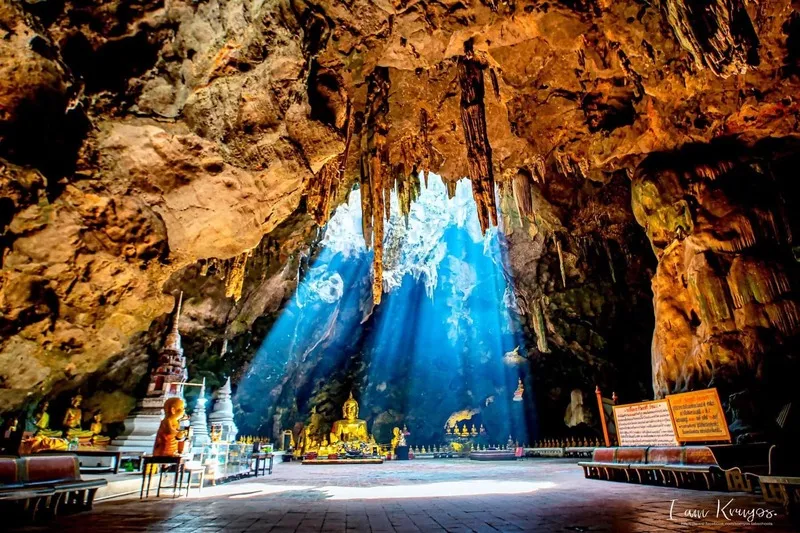
The feature that makes Tham Khao Luang instantly recognizable is its skylight openings inside the cave, where sunlight streams down in visible shafts at certain times. When natural light hits the cave floor, it creates a strong contrast between darkness and brightness, and the colors of the formations — cream, gray, warm brown, and reflective damp tones — become even more striking. The scene can feel less like a typical cave and more like light entering a sacred interior. This is why many travelers come specifically to photograph the sunbeams, and it is also why timing matters: planning your visit to match the best light helps you see the cave at its most dramatic and enjoy the walk without rushing.
Historically, Tham Khao Luang is closely associated with royal interest during the reign of King Mongkut (Rama IV). Accounts describe royal visits and the King’s strong appreciation for this cave, along with restorations of older Buddha images within it. There are also stories of the construction of stone steps to make access into the cave easier for worship and exploration. In the reign of King Chulalongkorn (Rama V), continued visits and further restoration reinforced Tham Khao Luang’s image as a long-established “royal cave” of Phetchaburi, known well before modern tourism.
Another widely told detail that helps explain the cave’s significance is the large number of Buddha images inside (often described in local accounts as around 170), as well as several stupas within the cave (often described as 6). These features make Tham Khao Luang more than a natural cavern; it is a sacred environment that has been shaped over time to support worship. As you walk through, you will see Buddha images arranged along walls and at key points in the chambers, including images regarded as especially revered. Elements such as a replica Buddha footprint and symbolic details within the cave also reflect an interesting blend of local devotion and royal-era stewardship.
By its natural form, Tham Khao Luang is organized into connected cave “rooms” or chambers, and the route between them is generally convenient, allowing visitors to move through in sequence without unnecessary backtracking. The first chamber often makes people slow down because it introduces the atmosphere of reverence, with features such as a replica Buddha footprint and natural stones whose shapes inspire local interpretation and storytelling (one commonly mentioned example is a stone said to resemble a turtle, formed over time by dripping water). In this first area, some formations are particularly beautiful, and the space also quietly reminds visitors how fragile cave environments are. There are stories that some stalactites were cut or damaged in the past, which adds a clear lesson to today’s visit: once nature like this is harmed, it cannot be restored to what it was.
As you continue deeper, the chambers open up, the air feels cool and comfortable, and the number of Buddha images becomes more visually prominent. When you reach the sunbeam zone, it becomes obvious that the cave’s beauty is not only about size but also about nature’s composition. The shaft of light functions like a natural spotlight. When it lands on the cave floor, it forms a bright focal area that is easy to see. On some days, tiny particles or faint moisture drift through the beam, softening the scene and adding depth. This is often where people spend the most time, both for photography and for absorbing the quiet, calm, sacred feeling that is difficult to find in typical city attractions.
One image frequently mentioned in stories about Tham Khao Luang is a royal-related Buddha image associated with Rama V, said to have been created as an important offering in remembrance connected to Rama IV. The cave is also described as containing a reclining Buddha image and a large revered Buddha image that visitors come specifically to pay respect to. These sacred elements mean that the cave visit is not simply sightseeing; it also requires the etiquette of a religious site. Some areas provide incense and candles for worship. Even visitors coming primarily as tourists can easily be respectful by dressing modestly, speaking quietly, and avoiding unnecessary touching or intrusive behavior around sacred objects.
Tham Khao Luang is also notable for its long-standing recognition among both Thai and international visitors. There are accounts that European travelers recorded the cave and that it appeared in published work by the French naturalist Henri Mouhot around 1864. It is also said that Sunthorn Phu visited and mentioned the cave in his travel literature, including Nirat Mueang Phet. Details like these give Tham Khao Luang weight beyond being a “beautiful photo spot.” It becomes a place that reflects a long relationship between people and landscape — as a refuge of the mind, a site of worship, and a natural classroom tied to Phetchaburi’s identity.
Near the foothill entrance area is an important temple that locals historically referred to as “Wat Tham Klaep,” now widely known as Wat Bunthawi. Its position makes it a natural companion stop before or after visiting the cave, allowing travelers to plan an easy “cave + temple” route in one trip. Wat Bunthawi is worth seeing for its architectural character, especially buildings designed with intention and wood carving details that show careful craftsmanship. If you enjoy observing Thai craftsmanship closely, pausing to look at door panels, gable details, and the temple’s structural elements adds depth to the trip and highlights a key cultural strength of Phetchaburi: it is not only known for desserts and the sea, but also for genuine artisan traditions.
In local legend, Wat Tham Klaep is linked to a long-told story about a cave mouth believed to lead to a hidden city inhabited only by women. While this is folklore, the presence of such stories makes Khao Luang more than simply a hill with a beautiful cave. It becomes a cultural landscape with narrative, belief, and community memory layered into the terrain. For travelers who enjoy stories, a polite conversation with locals or caretakers sometimes reveals small details that make the experience feel more alive than reading signage alone.
Tham Khao Luang suits visitors who prefer to walk slowly and take time, because highlights like the sunbeams and the details of the formations become more impressive the longer you look. It is practical to allow at least 1–2 hours for the full experience: walking up and down, exploring the chambers, taking photos, and resting. If you are traveling with older adults or small children, extra care is recommended due to stair sections, uneven surfaces, and occasional damp areas that may be slippery. Shoes with good grip are advisable, and high heels or overly smooth soles should be avoided.
One factor visitors sometimes underestimate at Khao Luang is the presence of monkeys. Monkeys live around the hill and may approach people, especially if they notice food. The safest approach, and the one that avoids creating problems for wildlife, is to keep food sealed in a closed bag, avoid feeding monkeys, and avoid close-range interactions or teasing. If you intend to buy offerings, purchase only from designated points and hold items securely. When resting, choose a spot with good visibility and where more people are present. These habits help keep the visit smooth and prevent disruptions that can affect the mood of the trip.
For photography lovers, Tham Khao Luang is one of the strongest places in Phetchaburi for capturing natural light inside a cave. At the same time, it remains a sacred site, so it is best not to use flash directly toward Buddha images and not to stand in a narrow pathway for too long where others need to pass. If you want a more atmospheric image, adjust exposure to the real light conditions and wait briefly for a quieter moment. The result is often more beautiful and more respectful to other visitors. Also be mindful of wet patches or small puddles that can reflect light and make distances harder to judge.
Getting There Tham Khao Luang is in Thong Chai Subdistrict, Mueang Phetchaburi District, and it is easy to reach from Khao Wang (Phra Nakhon Khiri) at a distance of about 5 kilometers. From Bangkok, take Phetkasem Road (Highway 4) into Phetchaburi city, then follow local signs toward Khao Luang. At the foothill there is parking, after which you walk up a concrete stairway to the access point down into the cave. Walk with attention because the stairs are continuous in parts and monkeys may be present near the route. For an efficient day plan, you can connect a route such as “Khao Wang – Tham Khao Luang – Wat Yai Suwannaram – Wat Mahathat Worawihan” without rushing, especially if you start in the morning to enjoy comfortable weather and adequate time at each site.
Tham Khao Luang is therefore a Phetchaburi destination that serves multiple traveler types at once: nature lovers who want a genuinely beautiful cave, art-focused visitors who want to see sacred images and Buddhist heritage in a living sanctuary, photographers seeking sunbeams in a cave chamber, and history-minded travelers who enjoy tracing Phetchaburi’s connection to royal travel and restoration in the Rama IV–V era. The distinctive advantage is that all of this exists on a small hill not far from Khao Wang, making planning easy and time-efficient. If you want to see beauty that feels unmanufactured and experience Phetchaburi in a deeper dimension than souvenir shopping, Tham Khao Luang deserves a clear place on your list.
| Place Summary | A major limestone cave in Phetchaburi featuring dramatic natural sunbeams, beautiful formations, and a cave sanctuary with numerous Buddha images and strong historical links to royal visits and restoration in the Rama IV–V era. |
| Address | Thong Chai Subdistrict, Mueang Phetchaburi District, Phetchaburi 76000, Thailand |
| Key Highlights | Natural sunbeam skylight inside the main chamber, striking stalactites and stalagmites, cave sanctuary atmosphere, Rama IV–V historical narratives, about 5 km from Khao Wang, cool and comfortable interior air. |
| Fees | A shuttle / uphill transport fee may apply depending on on-site management; confirm on arrival before using services. |
| Current Status | Open to visitors during operating hours; checking conditions is advisable during heavy rain or maintenance periods. |
| Contact Number | 032-706-639 |
| Nearby Tourist Attractions (With Distance) | 1) Phra Nakhon Khiri (Khao Wang) – 5 km 2) Wat Mahathat Worawihan (Phetchaburi) – 8 km 3) Wat Yai Suwannaram Worawihan – 9 km 4) Wat Khao Bandai It – 12 km 5) Hat Chao Samran Beach – 35 km |
| Popular Restaurants Nearby (With Distance + Phone) | 1) Khao Chae Mae On (Phetchaburi Town) – 7 km – 089-410-1696 2) Rabiang Rim Nam (Phetchaburi) – 8 km – 032-426-555 3) Je Lang Noodles (Near Town Branch) – 9 km – 081-527-5323 4) Je Praew (Krua Plai Khao) – 10 km – 093-787-7360 5) Krua Je Nong Seafood (Bo Kia Area) – 50 km – 081-986-0916 |
| Popular Accommodations Nearby (With Distance + Phone) | 1) Royal Diamond Hotel (Phetchaburi Town) – 8 km – 032-411-061 2) Sun Hotel Phetchaburi (Phetchaburi Town) – 9 km – 032-400-000 3) Fisherman’s Resort (Hat Chao Samran) – 55 km – 032-478-020 4) The Tree Riverside @ Kaeng Krachan – 55 km – 032-706-151 5) Mayatara Kaeng Krachan – 60 km – 087-379-9595 |
Frequently Asked Questions (FAQ)
Q: Is Tham Khao Luang Cave open every day?
A: Yes. It is open daily, with hours typically Mon–Fri 08:00 – 16:00 and Sat–Sun 08:00 – 17:00.
Q: What is the main highlight of Tham Khao Luang?
A: The signature highlight is the natural skylight where sunlight streams into the cave chamber, along with the formations and the many Buddha images inside.
Q: Is Tham Khao Luang far from Khao Wang?
A: No. It is about 5 kilometers from Khao Wang (Phra Nakhon Khiri), making it easy to combine both sites in a single day.
Q: Is the cave difficult to walk through, and is it suitable for older adults or children?
A: There are stairs and uneven surfaces, and some areas can be damp. Wear shoes with good grip and supervise children closely; older visitors should take the route slowly and rest as needed.
Q: What should visitors be careful about?
A: Be cautious on slippery sections, watch for monkeys near the stair route, keep food sealed, and respect the cave as a sacred place by dressing modestly and speaking quietly.
Q: What time of day is best to visit?
A: Morning is recommended for comfortable weather and a good chance of seeing the sunbeam effect clearly, with enough time to explore without rushing.
Q: Are there nearby temples or stops that pair well with the cave?
A: Yes. A practical day route is “Khao Wang – Tham Khao Luang – Wat Yai Suwannaram – Wat Mahathat Worawihan” to experience both nature and cultural heritage in Phetchaburi.
 Tham Khao Luang Cave Map
 Category:
  Group:
  Tag: ●Tham Khao Luang Cave●tham khao luang ●tham khao luang phetchaburi ●cave in phetchaburi ●phetchaburi attractions ●caves in thailand ●khao luang cave ●phetchaburi day trip ●near phra nakhon khiri ●thailand cave temple ●travel phetchaburi
Last Update: 2 MonthAgo
Tag: ●Tham Khao Luang Cave●tham khao luang ●tham khao luang phetchaburi ●cave in phetchaburi ●phetchaburi attractions ●caves in thailand ●khao luang cave ●phetchaburi day trip ●near phra nakhon khiri ●thailand cave temple ●travel phetchaburi
Last Update: 2 MonthAgo
Comment

Photo Gellery(3) 
 Thank you photo(3) from: TheEp