

 Home
Home Chiang Mai(







Wat Sa Long Ruea
Rating: 4.3/5 (4 votes)
 Search By
  Map
Map 
 Have Map
  No Map
Kanchanaburi attractions
Attractions in Thailand
Open Days: Daily
Opening Hours: 08:00 – 17:00
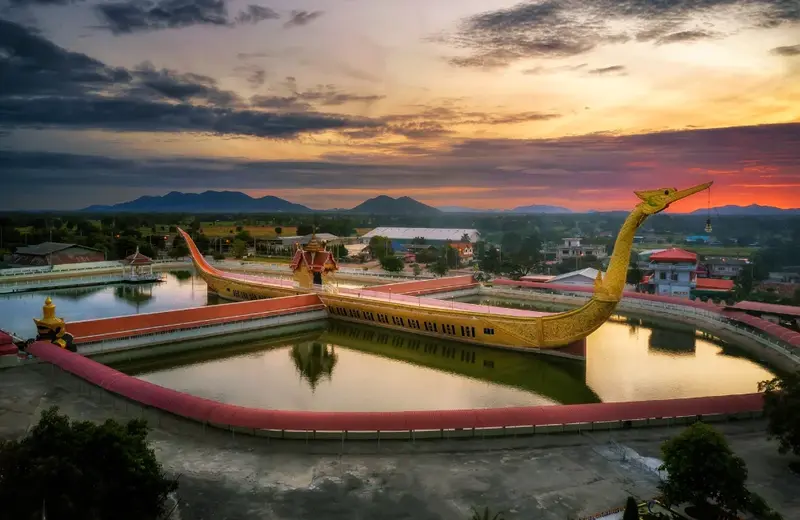
Wat Sa Long Ruea in Huai Krachao District, Kanchanaburi, is a working community temple and a local ceremonial hub. Its signature highlight is a large replica of the Royal Barge Suphannahong, making it ideal for a calm, culture-focused visit. Historically, local oral accounts and community-based assumptions suggest the temple may relate to the Middle Ayutthaya period (roughly 400–450 years old), yet there is no clear written evidence, so it is best understood as a living community narrative rather than a fixed, documented date.
Wat Sa Long Ruea in Huai Krachao District, Kanchanaburi, is a strong example of a local temple where you can “read the community” within a short walk. It is not only a place of worship, but also a shared civic space for the subdistrict: annual merit-making events, ordinations, funerals, dedicating merit to ancestors, and the everyday gathering of multiple generations. The meaning of a temple like this comes from continuity of use and the trust the community places in it, more than from monumental architecture alone.
What has made Wat Sa Long Ruea increasingly discussed in cultural travel is the presence of a large “Suphannahong royal barge replica” within the temple grounds. As a whole, the replica is not merely a photo spot; it is a tangible object that invites visitors to ask deeper questions about place-making: why a community chooses a “barge” as a language of faith, why a royal barge icon is situated within a temple, and why local people are willing to cooperate to make this a concrete landmark for Huai Krachao.
In terms of history, Wat Sa Long Ruea is described through oral accounts and local assumptions as an old temple, possibly reaching back to the Middle Ayutthaya period, estimated at about 400–450 years old or slightly more. At the same time, it is consistently emphasized that there is no clear written evidence about the temple’s foundation. For this reason, this article deliberately follows an evidence-aware framing: it does not claim a definitive year, but instead uses the idea that the age of a community temple is often expressed through traces of continuous use, the transmission of ritual practice, and shared communal memory, rather than through complete founding documentation.
When we view Wat Sa Long Ruea as the temple of its subdistrict, its importance becomes immediately clear. The temple functions as a “social structure” that supports relationships across the area. Annual merit-making brings extended families back together, funerals become the space where the community helps carry grief, ordinations confirm belonging to one’s roots, and Buddhist holy days act like a cultural clock that keeps community life moving in a shared rhythm, no matter how quickly the outside world changes. A living temple like this is a real “center” created by ongoing practice, not by publicity.
Another compelling dimension is how Wat Sa Long Ruea reflects “new meaning-making” in the present through the Suphannahong replica. Creating a large symbolic structure inside a temple requires funding, materials, labor, cooperation, and community-level coordination. In that sense, the replica becomes an important social proof that the temple still has the power to gather people, and it remains a place where the community can express its identity to outsiders without needing to imitate major tourism hubs. Visiting Wat Sa Long Ruea therefore suits travelers who want to see another side of Kanchanaburi: a rural area where culture and local pride are the starting point.
To experience the temple and the Suphannahong replica with meaning, you do not need a long schedule, but you do need a “non-rushed pace.” Walk slowly, observe the surroundings, the pond, merit-making spaces, and the rhythms of how local people use the temple. If you happen to see residents coming to offer merit or pay respects, you will understand that sacredness in a community temple is not limited to major ceremonies; it lives in the regularity of visits and the way everyday life remains tied to a simple, grounded space of faith.
From a cultural-travel perspective, Wat Sa Long Ruea offers a key lesson: “small places can carry big meaning.” What visitors take away is not only photographs, but also the understanding that a community can create a shared landmark through a religious site and keep a communal center functioning with continuity. If you prefer travel that teaches you along the way rather than checklist-style stops, this temple tends to feel calm and genuinely rural, without being overly packaged as a product.
Etiquette should be observed carefully. Dress modestly, avoid sleeveless tops and shorts/skirts above the knee, remove shoes before entering worship areas, keep voices low near those meditating or chanting, and avoid flash photography where it is inappropriate. If you plan to photograph the Suphannahong replica, do so without disturbing people making merit, and do not climb or approach fragile parts that could be damaged, so that the visit respects both the sacred space and the host community.
Getting There from Kanchanaburi City to Wat Sa Long Ruea can follow a commonly referenced route. Start on Highway 324 (U Thong Road) and drive straight to the junction with Highway 321 (Malai Man Road), then turn left. Continue past the Chorakhe Sam Phan junction to the right. At the Bo Phloi junction, turn left onto Highway 3342 (Bo Phloi – U Thong) and drive about 11 km to the Phai Si intersection. Turn right onto Highway 3443 (Talung Nuea) and continue about 1.5 km, passing Huai Krachao Pittayakhom School and the Sa Long Ruea Subdistrict Health Promoting Hospital. The temple will be on the opposite side of the road.
The final segment runs through rural roads. Drive at a reasonable speed, watch for agricultural vehicles, trucks, and slippery conditions during rainy periods. If you want to absorb the atmosphere, it helps to allow extra time and visit in the morning or late morning for cooler air and a relaxed walk. Afternoon works well for a stop along the way, but it is worth setting aside enough time to pay respects and walk the grounds respectfully, so the visit does not become only a quick parking stop.
| Name | Wat Sa Long Ruea (Wat Sa Long Ruea), Huai Krachao District, Kanchanaburi |
| Address | Sa Long Ruea Subdistrict, Huai Krachao District, Kanchanaburi 71170 |
| Place Summary | A local temple actively used by the community for ceremonies and merit-making, highlighted by a large replica of the Royal Barge Suphannahong within the grounds. Oral accounts suggest the temple may relate to the Middle Ayutthaya period (no clear written evidence to confirm a specific date). |
| Key Highlights | 1) A large Suphannahong royal barge replica as a shared symbol of faith and community cooperation 2) A community temple serving as the center for merit-making, ceremonies, and local support 3) Calm cultural travel experience, suitable for learning rural Kanchanaburi in a respectful way 4) A community narrative of historical depth (assumed Middle Ayutthaya connection) while acknowledging limited written evidence |
| Abbot Or Current Overseer | Phra Khru Welu Kanchanawan (Samart) Prempridee |
| Contact Number | 081-334-6375 |
| Current Status | Open for visits and worship (calling ahead is recommended) |
| Nearby Tourist Attractions With Distance | 1) Huai Krachao District Office – approx. 6 km 2) Huai Krachao Market/Service Area – approx. 7 km 3) Wat Nong Pling (Don Salaep) – approx. 12 km 4) Bo Phloi (town area) – approx. 25 km 5) Wat Thip Sukhontharam – approx. 28 km |
| Popular Restaurants Nearby With Distance And Phone | 1) Krua Khiang Ruea (Huai Krachao) – approx. 6 km – 087-167-6373 2) Moo Phan Lan (near the temple/Huai Krachao area) – approx. 6 km – 084-373-3382 3) Rak Yim Cafe (Huai Krachao) – approx. 7 km – 089-836-2032 4) Krua Ban Khwan (Huai Krachao) – approx. 7 km – 087-179-1721 5) Krua Sam Phu Yai Khot Saep (Huai Krachao) – approx. 7 km – 082-249-5616 |
| Popular Accommodations Nearby With Distance And Phone | 1) Green View Resort (Huai Krachao) – approx. 8 km – 034-510-545 2) Ban In Kan Homestay (Huai Krachao) – approx. 10 km – 064-650-9687 3) Nordic Hills Kanchanaburi (Huai Krachao) – approx. 12 km – 099-009-3319 4) NPJ Fantasy Resort (nearby area) – approx. 25 km – 091-891-0666 |
Frequently Asked Questions (FAQ)
Q: Is Wat Sa Long Ruea open every day, and what is the best time to visit?
A: The temple is generally open daily. Morning or late morning is recommended for cooler air and a calmer atmosphere. If you plan to visit late in the day, calling ahead helps confirm timing.
Q: How old is Wat Sa Long Ruea?
A: Oral accounts and local assumptions suggest it may date to the Middle Ayutthaya period (around 400–450 years), but there is no clear written evidence confirming a specific founding date, so it is best treated as a community narrative rather than a fixed year.
Q: Where is the Suphannahong royal barge replica, and how should I view it respectfully?
A: The replica is within the temple grounds. Walk around it calmly, do not climb on it, and take photos without disturbing people making merit, to respect both the sacred space and the community.
Q: Which driving route is commonly used from Kanchanaburi City?
A: A commonly referenced route uses Highway 324 to the junction with Highway 321, then continues via Highway 3342 (Bo Phloi – U Thong) to the Phai Si intersection, and then Highway 3443 (Talung Nuea), passing Huai Krachao Pittayakhom School and the Sa Long Ruea health promoting hospital before reaching the temple opposite the road.
Q: What should I wear and how should I behave when visiting the temple?
A: Dress modestly, avoid sleeveless tops and shorts/skirts above the knee, remove shoes in worship areas, keep voices low, and avoid flash where inappropriate.
Q: If I have limited time, where can I go next nearby after visiting the temple?
A: A simple follow-up plan is to continue into the Huai Krachao town/market area for a meal, then choose another nearby stop such as Wat Nong Pling or the Bo Phloi area depending on your available time.
 Wat Sa Long Ruea Map
 Category:
  Group:
  Tag: ●Wat Sa Long Ruea●wat sa long ruea ●wat sa long ruea huai krachao ●wat sa long ruea kanchanaburi ●suphannahong royal barge replica ●huai krachao attractions ●things to do in huai krachao ●kanchanaburi cultural travel ●temples in kanchanaburi ●ayutthaya period temple ●thai temple etiquette Last Update: 1 WeekAgo
Comment
 Nearby Attractions
| Keyword (Advance) |
 Region
|
 Muang Kanchanaburi(
 Copyright 2012,