
 Home
Home North(
 Chiang Mai(


Samakkee Tham Reservoir
Rating: 3.6/5 (8 votes)
 Search By
  Map
Map 
 Have Map
  No Map
Kanchanaburi attractions
Attractions in Thailand
Open Days: Open daily (public areas around the reservoir)
Opening Hours: 06:00 – 18:00
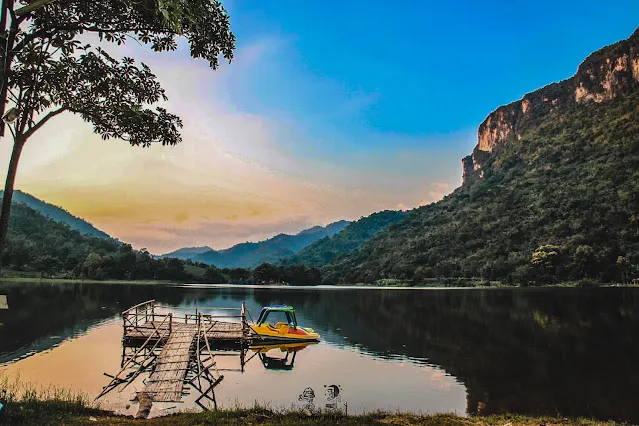
Samakkee Tham Reservoir is located in Moo 5, Ban Samakkee Tham Village, Lum Sum Subdistrict, Sai Yok District, Kanchanaburi Province. It is a community reservoir that has played a continuous and vital role in supporting local livelihoods, serving as a primary water source for domestic use and agriculture for surrounding communities. Although it is not a large reservoir or a nationally recognized destination, this reservoir represents an essential piece of infrastructure with deep significance for water security, daily life, and collective cooperation within Ban Samakkee Tham village.
The overall landscape of Lum Sum Subdistrict and Sai Yok District is characterized by mountains interspersed with lowland areas, forests, and numerous natural streams that serve as minor headwaters of the Khwae Noi River. While the region appears relatively rich in natural water resources, many communities in the past experienced water shortages during the dry season and significant fluctuations in water volume during the rainy season, particularly during periods of delayed rainfall or short but intense storms. Reliance on natural water systems alone proved insufficient to meet the growing demands of households and agricultural land.
The construction and development of Samakkee Tham Reservoir therefore emerged from strong cooperation between community members and relevant agencies, guided by the principle of “unity,” which is clearly reflected in the reservoir’s name. “Samakkee Tham” is more than a place name; it symbolizes collective strength, cooperation, and shared responsibility in managing common resources to resolve water issues in a sustainable and equitable manner for all households.
Physically, Samakkee Tham Reservoir is a community-scale earthen reservoir that collects water from natural streams and rainfall in the surrounding area. Its primary function is to store water for use during periods when natural water availability declines. The reservoir’s structure is designed to suit the local terrain of rolling hills and plains, featuring earthen embankments, drainage systems, and simple yet effective water distribution channels that ensure reliable water delivery to agricultural areas and households throughout the village.
The reservoir’s most important role lies in domestic water supply. Water stored in the reservoir is used for daily household consumption, general domestic activities, and as a reserve during the dry season. The stability of this water source reduces the need to transport water from distant locations, lowers household expenses, and enhances sanitation and public health, particularly during droughts or prolonged dry spells that once posed major challenges to the community.
In terms of agriculture, Samakkee Tham Reservoir plays a crucial role in sustaining local farmland, including rice fields, household vegetable gardens, and small-scale economic crops. Water from the reservoir enables farmers to plan cultivation more accurately, reduces the risk of water shortages, and expands opportunities for year-round farming. This water security not only increases agricultural output but also significantly reduces costs and uncertainty in farmers’ livelihoods.
Beyond direct water use, the reservoir also contributes to the local ecosystem. The calm waters provide habitat and breeding grounds for various freshwater species such as fish, frogs, and other small aquatic animals that are essential to the surrounding food chain. Aquatic plants and green areas around the reservoir help filter sediments and maintain water quality, making Samakkee Tham Reservoir both a functional water source and a natural environment that supports community life.
From a social and cultural perspective, Samakkee Tham Reservoir serves as a shared community space where residents engage in activities such as small-scale fishing, evening relaxation, and informal gatherings. Many elderly villagers recall that before the reservoir existed, water availability was uncertain and unpredictable; after its establishment, daily life became more stable and manageable. This growing bond between people and the reservoir has gradually become part of the identity of Ban Samakkee Tham village.
Although Samakkee Tham Reservoir has not been officially developed as a tourist attraction, its peaceful atmosphere and natural surroundings offer potential for low-impact community-based tourism. Visitors can experience rural tranquility, learn about community water management, and conveniently connect their visit with major attractions in Sai Yok District, such as Sai Yok National Park, Sai Yok Noi Waterfall, Sai Yok Yai Waterfall, or river-based activities along the Khwae Noi River.
Getting There Samakkee Tham Reservoir can be accessed by both public transportation and private vehicles. From Sai Yok District, travelers can take local roads into Lum Sum Subdistrict and continue on to Ban Samakkee Tham village. The surrounding routes are village and agricultural roads, making the reservoir easy to reach for those interested in visiting a community water source and experiencing the rural landscape of Sai Yok up close.
| Place Summary | A community reservoir providing water for domestic use and agriculture in Ban Samakkee Tham, Lum Sum Subdistrict, Sai Yok District |
| Highlights | Primary community water source, strong local cooperation, freshwater ecosystem, and natural surroundings |
| Nearby Tourist Attractions | 1) Sai Yok National Park — approx. 15 km 2) Sai Yok Noi Waterfall — approx. 13 km 3) Sai Yok Yai Waterfall — approx. 18 km 4) Lawa Cave — approx. 22 km 5) Khwae Noi River — approx. 7 km |
| Nearby Restaurants | 1) Sai Yok Riverside Restaurant — approx. 8 km — Tel. 034-538-222 2) Krua Chao Phae Sai Yok — approx. 9 km — Tel. 034-538-333 3) Sai Yok Market Cooked-to-Order Food — approx. 10 km — Tel. 034-538-444 4) Sai Yok Noodle Shop — approx. 10 km — Tel. 034-538-555 5) Sai Yok Local Cuisine Restaurant — approx. 9 km — Tel. 034-538-666 |
| Nearby Accommodations | 1) Sai Yok River House — approx. 9 km — Tel. 034-538-777 2) Khwae Noi Riverside Resort — approx. 10 km — Tel. 034-538-888 3) Sai Yok Guesthouse — approx. 10 km — Tel. 034-538-999 4) Sai Yok Community Homestay — approx. 9 km — Tel. 034-539-111 5) Sai Yok District Hotel — approx. 10 km — Tel. 034-539-222 |
Frequently Asked Questions (FAQ)
Q: What was Samakkee Tham Reservoir built for?
A: It was developed to serve as a water source for domestic use and agriculture for Ban Samakkee Tham village and nearby communities.
Q: Where is Samakkee Tham Reservoir located?
A: It is located in Moo 5, Ban Samakkee Tham, Lum Sum Subdistrict, Sai Yok District, Kanchanaburi Province.
Q: Who benefits from Samakkee Tham Reservoir?
A: Local residents and farmers in Ban Samakkee Tham and surrounding areas benefit directly from the reservoir.
Q: How can visitors travel to Samakkee Tham Reservoir?
A: Visitors can reach the reservoir by public transportation or private vehicles via local roads from Sai Yok District.
Q: When can visitors access Samakkee Tham Reservoir?
A: Public areas around the reservoir are open daily from 06:00 to 18:00.
 Samakkee Tham Reservoir Map
 Category:
  Group:
  Tag: ●Samakkee Tham Reservoir●samakkee tham reservoir ●samakkee tham dam ●lum sum reservoir ●sai yok reservoir ●community reservoir sai yok ●kanchanaburi community reservoir ●water resource sai yok ●irrigation water lum sum ●rural reservoir kanchanaburi
Last Update: 2 MonthAgo
Tag: ●Samakkee Tham Reservoir●samakkee tham reservoir ●samakkee tham dam ●lum sum reservoir ●sai yok reservoir ●community reservoir sai yok ●kanchanaburi community reservoir ●water resource sai yok ●irrigation water lum sum ●rural reservoir kanchanaburi
Last Update: 2 MonthAgo
Comment
 Nearby Attractions
| Keyword (Advance) |
 Facebook Fanpage
 Region
 Art, Culture and Heritage
 Historical Sites and Monuments(
 Landmarks and Memorials(
 Art, Craft Centres, Tradition(
 Museums(
 Art Gallery(
 University
 Places of Worship
 Temple(
 Church(
 Other religious and spiritural sites(
 Research and Development
 Royal Project(
 Suburban Living
 Village, Community(
 Local Market(
 National Parks and Marine Reserves(
 Mountain (Doi)(
 Waterfalls(
 Hot Springs(
 Caves(
 River, Canal(
 Other natural attractions(
 Entertainment and Agricultural
 Zoos and Aquariums(
 Animal camps and shows(
 Farm, Parks, Gardens and Ecotourism(
 Cinema(
 Outdoor and Adventure Activities(
 Travel Articles, Recipes
 Travel Review, Food Review(
 Copyright 2012,