

 Home
Home Chiang Mai(










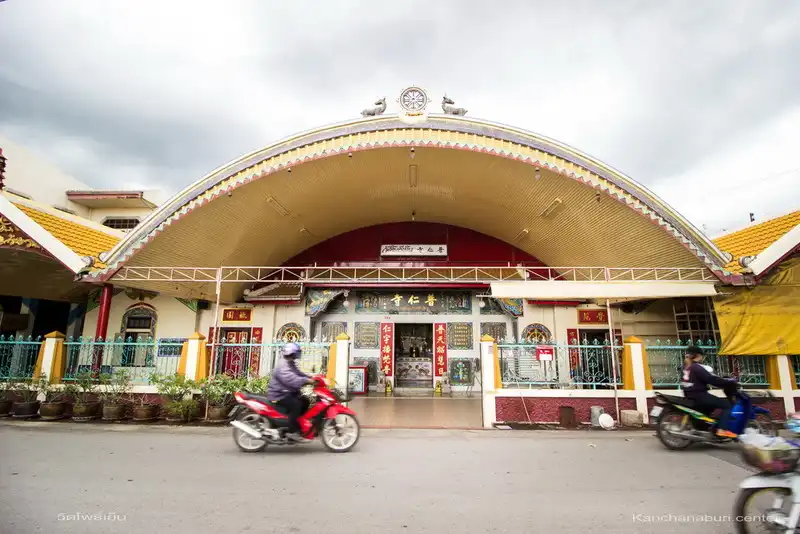
Wat Pho Yen (Chinese Temple)
Rating: 4/5 (7 votes)
 Search By
  Map
Map 
 Have Map
  No Map
Kanchanaburi attractions
Attractions in Thailand
Open Days: Daily
Opening Hours: 08:00 – 17:00
Wat Pho Yen (Chinese Temple) is located to the north of Luk Ka Market in Tha Maka District, Kanchanaburi Province. It is an important Mahayana Buddhist temple with significant historical, artistic, and religious value for the local Thai-Chinese community. Near the temple stands a small mountain known among local residents as “Khao Phra Than,” where a sacred platform enshrines a Buddha image seated in the cross-legged meditation posture. The Buddha image faces directly toward a large Bodhi tree along the Mae Klong River, creating a sacred landscape that closely intertwines religion, nature, and the way of life of the local people.
The large Bodhi tree by the Mae Klong River near Wat Pho Yen has long provided shade and relief for travelers passing through the area. It serves as a place to rest and recover from physical fatigue, while the cool breeze from the river brings freshness and tranquility. This place has therefore been more than a physical resting spot; it has also become a spiritual space to which people have felt a deep and lasting connection.
Originally, the area of Wat Pho Yen was the site of a temporary vegetarian hall established by Chinese residents who had settled around Luk Ka Market. They jointly built the hall under the name “Hok Siu Tua Vegetarian Hall” as a place for practicing Buddhist religious activities according to their faith. This vegetarian hall functioned as a spiritual center for the overseas Chinese community in the area, supporting rituals, observance of precepts, and the continuation of Mahayana Buddhist beliefs.
Over time, Hok Siu Tua Vegetarian Hall was further developed and officially elevated to temple status, receiving the name “Wat Pho Yen” on October 7, 1947. This transition marked an important milestone in the history of Mahayana Buddhism in Thailand, as it represented official recognition of a Mahayana temple rooted in a local Chinese community.
Within Wat Pho Yen stands an ordination hall completed around 1952. This ordination hall is particularly notable for its Tibetan-style architectural design. It is recognized as a Mahayana ordination hall with a properly established and complete boundary according to monastic discipline, and it has been acknowledged as the first Mahayana ordination hall in Thailand. This distinction grants Wat Pho Yen a unique and significant place in the history of Thai Buddhism.
Inside the ordination hall, a statue of Shakyamuni Buddha is enshrined at the center as the principal Buddha image, symbolizing the Enlightened One as the foundation of the Dharma. Below this are images of Vairocana Buddha, one of the most important Buddhas in Mahayana tradition, flanked by representations of Manjushri Bodhisattva and Sangharama Bodhisattva. Together, these figures reflect the Mahayana ideal of compassion and the aspiration to liberate all sentient beings from suffering.
At the rear of Wat Pho Yen stand five Vajra stupas, also known as Tibetan stupas. These five stupas hold profound symbolic meaning within Vajrayana and Mahayana traditions, with the number five representing wisdom and the five fundamental virtues. Beyond their architectural value, these stupas serve as important spiritual focal points and are used in significant religious rituals of the temple.
At present, Wat Pho Yen is led by Venerable Chinese Master Winyanugara Suntharathamphusit Pariyattikijakosol, widely known as “Chao Khun Yen Yi,” who serves as the abbot. He also holds the position of Deputy Chief Patriarch of the Right Division of the Chinese Sangha and is a member of the Chinese Sangha Council. He plays a vital role in both monastic administration and the continued propagation of Mahayana Buddhism in Thailand.
Wat Pho Yen is therefore not merely a place for religious observance, but also a cultural and spiritual center of the Luk Ka community. It harmoniously connects the ancestral beliefs of Thai-Chinese people with the broader Thai social context, while standing as an important source of learning in Buddhist studies and religious art at the national level.
Getting There Luk Ka Market is located in Don Khamin Subdistrict, Tha Maka District, Kanchanaburi Province, between Ban Pong District in Ratchaburi Province and Kanchanaburi town. Visitors can travel via the Ban Pong–Kanchanaburi highway, which passes directly through Luk Ka Market, with regular bus services operating throughout the day. In addition, the Bangkok–Nam Tok Sai Yok Noi railway line runs behind the market, while the Mae Klong River flows along its front, making Wat Pho Yen easily accessible by both road and rail.
| Summary | An important Mahayana temple in Luk Ka Market featuring the first Tibetan-style Mahayana ordination hall in Thailand. |
| Highlights | Tibetan-style ordination hall, five Vajra stupas, Khao Phra Than, and deep Chinese community roots. |
| Abbot / Administrator | Venerable Chinese Master Winyanugara Suntharathamphusit Pariyattikijakosol (Chao Khun Yen Yi) |
| Nearby Attractions | 1) Luk Ka Market – 1 km 2) Mae Klong River – 1 km 3) Wat Tham Suea – 12 km 4) Bridge over the River Kwai – 38 km 5) Thai–Burma Railway Museum – 39 km |
| Nearby Restaurants | 1) Luk Ka Market Restaurant – 1 km, Tel. 034-123-456 2) Mae Klong Boat Noodles – 2 km, Tel. 081-234-5678 3) Traditional Chinese Restaurant Luk Ka – 1 km, Tel. 089-345-6789 4) Don Khamin Local Eatery – 3 km, Tel. 086-456-7890 5) Riverside Mae Klong Restaurant – 2 km, Tel. 082-567-8901 |
| Nearby Accommodations | 1) Luk Ka Resort – 3 km, Tel. 034-222-333 2) Riverside Mae Klong Homestay – 4 km, Tel. 081-333-4444 3) Tha Maka Place – 7 km, Tel. 034-444-555 4) Muang Tha Maka Hotel – 8 km, Tel. 034-555-666 5) Saeng Chuto Inn – 6 km, Tel. 082-666-7777 |
Frequently Asked Questions (FAQ)
Q: How is Wat Pho Yen different from typical Thai temples?
A: It is a Mahayana temple featuring Tibetan-style architecture and Chinese Buddhist traditions.
Q: Why is Wat Pho Yen nationally significant?
A: It houses the first officially recognized Mahayana ordination hall in Thailand.
Q: What is Khao Phra Than?
A: It is a nearby hill with a sacred platform and a Buddha image enshrined on it.
Q: What is the meaning of the five Vajra stupas?
A: They symbolize Vajrayana concepts and the five core virtues of Mahayana Buddhism.
Q: Who would enjoy visiting Wat Pho Yen?
A: Visitors interested in Mahayana Buddhism, Tibetan art, and Thai–Chinese cultural heritage.
 Wat Pho Yen (Chinese Temple) Map
 Category:
  Group:
  Tag: ●Wat Pho Yen (Chinese Temple)●wat pho yen ●chinese temple luk ka ●mahayana temple kanchanaburi ●tibetan style ordination hall thailand ●luk ka market temple ●chinese buddhist temple thailand ●vajra stupa thailand ●mahayana buddhism thailand Last Update: 2 WeekAgo
Comment
 Nearby Attractions
| Keyword (Advance) |
 Region
|
 Muang Kanchanaburi(
 Copyright 2012,