
 Home
Home North(
 Chiang Mai(


Sattamit Waterfall
Rating: 4.4/5 (5 votes)
 Search By
  Map
Map 
 Have Map
  No Map
Kanchanaburi attractions
Attractions in Thailand
Open Days: Daily
Opening Hours: 08:00 – 17:00 (Recommended to visit during daylight hours)
Sattamit Waterfall is one of those nature spots that makes you feel like you’ve stepped out of your ordinary world the moment you arrive. The route was never designed to be an easy, casual tourist stop where you stroll a few steps and instantly reach a picture-perfect viewpoint. Instead, it still carries the raw, quiet, and serious character that Thong Pha Phum is known for. Many travelers recognize the Pilok area through familiar images of E-Tong Village, early morning mist, winding roads, and mountain layers rolling into the distance. But if you look closer, you’ll find many natural sites that lie deeper and require more intention. Sattamit Waterfall is often mentioned among travelers who prefer slow-paced nature trips, who enjoy silence, and who love the feeling that every step forward brings them closer to the forest itself.
What sets Sattamit Waterfall apart from many popular waterfalls is that it combines both a cave and a waterfall within the same area. The experience is not only about watching water flow over rock layers, but also about sensing forest humidity, the coolness hidden behind dense trees, the darkness and stillness of a cave chamber, and the way natural sounds become strangely clearer as you move farther away from main roads. For travelers who enjoy nature in detail—the shapes of rocks, the patterns carved by erosion, the texture of moss, the shadows of leaves, and the shifting “mood of the forest” throughout the day—Sattamit Waterfall fits naturally. It does not try to impress through staging or spectacle. Its beauty comes from the honesty of its landscape and the calmness of its surroundings.
To picture its setting, Sattamit Waterfall lies in the Ban E-Pu area, Pilok Subdistrict, Thong Pha Phum District, Kanchanaburi Province, and it is closely tied to the scenery of Thailand’s western forest belt, where ridgelines, valleys, and small streams weave together into a living watershed. This forest zone is known for high moisture during the rainy season and a lush green density that feels like a natural filter covering everything. When sunlight slips through leaves and meets the damp forest floor, the air looks soft and cool—even on bright days. The shade from the canopy and the moisture from nearby streams often lower the felt temperature noticeably. That is why many people say that visiting waterfalls in Thong Pha Phum offers more than freshness from water; it brings a kind of calm coolness that reaches the mind as much as the skin.
The name “Sattamit” is intriguing because it carries a clear meaning in Thai. The word “satta” relates to the number seven, so some sources also call it “Jed Mit Waterfall” (literally, “Seven Friends Waterfall”). Names like this often make first-time visitors curious: What does “seven” refer to? Is it the number of tiers, the number of streams, or a local story behind the name? What is interesting is that even if you do not have the full answer at the start, the journey into the actual landscape tends to reveal something important: many natural sites in Thong Pha Phum were not named for marketing. They were named through the way local people interpret nature and choose to remember it in their own language. In that sense, traveling to Sattamit Waterfall is not only a trip; it feels like learning to read the local “language of the land” through real terrain.
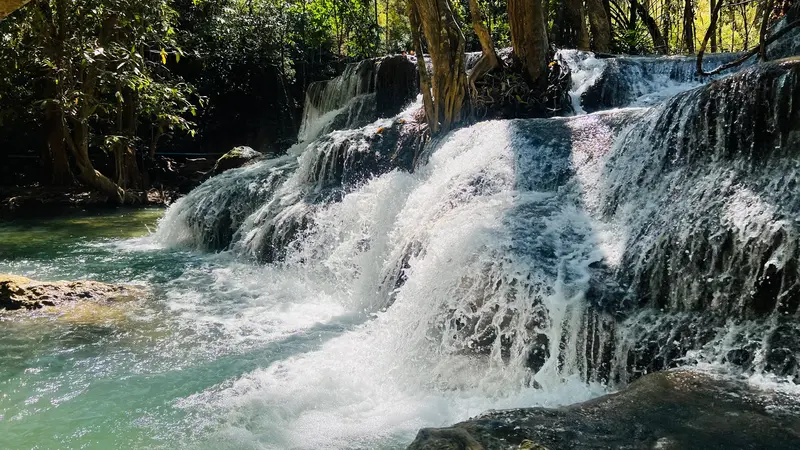
In terms of geography, Sattamit Waterfall is shaped by water moving naturally over layered rock. Waterfalls in Thailand’s western forests are not always tall vertical cliffs. More often, they descend in rhythms and steps. Boulder formations break the flow into spray, or guide it into thin ribbons sliding over rock surfaces before gathering into pools below. What makes a waterfall feel alive is not only what you see but also what you hear. The sound of water changes depending on the amount of flow and the shape of the streambed. Some sections roar clearly, some whisper like rain on leaves, and some become distinct drips echoing from stone hollows. If you are someone who enjoys listening to nature, standing still near the waterfall can feel like hearing music without written notes—with the forest setting the tempo.
The cave element adds a dimension that most typical waterfalls do not offer. Forest caves often create a feeling of “time pausing.” As you approach a cave entrance, the temperature shifts. The air turns cooler, humidity increases, and light fades, forcing your eyes to adjust. The stillness inside also makes small sounds—footsteps, water drops—stand out more sharply. Experientially, having both a cave and a waterfall in one place can feel like passing through “two worlds” within the same landscape: one world of moving water and light, and another world of stone and shadow that feels deeper and still. They sit close enough together that you can sense the contrast immediately, without needing much explanation.
It is also important to understand that waterfalls in Thong Pha Phum change noticeably with the seasons. Water volume depends on rainfall accumulation in small watersheds and the moisture stored within the forest. During the rainy season, water typically becomes more powerful and the entire area looks intensely green and fresh. The scent of soil, leaves, and damp air becomes especially vivid. At the same time, risks also increase: slippery rocks and sudden rises in water level can occur. Late rainy season into early winter is often preferred because the landscape remains green and the water still looks attractive, while traveling and walking tend to be easier than during heavy rain. In the dry season, water may naturally decrease, but the advantage is that paths are often drier, details of the streambed and rocks become clearer, and the trip may suit those who want to study the landscape rather than focus on swimming.
For that reason, Sattamit Waterfall is best enjoyed by travelers who plan around the season and allow nature to set the rhythm. If you want to see strong flow and a full, lively forest, the rainy period or just after rainfall can be rewarding—but you should prepare more carefully with proper footwear, traction, and extra travel time. If you want a comfortable walking experience with soft light for photography, late rainy season into early winter is often ideal, and mist in Thong Pha Phum can be especially charming. If your goal is to explore the cave area or observe rock and stream details more clearly, the dry season may feel more suitable, because lower water levels can reveal features that are otherwise hidden when the flow is stronger.
Another point people sometimes overlook is personal and group readiness. The “beauty” of nature often comes with real conditions. A deeper waterfall site may include damp ground, slippery stones, and sections that require extra caution, especially right after rain. Moss and algae can make footing unpredictable. That is why shoes with good grip matter. If you plan to go near the cave zone, bringing a flashlight or headlamp is also wise. Natural light in the forest can drop quickly in the afternoon, especially on cloudy days. Good preparation does not make the trip unnecessarily intense; it simply gives you enough peace of mind to enjoy nature fully without constant worry.
If you enjoy photography, Sattamit Waterfall offers several strong visual moods. One is the classic scene of flowing water against a deep, layered green forest canopy. Another is close detail: erosion lines on rock, moss textures, and misty droplets hanging in the air. A third is the quieter atmosphere around the cave or shaded zones, which can feel like nature documentary imagery. If you shoot on a phone, morning or late afternoon light often helps deliver softer contrast and better dynamic range. If you use a camera, adjusting shutter speed lets you decide whether you want silky water lines or crisp droplets, depending on your preferred style.
However, the beauty you take home should come with responsibility toward the place. Waterfall and cave ecosystems are fragile. Even one piece of trash can become the kind of negative memory that ruins the experience for others. And in areas where silence is part of what makes nature feel whole, loud voices or playing music can disturb both visitors and wildlife. Respectful travel in Thong Pha Phum is not just a nice idea; it is what keeps these places genuinely pleasant over time—especially sites that do not operate as large commercial tourist zones.
Getting There Based on commonly shared local directions, most travelers start from Ban E-Pu and then turn onto the Pha Pae route. From Ban E-Pu to the destination is approximately 24 kilometers. Planning should match weather conditions, especially during the rainy season when roads can be wet, debris like soil or leaves may appear on the surface, and visibility may drop in some sections due to mist or rain. If you are driving your own vehicle, it is recommended to check brakes and tires and to fill up fuel before entering the area, because the Pilok zone and mountain roads are naturally winding. Driving at an appropriate speed and allowing extra travel time will make the trip significantly safer and more comfortable.
Overall, Sattamit Waterfall suits travelers who want nature that leaves a lasting impression, not just a quick photo stop. It encourages you to slow down and experience the forest up close—from the changing rhythm of water over stone, to the coolness that arrives without air conditioning, to the stillness of a cave that can make you feel you are standing before something ancient. If you are looking for a trip that does not need luxury but must feel real—and must send you home with calmness—Sattamit Waterfall is a place worth keeping on a serious Thong Pha Phum list. And if everyone helps keep the area clean and respectful, this kind of nature will continue to hold value for future visitors for a long time.
| Place Summary | A nature site combining a cave zone and a waterfall near Ban E-Pu, Pilok Subdistrict, Thong Pha Phum, Kanchanaburi, within the Thong Pha Phum National Park area; ideal for travelers seeking quiet, immersive forest travel. |
| Address | Ban E-Pu, Pilok Subdistrict, Thong Pha Phum District, Kanchanaburi Province (Thong Pha Phum National Park area) |
| Key Highlights | 1) Relatively quiet, immersive natural atmosphere 2) A “cave + waterfall” experience in one area 3) Lush Thong Pha Phum forest scenery (especially beautiful during rainy and late rainy seasons) 4) Suitable for nature photography and unhurried exploration 5) Feels closer to “real forest travel” than quick-stop attractions |
| Getting There | Start from Ban E-Pu → follow the Pha Pae route → reach the destination (approx. 24 km). It is recommended to check weather and vehicle readiness before entering the area. |
| Fees | Located within Thong Pha Phum National Park (Thai: Adult 40 THB, Child 20 THB / Foreigner: Adult 200 THB, Child 100 THB). Conditions or specific activities may vary by season; check the latest updates before traveling. |
| Current Status | A natural attraction within a national park area. Check weather and any local advisories before traveling, especially during the rainy season due to slippery conditions and potential flash floods. |
| Nearby Attractions (Approx. Distance) | 1) E-Tong Village – Pilok Mine (approx. 29 km) 2) Chok Kradin Waterfall (approx. 24 km) 3) Noen Chang Suek Viewpoint (approx. 32 km) 4) Km.12 Viewpoint (approx. 35 km) 5) Thong Pha Phum National Park (Visitor Service Area) (approx. 45 km) |
| Nearby Restaurants (Approx. Distance + Phone) | 1) Krua Je Nee (Pilok) (approx. 29 km) Tel. 089-515-3528 2) Chao Mueang Cake Pilok (approx. 29 km) Tel. 098-408-6509 3) Brume Cafe N' Room (Cafe/Drinks) (approx. 29 km) Tel. 082-258-5456 4) Ma Kin Kan (Made-to-Order Meals) (approx. 29 km) Tel. (Please confirm with the restaurant before traveling) 5) Pla Khuean Thong Pha Phum Restaurant (Town Area) (approx. 70 km) Tel. 098-925-5909 |
| Nearby Accommodations (Approx. Distance + Phone) | 1) Pilok Hill House (approx. 29 km) Tel. 080-781-5702 2) E-Tong Homestay (approx. 29 km) Tel. 092-249-1915 3) Pilok My Home (approx. 29 km) Tel. 063-183-4056 4) Brume Cafe N' Room (Homestay) (approx. 29 km) Tel. 082-258-5456 5) Pha Pae Homestay (approx. 10 km) Tel. 064-372-5666 |
Frequently Asked Questions (FAQ)
Q: Where is Sattamit Waterfall located?
A: It is in the Ban E-Pu area, Pilok Subdistrict, Thong Pha Phum District, Kanchanaburi Province, and it is associated with the Thong Pha Phum National Park area.
Q: What is the best season to visit Sattamit Waterfall?
A: Late rainy season to early winter is often the most comfortable, with lush scenery and good water flow. The rainy season can be very beautiful but requires extra caution due to slippery conditions and potential flash floods.
Q: Is there really a cave there, and what should I be careful about?
A: The area is commonly described as featuring both a cave zone and a waterfall. Bring a flashlight or headlamp and non-slip footwear, and avoid going deep inside if you are inexperienced or traveling with a small group, especially during wet conditions.
Q: What should I prepare before traveling?
A: Wear shoes with good grip, bring drinking water, a rain jacket or windbreaker, a trash bag to carry out all waste, and check your vehicle condition before entering the Pilok area due to curves and fast-changing weather.
Q: Are there important visitor guidelines for nature travel here?
A: Do not leave trash, avoid loud noise, do not damage rocks or natural features, watch for slippery surfaces, and avoid entering the water if currents are unusually strong or if heavy rain continues.
Q: If I want to make the trip more complete, where should I go next?
A: Many travelers connect the route to E-Tong Village – Pilok Mine, stop at Chok Kradin Waterfall, and go up to Noen Chang Suek Viewpoint for misty mornings or borderland views. Plan time carefully and check weather conditions before setting out.
 Sattamit Waterfall Map
 Category:
  Group:
  Tag: ●Sattamit Waterfall●sattamit waterfall ●jed mit waterfall ●thong pha phum waterfall ●pilok travel ●kanchanaburi nature ●ban e pu ●pha pae route ●thailand rainforest waterfall ●pilok village nearby ●thong pha phum national park
Last Update: 2 MonthAgo
Tag: ●Sattamit Waterfall●sattamit waterfall ●jed mit waterfall ●thong pha phum waterfall ●pilok travel ●kanchanaburi nature ●ban e pu ●pha pae route ●thailand rainforest waterfall ●pilok village nearby ●thong pha phum national park
Last Update: 2 MonthAgo
Comment
 Nearby Attractions
| Keyword (Advance) |
 Facebook Fanpage
 Region
 Art, Culture and Heritage
 Historical Sites and Monuments(
 Landmarks and Memorials(
 Art, Craft Centres, Tradition(
 Museums(
 Art Gallery(
 University
 Places of Worship
 Temple(
 Church(
 Other religious and spiritural sites(
 Research and Development
 Royal Project(
 Suburban Living
 Village, Community(
 Local Market(
 National Parks and Marine Reserves(
 Mountain (Doi)(
 Dam, Reservoir, Lake(
 Hot Springs(
 Caves(
 River, Canal(
 Other natural attractions(
 Entertainment and Agricultural
 Zoos and Aquariums(
 Animal camps and shows(
 Farm, Parks, Gardens and Ecotourism(
 Cinema(
 Outdoor and Adventure Activities(
 Travel Articles, Recipes
 Travel Review, Food Review(
 Copyright 2012,