

 Home
Home Chiang Mai(







Wat Takram-En (Luang Phor Dum)
Rating: 3.9/5 (7 votes)
 Search By
  Map
Map 
 Have Map
  No Map
Kanchanaburi attractions
Attractions in Thailand
Open Days: Daily
Opening Hours: 06:00 – 18:00
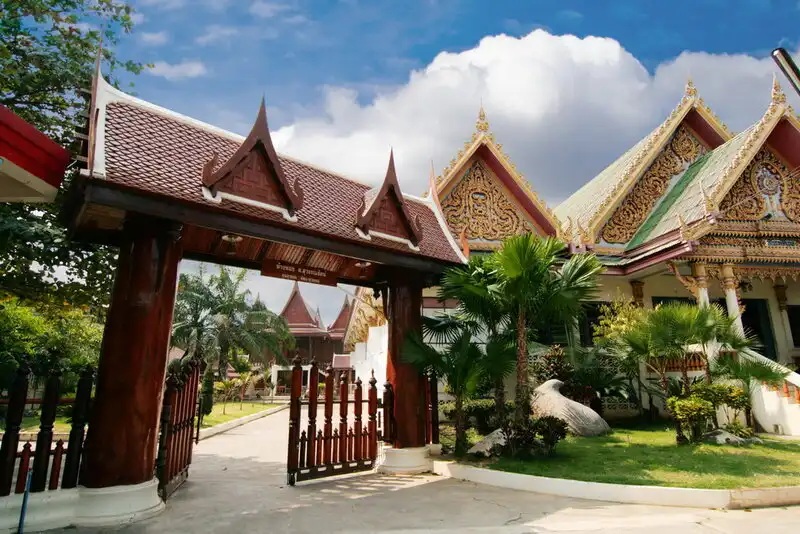
Wat Takram-En is located in Takram-En Subdistrict, Tha Maka District, Kanchanaburi Province. It is a community temple under the Mahanikaya sect, occupying an area of approximately 22 rai, 2 ngan, and 24 square wah. For many decades, the temple has served as a central hub for religion, culture, and community learning in Takram-En, playing an important role in linking Buddhist faith with the preservation of Thai traditions and local wisdom in a tangible and enduring way.
Wat Takram-En was established in 1955, with Khun Thonglor Chengsutha, a local benefactor, taking the lead in its construction. His strong faith in Buddhism, combined with a desire to create a sacred space that would serve as the spiritual center of the community during a period when Thai society was recovering from World War II, made the construction of the temple especially meaningful. At that time, building a temple was not merely the creation of a religious site, but also a means of restoring morale and spiritual strength to the local population.
One of the most significant events in the history of Wat Takram-En was the creation of 113 Buddha images during Visakha Bucha Day, as an act of Buddhist devotion marking the approach of the Midpoint of the Buddhist Era. This took place around 1957, under the leadership of the abbot at that time, Phra Khru Prakat Sunthornkit (Luang Pho Sont). He oversaw the process of receiving and enshrining these Buddha images within the temple, establishing them as symbols of collective faith and the continuity of Buddhism within the community.
The most important Buddha image at Wat Takram-En is the principal image known locally as “Luang Pho Dam.” This image is depicted in the Maravijaya posture and reflects an applied U-Thong artistic style. The Buddha image is entirely black in color, with a lap width of approximately 44 inches. Initially, it was enshrined inside the ordination hall around 1960–1961. However, according to accounts from the abbot, he repeatedly experienced visions in which Luang Pho Dam expressed a wish not to remain inside the ordination hall, but instead to be placed in front of it.
Out of respect for these visions and deep faith, the abbot decided to relocate Luang Pho Dam to the front of the ordination hall. Over time, the surface of the image naturally deteriorated, and there was consideration of regilding it. However, it was believed that Luang Pho Dam wished to retain its original black appearance. As a result, the image was left in its original state. This decision has made Luang Pho Dam a defining identity of Wat Takram-En and an object of profound reverence among local residents and visitors alike.
Beyond its religious role, Wat Takram-En also functions as a center for moral and ethical training for students, youth, and the general public. The temple regularly organizes activities that promote moral values, ethical conduct, and learning related to Thai traditions, culture, and local wisdom. These activities help nurture spiritual values within the community and ensure that the temple continues to play a meaningful role in the daily lives of local people.
Another highlight of Wat Takram-En is the Wat Takram-En Museum, which is housed within the Luang Pho Dam Vihara. This vihara was constructed in imitation of Lopburi-style art. Inside, a wide variety of historical artifacts and everyday objects from the past are displayed, including ancient coins, old banknotes, firearms, and earthenware such as pots, bowls, jars, and dishes. These exhibits reflect the way of life and wisdom of earlier generations, making Wat Takram-En both a place of religious practice and a valuable center for historical and cultural learning.
Getting There Wat Takram-En is easily accessible by private car. From Bangkok, travel toward Kanchanaburi Province. Upon entering Tha Maka District, continue toward Takram-En Subdistrict and follow local road signs leading to the temple, which is located close to the community and can be conveniently reached throughout the year.
| Place Summary | A community temple serving as a center of faith and learning for Takram-En village |
| Key Highlights | Luang Pho Dam, a black Maravijaya Buddha image, and the Wat Takram-En Museum |
| Abbot / Administrator | Phra Khru Prakat Sunthornkit |
| Current Status | Open for merit-making, worship, and museum visits |
| Nearby Accommodations | 1) West View Villa (15 km) Tel. 034-612-222 2) Whitehouse Resort Kanchanaburi (18 km) Tel. 081-848-0836 3) Love In Kan Resort (20 km) Tel. 096-850-7293 4) BanRuen Resort (17 km) Tel. 089-967-4686 5) The Vista Pool Villa (22 km) Tel. 034-510-959 |
| Nearby Restaurants | 1) Khrua Khuen Mae Klong (16 km) Tel. 096-925-5986 2) KAAN Riverkwai Restaurant (18 km) Tel. 099-939-3745 3) Keereetara Riverside (19 km) Tel. 034-518-888 4) Rakkanna Noodle & Café (17 km) Tel. 080-061-6888 5) On’s Thai-Issan Vegan (19 km) Tel. 087-364-2264 |
| Nearby Attractions | 1) Tha Maka Market (6 km) 2) Mae Klong River (2 km) 3) Bridge over the River Kwai (25 km) 4) Thailand–Burma Railway Museum (25 km) 5) Sai Yok National Park (50 km) |
Frequently Asked Questions (FAQ)
Q: When was Wat Takram-En established?
A: Wat Takram-En was established in 1955.
Q: What posture is Luang Pho Dam depicted in?
A: Luang Pho Dam is depicted in the Maravijaya posture, in an applied U-Thong artistic style.
Q: Why is the principal Buddha image called Luang Pho Dam?
A: Because the image is entirely black in color and has been preserved in its original state in accordance with the abbot’s visions.
Q: What roles does Wat Takram-En play in the community?
A: The temple serves as a center for moral and ethical training, as well as a place for learning about Thai culture and traditions.
Q: Is there a museum within the temple?
A: Yes, Wat Takram-En has a museum displaying historical artifacts and traditional objects from earlier periods.
 Wat Takram-En (Luang Phor Dum) Map
 Category:
  Group:
  Tag: ●Wat Takram-En (Luang Phor Dum)●wat takram en ●wat takram en kanchanaburi ●tha maka district temple ●luang pho dam ●black buddha statue thailand ●community temple kanchanaburi ●buddhist museum thailand ●religious tourism kanchanaburi Last Update: 2 MonthAgo
Comment
 Nearby Attractions
| Keyword (Advance) |
 Facebook Fanpage
 Region
 Art, Culture and Heritage
 Historical Sites and Monuments(
 Landmarks and Memorials(
 Art, Craft Centres, Tradition(
 Museums(
 Art Gallery(
 University
 Church(
 Other religious and spiritural sites(
 Research and Development
 Royal Project(
 Suburban Living
 Village, Community(
 Local Market(
 Nature and Wildlife
 National Parks and Marine Reserves(
 Mountain (Doi)(
 Dam, Reservoir, Lake(
 Waterfalls(
 Hot Springs(
 Caves(
 River, Canal(
 Other natural attractions(
 Entertainment and Agricultural
 Zoos and Aquariums(
 Animal camps and shows(
 Farm, Parks, Gardens and Ecotourism(
 Cinema(
 Outdoor and Adventure Activities(
 Travel Articles, Recipes
 Travel Review, Food Review(
 Copyright 2012,