
 Home
Home North(
 Chiang Mai(


Tha Thung Na Dam
Rating: 3.8/5 (9 votes)
 Search By
  Map
Map 
 Have Map
  No Map
Kanchanaburi attractions
Attractions in Thailand
Open Days: Daily (generally open for visits from 08.00 – 16.00)
Opening Hours: 08.00 – 16.00 (recommended golden-light periods: 06.30 – 09.00 and 16.00 – 18.00 for photos of the “outer area/exterior views”)
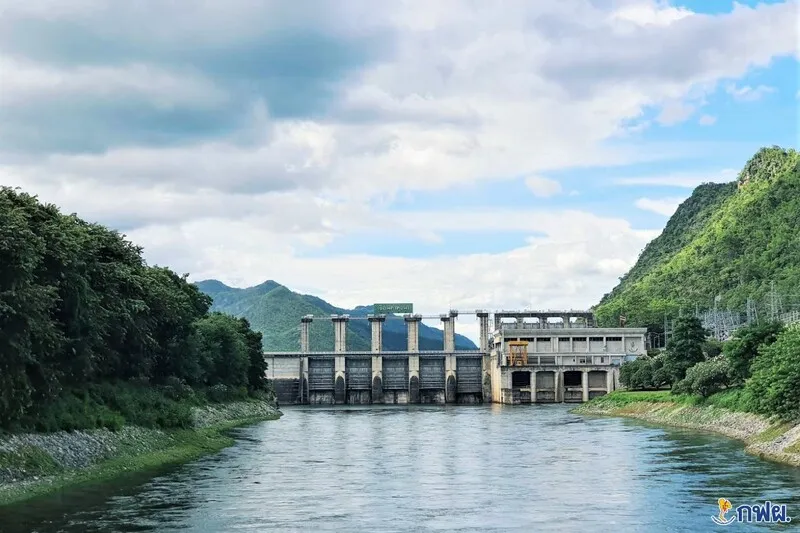
Tha Thung Na Dam in Kanchanaburi Province is a “downstream regulating reservoir dam” built to support the hydropower generation system of the Greater Khwae Yai River Basin. Located downstream from Srinagarind Dam on the Khwae Yai River, this dam plays a key role in electricity generation, irrigation, and overall water resource management. Although it is smaller than Srinagarind Dam, Tha Thung Na Dam is important because it helps maximize the reuse of water energy and improves the stability of water releases from the upstream dam for both the power system and agricultural water use. The primary operator and responsible agency is the Electricity Generating Authority of Thailand (EGAT).
The charm of Tha Thung Na Dam for visitors lies in its “chill and natural” atmosphere. The dam sits among mountain ridges and a reservoir wide enough to reveal a clear horizon. On fine-weather days, the open sky becomes a beautiful backdrop for the dam crest and the water surface. When the wind is gentle, the reservoir appears smooth and reflective; toward evening, warm light adds depth to the distant mountains. Another highlight is the sense of “not being crowded” compared with popular attractions in Kanchanaburi town, making this a good place for those who want to rest their eyes, watch the water, enjoy the view without rushing, and spend quiet time in nature.
From an engineering perspective, Tha Thung Na Dam is a composite dam, combining a rockfill dam with a clay core and a concrete overflow spillway section. The dam stands about 30 meters high from its foundation, with a crest length of about 840 meters and a crest width of about 8 meters. The dam body volume is approximately 280,000 cubic meters. The reservoir’s maximum operating water level is about 59.70 meters, and the minimum operating water level is about 55.50 meters. Total storage capacity is about 54.8 million cubic meters (at the 59.70-meter level), with about 28.8 million cubic meters of usable water. The power station structure is a multi-storey reinforced-concrete building, housing two alternating-current generators, each rated at about 19 megawatts, for a total installed capacity of about 38 megawatts. The project is part of the integrated water-and-energy development and management plan for the Khwae Yai River Basin.
What makes Tha Thung Na Dam “special” in an energy context is its concept of maximizing hydropower efficiency through an upstream–downstream dam system. Water that has already passed through the turbines at Srinagarind Dam can flow downstream to Tha Thung Na Dam and be used to generate electricity again. In simple terms, water released from the higher elevation of the upstream dam still retains sufficient energy potential as it moves through the system, allowing it to drive turbines at the downstream dam as well. This improves overall hydropower efficiency within the same river basin. That is why Tha Thung Na Dam is often seen as a “supporting dam” that helps strengthen stability and increase value in the area’s hydropower generation system.
If you are searching with an information-focused query like “How does Tha Thung Na Dam generate electricity?”, the key principle is converting the energy of water into mechanical energy and then into electrical energy. Water from the reservoir is controlled to flow through a penstock or water conveyance system into a turbine. When the flow and pressure are suitable, the turbine blades rotate; the turbine shaft then drives the generator, producing alternating current (AC) electricity, which is subsequently transmitted through the power grid. A crucial point for Tha Thung Na Dam is managing the “timing and volume of water releases” from Srinagarind Dam to balance electricity generation with other water uses. This requires systematic control of water levels, discharge, and overall flow regulation.
In terms of project history, Tha Thung Na Dam is an EGAT project under the Khwae Yai River Basin development plan. The government approved construction around September 1977 (B.E. 2520), after which construction of facilities and main works proceeded. For commercial operation, the dam began supplying electricity in December 1981 (B.E. 2524), followed by another unit in February 1982 (B.E. 2525), before the official opening ceremony on 16 April 1982 (B.E. 2525). This timeline reflects an era when Thailand was actively expanding energy and water-management infrastructure to meet rising electricity demand and to support water use for agriculture and communities in the region.
Viewed through a tourism lens, the “beauty” of Tha Thung Na Dam is not about flashy landmark appeal, but rather the simple harmony of water, mountains, and the clean lines of the dam crest cutting across the sky. Many visitors come to stroll along the dam crest, take wide-angle photos, and sit at viewpoints overlooking the reservoir. Some arrive early to enjoy fresh air and soft light, while others prefer late afternoon for the warm glow that adds dimension to the mountains and creates shimmering reflections on the water. Overall, Tha Thung Na Dam suits a “day trip” style visit or a stop along the Kanchanaburi–Si Sawat travel route, with easy connections to other natural sites nearby.
Popular activities are generally light and do not require special equipment, such as walking for views, photographing the reservoir and dam crest, watching the sky change color during morning and evening, or simply sitting quietly to rest from screens and city noise. In certain seasons, when water levels and weather conditions are suitable, some groups enjoy water-based activities in nearby permitted areas (while following local safety rules), such as boat trips, fishing, or kayaking where allowed. If you enjoy photography, it helps to budget time to observe light and shadow, because the same viewpoint can look very different in the morning, midday, and evening—especially on days with layered clouds that add depth to the scene.
To keep your visit smooth, it helps to prepare with “disciplined nature travel” in mind: bring enough drinking water, a hat, sunglasses, and a light outer layer, because many viewpoints and the dam crest are exposed and the sun can be strong from late morning to afternoon. It is also recommended to carry a trash bag and take all waste back with you, as cleanliness is a basic condition for long-term sustainability of nature-based attractions. If you are filming or creating content, be especially cautious near edges or risk-prone areas, and avoid climbing on restricted structures.
Another topic many visitors are interested in is how “water level” affects the beauty of the view. Tha Thung Na Dam can feel different by season. Late rainy season into early winter often looks especially fresh, with greener mountains and comfortable temperatures. Winter tends to bring clearer skies and cooler air, ideal for walking and crisp photos of the dam crest. Summer can be hotter, but often offers open skies that suit wide, clean landscape shots. If you want a more “dramatic” water-scape, check the forecast and aim for a day with lighter winds, since a calmer water surface reflects light more beautifully.
From a learning perspective, Tha Thung Na Dam is a good real-world example of integrated resource management, combining power generation, water storage, and coordinated water-release management from the upstream dam for multiple scenarios. Put simply, the system works like a “balancing controller” that tries to match energy needs (electricity) with water needs (irrigation, ecosystem support, and community use). When water is released for electricity generation, it can still benefit downstream uses. For that reason, Tha Thung Na Dam is not only a scenic spot; it is also an infrastructure asset that affects people’s lives and the local economy.
Getting There From Bangkok, the distance by private car is about 200 kilometers (depending on your starting point). A common route is via Phutthamonthon Road through Nakhon Chai Si (Nakhon Pathom), then Ban Pong (Ratchaburi), into Kanchanaburi town, and continuing on Highway 3199 toward Si Sawat for about 36 kilometers to the dam area. Overall, the route uses main roads and local roads that are generally driveable, but it is wise to allow extra time and drive carefully on curves and darker stretches. If traveling by public transport, you can take a bus from the Southern Bus Terminal to Kanchanaburi, then connect to a Kanchanaburi–Si Sawat local bus toward the dam area, or take the Thonburi–Kanchanaburi train and connect by local transport in town along the Si Sawat route.
Once you arrive at Tha Thung Na Dam, it is recommended to take an unhurried walk along the dam crest to appreciate the details of the view and the atmosphere. If you enjoy photography, look for the long lines of the crest against the mountain backdrop and play with the “water–sky–mountain” composition for clean, calm images. If you are visiting with family or seniors, this area is generally easier than hiking routes because it is accessible and semi-structured, but you should still pay close attention to sun exposure and safety—especially with young children.
If you want a full day itinerary, Tha Thung Na Dam works well as a “rest-your-eyes stop” before continuing to other natural zones such as viewpoints, waterfalls, or nearby national parks, or before stopping at cafes and restaurants along Highway 3199. If you plan to stay overnight, accommodations in the Chong Sadao–Lat Ya area or along the route to Erawan are often convenient for reaching the dam and for extending your trip to Erawan Waterfall or other nearby nature attractions.
In summary, Tha Thung Na Dam is best suited to travelers looking for “tranquility + reservoir views + mountains” in an unhurried setting, while also offering meaningful insight into real-world energy and water management. If you are searching for a Kanchanaburi destination that does not require strenuous activity but still provides a calming reset and simple, beautiful scenery, Tha Thung Na Dam is a worthwhile choice—especially when you plan your timing around the soft morning light or warm evening tones.
| Place Summary | Tha Thung Na Dam is a small multi-purpose dam operated by EGAT under the Khwae Yai River Basin development plan. It serves as a downstream reservoir that supports hydropower generation in the Srinagarind Dam system, provides irrigation benefits, and offers a peaceful viewpoint with reservoir-and-mountain scenery suitable for a relaxed visit. |
| Highlights | 1) Scenic reservoir-and-mountain views with a quiet atmosphere 2) A supporting dam in the Khwae Yai hydropower system (water from the upstream dam can generate electricity again downstream) 3) Ideal for strolling, photography, and resting without strenuous activities 4) Practical learning value in engineering and energy (composite dam + 2 hydropower units, total 38 MW) 5) A convenient stop on the Kanchanaburi–Si Sawat route, connecting easily to other nature spots |
| Address | Chong Sadao Subdistrict, Mueang Kanchanaburi District, Kanchanaburi 71190, Thailand |
| Coordinates | Latitude 14.2336, Longitude 99.2359 |
| Open Days | Daily |
| Opening Hours | 08.00 – 16.00 |
| Commissioning Year (Detailed) | Power supply began: Dec 1981 (Unit 1) and Feb 1982 (Unit 2) / Official opening ceremony: 16 Apr 1982 |
| Managing Agency / Contact | Electricity Generating Authority of Thailand (EGAT) – Tha Thung Na Dam, Tel. 0 3469 7501 – 6 |
| Nearby Attractions (Approx. Real-Route Distance) | 1) Erawan National Park – 25 km 2) Srinagarind Dam – 25 km 3) Erawan Waterfall – 28 km 4) Lat Ya Viewpoint / shops & cafe zone – 30 km 5) Bridge over the River Kwai (Kanchanaburi town) – 40 km |
| Nearby Restaurants (Approx. Distance + Verified Phone) | 1) Lakeview Cafe (near Tha Thung Na Dam) – 2 km – 083-836-5736 2) Krua Khun Lung (Highway 3199) – 3 km – 081-772-2993 3) Kao Thap Jungle Curry – 4 km – 089-911-6701 4) Krua Phonsawan – 3 km – 086-671-9071 5) Adam's Coffee (Elephant-Dung Coffee) – 3 km – 091-249-6911 |
| Nearby Accommodations (Approx. Distance + Verified Phone) | 1) Mida Resort Kanchanaburi – 20 km – 034-542-777 2) Riverkwai Park & Resort – 12 km – 034-696-232 3) Ban Kok Kot Kanchanaburi – 3 km – 085-519-1953 4) Chanapat Resort – 5 km – 093-840-9223 5) Tassaniya Hill Resort – 8 km – 081-802-0238 |
Frequently Asked Questions (FAQ)
Q: How does Tha Thung Na Dam generate electricity?
A: The principle is to release water to flow through turbines, which drive generators to produce alternating current electricity and feed it into the transmission grid. Tha Thung Na Dam receives water that has already been used for power generation at Srinagarind Dam and can generate electricity again downstream, maximizing water use efficiency.
Q: Since which year has Tha Thung Na Dam been in operation?
A: Electricity supply began in December 1981 and February 1982 (by generating unit), with the official opening ceremony on 16 April 1982.
Q: When is the best time to visit Tha Thung Na Dam?
A: For photography, 06.30 – 09.00 is recommended for soft light and comfortable weather, or 16.00 – 18.00 for warm tones and shadows that add depth to the mountains and reservoir.
Q: Is Tha Thung Na Dam close to Erawan National Park?
A: Yes, it is relatively close and often combined in the same trip. Driving from Tha Thung Na Dam to the Erawan National Park area is about 25 km (depending on the exact destination within the park).
Q: What should I prepare before visiting the dam?
A: Bring drinking water, a hat/sunglasses, and a trash bag to carry waste back. Viewpoints are quite exposed and the sun can be strong from late morning to afternoon, and keeping the area clean supports sustainable tourism.
Q: Where can I contact for the latest visiting information?
A: You can contact EGAT – Tha Thung Na Dam at 0 3469 7501 – 6 to ask about the latest access information and any necessary details before traveling.
 Tha Thung Na Dam Map
 Category:
  Group:
  Tag: ●Tha Thung Na Dam●tha thung na dam ●tha thung na dam kanchanaburi ●how tha thung na dam generates electricity ●tha thung na hydroelectric power plant ●visit tha thung na dam ●tha thung na dam opening hours ●tha thung na dam viewpoint ●things to do near tha thung na dam ●hotels near tha thung na dam ●restaurants near tha thung na dam
Last Update: 2 MonthAgo
Tag: ●Tha Thung Na Dam●tha thung na dam ●tha thung na dam kanchanaburi ●how tha thung na dam generates electricity ●tha thung na hydroelectric power plant ●visit tha thung na dam ●tha thung na dam opening hours ●tha thung na dam viewpoint ●things to do near tha thung na dam ●hotels near tha thung na dam ●restaurants near tha thung na dam
Last Update: 2 MonthAgo
Comment
 Nearby Attractions
| Keyword (Advance) |
 Region
|
 Muang Kanchanaburi(
 Copyright 2012,