

 Home
Home Chiang Mai(










Ban Don Chedi Archaeological Site
Rating: 4.3/5 (4 votes)
 Search By
  Map
Map 
 Have Map
  No Map
Kanchanaburi attractions
Attractions in Thailand
Open Days: Open daily
Opening Hours: 09:00 – 17:00
Ban Don Chedi Archaeological Site in Don Chedi Subdistrict, Phanom Thuan District, Kanchanaburi, is one of those places that makes the phrase “historical travel” feel weightier than simply walking past old brick remains. The area is remembered as a “battlefield” where local memory meets archaeological evidence in a way that invites careful thought. The more slowly you explore, the more you realize that Ban Don Chedi’s value is not limited to linking the site to a single historical episode. Rather, it helps us understand that the “history of war” does not always survive as monumental architecture. Sometimes it remains as open ground, old travel corridors, temples, schools, a living community, and traces hidden beneath the soil—and when those traces are excavated and explained with reason, the past becomes clearer layer by layer.
The site’s appeal begins with the fact that it is a “real place in real life,” not a staged reconstruction. When you arrive, you can feel that this is still a functioning community with movement, a school, a temple, and roads connecting nearby districts. The coexistence of present-day life with historical layers makes Ban Don Chedi feel like a “landscape of memory” that is still in motion. From this perspective, a visit should not be framed as a rush to a definitive verdict, but as a careful exploration of why the area has long been associated with conflict—and how the evidence found here supports (and also limits) what we can responsibly conclude.
Ban Don Chedi is often discussed in relation to the Ayutthaya-period royal elephant duel narrative (Yutthahatthi). Regardless of which version of the story you grew up with, standing on the ground itself tends to provoke a more valuable question than a simple “yes or no”: “How can a place become a record book of war?” In Thai society, wartime memory is frequently tied to major figures and episodes preserved in mainstream historical writing. At the local level, that memory is often carried through village and temple names, elders’ oral narratives, and physical evidence that may only be discovered later. In this sense, visiting Ban Don Chedi is like learning how the past becomes embedded in local landscapes rather than treating history as a multiple-choice test.
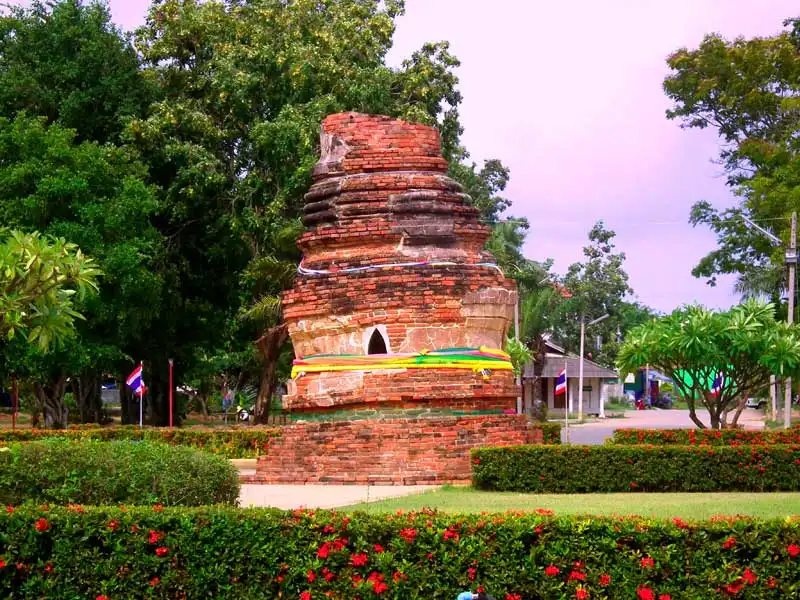
What gives Ban Don Chedi particular weight is information associated with archaeological fieldwork in the area. Reports note that in a 1982 survey, a large number of human skeletal remains were found, along with objects that reflect contexts of conflict and movement, such as ancient swords, elephant jaw fragments, and horse-related equipment. Ruins of an Ayutthaya-period chedi were also identified. When multiple categories of evidence appear together in one place, it becomes more reasonable to interpret the area as having witnessed violence or confrontation in the past. This is the point where Ban Don Chedi differs from locations sustained only by “stories” without material corroboration: here, the layers of memory and evidence sit side by side and invite you to think like a landscape reader.
At the same time, interpreting evidence requires methodological caution. A large number of skeletal remains does not automatically identify one specific event; it indicates that “many deaths occurred here,” which could relate to warfare, disease, or other forms of upheaval if detailed supporting data is absent. High-quality storytelling therefore rests on a simple principle: “respect the evidence,” and leave room for uncertainty where certainty cannot be justified. Ban Don Chedi suits travelers who want deeper historical understanding—not only listening to an inherited narrative, but thinking through what the evidence can and cannot reliably tell us.
On the ground, visitors often sense that Ban Don Chedi is a community-area site accessible by car, with clear references to major roads such as Highway 323, an important route connecting Kanchanaburi to the western zone. Once you arrive, the most meaningful approach is not to take a quick photo and leave, but to spend time “reading the surroundings.” Start by observing road alignments and directions of movement that connect the community to adjacent districts, then look for architectural traces or chedi remains associated with the Ayutthaya period. Seeing the site through this lens helps you understand why this area may have been a practical corridor for many people—and why a confrontation could plausibly occur here in spatial terms.
The significance of Ayutthaya-period chedi remains is that they suggest the land is not simply an empty field, but a place where religious or commemorative construction was established within the relevant era. When considered alongside objects such as swords, horse equipment, and elephant jaw fragments, the picture of war-related activity becomes more intelligible, because elephants and horses were meaningful components of movement and combat in certain pre-modern contexts. Even so, the most responsible way to present this story is without sensationalism, and without turning loss of life into entertainment. Ban Don Chedi is not a place for spectacle; it is a place for understanding.
From a visitor’s perspective, what Ban Don Chedi offers is a highly human form of learning. You begin to see war not as a name of a battle or a Buddhist-era year on a page, but as something that happened to real people in a real landscape. Walking through an area reported to contain so many remains naturally makes you pause and consider the cost of conflict in a way textbooks rarely convey. That is precisely why historical travel can matter: it reminds us that history is not only about victories, but also about lives lost in large numbers.
If you want the trip to feel genuinely “worth it” in terms of insight, try visiting with a simple learning goal. You might aim to understand the Ayutthaya-era warfare context, the basics of archaeological field interpretation, or the way local memory is preserved. Then use direct observation as your anchor: entry points, community layout, the relationship between the temple and the school, and the broader terrain suggesting why many people could have passed through here. With this approach, Ban Don Chedi becomes more than a check-in—it becomes a thinking framework you can apply to other historical places as well.
Equally important is etiquette and responsibility when visiting places associated with war and death. Former battle landscapes should not be treated as playgrounds or content backdrops that strip away dignity. Do not litter, do not pick up objects that could be evidence, do not climb on or damage remains, and respect the community around the site. These are baseline practices that keep historical tourism sustainable. Ban Don Chedi is best visited calmly, with awareness, and with acceptance that you are there to “learn,” not to “prove” something in a way that oversimplifies complex history.
Ban Don Chedi also fits easily into broader Kanchanaburi itineraries because Phanom Thuan is not far from the city zone and the main tourism corridors. Many visitors plan a half-day to one-day visit for the Don Chedi–Phanom Thuan area, then head toward Kanchanaburi city for riverside dining, rest, or further visits to war-related museums and the historic railway on another day. Planning the trip this way gives you both the “local landscape” layer of history and the “provincial/regional picture” in one connected journey.
Getting There To reach Ban Don Chedi Archaeological Site, use Highway 323 from Bangkok or from Kanchanaburi town. Drive along Highway 323 to the Tha Muang intersection area, then turn right and continue for approximately 2 km. You will see signage indicating Don Chedi; follow the signs for a further approximately 11 km to enter Don Chedi Subdistrict. Local directions commonly note that, when you are close to the site, you should look for the turn leading behind Wat Thung Samo School, which serves as a practical reference point for finding the correct access route. If you are traveling by private car, allow a little extra time for reading signs and locating turns, and drive carefully in rainy conditions when visibility may drop or water may collect on parts of the road.
The most comfortable visiting window is from morning to late morning, or in the late afternoon, when the sun is less intense and walking is more pleasant. If you want to read the landscape carefully, bring drinking water, a hat, and comfortable walking shoes. Learning at a place like this rarely happens from standing in one spot; it comes from walking slowly, observing how elements relate to each other, and connecting what you know with what you can actually see. With that mindset, Ban Don Chedi tends to leave you with a deeper understanding than surface-level memory, and makes your Kanchanaburi trip feel more meaningful.
Ultimately, Ban Don Chedi does not only ask you to remember a battle name; it invites you to understand that major historical events often cast the shadow of countless ordinary lives behind them. The evidence reported from this area underscores violence and loss without needing harsh language. Simply knowing that many remains, weapons, movement-related objects, and Ayutthaya-era architectural traces were found here is enough to make you leave with respect for the past—and with a clearer sense that “history is about real people,” not only famous names or dates.
| Place Name | Ban Don Chedi Archaeological Site |
| Location | Don Chedi Subdistrict, Phanom Thuan District, Kanchanaburi |
| Address | Don Chedi Subdistrict, Phanom Thuan District, Kanchanaburi 71140 |
| Place Summary | A community-area archaeological site where reports describe extensive finds from field survey work (including human remains, weapons, and movement-related objects) alongside Ayutthaya-period chedi remains. The area is therefore discussed in spatial relation to Ayutthaya-era battlefield context and is well suited to learning-based travel focused on reading landscape and evidence. |
| Highlights | A war-history landscape told through archaeological evidence, Ayutthaya-era chedi traces in the same context as major finds, convenient access with easy itinerary connections within Kanchanaburi, best experienced as a calm and respectful learning visit |
| Open Days | Open daily |
| Opening Hours | 09:00 – 17:00 |
| Current Status | A historical learning site within a community area, open for visits during operating hours |
| Travel | Use Highway 323 to the Tha Muang intersection area, turn right for about 2 km, then follow signs toward Don Chedi for a further about 11 km. Local directions commonly reference turning in behind Wat Thung Samo School to access the area correctly. |
| Local Inquiry Contact | Don Chedi Subdistrict Municipality Tel. 034-540-442 |
| Nearby Tourist Attractions (With Distance) | 1) King Naresuan the Great Monument (approx. 2 km) 2) Wat Thung Samo (old ordination hall) (approx. 5 km) 3) Wat Ban Noi (old ordination hall) (approx. 6 km) 4) Wat Phra Thaen Dong Rang Worawihan (approx. 18 km) 5) Bridge over the River Kwai (approx. 38 km) |
| Nearby Restaurants (With Distance + Phone) | 1) Keeree Tara Restaurant (approx. 38 km) Tel. 034-513-855 2) Krua Chuk Don (approx. 37 km) Tel. 034-620-548 3) On's Thai Issan Vegetarian Restaurant (approx. 38 km) Tel. 087-364-2264 4) Keeree Mantra Restaurant (approx. 39 km) Tel. 034-540-889 5) By De River (approx. 38 km) Tel. 085-405-9161 |
| Nearby Accommodations (With Distance + Phone) | 1) Felix River Kwai Resort (approx. 40 km) Tel. 034-551-000 2) U Inchantree Kanchanaburi (approx. 39 km) Tel. 034-521-584 3) Dheva Mantra Resort (approx. 42 km) Tel. 034-615-999 4) Royal River Kwai Resort & Spa (approx. 41 km) Tel. 086-313-4273 5) Good Times Resort Kanchanaburi (approx. 38 km) Tel. 034-512-142 |
Frequently Asked Questions (FAQ)
Q: When is the best time to visit Ban Don Chedi Archaeological Site?
A: Morning or late afternoon is recommended because the weather is more comfortable, making it easier to walk and observe the surroundings without rushing.
Q: How much time should I plan to spend here?
A: If you want to read the landscape carefully and visit at a thoughtful pace, plan at least 1.5 – 3 hours to absorb the context and observe how the area relates to the surrounding community.
Q: Is the site suitable for children or older visitors?
A: Yes, especially if you keep the visit relaxed. Bring drinking water and a hat, and choose a walking distance that matches everyone’s comfort, avoiding the hottest midday hours.
Q: If I want to “read the site” for meaningful understanding, what should I pay attention to?
A: Observe the directions of movement and community layout, reference points such as the temple and the school, and any architectural traces. Then connect those observations with what has been reported as evidence found in the area, keeping conclusions evidence-led and reasonable.
Q: Where should I go next to make the trip more worthwhile?
A: You can continue in the Phanom Thuan area, such as Wat Phra Thaen Dong Rang Worawihan, then head into Kanchanaburi city to visit the Bridge over the River Kwai and riverside areas, creating a single trip that blends local history with the wider provincial narrative.
 Ban Don Chedi Archaeological Site Map
 Category:
  Group:
  Tag: ●Ban Don Chedi Archaeological Site●ban don chedi archaeological site ●don chedi phanom thuan ●kanchanaburi historical attractions ●ayutthaya period ruins ●war history kanchanaburi ●things to do in kanchanaburi ●historical site in thailand ●thailand archaeology site ●naresuan legend site ●kanchanaburi day trip Last Update: 2 MonthAgo
Comment
 Nearby Attractions
| Keyword (Advance) |
 Region
|
 Muang Kanchanaburi(
 Copyright 2012,