

 Home
Home Chiang Mai(







Muang Sing Historical Park (Prasat Muang Sing)
Rating: 3.8/5 (4 votes)
 Search By
  Map
Map 
 Have Map
  No Map
Kanchanaburi attractions
Attractions in Thailand
Open Days: Open daily
Opening Hours: 08:00 – 17:00
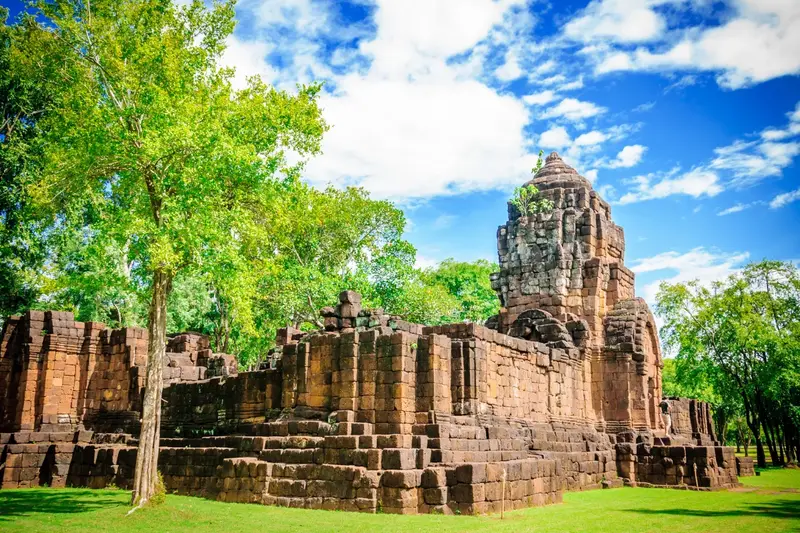
Muang Sing Historical Park (Prasat Muang Sing) is one of those places that makes a trip to Kanchanaburi feel “deeper” than simply admiring rivers and mountains. This is an ancient city on the banks of the Khwae Noi River where the traces remain remarkably legible—its city plan, ramparts and moat system, and a group of Khmer-style religious monuments that clearly reflect the region’s artistic and spiritual influence. Walking into Muang Sing can feel like stepping back into an era when the Khwae River basin mattered not only for travel and transport, but also for territorial control and for linking cultural networks between the Chao Phraya basin and the western reaches of the region.
What makes Muang Sing memorable from the very first moment is the atmosphere created by the long ridgelines that wrap around the area. When you stand close to the laterite city wall and look outward, the landscape explains itself: why people in the past chose to settle here and build a city at this position. The Khwae Noi River flowing past is not merely a water source; it is also a lifeline for movement and trade. Meanwhile, the mountains and rolling terrain form a natural “backdrop” that works like a protective barrier. Muang Sing is therefore not simply an archaeological site in the forest, but an urban landscape that is intimately connected to nature—and the more you walk, the more you sense that every component was placed so the city could genuinely function.
The city’s layout takes the form of a rectangle, which makes it easy for visitors to read the defensive system and the way space was allocated inside. The laterite wall measures roughly 800 meters in width and about 850 meters in length, with an approximate height of 7 meters. There are four gates, one on each side, and an earthen embankment and moat surrounding the city. The design feels “complete”: wall, moat, gates, and interior zones that support activities within—religious areas, water resources for daily life, and living spaces. Especially notable are the six ponds inside the city, reinforcing that water management was central to ancient urban planning, whether for practical use, seasonal resilience, or as part of religious concepts embedded in sacred spaces.
When it comes to the “history of Muang Sing,” many travelers gradually realize during their walk that this city did not emerge in isolation. It stands as evidence of a Khmer cultural network that once extended into the Kanchanaburi area. Interpretations based on its art and architectural remains often connect Muang Sing to Bayon-style influence and the era of King Jayavarman VII, associated with Mahayana Buddhism. Seeing architectural fragments and the structural elements of the temples here helps you understand that “Kanchanaburi” in the past was not a quiet periphery; it was part of a larger regional picture. Muang Sing functioned both as a religious complex and as a point where power was anchored through architectural symbolism.
Walking around the park also makes clear that Muang Sing’s significance is not limited to a single “prasat” (temple). It is the fact that it remains a “city” with an intact system you can still learn from. The laterite wall, though weathered by time, still lets you imagine an orderly city with defined boundaries. The four gates invite thoughts about regulating entry and exit and connecting to outside routes. The moat and embankment serve both as defense and as infrastructure tied to seasonal drainage. And looking back inward, you notice how the ponds are distributed in ways that align with the city’s internal use of space, rather than appearing as random excavations without meaning.
For the key archaeological monuments, the best experience is to walk slowly and “read” the site instead of rushing for photos and moving on. Details in the laterite blocks, doorways, base lines, and architectural fragments are like text that tells the past. Even where only foundations or walls remain, close observation reveals why forms were chosen: how entrances were arranged, how sacred zones were defined, how raised bases signaled religious concepts, and how materials suited local terrain and resources. In this way, Muang Sing becomes an open-air classroom in ancient architecture that feels genuinely accessible.
In terms of “cultural meaning,” Muang Sing helps explain how religion and art once worked as tools to create unity and legitimacy. The Mahayana Buddhist concept expressed through certain temple forms and artistic traces makes this place feel distinct from many better-known sites in central Thailand. Standing among the temple ruins and the city wall, you can sense the intentional effort to make this landscape sacred in its own way. While time has softened some details, the larger structure still communicates the builders’ original intent with surprising clarity.
Another charm of Muang Sing is its quietness and unhurried rhythm. The area is fairly expansive, so visitors can choose a comfortable walking pace. A good approach is to begin at the information point or on-site museum to “set your understanding,” then follow the path outward to the temple group and along the city wall. This creates a continuous storyline in your mind—from the big picture of the city plan to the fine-grained texture of laterite blocks—until you return to the essential questions: what role did this city play in its time, and why does it still matter today?
The best time to visit is in the morning or late afternoon. The light brings out depth in the laterite surface, and shadows along the wall and temple bases add dimension to photographs. The weather is also more comfortable than midday heat, especially if you plan to walk sections of the wall or explore the ponds. Bringing water, a hat, and comfortable walking shoes is recommended. Just as important are respectful visiting practices: do not climb the bases or walls, do not touch or move fragments, do not write or scratch surfaces, and do not litter. These monuments are not merely photo backdrops—they are shared historical evidence that deserves collective care.
Although Muang Sing is a historical destination, it pairs naturally with nature and local-life travel. The Sai Yok area includes waterfalls, the historic railway corridor, river viewpoints, and other cultural sites. Planning a 1-day or 2-day trip is therefore straightforward. If you want a well-balanced itinerary, you can start the morning at Muang Sing for historical context, then continue in the afternoon to a natural attraction or to places connected with World War II history in the same zone. This creates a coherent “storyline” for a full day in Kanchanaburi.
Getting There Muang Sing Historical Park is located in Sing Subdistrict, Sai Yok District, Kanchanaburi. The most common route is via Highway 323 (Kanchanaburi–Sai Yok). Around kilometer 15, look for the left turn toward Prasat Muang Sing, then continue for about 7 kilometers to reach the park. Overall, the drive is easy and signage appears along the way, making it convenient for private vehicles. If you do not have a car, you can plan for local hired transport or a private car service from Kanchanaburi or Sai Yok, especially if you intend to combine multiple nearby attractions in a single day.
In the end, “Muang Sing” is a place that lets you witness the scale of the past through what still stands today—an intelligible city plan, laterite walls that continue to tell a story of defense, moat-and-embankment systems that reveal how people once worked with nature, and temple ruins that express cross-cultural artistry and belief. If you want a Kanchanaburi trip that is more than a checklist of stops, Muang Sing is a destination worth walking slowly, letting the landscape tell its own history.
| Place Name | Muang Sing Historical Park (Prasat Muang Sing) |
| Location | Sing Subdistrict, Sai Yok District, Kanchanaburi |
| Address | Sing Subdistrict, Sai Yok District, Kanchanaburi 71150 |
| Place Summary | An ancient riverside city on the Khwae Noi River where the rectangular city plan, laterite walls, moat system, and Khmer-style religious monuments remain clearly readable—ideal for slow, immersive historical exploration. |
| Highlights | Rectangular city plan and laterite walls, encircling moat and embankment, 6 ponds inside the city, temple ruins and traces of art linked to Khmer influence |
| Open Days | Open daily |
| Opening Hours | 08:00 – 17:00 |
| Fees | Thai nationals: 20 THB, foreign visitors: 120 THB, car: 50 THB (other vehicle rates may apply as posted on-site) |
| Current Status | Open to visitors during operating hours |
| Getting There | Take Highway 323 (Kanchanaburi–Sai Yok) to around km 15, turn left toward Prasat Muang Sing, then continue about 7 km. |
| Contact Number | 034-670-264-5 |
| Nearby Tourist Attractions (With Distance) | 1) Mallika R.S.124 (approx. 6 km) Tel. 034-540-884 2) Sai Yok National Park (approx. 45 km) Tel. 034-686-024 3) Sai Yok Noi Waterfall (approx. 50 km) Tel. 034-686-024 4) Hellfire Pass Interpretive Centre (approx. 80 km) Tel. 034-919-605 5) Erawan National Park (approx. 95 km) Tel. 034-574-222 |
| Nearby Restaurants (With Distance + Phone) | 1) Baan Kafae (approx. 6 km) Tel. 081-763-7792 2) Krua Asa (wild cuisine) (approx. 9 km) Tel. 092-775-1978 3) Krua Phak Wan Baan Rai Naropadin (approx. 12 km) Tel. 086-384-1450 4) ImmSook SteakHouse (FM Cafe / ImmSook SteakHouse) (approx. 14 km) Tel. 098-437-4700 5) Bambooglamping Cafe&Camping (approx. 18 km) Tel. 090-899-6424 |
| Nearby Accommodations (With Distance + Phone) | 1) Yoko River Kwai Resort (approx. 40 km) Tel. 081-880-1002 2) River Kwai Resotel (approx. 55 km) Tel. 081-734-5238 3) The FloatHouse River Kwai (approx. 55 km) Tel. 084-725-8686 4) Hintok River Camp at Hellfire Pass (approx. 80 km) Tel. 081-754-3898 5) Home Phutoey River Kwai Resort (approx. 75 km) Tel. 081-817-5182 |
Frequently Asked Questions (FAQ)
Q: When is the best time to visit Muang Sing Historical Park?
A: Morning or late afternoon is recommended for cooler weather and more dimensional light on the laterite surfaces, especially if you plan to walk around the walls and moat.
Q: How many hours should I plan for the visit?
A: Allow at least 1.5–3 hours for an unhurried walk to see the city plan, walls, moat, ponds, and temple ruins.
Q: Is the site suitable for children and older visitors?
A: Yes, but choose walking distances appropriately, bring drinking water and a hat, avoid strong midday heat, and take breaks as needed.
Q: What etiquette should visitors follow at the ruins?
A: Do not climb on walls or bases, do not touch or move fragments, do not write on surfaces, and keep the area clean—each element is historical evidence.
Q: If I plan a one-day trip, what can I combine with Muang Sing nearby?
A: You can continue around Sai Yok, such as Mallika R.S.124 or Sai Yok Noi Waterfall, and if you have an extra day, extend to Sai Yok National Park or the Hellfire Pass Interpretive Centre.
 Muang Sing Historical Park (Prasat Muang Sing) Map
 Category:
  Group:
  Tag: ●Muang Sing Historical Park (Prasat Muang Sing)●muang sing historical park ●prasat muang sing ●muang sing kanchanaburi ●sai yok attractions ●kanchanaburi attractions ●kanchanaburi historical sites ●khmer ruins thailand ●bayon style ●khwae noi river ●things to do in sai yok Last Update: 1 DayAgo
Comment
 Nearby Attractions
| Keyword (Advance) |
 Facebook Fanpage
 Region
 Landmarks and Memorials(
 Art, Craft Centres, Tradition(
 Museums(
 Art Gallery(
 University
 Places of Worship
 Temple(
 Church(
 Other religious and spiritural sites(
 Research and Development
 Royal Project(
 Suburban Living
 Village, Community(
 Local Market(
 Nature and Wildlife
 National Parks and Marine Reserves(
 Mountain (Doi)(
 Dam, Reservoir, Lake(
 Waterfalls(
 Hot Springs(
 Caves(
 River, Canal(
 Other natural attractions(
 Entertainment and Agricultural
 Zoos and Aquariums(
 Animal camps and shows(
 Farm, Parks, Gardens and Ecotourism(
 Cinema(
 Outdoor and Adventure Activities(
 Travel Articles, Recipes
 Travel Review, Food Review(
 Copyright 2012,