
lovethailand home >Central Travel Attractions >Kanchanaburi Travel Attractions >Phanom Thoan >Don Chedi > King Naresuan the Great Monument
TL;DR: King Naresuan the Great Monument is located at Near Don Chedi Historical Site, Phanom Thuan District, Kanchanaburi Province (the “Don Chedi” area), open Daily, hours 08:30 – 16:30.
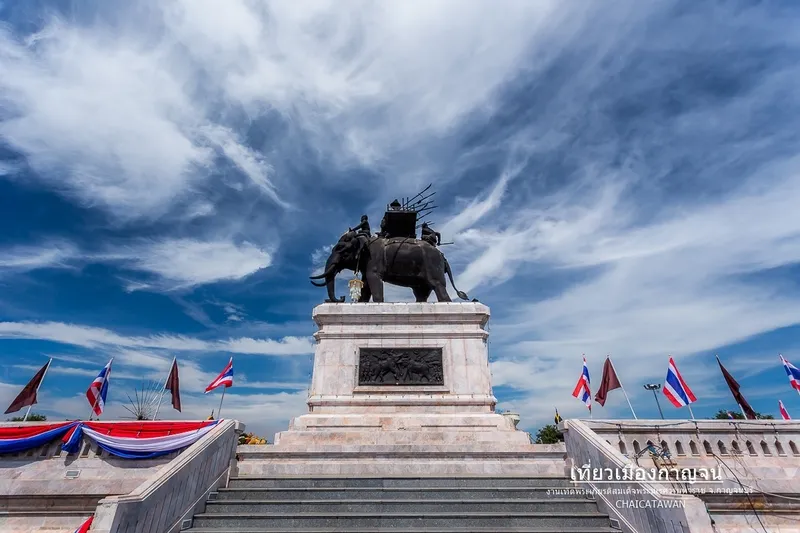
King Naresuan the Great Monument
Open Days: Daily
Opening Hours: 08:30 – 16:30
King Naresuan the Great Monument in Kanchanaburi Province is a historical memorial site that does far more than stand as a “significant statue.” It functions as a place where Thai society connects its shared memory of restoring national independence, courage, and the leadership of a warrior-king from the Ayutthaya period. The monument is situated in an area linked to historical narratives and archaeological traces of past warfare, and it lies near a locality that residents commonly know as “Don Chedi.” This setting means a visit is not merely about taking photos, but about “reading history through the real landscape” by walking, observing, and asking why this place has been regarded as a destination of national remembrance.
From the perspective of cultural tourism, the value of this monument is that it can tell multiple layers of story at once. The first layer is political and military history: when people mention King Naresuan the Great, the familiar image is his royal mission of restoring independence and leading wars that ultimately affirmed Siam’s sovereignty at a critical turning point in the region. The next layer is public art and modern commemoration, because the monument is a civic artwork designed to communicate a “warrior persona” through the king’s posture atop a war elephant. It also serves as a venue for remembrance rituals, which keeps the site alive—not simply an object to glance at and move on.
The context of its creation reflects the intention of the state and the public in the modern era to “underline the meaning of independence” in a public space. The core idea behind a memorial like this is to make history tangible. Younger generations can see a grand, symbolic portrayal of the king, while local communities and visitors from elsewhere can use this site as a starting point before exploring other historical attractions in Kanchanaburi. This province uniquely contains narratives from both the Ayutthaya era and World War II within the same geographic area, making Kanchanaburi a place where “multiple historical periods” overlap with unusual clarity.
The King Naresuan the Great Monument in Kanchanaburi is often explained in connection with a major historical event: the royal elephant duel (Yutthahatthi). In Thailand’s collective understanding, this event represents courage, resolve, and decisions that shaped the direction of the state. While details in historical records remain debated in academic circles, what matters for public learning and tourism is that the monument makes it easier for people to “begin a conversation with the past”—starting with fundamental questions such as what happened in that era, why conflict occurred, and how national independence influenced people’s lives over the long term.
Walking around the monument helps visitors notice the artistic language used to communicate the narrative, especially the king seated upon a war elephant. This posture is not only about grandeur; it is a “visual stand-in for warfare” in an age when elephants were a crucial military force. The war elephant therefore symbolizes power and the dignity of a warrior-king. At the same time, the surrounding components—the elephant, the mahout, and the detailed accessories—also function as learning cues that help visitors imagine the realities of warfare in the past. The meaning is not limited to the royal figure alone; it is embedded in the carefully chosen details that the sculpture decides to tell.
In terms of construction history, the monument holds a modern commemorative milestone connected to a period of honoring and remembering a major historical event. The year 1999 (B.E. 2542) is often cited as a key moment associated with remembrance of events from centuries earlier. Important ceremonial elements further elevated the monument’s “social status,” including the foundation-laying and opening ceremonies presided over by members of the royal family. This reinforced the site’s meaning as a nationally significant place, rather than merely a local attraction.
Another layer that makes this monument compelling for cultural tourism is its connection to “evidence” that the area has reportedly revealed or preserved through local accounts. Visitors may encounter references to ancient objects and items associated with warfare—such as weapons, elephant and horse ornaments, and other martial artifacts—which help people understand that the site was not selected only for symbolic reasons. It is also linked to “traces of the past” that communities have attempted to preserve by creating a public space accessible to later generations.
From a landscape and planning perspective, the site has been arranged to support remembrance ceremonies and acts of paying respect, creating an environment that is orderly, simple, and suitable for quiet walking. Many visitors come to pay respects personally; others arrive as part of school or university field trips; and many treat it as a convenient stop on a broader Kanchanaburi itinerary. Because it “accommodates many types of visitors,” the monument becomes a meeting point for different kinds of meaning—from personal reverence to academic learning and experiential travel.
To gain more value from a visit, travelers should take time to observe the sculpture closely, beginning with elements that convey “leadership”—such as a still yet forceful posture, the presence of the royal sword, and a composition that reads as a “battle scene” rather than a purely ceremonial image. From there, visitors can connect the visuals to historical understanding: why the war elephant and the elephant duel remain deeply rooted in Thai collective memory, and why society chose those symbols as the core of a memorial designed for remembrance.
A visit can also be developed into an integrated historical itinerary, because Kanchanaburi and its surroundings include archaeological sites, important temples, and modern-era historical landmarks. Travelers can design a trip that reveals the “evolution of the country” within one province: starting with Ayutthaya-era narratives associated with King Naresuan the Great, continuing to archaeological sites that reflect daily life and external contacts, and ending with World War II landmarks that offer lessons on humanity, conflict, and geopolitics. This approach turns travel into an understanding of how each era shaped Kanchanaburi’s identity, rather than simply “collecting checkpoints.”
For those interested in the social and political dimensions of memory, the monument is also an example of how society uses public space to “arrange meaning” for the past through rituals, commemorative dates, and repeated storytelling in a real location. The memorial becomes a stage where people gather on significant occasions, reaffirm shared identity, and pass on values that society seeks to preserve—such as sacrifice, loyalty, and courage. All of this is part of how society builds a “bond” between earlier generations and the present.
As a travel experience, morning visits are ideal for walking and photography in softer light, with cooler temperatures and fewer crowds. Afternoon visits suit travelers who primarily want to pay respects and then continue to other attractions. Regardless of timing, visitors should maintain appropriate etiquette and respect, because the monument is a symbolic place with deep emotional value for many. Dressing modestly, keeping noise to a minimum, and avoiding restricted areas help preserve an atmosphere suitable for remembrance and shared learning.
From an educational standpoint, the site is a strong case study for learning about “memorial-making” in modern society: what symbols are chosen, how stories are told through imagery, and how spaces are managed to support both ritual and tourism. Visitors can further ask how the image of a warrior-king is communicated to younger audiences, and how the site helps cultivate a sense of national connection through a tangible experience. This kind of learning makes the journey more meaningful than a single pass-through visit.
In the larger identity of Kanchanaburi, the King Naresuan the Great Monument is one piece that strengthens the province’s profile as a historical destination. Kanchanaburi is not defined only by the Bridge over the River Kwai or the “Death Railway”; it also holds Ayutthaya-era narratives about border relations, warfare, and troop movements. Having a memorial like this therefore helps “balance” the province’s public image with more historical diversity, and invites travelers to see Kanchanaburi as a strategic landscape from the past through the present.
Getting There is possible by private car, rental car, or hired transport from Kanchanaburi town. Most travelers begin from the city area and head toward the zone associated with Don Chedi. Having a private vehicle makes it easier to continue the trip to nearby sites, especially if you plan to stop at important temples, archaeological locations, or other historical learning points within the same day. For group travelers, hiring transport can reduce route-related hassles and improve time management.
Once on site, a practical sequence is to begin by viewing the monument and reading signage or observing the artistic details. Then, walk around to understand how the space supports different roles—such as ceremonial use, photography, or learning for students. After that, continue to nearby attractions to create a more coherent “storyline” for the day, which helps visitors remember details better than a brief stop.
Another reason this place matters in contemporary society is that it helps connect different generations. Many older visitors feel attached to the story of King Naresuan the Great through education and cultural familiarity, while younger visitors may arrive through interests in travel, photography, or content creation. When both groups share the same space, storytelling naturally emerges: older visitors share memories, while younger visitors ask questions and explore further. In this sense, the monument becomes a “bridge” for passing historical meaning forward in an approachable, lived way.
For travelers who want deeper understanding, reading Ayutthaya history alongside a visit can make the experience much clearer. It helps visitors see relationships between state power, frontier towns, and historical marching routes. With maps and the real landscape, it becomes easier to understand why the Kanchanaburi area has long functioned as a strategic corridor, and why a memorial would be placed in a location associated with memory of warfare and the affirmation of independence. This approach turns the site from a simple tourist stop into a place that reveals how history works.
Ultimately, the King Naresuan the Great Monument in Kanchanaburi is best suited for travelers seeking “meaning” more than spectacle. It offers space for remembrance, historical questioning, and understanding why narratives of independence remain powerful today. If you arrive with the intention to learn, you gain more than photographs—you gain a broader perspective on Kanchanaburi and on Thai history as an interconnected whole.
| Place Name | King Naresuan the Great Monument (Kanchanaburi) |
| Address | Near Don Chedi Historical Site, Phanom Thuan District, Kanchanaburi Province (the “Don Chedi” area) |
| Place Summary | A historical memorial honoring King Naresuan the Great’s legacy and leadership, closely associated with narratives of past warfare near the “Don Chedi” area. Well suited for historical, cultural, and educational travel. |
| Highlights | A royal statue on a war elephant symbolizing a warrior-king and courage, used for remembrance ceremonies and respectful visits, with a calm setting suited to learning history through the real landscape. |
| Period / Key Timeline | Ayutthaya Period (historical context of King Naresuan the Great) and a modern memorial created in the late 20th to early 21st century. |
| Key Historical Notes | Local narratives and references to artifacts associated with warfare in the area (such as weapons and elephant/horse ornaments) add a layer of “traces of the past” alongside a sculpture that tells the story through the war elephant and royal sword symbolism. |
| Name Meaning | Named to honor King Naresuan the Great as a symbol of independence, courage, and leadership in Thai history. |
| Travel | Accessible by private car, rental car, or hired transport from Kanchanaburi town. Follow routes toward the “Don Chedi” area in Phanom Thuan District. A private vehicle is convenient for linking multiple historical stops in one day. |
| Current Status | Open to the public for respectful visits and learning, and used for remembrance ceremonies during significant occasions. |
| Admission / Fees | No confirmed fee information provided – please verify on site before traveling. |
| Facilities | A plaza for paying respects and remembrance activities, walking areas, and photo points (service-level facility details should be verified on site). |
| Contact Number | 034-589233, 034-652166 |
| Nearby Tourist Attractions With Distance | 1) Ban Don Ta Phet Archaeological Site – 15.34 km 2) Wat Tham Suea (Tiger Cave Temple) – 14.23 km 3) Don Rak War Cemetery – 16.89 km 4) Kanchanaburi City Pillar Shrine – 16.66 km 5) Kanchanaburi City Gate – 16.78 km |
| Popular Restaurants Nearby | 1) Krua Anong (Nong Khao) – 5.92 km – 034-586107 2) Krua Chana Suek – 1 km – 065-5650484 3) Sabai Sabai Chai Thung – 2 km – 092-4654856 4) Jay Ka Dai (Meena Lae Pa Cha) – 3 km – 093-9480851 5) Som Tam Mae Bu-nga (Don Chedi) – 2 km – 085-5081581 |
| Popular Accommodations Nearby | 1) Natee The Riverfront Hotel Kanchanaburi – 17.55 km – 034-518777 2) Good Times Resort Kanchanaburi – 17.88 km – 087-1624949 3) Phutawan Kanchan Resort – 19 km – 034-670636 4) The Tryst River Kwai – 55 km – 092-7276262 5) Phu-Naphat Resort Kanchanaburi – 85 km – 099-1191192 |
Frequently Asked Questions (FAQ)
Q: Why was the King Naresuan the Great Monument built?
A: It was built to honor King Naresuan the Great’s legacy, leadership, and role in restoring independence, and it also serves as a shared memorial space for Thai society.
Q: What is the key artistic highlight of this monument?
A: The standout feature is the royal statue atop a war elephant, which communicates the warrior-king symbolism and the historical meaning of warfare through carefully designed sculptural details.
Q: How long should visitors plan to spend here?
A: Most visitors should allow about 30 – 60 minutes for paying respects, observing the details, and taking photos, then continue to nearby historical sites if desired.
Q: What type of trip is this place best suited for?
A: It is well suited for historical and cultural tourism, learning-focused travel, and educational field trips, as well as visitors interested in memorial spaces and collective memory.
Q: What etiquette should visitors follow while visiting?
A: Dress modestly, keep noise to an appropriate level, respect other visitors who come to pay respects, and avoid entering restricted areas to help maintain the site’s dignity.
Q: Are there recommended nearby places to visit afterward?
A: Yes. Suggested stops include Ban Don Ta Phet Archaeological Site, Wat Tham Suea, the Kanchanaburi City Pillar Shrine, and other historical learning points in Kanchanaburi town for a multi-era itinerary in one day.
Q: Is it convenient to travel here from Kanchanaburi town?
A: Yes. Traveling by private car, rental car, or hired transport is convenient, and the site can be combined with other attractions as a half-day or full-day route.
 Category: ●Art, Culture and Heritage
 Group: ●Landmarks and Memorials
Last Update : 7 MonthAgo
 Last Update : 7 MonthAgo
 Click to Access the Navigation Map GPS
King Naresuan the Great Monument Map
Recommend

 Historical Sites and Monuments(13)
Landmarks and Memorials(5)
Historical Sites and Monuments(13)
Landmarks and Memorials(5)
 Art, Craft Centres, Tradition(7)
 Museums(7)
 Art Gallery(1)
 Places of Worship
 Temple(37)
 Church(2)
 Other Sacred Sites(6)
 Research and Development
 Royal Project(1)
 Suburban Living
 Village, Community(5)
 Local Market(1)
 Nature and Wildlife
 National Parks and Marine Reserves(11)
 Mountain (Doi)(6)
 Dam, Reservoir, Lake(9)
 Waterfalls(19)
 Hot Springs(3)
 Caves(20)
 River, Canal(3)
 Other natural attractions(4)
 Entertainment and Agricultural
 Zoos and Aquariums(2)
 Animal camps and shows(4)
 Farms, Parks and Ecotourism(11)
 Cinema(1)
 Outdoor and Adventure Activities(2)
 Travel Articles, Recipes
 Travel Review, Food Review(1)


