
lovethailand home >Central Travel Attractions >Kanchanaburi Travel Attractions >Tha Muang >Wang Khanai > Wat Wang kanai Ai Yi Ka Ram Hot Water
TL;DR: Wat Wang kanai Ai Yi Ka Ram Hot Water is located at Wat Wang Khanai Thayikaram, Wang Khanai Subdistrict, Kanchanaburi Province, open Open Daily, hours 05.00 – 21.00 (Hours may change depending on local announcements).
Wat Wang kanai Ai Yi Ka Ram Hot Water
Open Days: Open Daily
Opening Hours: 05.00 – 21.00 (Hours may change depending on local announcements)
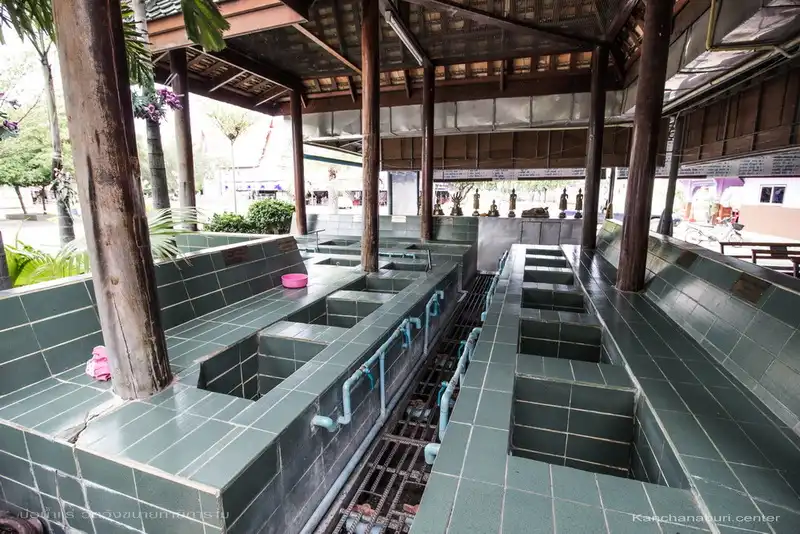
Wat Wang Khanai Thayikaram Hot Well is a place that surprises many visitors, because a “mineral hot spring inside a temple” can genuinely function as a practical place to rest while also feeling calmer than many commercial hot springs. The pool is located within Wat Wang Khanai Thayikaram in Wang Khanai Subdistrict, Kanchanaburi Province, in the Nong Khao community area, where the atmosphere still reflects a simple local way of life. When you arrive, you immediately sense the tone of a religious site: everything feels polite, gentle, and unhurried. Conversations are naturally quieter than usual, most people use the area respectfully, and many families choose this spot because it feels safe, clean, and clearly organized for real use.
The charm of Wat Wang Khanai Thayikaram Hot Well is not about luxury or resort-style decoration. It is the straightforward experience itself. You arrive, change into suitable clothing, and let the warmth of the water ease the tightness in your body. For travelers who have been on the road for hours or have already spent the day doing activities, the shoulders, back, and legs that feel stiff from sitting and moving around often begin to relax without effort. Because it is within temple grounds, the surrounding environment feels calmer than crowded tourist spots, making it ideal for anyone who wants to “recharge” in a simple but effective way.
Another reason this place feels credible to travelers is the repeated mention of evidence-based information about the hot water and its mineral content in various local travel sources. The direction of development became clearer when the site was coordinated with geological-resource agencies and when the water quality began to be discussed in a more systematic way. The story of development is also linked to cooperation between monks, the community, and local stakeholders. As a result, today’s visit is not only about “stopping by to soak,” but also about experiencing a community space that has gradually developed without losing its original roots.
According to the widely shared local history, the hot well is connected to a project to drill a hot-water well in front of the temple in 1997 (B.E. 2540). Many accounts mention the role of Phra Khru Kanchana Suttakhom in coordinating the work in the area. Later, in 1998 (B.E. 2541), the temple arranged a community forum to gather residents’ opinions on village development and how local resources should be used. In that process, there are also accounts of private-sector stakeholders suggesting that water samples be sent to an academic institution for analysis, so that scientific data could support development planning. When these stories are placed together, the hot well becomes more than a relaxation spot: it reflects a gradual, community-based approach to using natural resources within the setting of a temple and village life.
Travel sources often describe the water temperature in a range of about 40 – 45 degrees Celsius, a level that many adults can enjoy comfortably if they soak appropriately and do not push their bodies too far. At this warmth, the sensation tends to feel more “skin-hugging” than painfully hot, making it suitable for relaxing muscles after travel or after a day of activities, such as walking around Kanchanaburi town, driving between cafés in Tha Muang District, or returning from nature trips in the Sai Yok area and stopping here before heading back to accommodation.
What makes discussion about this hot well especially interesting is the “set of water-analysis values” that appears in local information and some published materials. These accounts mention values such as pH 6.15, conductivity 1.20 mS/cm, total hardness 740 ppm, and total solids 740 ppm. They also note minerals detected at different levels, including zinc (Zn) 0.002 ppm, copper (Cu) less than 0.005 ppm, sodium (Na) 30 ppm, calcium (Ca) 150 ppm, magnesium (Mg) 36 ppm, iron (Fe) 0.02 ppm, chloride (Cl) 6 ppm, manganese (Mn) 0.17 ppm, nitrate (NO3) 0.09 ppm, alkalinity 1430 ppm, and turbidity 1. Having figures like these helps many visitors feel that, at minimum, the water has been examined and discussed with reference data rather than only being described through vague word-of-mouth. While health claims should remain within an appropriate frame, for general travelers these details can increase confidence that the hot water is treated as something worth understanding and managing carefully.
That said, soaking in hot water should not be treated as a medical cure, because everyone’s body condition differs. The priority should be a “safe and relaxing experience.” A simple guideline that works for most people is to soak briefly, rest often, and listen to your body. Many visitors soak for about 10 – 15 minutes per round, then step out to rest in the shade, allowing the body to cool down gradually and drinking water to replace fluids lost through sweating. If you still feel comfortable, you can soak again. Staying in too long without resting, especially on hot days or for people who are sensitive to temperature changes, can cause dizziness, fatigue, or palpitations. If you feel faint, short of breath, or unwell, it is best to exit immediately and rest until you feel normal again.
For families traveling with small children, the most suitable approach is to let children start by soaking their feet or soaking only very briefly, with close adult supervision at all times, because warm water can cause sweating without children noticing. Older adults or anyone with chronic conditions such as high blood pressure or heart-related issues should avoid long soaking sessions and assess their body condition each time. It is also helpful to avoid standing up too quickly after soaking, because the body may not adjust fast enough. The guiding idea is not to soak for the longest time possible, but to achieve “comfort that feels right,” and return home safely.
Because the hot well is located within a temple, proper etiquette is essential and is the core reason the place can continue to serve the community sustainably. Visitors should dress respectfully before and after soaking, keep voices low, and avoid behavior that is inappropriate for a religious site. Most importantly, do not use soap, shampoo, or cleaning products in the pool, as this can affect water quality and the surrounding environment. Help keep the area clean, do not litter, and take all personal items back out with you. The simplicity and quietness here are what many people love and what brings them back, so using the space thoughtfully helps preserve that character for others.
Getting There If traveling by private car, most visitors start from Kanchanaburi town and drive toward Tha Muang District using the main local roads, then follow navigation to “Wat Wang Khanai Thayikaram.” Once you arrive at the temple, you can find the hot-well area within the temple grounds. For a more comfortable experience, many travelers avoid the strongest midday sun if they do not like heat buildup, and choose early morning or late afternoon when the air is cooler, making the warm-water soak feel especially pleasant. If traveling as a family, allowing extra time to rest after soaking and to drink water makes the visit smoother and more enjoyable for everyone.
For travelers without a private vehicle, a practical option is to reach Kanchanaburi town first, then take public transport or a van service toward Tha Muang District, and finally use local hired transport to get to Wat Wang Khanai Thayikaram. This method can be suitable for those who do not want to drive, but it requires extra time and a clear plan for the return trip, especially if you intend to return to Kanchanaburi town on the same day.
If you want a “complete” trip without rushing, a good pattern is to make the hot well your main activity in the morning or evening, then continue with temple visits or a short stop in the Nong Khao community area to experience local life. After that, you can choose a restaurant in Tha Muang District or a relaxed café before returning to accommodation or heading back to Kanchanaburi town. This style suits travelers who truly want to rest, do not want to sprint through multiple spots, and prefer to let the body “reset” gradually.
In terms of value, Wat Wang Khanai Thayikaram Hot Well suits many kinds of travelers: working people who want a gentle nearby escape, long-distance drivers who want to loosen their muscles before heading home, or families who want an affordable and calm warm-water soak for older relatives. The most useful items to bring are a towel, a change of clothes, sandals, drinking water, and a small bag for personal waste. When you come prepared and choose the right time, you get a simple experience that often feels better than expected — the kind many people describe as “good for the mind and good for the body,” without needing anything complicated.
| Name | Wat Wang Khanai Thayikaram Hot Well |
| Location | Wat Wang Khanai Thayikaram, Wang Khanai Subdistrict, Kanchanaburi Province |
| Address | Nong Khao community area, Wang Khanai Subdistrict, Tha Muang District, Kanchanaburi (Please confirm the navigation point “Wat Wang Khanai Thayikaram” before departure) |
| Overview | A hot well within temple grounds that is open for public use. The atmosphere is calm and respectful, with discussions and references to water analysis and community-based development. Suitable for a warm-water soak for relaxation without rushing. |
| Highlights | A quiet hot well in a temple setting, mentions of water-quality/mineral analysis data, warm temperature suitable for soaking, appropriate for families and older visitors when soaking responsibly, an easy relaxation trip near Kanchanaburi town. |
| Period | Local accounts mention drilling and development in 1997 – 1998 (B.E. 2540 – 2541), with later development as a public-use site. |
| Key Evidence | Accounts mention water-analysis values such as pH 6.15, conductivity 1.20 mS/cm, total hardness 740 ppm, total solids 740 ppm, and multiple minerals at different levels, along with a water temperature around 40 – 45°C (as described in travel sources). |
| Abbot / Current Supervisor | Phra Khru Kanchana Suttakhom (commonly cited in local/community travel information related to development) |
| Travel | By Car: Drive from Kanchanaburi town toward Tha Muang District and navigate to “Wat Wang Khanai Thayikaram”; the hot well area is within the temple grounds. By Public Transport: Reach Kanchanaburi town → travel to Tha Muang → use local hired transport to the temple. |
| Current Status | Open for visits and public use (please check the latest local announcements before traveling) |
| Facilities | Hot-well soaking area, resting/changing area, toilets (on-site details may vary depending on management) |
| Fees | Typically donation-based (please check the latest on-site notice) |
| Contact | 034-611-022, 087-998-4311, 081-736-1707 |
| Popular Accommodations Nearby | 1) Tha Muang Hotel (Approx. 10 km) Tel. 034-611-251 2) Monsane River Kwai Resort & Spa (Approx. 18 km) Tel. 034-604-604 3) The Vista Pool Villa (Approx. 20 km) Tel. 082-492-2228 4) By Hotel Kanchanaburi (Approx. 26 km) Tel. 092-901-7722 5) By Hotel Kanchanaburi (Reservations/Info) (Approx. 26 km) Tel. 034-512-598 |
| Popular Restaurants Nearby | 1) King Phai Bai Tong Garden Restaurant (Approx. 12 km) Tel. 081-803-0109 2) View Suay Nam Sai Floating Restaurant (Approx. 20 km) Tel. 088-544-5757 3) View Suay Nam Sai Floating Restaurant (Reservations/Info) (Approx. 20 km) Tel. 098-268-2721 4) Mor Chu Restaurant, Phang Tru Branch 1 (Approx. 16 km) Tel. 081-018-7630 5) Rica Coffee Thamuang (Approx. 11 km) Tel. 093-635-4198 |
| Nearby Tourist Attractions | 1) Wat Tham Suea (Approx. 18 km) 2) Wat Tham Khao Noi (Approx. 18 km) 3) Kanchanaburi Skywalk (Approx. 28 km) 4) Bridge Over the River Kwai (Approx. 30 km) 5) Don Rak War Cemetery (Approx. 29 km) |
Frequently Asked Questions (FAQ)
Q: Who is Wat Wang Khanai Thayikaram Hot Well best for?
A: It suits travelers who want a calm, unhurried soak, especially long-distance drivers or anyone seeking a gentle activity near Kanchanaburi town. It can also work well for families who want a quiet warm-water soak for older relatives in a respectful temple atmosphere.
Q: How long should I soak for comfort and safety?
A: Many visitors soak for about 10 – 15 minutes per round, then rest and drink water before soaking again if they still feel comfortable. If you feel dizzy, unusually tired, or experience palpitations, exit immediately and rest until you feel normal.
Q: Can children and older adults soak here?
A: Yes, but children should start with foot soaking or very short sessions and must be supervised closely. Older adults should take frequent breaks, avoid overly hot soaking, and prioritize comfort, especially if they are sensitive to temperature changes.
Q: What etiquette should I follow when using a hot well inside a temple?
A: Dress respectfully before and after soaking, keep voices low, do not litter, and do not use soap, shampoo, or cleaning products in the pool. Please respect the religious setting and other visitors at all times.
Q: How do I get there if I do not have a private car?
A: Travel to Kanchanaburi town first, then take public transport or a van toward Tha Muang District. From there, use local hired transport to reach Wat Wang Khanai Thayikaram. Plan extra time and confirm your return trip in advance if you are traveling in one day.
Q: Is it open every day, and what time is best to visit?
A: It is generally open daily. Early morning or late afternoon is often the most comfortable time because the outside air is cooler, making the warm soak feel especially pleasant. If visiting midday, drink enough water and take breaks.
Q: What should I bring for a comfortable visit?
A: Bring a towel, a change of clothes, sandals, drinking water, and a small bag for personal waste. Being prepared helps keep your visit smooth and supports cleanliness within the temple area.
Mobile : 0810051355
 Mobile : 0810051355
 Category: ●Nature and Wildlife
 Group: ●Hot Springs
Last Update : 8 MonthAgo
 Last Update : 8 MonthAgo
 Click to Access the Navigation Map GPS
Wat Wang kanai Ai Yi Ka Ram Hot Water Map
Recommend

 Art, Culture and Heritage
 Historical Sites and Monuments(13)
 Landmarks and Memorials(5)
 Art, Craft Centres, Tradition(7)
 Museums(7)
 Art Gallery(1)
 Places of Worship
 Temple(37)
 Church(2)
 Other Sacred Sites(6)
 Research and Development
 Royal Project(1)
 Suburban Living
 Village, Community(5)
 Local Market(1)
 National Parks and Marine Reserves(11)
 Mountain (Doi)(6)
 Dam, Reservoir, Lake(9)
 Waterfalls(19)
Hot Springs(3)
Waterfalls(19)
Hot Springs(3)
 Caves(20)
 River, Canal(3)
 Other natural attractions(4)
 Entertainment and Agricultural
 Zoos and Aquariums(2)
 Animal camps and shows(4)
 Farms, Parks and Ecotourism(11)
 Cinema(1)
 Outdoor and Adventure Activities(2)
 Travel Articles, Recipes
 Travel Review, Food Review(1)


