
 Home
Home North(
 Chiang Mai(


Pha Sawan Waterfall
Rating: 3.3/5 (7 votes)
 Search By
  Map
Map 
 Have Map
  No Map
Kanchanaburi attractions
Attractions in Thailand
Open Days: Seasonal Opening (Closed May 1 – October 31 every year)
Opening Hours: 08:00 – 18:00
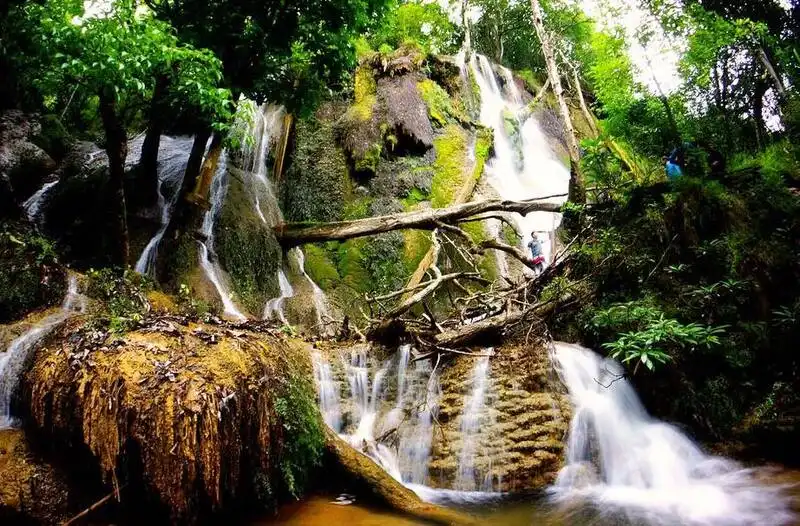
Pha Sawan Waterfall in Kanchanaburi is a large waterfall that feels “deep in the wild” even before you see the water itself. This isn’t the kind of place where you park and walk a few steps to a viewpoint like many popular waterfalls. Reaching it takes real intention—both the drive into the western forest zone and an additional hike to the main viewing area. That effort is part of what makes it special: the beauty isn’t only the waterfall, but also the surrounding forest atmosphere, the sound of wind moving through leaves before the sound of rushing water, and the feeling that you’ve truly “entered nature” rather than simply stopping by for a quick check-in.
The heart of Pha Sawan Waterfall is its seven cascading tiers. According to published travel information, the highest tier reaches roughly 80 meters, giving the waterfall a dramatic, layered presence. It’s not just “tall”—its beauty unfolds gradually along the way. Lower levels feel especially lush and humid, with intense greens fed by constant moisture, while higher tiers convey the growing force of water striking rock in heavier, more powerful rhythms. When water volume is strong, the mist and the forest wall behind the falls add depth to the scene in a way that feels unmistakably wild and alive.
If you’re the kind of traveler who loves waterfalls that feel “worth the journey,” Pha Sawan Waterfall often belongs in that category. The surrounding nature remains highly intact and hasn’t been heavily shaped into a commercial tourist site. The quiet you experience here isn’t manufactured—it’s a natural result of real conditions: access takes time and commitment. Most people who reach this place come to see “real nature,” not just to do light activities or collect quick photos.
Pha Sawan Waterfall is located in Thong Pha Phum District and lies within Khuean Srinagarindra National Park. Local agencies have published that the park was established in 1981, and being within protected national-park boundaries helps preserve a strong sense of wilderness. It also reflects the reality of managing natural areas where safety and seasonal trail recovery must be considered as part of ongoing conservation.
One essential thing to know from the start is that Pha Sawan Waterfall has an annual seasonal closure. According to multiple published sources, the area is closed to tourism from May 1 to October 31 every year. This detail matters because it’s the reason many travelers plan incorrectly and end up making the trip only to find access closed. If you were hoping to visit during the rainy season, note that this is typically when closures are enforced for safety and trail maintenance during heavy rain. As a result, the most practical travel window is usually late rainy season into early winter and through the start of the year, when conditions are safer and access aligns better with visitor safety.
Many people say the waterfall looks best from July to January in terms of “natural water conditions,” because late rainy season into early winter often brings higher water volume and intensely green forest. However, when you factor in the closure period from May 1 to October 31, if you want to catch the waterfall with strong flow similar to late rainy season, you may need to wait until late October into early November when access begins reopening, or plan for November through January when water can still be good, temperatures are more comfortable for hiking, and the trail is generally less slippery than during peak heavy rains.
Getting There The most common approach to Pha Sawan Waterfall begins from Kanchanaburi town toward Thong Pha Phum District via Highway 323 (Kanchanaburi – Thong Pha Phum). Published route descriptions suggest watching for around kilometer marker 110, passing the area near Ban Sahakon Nikhom and continuing approximately 15 kilometers before turning right into a dirt laterite track and driving on for roughly another 13 kilometers. Because this route includes unpaved sections, careful driving is important—especially where the road surface changes or where rain can create ruts. During the rainy season, a 4WD vehicle is often recommended to reduce traction risk.
Another option mentioned in travel information is to connect from Pha Tad Waterfall and then hike on for about 40 minutes to reach Pha Sawan Waterfall. This approach suits travelers who want a “waterfalls-in-one-trip” style itinerary and enjoy more walking through forest terrain, because visiting Pha Sawan is not simply a single stop-and-return location—it’s a journey with multiple stages, combining both off-road driving and a fairly deep forest hike.
There is also a connecting route from Huai Mae Khamin Waterfall, passing the Noen Sawan mining area and Saphan Lao village for roughly 42 kilometers to a junction near a reforestation project, then turning left and driving about 13 kilometers to the parking area. From there, you continue on foot for around 40 minutes. This route is often viewed as more adventurous because it includes unpaved roads and conditions that can change by season. If you are comfortable with forest driving and have experience hiking on damp, slippery trails, this option may feel more immersive. For families or first-time visitors who want the most straightforward plan, the main route from Highway 323 is usually easier to understand and follow.
Once you reach the parking area or trailhead, many visitors are surprised by how satisfying the roughly 40-minute hike can be. It’s not a casual stroll, but it also doesn’t require an all-day extreme trek. If you manage your pace well, this walk becomes part of the experience: you naturally adjust your breathing to the forest, notice the details of large trees, damp ground, the scent of leaves, and the way natural sounds sharpen as you go. This is the charm of Pha Sawan—it’s not a place that is “beautiful right beside the road,” but a place that becomes beautiful as you slowly arrive.
During the hike, the main challenge is often not only slope, but also moisture and slippery footing—especially after rain or when waterfall mist reaches the trail. Footwear and pacing matter because many waterfall accidents happen from slipping on wet rock or damp soil, not from obviously dangerous points. Walking without rushing and avoiding overtaking on narrow sections helps keep the hike safer and prevents unnecessary fatigue before you even reach the waterfall.
As you get closer, the sound of water grows louder until it becomes the dominant sound in the area. Many people notice that the “air changes”—cooler temperatures from mist and shade under large trees can be felt clearly. This is a good moment to pause briefly, reset your breathing, and continue calmly. Visiting Pha Sawan isn’t only about seeing the waterfall and leaving immediately, but about staying long enough to fully absorb the place before walking back out without rushing the experience away.
On days with strong flow, the beauty of Pha Sawan stands out through its “layered tiers.” Water cascading across multiple levels creates rhythm, spacing, and natural structure—not a single straight drop. For photography, you can capture both curtain-like water in some sections and thin streams breaking across textured rock in others, depending on flow and cliff shape. The highest tier, published as close to 80 meters, is often the point where the waterfall’s power feels most unmistakable and is a key reason many consider Pha Sawan one of Kanchanaburi’s truly “large-scale” waterfalls.
That said, being deep in forest and highly natural also means convenience will not match fully developed tourist sites. Visitors should plan realistically: allow enough time for the return hike, as damp trails often slow you down automatically, and consider entering the area early to avoid rushing. If you like photography, mornings usually offer softer light and cooler conditions, making walking easier and shooting more comfortable. In the afternoon, light can be harsher and the remaining time for the hike out becomes tighter.
For those who want to swim, forest waterfalls often have tempting spots for a refreshing dip, but assessing real conditions on-site is essential. Different tiers have different current strength, and rocks in humid environments often have algae that makes them slick. Choosing areas with gentle flow and stable footing is safer. For families, close supervision of children is important, and climbing higher rocks for photos should be avoided because the risk is rarely worth the reward of a few pictures.
In terms of value, Pha Sawan suits travelers who want the experience of “reaching nature for real” more than those who want a short stop-and-photo trip. If you enjoy walking, forest atmosphere, and waterfalls with genuine quiet, this destination often delivers high satisfaction. Everything from the laterite road and the hike to the layered waterfall tiers naturally forms a story, making one visit feel more meaningful than a quick check-in.
Regarding fees, if you enter as part of a national-park visit, the commonly published rate for Group 3 parks is 60 THB for Thai adults, 30 THB for Thai children, and 300 THB for foreign adults, 150 THB for foreign children. However, fees and conditions may change based on official announcements or seasonal management, so it’s best to confirm directly with the park for the most accurate information on your visit date.
Overall, Pha Sawan Waterfall is a destination that offers both “grandeur” and “quiet” in the same trip. It isn’t a place you visit because of hype, but a place that fits travelers who want beauty without artificial styling—who want to feel the effort of reaching forest terrain and to see a waterfall that still holds a strong sense of natural completeness. If that sounds like you, there’s a good chance Pha Sawan will become one of Kanchanaburi’s waterfalls you’ll want to revisit in a different season, to see how this “heaven in the forest” changes its face through the year.
| Place Name | Pha Sawan Waterfall |
| Overview | A large waterfall deep in forest with 7 tiers; the top tier is published at around 80 meters. Reaching the main area typically requires about a 40-minute hike and suits nature-focused travelers seeking quiet wilderness. |
| Location | Thong Pha Phum District, Kanchanaburi Province (within Khuean Srinagarindra National Park) |
| Address | Forest area within Khuean Srinagarindra National Park, Thong Pha Phum District, Kanchanaburi (follow official coordinates/meeting point as advised by staff) |
| Key Highlights | 7-tier waterfall, well-preserved nature, about 40 minutes hiking into forest, top tier published around 80 meters, quiet deep-forest atmosphere with a moderate adventure feel |
| Origin / Background | Located within Khuean Srinagarindra National Park, which has published information indicating establishment in 1981 and plays a role in conservation within Thailand’s western forest landscape. |
| Number of Tiers | 7 |
| Top Tier Height (Published) | Approximately 80 meters |
| Hiking Time | About 40 minutes (from parking/trailhead) |
| Best Time to Visit | November – January (popular for comfortable hiking and a good chance of attractive water conditions), within the general open season |
| Open Days | Seasonal Opening (Closed May 1 – October 31 every year) |
| Opening Hours (Published) | 08:00 – 18:00 |
| Entrance Fees (National Park Reference) | Typically Group 3: Thai adults 60 THB / Thai children 30 THB; Foreign adults 300 THB / Foreign children 150 THB (please verify before travel) |
| Facilities | Parking/trailhead area and park-standard management (site conditions depend on season) |
| Current Status | Open seasonally; closed May 1 – October 31 every year |
| Contact | Khuean Srinagarindra National Park Tel. +66 62-325-5498, +66 82-290-2466 |
| Nearby Attractions (Approximate Distance) | 1) Pha Tad Waterfall (18 km) 2) Hin Dad Hot Springs (20 km) 3) Thong Pha Phum Town (45 km) 4) Huai Mae Khamin Waterfall (60 km) 5) Etong Village – Pilok (85 km) |
| Nearby Restaurants (Approx. Distance + Phone) | 1) Krua Ka Kai (20 km) Tel. +66 95-227-4775 2) Thungyai Quality Coffee & Roastery (45 km) Tel. +66 97-949-6196 3) 109 Cafe Thong Pha Phum (45 km) Tel. +66 62-345-4539 4) Rose House Cafe (45 km) Tel. +66 98-561-9768 5) Krua Paed Riw Thong Pha Phum (45 km) Tel. +66 89-546-1079 6) Khao Laem Dam Fish Restaurant (50 km) Tel. +66 98-925-5909 |
| Nearby Accommodations (Approx. Distance + Phone) | 1) Nakakiri Resort & Spa (20 km) Tel. +66 83-113-8763 2) Kala Hill (22 km) Tel. +66 81-407-1938 3) Rai Thongthana Homelodge (21 km) Tel. +66 93-149-9795 4) Pha Tad Valley Resort (20 km) Tel. +66 81-801-7504 5) Vajiralongkorn Dam – Khun Saichol Villa (55 km) Tel. +66 34-598-030 |
Frequently Asked Questions (FAQ)
Q: Which months is Pha Sawan Waterfall closed, and when is the best time to visit?
A: Published information indicates the waterfall is closed from May 1 to October 31 each year. A popular window to visit is November to January, when hiking is more comfortable and there is still a good chance of attractive water conditions.
Q: How long is the hike to reach Pha Sawan Waterfall?
A: The hike is typically around 40 minutes from the parking area or trailhead, depending on trail conditions and your walking pace.
Q: How many tiers does Pha Sawan Waterfall have, and how tall is the highest tier?
A: The waterfall has 7 tiers, and published travel information notes the highest tier is approximately 80 meters.
Q: What type of vehicle is recommended to access the area?
A: Because the route includes laterite/unpaved sections and conditions can change by season, a 4WD vehicle is often recommended during the rainy season for better traction and safety.
Q: Is Pha Sawan Waterfall suitable for children or older travelers?
A: Visitors with limitations in walking endurance or balance should consider carefully, as reaching the waterfall requires a hike and the trail can be damp and slippery. It is best suited to those who can walk continuously at a controlled pace.
Q: Is it better to visit in the morning or afternoon?
A: Morning visits are often more practical because you have ample time for the hike in and out, and photography can be easier without rushing.
Q: Is there an entrance fee?
A: As a national-park area, entrance fees generally apply according to national park rates (commonly published as 60 THB for Thai adults, 30 THB for Thai children, and 300 THB for foreign adults, 150 THB for foreign children). It is best to confirm the latest rates before travel.
 Pha Sawan Waterfall Map
 Category:
  Group:
  Tag: ●Pha Sawan Waterfall●pha sawan waterfall ●pha sawan waterfall kanchanaburi ●pha sawan waterfall thong pha phum ●waterfall trekking kanchanaburi ●khuean srinagarindra national park ●kanchanaburi waterfall 7 tiers ●nature trip thong pha phum ●trekking waterfall thailand ●off the beaten path kanchanaburi ●best time to visit kanchanaburi waterfall
Last Update: 2 MonthAgo
Tag: ●Pha Sawan Waterfall●pha sawan waterfall ●pha sawan waterfall kanchanaburi ●pha sawan waterfall thong pha phum ●waterfall trekking kanchanaburi ●khuean srinagarindra national park ●kanchanaburi waterfall 7 tiers ●nature trip thong pha phum ●trekking waterfall thailand ●off the beaten path kanchanaburi ●best time to visit kanchanaburi waterfall
Last Update: 2 MonthAgo
Comment
 Nearby Attractions
| Keyword (Advance) |
 Facebook Fanpage
 Region
 Art, Culture and Heritage
 Historical Sites and Monuments(
 Landmarks and Memorials(
 Art, Craft Centres, Tradition(
 Museums(
 Art Gallery(
 University
 Places of Worship
 Temple(
 Church(
 Other religious and spiritural sites(
 Research and Development
 Royal Project(
 Suburban Living
 Village, Community(
 Local Market(
 National Parks and Marine Reserves(
 Mountain (Doi)(
 Dam, Reservoir, Lake(
 Hot Springs(
 Caves(
 River, Canal(
 Other natural attractions(
 Entertainment and Agricultural
 Zoos and Aquariums(
 Animal camps and shows(
 Farm, Parks, Gardens and Ecotourism(
 Cinema(
 Outdoor and Adventure Activities(
 Travel Articles, Recipes
 Travel Review, Food Review(
 Copyright 2012,