
lovethailand home >North Travel Attractions >Chiang Mai Travel Attractions >Chai Prakan >Nong Bua > Wat Pa Mai Daeng
TL;DR: Wat Pa Mai Daeng is located at No. 119, Ban Pa Mai Daeng, Moo 9, Chotana Road, Nong Bua Subdistrict, Chai Prakan District, Chiang Mai Province 50320, open Daily, hours Recommended 08.00–17.00.
Wat Pa Mai Daeng
Open Days: Daily
Opening Hours: Recommended 08.00–17.00
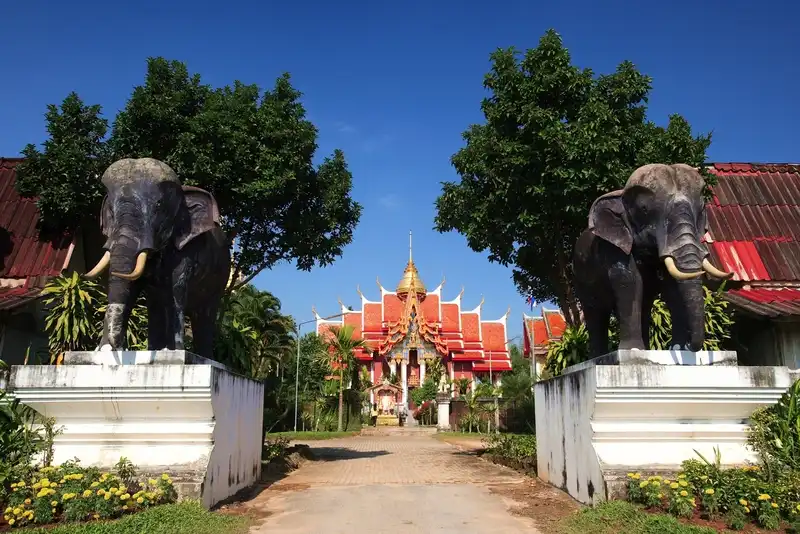
Wat Pa Mai Daeng (Phra Chao Phrom Maharaj) is one of the most significant temples in Chai Prakan District, Chiang Mai Province, widely regarded by local communities as both a place of faith and a living memorial connected to the historical identity of “Wiang Chai Prakan.” What makes this temple stand out is that it is not only a site for worship, but also a space where local history, civic memory, and religious life are woven together through monuments, important structures, and distinctive cultural features found throughout the grounds.
The temple is located at No. 119, Ban Pa Mai Daeng, Moo 9, Chotana Road, Nong Bua Subdistrict, Chai Prakan District, Chiang Mai Province. It belongs to the Mahanikaya Buddhist order. The temple land is notably large, covering approximately 49 rai 3 ngan 40 square wah. The boundaries are clearly defined: the north and west sides border public roads, while the south and east sides border public irrigation canals. This open layout gives the site an airy feel and makes it comfortable for visitors to walk around, especially in the morning when the softer light highlights the craftsmanship on many structures.
According to local tradition, the temple was originally an abandoned temple site, said to have been established around 1056 CE (B.E. 1599) during the era of Phra Chao Phrom Maharaj, the ruler credited with founding Wiang Chai Prakan. Over time, the site fell into ruin and was covered by “pa mai daeng” (a local red-wood forest), which later became the origin of the place name. In 1972 (B.E. 2515), Phra Kru Pradit Phromkhun (Luang Pho Boon Yen Thanadhammo) led local devotees from Ban Pa Mai Daeng and nearby villages to restore the neglected area. A royal monument to Phra Chao Phrom Maharaj was constructed, and the site was established as a monastery center under the name “Phra Chao Phrom Maharaj Monastic Center.” The temple later received official recognition as an active temple with resident monks on 24 October 1990 (B.E. 2533), and the first officially appointed abbot began serving from 1991 (B.E. 2534) onward.
One of the temple’s strongest charms is how “complete” the overall experience feels. Visitors are not simply coming to see a single structure, but are instead walking through a carefully layered landscape of faith and local heritage. The site includes key architectural landmarks such as the four-sided pavilion-style viharn (Wihan Chaturamuk), and Wihan Thammanusati, which is known for its mural paintings depicting the “12 Lanna Traditions by Month,” presenting northern cultural life through a visual calendar of rituals and seasonal practices. Another important focal point is the Chedi Nawalokuttara Sathit Sri Chai Prakan, which serves as a spiritual landmark and contributes to the temple’s distinctive identity within Chai Prakan.
What further distinguishes Wat Pa Mai Daeng is its concentration of monuments and civic-symbolic sites tied to the history of Chai Prakan. Within the grounds are the monument of Phra Chao Phrom Maharaj, honored as the founder of Wiang Chai Prakan, as well as the monument of King Mangrai the Great, the founder of Chiang Mai. There is also a monument to Luang Pho Boon Yen Thanadhammo, remembered as a key figure in reviving the temple site. Another important feature is the shrine of the city pillar protector for Chai Prakan (Phra Khum Sao Lak Mueang Chai Prakan), reinforcing the role of the temple as a cultural anchor for the district rather than a purely religious destination.
Beyond its religious role, the temple also functions as a practical community hub. Facilities include merit-making halls, open pavilions, a multipurpose hall, monks’ quarters, and guest accommodation. The temple also hosts educational and community support functions, including buildings for the Buddhist scripture school (Dhamma and Pali studies), a general education program, and a child development center for preschool-aged children. These functions make the temple a place the community actively uses in everyday life, helping it remain vibrant and meaningful beyond occasional visits.
Getting There From Chiang Mai city, take Highway 107 (Chiang Mai–Fang) north toward Chai Prakan District. From there, continue into Nong Bua Subdistrict and follow local signage to Ban Pa Mai Daeng and Chotana Road. Parking is available at the temple, and visitors can walk in to pay respects and explore the grounds. The journey is relatively long, so it is recommended to allow sufficient travel time and check road conditions by season, especially during the rainy period.
| Place Name | Wat Pa Mai Daeng (Phra Chao Phrom Maharaj) |
| Location | No. 119, Ban Pa Mai Daeng, Moo 9, Chotana Road, Nong Bua Subdistrict, Chai Prakan District, Chiang Mai Province 50320 |
| Open Days | Daily |
| Opening Hours | Recommended 08.00–17.00 |
| Highlights | Major temple of Chai Prakan with monuments to Phra Chao Phrom Maharaj and King Mangrai; Wihan Chaturamuk; Wihan Thammanusati with “12 Lanna Traditions” murals |
| Period / Timeline | Local tradition: founded around B.E. 1599; restoration as monastic center in B.E. 2515; officially recognized as a temple with resident monks on 24 Oct B.E. 2533 |
| Key Sacred Sites / Points of Interest | Wihan Chaturamuk; Wihan Thammanusati (12 Lanna Traditions murals); Chedi Nawalokuttara Sathit Sri Chai Prakan; Monument of Phra Chao Phrom Maharaj; Monument of King Mangrai; City Pillar Protector Shrine of Chai Prakan |
| Name Origin | Traditionally said to come from the former abandoned site being covered by a “pa mai daeng” forest, leading to the name “Wat Pa Mai Daeng” |
| Travel | Drive via Highway 107 (Chiang Mai–Fang) to Chai Prakan, then continue to Nong Bua Subdistrict and Ban Pa Mai Daeng following local signs |
| Current Status | Open for worship and visits |
| Contact Phone | 081-672-0141 |
| Facilities | Parking, rest pavilions / multipurpose halls, toilets, shaded seating areas within the temple grounds |
| Fees | No official entrance fee found (donations welcome) |
| Nearby Attractions (with distance) | Hinoki Land (approx. 10–20 km) Wat Tham Tab Tao (approx. 15–30 km) Chai Prakan town / market area (approx. 5–15 km) Fang District (approx. 20–35 km) Chiang Dao District (approx. 45–70 km) |
| Popular Restaurants Nearby (distance + phone) | Pop-Pae (approx. 5–15 km), Tel. 053-457-067 Cafe’ De Mamana (approx. 10–25 km), Tel. 099-435-4061, 090-435-4061 Moat Cafe (approx. 10–25 km), Tel. 095-861-5556 Ma Heng Chinese Food, Chai Prakan (approx. 5–20 km), Tel. 099-421-1516 Hinoki Land (café / food zone) (approx. 10–20 km), Tel. 094-731-0731, 089-837-3373 |
| Popular Accommodations Nearby (distance + phone) | Chai Prakan Mansion (approx. 5–15 km), Tel. 053-457-911 Saimoonbury Resort (approx. 5–20 km), Tel. 053-870-410, 081-884-0286 Leelawadee Resort (approx. 5–20 km), Tel. 064-495-5569 Saeng Chan Resort, Chai Prakan (approx. 5–20 km), Tel. 088-251-1452 Wang Than House (approx. 5–20 km), Tel. 082-183-6636 |
Frequently Asked Questions (FAQ)
Q: Is Wat Pa Mai Daeng (Phra Chao Phrom Maharaj) open every day?
A: It is generally open daily, and visiting between 08.00 and 17.00 is recommended for comfortable sightseeing.
Q: What is the main highlight of Wat Pa Mai Daeng?
A: The key highlights are the monument of Phra Chao Phrom Maharaj and the temple’s connection to Wiang Chai Prakan, along with Wihan Chaturamuk and Wihan Thammanusati featuring the “12 Lanna Traditions” mural paintings.
Q: How is the temple connected to the history of Chai Prakan?
A: Local tradition links the site to Phra Chao Phrom Maharaj, credited with founding Wiang Chai Prakan. The monuments and the city pillar protector shrine within the grounds reflect the temple’s cultural role for the district.
Q: What can visitors see besides worshipping?
A: Visitors can explore major structures such as Wihan Chaturamuk, Wihan Thammanusati, the chedi, and the monument area, as well as observe mural details and local craftsmanship throughout the temple.
Q: Who can be contacted for more information?
A: You can contact the temple by phone at 081-672-0141.
 Category: ●Places of Worship
 Group: ●Temple
Last Update : 8 MonthAgo
 Last Update : 8 MonthAgo
 Click to Access the Navigation Map GPS
Wat Pa Mai Daeng Map
Recommend

 Art, Culture and Heritage
 Historical Sites and Monuments(8)
 Landmarks and Memorials(5)
 Royal Palace(2)
 Art, Craft Centres, Tradition(43)
 Museums(24)
 Educational Places
 Museum for Study(2)
 Educational Gardens, Farm(5)
 Training Center(1)
Temple(79)
Training Center(1)
Temple(79)
 Mosque(2)
 Other Sacred Sites(17)
 Research and Development
 Royal Project(44)
 Suburban Living
 Village, Community(41)
 Local Market(14)
 Nature and Wildlife
 National Parks and Marine Reserves(16)
 Mountain (Doi)(21)
 Dam, Reservoir, Lake(26)
 Waterfalls(43)
 Hot Springs(12)
 Caves(11)
 River, Canal(6)
 Other natural attractions(14)
 Entertainment and Agricultural
 Zoos and Aquariums(2)
 Animal camps and shows(3)
 Stadium(1)
 Farms, Parks and Ecotourism(19)
 Waterpark(2)
 Theater(1)
 Outdoor and Adventure Activities(10)
 Shopping
 Shopping and Night Market(6)
 Restaurant
 Michelin Star(1)
 Michelin Guide(23)
 Call Customer Service in Tourism
 Call Customer Service in Tourism(1)
 Travel Articles, Recipes
 Travel Review, Food Review(15)
 Food Menu, North Recipes(30)
 Thai Desserts, North Recipes(17)


