

 Home
Home Chiang Mai(










Angkhang Royal Agricultural Station
Rating: 4/5 (5 votes)
 Search By
  Map
Map 
 Have Map
  No Map
Chiang Mai attractions
Attractions in Thailand
Open Days: Daily
Opening Hours: 06.00–18.00
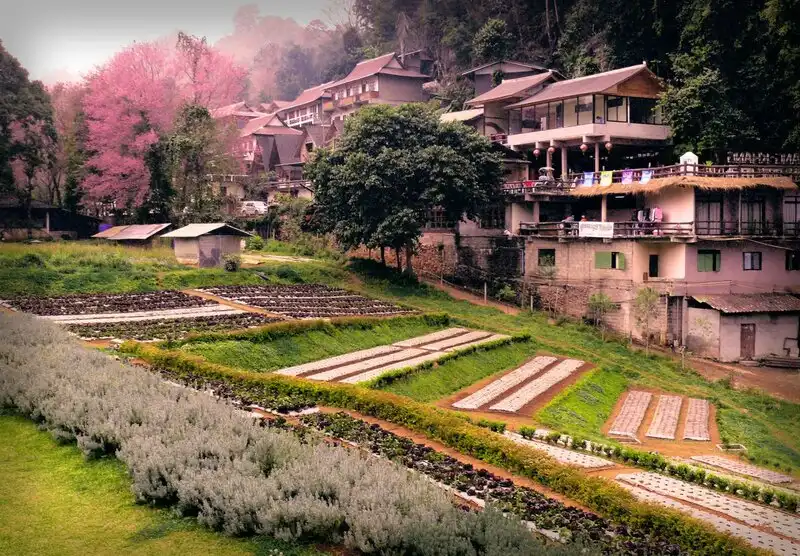
Angkhang Royal Agricultural Station is located in Angkhang Subdistrict, Fang District, Chiang Mai Province, on the highlands of Doi Angkhang where cool weather prevails throughout the year. It is one of Thailand’s most historically significant Royal Projects and stands as a true prototype of highland development. At first glance, Angkhang may appear to be a scenic agricultural attraction where visitors can stroll through flower gardens, observe fruit plantations, and purchase seasonal produce. However, beneath this pleasant surface lies a far deeper story — one that demonstrates how human livelihoods and environmental restoration can be achieved simultaneously, without sacrificing either.
The origins of Angkhang Royal Agricultural Station are often told through a widely shared historical account. During one of his helicopter flights over northern Thailand, His Majesty King Bhumibol Adulyadej observed clusters of houses scattered across the mountain ridge and instructed the aircraft to land for closer inspection. What he found were opium poppy fields and villages inhabited primarily by the Lahu (Muser) people. At that time, opium cultivation was not merely a matter of illegal activity, but rather a consequence of poverty, isolation, and the lack of viable economic alternatives for highland communities.
The royal initiative that transformed Angkhang did not begin with a command to eradicate opium cultivation outright. Instead, it started with a far more fundamental question: “If opium is removed, what will people grow instead?” This question reflects a development philosophy that places people at the center of problem-solving and addresses root causes rather than symptoms. Suppression alone could never provide lasting change if communities were left without sustainable livelihoods.
Established in 1969, Angkhang Royal Agricultural Station was founded to research and develop alternative crops suitable for high-altitude, cool-climate, and sloping terrain conditions. Its objective was to replace opium cultivation with economically viable agriculture while promoting sustainable land use among surrounding communities. What distinguishes Angkhang from conventional development projects is its holistic, system-based approach that integrates agriculture with forest conservation, soil preservation, water management, and land-use planning. As farmers gained stable incomes from suitable crops, pressure on forest resources naturally declined, allowing ecosystems to recover.
Operationally, Angkhang is far more than an experimental research plot. It functions as a large-scale open-air classroom under real-world conditions. Research activities include cold-climate fruit cultivation, plant propagation, crop trials, and training programs for farmers and Royal Project staff. Not all experiments succeeded. Certain crops proved economically unviable, others were too susceptible to disease, and some required maintenance beyond the capacity of local farmers. Yet these failures were essential learning experiences, allowing Thailand’s knowledge of highland agriculture to evolve based on reality rather than theory.
Today, visitors commonly encounter a diverse range of temperate fruits such as peaches, plums, strawberries, pears, raspberries, persimmons, kiwifruit, loquat, and various cold-climate vegetables including carrots and leafy salads. Ornamental flowers such as carnations, roses, asters, and chrysanthemums also play a role in enhancing the area’s economic and visual value. Importantly, Angkhang does not operate as an intensive agricultural factory; instead, it emphasizes ecological balance, particularly soil health and watershed protection, which are critical for steep mountainous terrain.
The most vital yet often unseen achievement of Angkhang is its success in enabling people to coexist sustainably with forests. Rather than relying solely on conservation enforcement, the project demonstrates that when communities possess stable livelihoods aligned with environmental conditions, deforestation naturally declines. Forest cover regenerates, soil erosion decreases, and watershed stability improves. Development, in this sense, becomes a mutually reinforcing relationship between human well-being and ecological health.
The social dimension of Angkhang is equally significant. Local ethnic communities are not passive recipients of aid but active participants in transformation. The transition away from opium cultivation required time, trust, and consistent institutional support. Crucially, development did not erase cultural identity. Language, dress, and traditions remain intact, while agricultural practices and land use evolved to ensure greater economic security. Angkhang thus represents a model of development that preserves dignity alongside progress.
From a tourism perspective, Angkhang offers experiences ranging from leisurely sightseeing to purposeful learning. During winter and early summer, visitors enjoy crisp morning air, orderly agricultural plots, and landscapes that vividly explain why temperate crops thrive here. The rainy season, though less popular, reveals lush greenery and highlights the importance of forest and watershed systems. A slow-paced visit allows travelers to move beyond photography and gain genuine insight into the region’s development journey.
In the present era of climate uncertainty, food security challenges, and increasing environmental pressures, Angkhang’s role extends far beyond tourism. It serves as a living laboratory for adaptive agriculture, soil and water management, and sustainable highland livelihoods. More than a picturesque mountain destination, Angkhang stands as tangible proof that long-term sustainability is achievable when development systems are thoughtfully designed.
Getting There Visitors traveling by private vehicle can use Highway 107 (Chiang Mai–Fang) and choose an appropriate ascent route to Doi Angkhang, bearing in mind steep slopes and sharp curves. Extra caution is advised during rainy or foggy conditions. Public transportation options include buses from Chiang Mai to Fang or Tha Ton, followed by local songthaews or vans to ascend the mountain, offering an alternative for those uncomfortable with mountain driving.
| Name | Angkhang Royal Agricultural Station |
| Location | Angkhang Subdistrict, Fang District, Chiang Mai Province |
| Open Days | Daily |
| Opening Hours | 06.00–18.00 |
| Key Features | Thailand’s first Royal Project agricultural research station and a model for sustainable highland development |
| What to See | Cold-climate fruit plots (peach, plum, pear, strawberry, raspberry, persimmon, kiwi, loquat) Vegetable gardens and salad crops Flower fields (carnations, roses, asters, chrysanthemums) Seasonal produce shops |
| Nearby Attractions (Approx. Distance) | 80th Anniversary Garden (2 km) No Lae Village (3 km) Kiew Lom Viewpoint (4 km) Fang Town Market (22 km) Doi Pha Hom Pok National Park (25 km) |
| Nearby Dining | Restaurants within Angkhang Station Local eateries in No Lae Village (3 km) Highland community restaurants (5–8 km) Local restaurants in Fang District (20–22 km) |
| Accommodation Nearby | On-site guesthouses within Angkhang Station Camping areas on Doi Angkhang Homestays in No Lae Village (3 km) Hotels in Fang District (20–22 km) Accommodation in Chiang Dao District (40 km) |
| Current Status | Open to visitors |
Frequently Asked Questions
Q: How is Angkhang Royal Agricultural Station different from typical nature attractions?
A: It functions as a national model for sustainable highland development, integrating agricultural research, forest conservation, and community livelihoods rather than serving solely as a scenic viewpoint.
Q: Is a day trip sufficient?
A: A day trip is possible, but staying overnight allows visitors to explore the area more comfortably and fully experience the highland atmosphere.
Q: When is the best time to visit?
A: Each season offers unique appeal, but winter through early summer provides cool weather and the most iconic highland scenery.
Q: Are there alternatives to driving up the mountain?
A: Yes. Visitors can travel by bus to Fang or Tha Ton and continue by local songthaew or van to reach Doi Angkhang.
 Angkhang Royal Agricultural Station Map
 Category:
  Group:
  Tag: ●Angkhang Royal Agricultural Station●angkhang royal agricultural station ●doi angkhang ●royal project thailand ●angkhang travel ●chiang mai attractions ●highland agriculture ●temperate fruits thailand ●sustainable development thailand Last Update: 3 MonthAgo
Comment

Photo Gellery(24) 
 Thank you photo(6) from: Pohpo