
lovethailand home >North Travel Attractions >Chiang Mai Travel Attractions >Mae Wang >Mae Win > Wat Tham Doi Ton
TL;DR: Wat Tham Doi Ton is located at 128 Moo 5, Ban Mae Sapok, Mae Win Subdistrict, Mae Wang District, Chiang Mai 50360, Thailand, open Daily, hours 08:00 – 16:00.

Wat Tham Doi Ton
Open Days: Daily
Opening Hours: 08:00 – 16:00
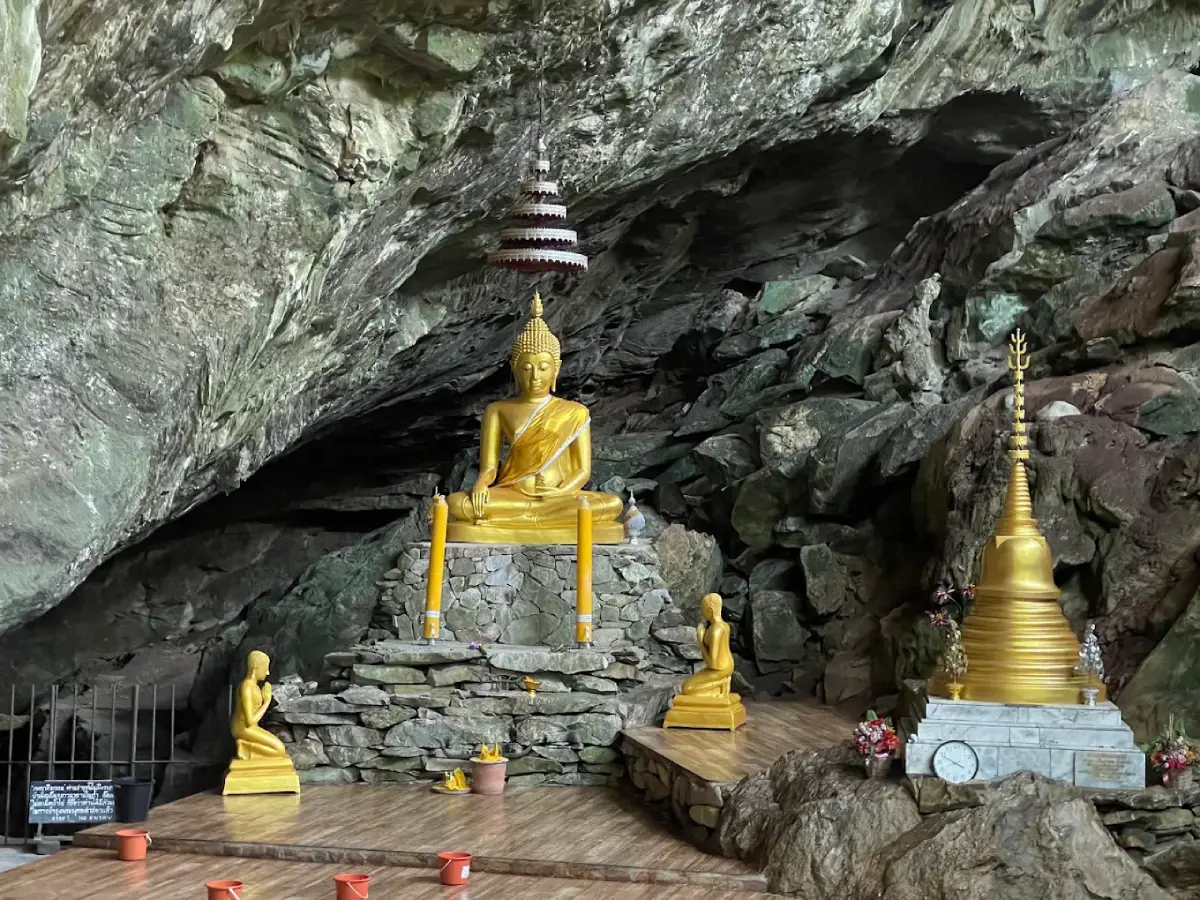
Wat Tham Doi Ton is located at 128 Moo 5, Ban Mae Sapok, Mae Win Subdistrict, Mae Wang District, Chiang Mai 50360, Thailand. It is a public non-royal Buddhist temple of the Mahanikaya order, registered under temple code 350220401 and formally declared a Buddhist temple on 10 April 1997. Wat Tham Doi Ton is unusual among Mae Wang’s temples because its identity is inseparable from its mountain landscape. A large two-level natural cave, the Doi Ton mountain ridge, Phra Borommathat Doi Ton at the summit, a Bodh Gaya-style chedi, meditation terraces, rice terraces, forest, and the meeting of the Mae Wang and Mae Sapok rivers create an environment designed as much for contemplation as for conventional temple worship.
The temple remains active today. Current Buddhist temple directories continue to list Wat Tham Doi Ton in Mae Sapok, Moo 5, Mae Win, while the monastery’s meditation center has published a full retreat schedule for 2026, including programs for international practitioners. Phra Ajarn Nawee Piyadassi remains identified by the monastery as its presiding monk and continues to teach through meditation courses, Dhamma talks, publications, and online media.
The story of Wat Tham Doi Ton begins before the modern temple existed. Ban Mae Sapok once had a small religious retreat or monastic shelter established through the Buddhist Dhammacarika mission. It provided a place where villagers could make merit and where monks traveling through the highland area could stay. When the mission later moved farther into more remote communities, the original shelter gradually became an intermittently occupied hermitage rather than a permanent monastery.
The old site had a major legal limitation. It stood inside reserved forest land and lacked the land documentation required for the formal establishment and long-term development of a Buddhist temple. As Ban Mae Sapok grew, villagers increasingly wanted a stable monastery that could support both community religious life and permanent monastic residence. A new site therefore had to offer not only peace and accessibility but also legitimate land tenure.
In the middle of 1985, Phra Ajarn Piyadassi passed through Ban Mae Sapok while traveling as a forest monk. Local residents invited him to spend the rains retreat at the old monastic shelter. During that retreat, he discussed with villagers the possibility of finding a more suitable location where a new temple could become a center for both Buddhist study and meditation practice.
Villagers brought him to Doi Ton Cave. The site consisted of a large two-level cave with a partly open cliff-shelter form. Cool air moves naturally from the inner cave toward the outer chamber, creating a fresh atmosphere that differs from the humid conditions found in many enclosed caves. In front of the cave lay approximately 11 rai of former rice fields with Nor Sor 3 land documentation, providing the legal foundation required for establishing a monastery.
The land in front of the cave was donated by Police Lieutenant Thawee and Khunying Kampui Chemnasiri to the Sangha of San Pa Tong District. At that time, Mae Wang had not yet been separated into its current district administration. Phra Khru Khantayaphon, then ecclesiastical district chief of San Pa Tong, accepted responsibility as senior monastic patron of the project.
The development was incorporated into the “Land of Dhamma, Land of Gold” temple project organized by the Sangha and Buddhist community of San Pa Tong. The project also honored King Bhumibol Adulyadej on the occasion of his 60th birthday in 1987. The establishment of Wat Tham Doi Ton therefore grew from the combined efforts of local villagers, Buddhist clergy, land donors, and the wider religious community.
Temple construction and development began during the second half of the 1980s. An application for formal establishment was submitted in 1995, and the Ministry of Education officially declared Wat Tham Doi Ton a Buddhist temple on 10 April 1997. The years between the initial development and formal recognition were necessary for preparing the land, monastic facilities, community organization, and administrative requirements.
The name “Tham Doi Ton” directly describes the geography. “Tham” means cave, “doi” means mountain, and “ton” is a northern pronunciation related to the Thai word “thon,” conveying the idea of something standing alone. The name therefore refers to an isolated mountain containing a natural cave. The cave had already been used by wandering monks for meditation before the formal monastery was developed.
The temple lies at an elevation of approximately 600 metres above sea level. To the north rises the steep Doi Ton cliff. The ridge gradually descends toward the east and south, while the western side opens toward terraced rice fields. The transition between cave, mountain, forest, and agriculture occurs within a remarkably compact landscape.
At the edge of the agricultural area, the Mae Wang and Mae Sapok rivers meet. These waterways support the valley’s settlements and farming landscape and contribute greatly to the quiet atmosphere of the monastery. Flowing water, forest sounds, and cultivated terraces create a natural buffer between the temple and the busier parts of the village.
A Karen community occupies the hills around Mae Sapok, and the temple’s history is closely connected with the wider highland settlement. The original Dhammacarika shelter had already linked Buddhist religious activity with local highland communities before Wat Tham Doi Ton was formally established.
Walking routes along the Mae Wang River lead farther into the valley, where a sequence of waterfalls and cascades can be found among the forest and mountains. Mae Wang Waterfall and Mae Sapok Waterfall remain convenient natural attractions that can be combined with a visit to the monastery.
The natural cave is the defining feature of Wat Tham Doi Ton. It consists of two levels and has the character of both a cave and an open rock shelter. Rather than enclosing the sacred space inside conventional walls, the cave uses its natural stone ceiling, rock surfaces, and filtered daylight to create a meditation environment.
The importance of the cave is spiritual as well as geological. Forest monks used the site for meditation before the modern monastery existed. The relative isolation, cool air, and minimal disturbance made it well suited to contemplative practice. The present monastery has preserved that function rather than transforming the cave into a purely sightseeing attraction.
At the highest point of the Doi Ton ridge stands Phra Borommathat Doi Ton. Reaching the summit requires a climb along the mountain route and stairways, making the journey physically more demanding than visiting the lower temple grounds. The area around the chedi has historically been used as an outdoor meditation terrace and includes a small shelter for meditation equipment.
The steep route is part of the character of the site. Historically, the summit practice area was more suitable during the dry and cool seasons and was avoided during heavy rains because the mountain path could become slippery. Visitors wishing to climb should use appropriate footwear and respect the area as part of the monastery’s meditation environment.
Another major monument is the Bodh Gaya-style chedi, inspired by the Mahabodhi Temple at Bodh Gaya in India, the place associated with the Buddha’s Enlightenment. The chedi at Wat Tham Doi Ton stands approximately 9.90 metres high on a base measuring about 3.90 metres. It was built under the leadership of Phra Ajarn Piyadassi together with lay supporters.
A relic-enshrinement ceremony for the chedi took place on 8 February 2001, corresponding to Makha Bucha Day and the full moon of the third lunar month. The choice of Bodh Gaya as the architectural inspiration is especially appropriate for a monastery dedicated to meditation because the monument symbolizes the Buddha’s awakening and the culmination of mental cultivation.
The Dhamma Terrace is another distinctive part of the complex. The semicircular open space uses the steep Doi Ton cliff as a natural backdrop, creating the feeling of an outdoor viharn. A large old tree forms a focal point, with a Buddha image in the First Sermon posture positioned near its base.
The terrace functions as a multipurpose Buddhist space. It can accommodate larger religious activities and is also used for walking meditation and individual sitting practice. Its design allows practitioners to remain directly exposed to the surrounding forest, cliff, air, and natural soundscape.
The Bodhi Terrace contains a sacred fig tree associated with a lineage connected to the Bodhi tree tradition of Anuradhapura in Sri Lanka. The tree gives the area a symbolic association with Enlightenment and creates another quiet outdoor zone for meditation.
Together, the cave, summit chedi, Bodh Gaya-style chedi, Dhamma Terrace, and Bodhi Terrace reveal the distinctive spatial philosophy of Wat Tham Doi Ton. Meditation areas are distributed vertically across the landscape rather than concentrated in one hall. Moving between them involves walking through forest, climbing, entering rock shelters, and crossing open terraces.
Meditation has remained central to the monastery from its earliest planning. Wat Tham Doi Ton currently organizes Vipassana courses every month throughout the year. Its official website publishes the 2026 retreat schedule as well as a separate schedule and information for international practitioners.
Joining a formal retreat is different from visiting the temple. Applicants must register and receive confirmation before arriving. Accommodation is provided separately for male and female lay practitioners, and participants follow the meditation center’s schedule and code of discipline.
Phra Ajarn Nawee Piyadassi has played the central role in the monastery’s development since his arrival in Mae Sapok in 1985. His work has included developing the temple site, organizing meditation courses, teaching practitioners, producing Buddhist publications, and delivering Dhamma talks. The monastery’s current channels continue to publish his teachings in 2026.
The temple also participates in the annual Kathin tradition following the end of Buddhist Lent. Records from the monastery include Kathin ceremonies at Wat Tham Doi Ton and affiliated monasteries, demonstrating the continuing connection between the meditation center, resident monks, lay disciples, and local Buddhist supporters.
Visitors should treat Wat Tham Doi Ton differently from a conventional tourist attraction. Much of the monastery is used for silent practice. Loud conversation, intrusive photography, and unnecessary disturbance are inappropriate near the cave, meditation terraces, retreat accommodation, and areas where practitioners are sitting or walking.
For a cultural visit, the natural cave should be the first priority because it explains both the temple’s name and its spiritual identity. Visitors can then pay respect at the Bodh Gaya-style chedi and explore the Dhamma Terrace. Those who are physically prepared can continue toward Phra Borommathat Doi Ton on the summit.
The temple is particularly appealing to travelers seeking quiet surroundings. Forest, fields, rivers, and mountain slopes reduce the sense of congestion found at major urban temples. Even when meditation courses are in session, the size and natural layout of the site allow activities to remain dispersed.
The cool season is particularly suitable for climbing and outdoor meditation, while the cave remains naturally cooler during the hot season. The rainy season brings lush green rice terraces and forest, but mountain paths and rock surfaces can become slippery and require additional caution.
Mae Sapok offers a very different travel experience from lower Mae Wang and Ban Kat. Mae Wang Waterfall is approximately 1.2 km from the temple, while Mae Sapok Waterfall is around 2.4 km away. These attractions make it possible to combine Buddhist heritage, meditation, and mountain nature within a half-day or full-day itinerary.
The wider Mae Sapok area also contains Karen communities, homestays, agricultural landscapes, and locally run accommodation. Staying overnight allows visitors to experience the valley in the quieter morning and evening periods rather than making a rapid return trip to Chiang Mai city.
Dining choices immediately around the monastery are limited compared with Ban Kat. De Ba No Mee Bar & Restaurant is one of the closest currently listed restaurants, while Farm Sook Homemade Kitchen and Plern Malee De Wang are additional options farther along the Mae Win route.
Nearby accommodation includes Baan Mae Sapok Homestay, Lazy Mango Homestay, The Doi Farm Stay, Serenity Resort - Chiang Mai, and Spicy Villa Eco-Lodges. These options make the area practical for visitors who want to combine the monastery with waterfalls, village landscapes, trekking, or other activities in Mae Win.
Getting There from Chiang Mai city, take Highway 108 south through Hang Dong and San Pa Tong, then turn onto Highway 1013 toward Mae Wang and Mae Win. Continue into the Mae Sapok area and follow the local road toward Wat Tham Doi Ton. The temple is approximately 55 km from Chiang Mai city and around 18 km from the Mae Wang district center. A private car or rental vehicle is the most practical option.
The Mae Win route includes mountain bends and changing gradients, so drivers should allow sufficient time and reduce speed during rain. Parking and toilets are available at the monastery, but several internal routes, particularly the cave area and the climb toward the summit chedi, are not completely level.
Current visitor information lists daily opening hours of 08:00–16:00. General visits are free of charge. Anyone intending to join a meditation retreat should contact the meditation center separately at +66 53 106 126 because accommodation and formal courses require registration and confirmation.
Wat Tham Doi Ton can be understood through five interconnected dimensions. Historically, it represents the development from a Dhammacarika hermitage into a formally registered monastery. Environmentally, it is shaped by a cave, mountain ridge, rivers, forest, and terraced fields. Religiously, it contains Phra Borommathat Doi Ton, the Bodh Gaya-style chedi, the Dhamma Terrace, and the Bodhi Terrace. Practically, it functions as an active Vipassana center. Socially, it remains connected with the Mae Sapok community and the cultural landscape of Mae Win.
The monastery’s character does not depend on monumental urban architecture. Its power comes from the way natural features themselves become part of Buddhist space. Visitors move from open fields to cave chambers, from shaded meditation terraces to the mountain summit. Nature is therefore not merely scenery but part of the experience of contemplation.
For travelers wishing to understand Mae Wang beyond bamboo rafting and conventional nature tourism, Wat Tham Doi Ton offers a substantially deeper perspective. Its story connects the Dhammacarika mission, forest monks, village cooperation, donated farmland, the Land of Dhamma–Land of Gold project, and contemporary meditation courses continuing into 2026. At the same time, the cave, rivers, mountain and terraced fields preserve the sense of seclusion that first made Doi Ton suitable for meditation.
| Name | Wat Tham Doi Ton |
| Location | 128 Moo 5, Ban Mae Sapok, Mae Win Subdistrict, Mae Wang District, Chiang Mai 50360, Thailand |
| Latitude | 18.660115 |
| Longitude | 98.638041 |
| Temple Registration Code | 350220401 |
| Temple Type | Public non-royal Buddhist temple, Mahanikaya order |
| Official Temple Declaration | 10 April 1997 |
| Current Monastic Leader | Phra Ajarn Nawee Piyadassi, Presiding Monk |
| Open Days | Daily |
| Opening Hours | 08:00 – 16:00 |
| Admission Fee | Free admission |
| Telephone | +66 53 106 126 |
| Elevation | Approximately 600 metres above sea level |
| Original Development Area | Approximately 11 rai of former rice fields in front of the cave with Nor Sor 3 land documentation |
| Important Sacred Areas | Two-level Doi Ton Cave, Phra Borommathat Doi Ton, Bodh Gaya-style chedi, Dhamma Terrace, Bodhi Terrace, and meditation areas |
| Bodh Gaya-Style Chedi | Approximately 9.90 metres high; relics were enshrined on 8 February 2001, Makha Bucha Day |
| Natural Highlights | Doi Ton mountain ridge, natural cave, cliffs, rice terraces, Mae Wang River and Mae Sapok River |
| Buddhist Activities | Monthly Vipassana courses, sitting meditation, walking meditation, Dhamma teaching and Kathin ceremonies |
| Meditation Accommodation | Separate accommodation for male and female lay practitioners; advance application and confirmation are required |
| Facilities | Parking, toilets and accommodation facilities for registered meditation practitioners |
| Getting There | Take Highway 108 from Chiang Mai through Hang Dong and San Pa Tong, then Highway 1013 toward Mae Wang, Mae Win and Ban Mae Sapok. The temple is approximately 55 km from Chiang Mai city. |
| Current Status | Active registered monastery with a published 2026 Vipassana retreat schedule |
| Nearby Attractions | 1. Mae Wang Waterfall, about 1.2 km 2. Elephant Retreat, about 1.1 km, Tel. 095-560-2569 3. Karen Elephant Habitat, about 1.7 km, Tel. 065-884-0802 4. Elephant Paradise Family, about 1.7 km, Tel. 062-929-2993 5. Mae Sapok Waterfall, about 2.4 km |
| Nearby Restaurants | 1. De Ba No Mee Bar & Restaurant, about 0.9 km, Tel. 098-773-5874 2. Farm Sook Homemade Kitchen, about 6.4 km 3. Plern Malee De Wang, about 6.8 km, Tel. 062-859-5954 |
| Nearby Accommodation | 1. Baan Mae Sapok Homestay, about 0.2 km 2. Lazy Mango Homestay, about 1.5 km, Tel. 061-567-7737 3. The Doi Farm Stay, about 2.1 km 4. Serenity Resort - Chiang Mai, about 2.5 km, Tel. 063-265-3216 5. Spicy Villa Eco-Lodges, about 4 km, Tel. 089-264-3738 |
Frequently Asked Questions (FAQ)
Q: Where is Wat Tham Doi Ton located?
A: Wat Tham Doi Ton is located at 128 Moo 5, Ban Mae Sapok, Mae Win Subdistrict, Mae Wang District, Chiang Mai 50360, Thailand.
Q: When was Wat Tham Doi Ton formally established?
A: Development began in the 1980s, an application for formal temple establishment was submitted in 1995, and Wat Tham Doi Ton was officially declared a Buddhist temple on 10 April 1997.
Q: Who currently leads the monastic community at Wat Tham Doi Ton?
A: Phra Ajarn Nawee Piyadassi is currently identified by the monastery as its presiding monk and has played a central role in the temple’s development since the founding period.
Q: What are the main features of Wat Tham Doi Ton?
A: Important features include the two-level natural cave, Phra Borommathat Doi Ton on the summit, the Bodh Gaya-style chedi, the Dhamma Terrace, the Bodhi Terrace and dedicated meditation areas.
Q: Does Wat Tham Doi Ton offer meditation retreats?
A: Yes. The monastery organizes Vipassana courses every month and publishes a 2026 retreat schedule, including programs for international practitioners.
Q: Is there an admission fee?
A: General temple visits are free. Formal meditation retreats require advance registration and confirmation from the meditation center.
Q: Is the climb to Phra Borommathat Doi Ton suitable for everyone?
A: The route is steep and requires a reasonable level of mobility. Visitors who prefer not to climb can remain in the lower temple area and visit the cave, chedi and meditation terraces.
Q: What attractions can be combined with Wat Tham Doi Ton?
A: Nearby options include Mae Wang Waterfall, Mae Sapok Waterfall, the Mae Sapok community, and other nature-based attractions and accommodation in Mae Win.
 Category: ●Places of Worship
 Group: ●Temple
Last Update : 2 MonthAgo
 Last Update : 2 MonthAgo
 Click to Access the Navigation Map GPS

 Muang Chiang Mai(121)Chom Thong(47)Mae Chaem(25)Chiang Dao(33)Doi Saket(68)Mae Taeng(85)Mae Rim(69)Samoeng(29)Fang(71)Mae Ai(59)Phrao(70)San Pa Tong(103)San Kamphaeng(66)San Sai(73)Hang Dong(73)Hot(32)Doi Tao(22)Omkoi(11)Saraphi(74)Wiang Haeng(15)Chai Prakan(28)Mae Wang(32)Mae On(22)Doi Lo(33)Galyani Vadhana(1)


