
lovethailand home >North Travel Attractions >Chiang Mai Travel Attractions >Phrao >Mae Pang > Wat Phra Chao Ton Luang
TL;DR: Wat Phra Chao Ton Luang is located at Ban Sop Pang, Moo 4, Mae Pang Subdistrict, Phrao District, Chiang Mai Province, open Daily, hours 08.00 – 17.00.

Wat Phra Chao Ton Luang
Open Days: Daily
Opening Hours: 08.00 – 17.00
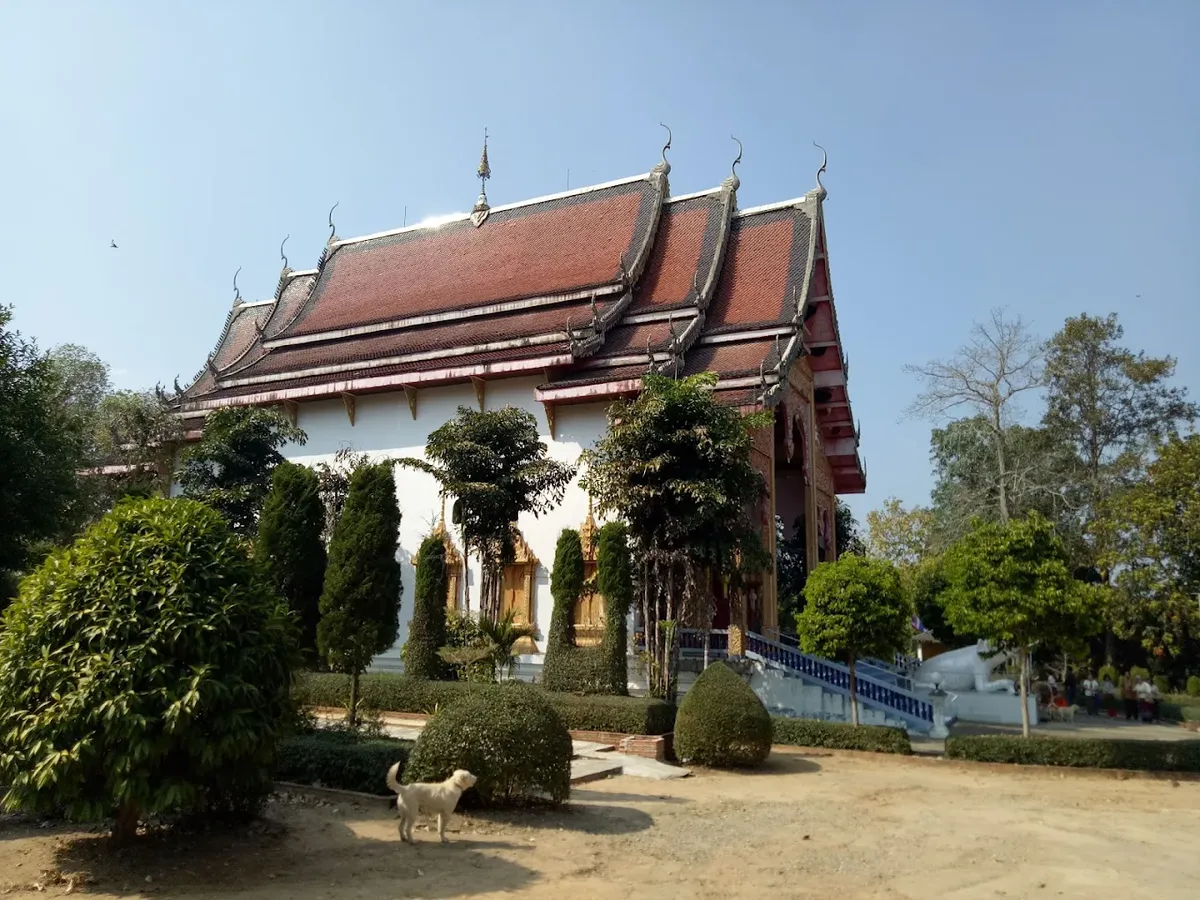
Wat Phra Chao Ton Luang is a local non-royal Buddhist temple under the Mahanikaya order, located in Moo 4, Ban Sop Pang, Mae Pang Subdistrict, Phrao District, Chiang Mai Province. The temple was officially permitted to be established in 1385 and is associated with Phra Athikan Somret Sutthachitto as abbot. Wat Phra Chao Ton Luang is an important temple connected with the history of Phrao in the Lanna period, especially through its large stucco Buddha image known locally as Phra Chao Ton Luang, or in an older local name, Phra Chao Nang Chang.
Ban Sop Pang is Moo 4 of Mae Pang Subdistrict in Phrao District. The village belongs to the rural Lanna landscape of northern Thailand, shaped by temples, houses, the Chiang Mai–Phrao road, local community roads, farmland, waterways, and surrounding hills. The name Sop Pang suggests a settlement connected with a meeting point of waterways, since sop in northern Thai usage often refers to a confluence. Wat Phra Chao Ton Luang therefore stands within a landscape that combines history, local faith, village life, and natural geography.
Mae Pang Subdistrict is one of the important temple landscapes of Phrao District. It includes village temples, hill temples, relic sites, and meditation-related sacred places such as Wat Doi Mae Pang, Wat Phra That Doi Namo, Wat Thung Buak Khao, Wat Pradu, Wat Pa Sahathammikaram, Wat Pa Miang Khun Pang, Wat Pong Bua Ban, Wat Pha Daeng, Wat Mon Hin Lai, Wat Mae Pang, Wat Mae Phaeng, Wat Huai Ngu, and Wat Huai Sai. Within this network, Wat Phra Chao Ton Luang stands out because of its historical link with Phaya Kue Na and its large Buddha image.
The history of Wat Phra Chao Ton Luang is closely connected with Phrao town in the Lanna period. Local accounts state that when Phaya Kue Na came to Phrao, he established this temple around 1385 and ordered the construction of a large Buddha image seated above the back of an elephant. This image later became the source of the name Wat Phra Chao Ton Luang. The older name, Wat Phra Chao Nang Chang, directly refers to the distinctive image of the Buddha seated on an elephant.
The year 1385 gives Wat Phra Chao Ton Luang special importance among community temples in Phrao. The temple is not merely a modern village temple; it preserves a story connected with Lanna rule, the historical landscape of Phrao, and the creation of a large sacred image. This makes the temple important for travelers interested in Lanna history, local Buddhist art, and the religious geography of northern Thailand.
At one point, Wat Phra Chao Ton Luang became an abandoned temple, leaving behind its large stucco Buddha image. The image is described as late Lanna art and remained the key evidence of the temple’s sacred history. Later, the temple was revived, registered again as a temple, and became a place where monks reside. The large Buddha image was restored as a major Buddhist image worthy of the temple’s name.
The most important sacred object at Wat Phra Chao Ton Luang is the large stucco Buddha image known as Phra Chao Ton Luang. It is associated with late Lanna art and with the story of the Buddha seated above an elephant. This image is the heart of the temple. It connects the temple’s name, its old local name, its historical memory, and the continuing faith of Ban Sop Pang into one central sacred object.
A large Buddha image in a village temple is not only a religious object. It is also a spiritual landmark, a visual center for worship, and a symbol of the temple’s survival through abandonment and restoration. Visitors should take time to pay respect to Phra Chao Ton Luang and observe its scale, presence, and surrounding atmosphere. The image carries the deepest layer of meaning at the temple.
Phra That Doi Kalong adds another important layer to the sacred landscape of Wat Phra Chao Ton Luang. The relic site and the temple are referred to together as important places in Ban Sop Pang, Moo 4, Mae Pang Subdistrict. An annual merit-making and relic-bathing tradition is held on the full moon day of the eighth northern lunar month. This tradition shows that the site remains active in local religious life and is not only a historical memory.
The annual relic-bathing ceremony gives Wat Phra Chao Ton Luang strong community significance. It brings villagers and devotees together to make merit, honor the relic site, and maintain the relationship between the temple, the relic, and the community. The use of the northern lunar calendar also reflects Lanna cultural continuity in Mae Pang Subdistrict.
Phra Athikan Somret Sutthachitto is the abbot of Wat Phra Chao Ton Luang. In a temple with a major Buddha image, a long historical memory, and an annual relic tradition, the abbot plays an important role in maintaining the temple grounds, guiding religious activities, preserving the sacred image, and coordinating with the local community. A temple of this kind depends on monks, community leaders, temple committees, elders, and devotees working together.
Publicly available information does not provide a complete inventory of every building inside the temple. For that reason, this article does not add unsupported details about specific buildings. The confirmed core of Wat Phra Chao Ton Luang is the large stucco Buddha image, the revived temple with resident monks, and the relationship with Phra That Doi Kalong. The main areas to understand are the worship area of Phra Chao Ton Luang, the temple courtyard, merit-making areas, ceremonial spaces, and monastic residence.
The main appeal of Wat Phra Chao Ton Luang lies in its combination of Lanna history, a large Buddha image, the old name Phra Chao Nang Chang, the memory of an abandoned temple, later restoration, and the annual relic-bathing tradition of Phra That Doi Kalong. It is suitable for travelers interested in old Lanna temples, Phrao history, major Buddha images, local religious traditions, and quiet temple routes in Mae Pang Subdistrict.
Wat Phra Chao Ton Luang plays several roles in the local community. Spiritually, it is a place for worship, merit-making, offerings to monks, Dhamma listening, and Buddhist ceremonies. Historically, it preserves the memory of Phaya Kue Na and the Buddha image seated on an elephant. Culturally, it is connected with the annual relic-bathing tradition. Socially, it serves as a gathering space for Ban Sop Pang and nearby villages during merit-making events.
Kathin, Pha Pa, Buddhist holy day merit-making, Buddhist Lent, and the end of Lent are all appropriate activities within the context of a community temple, but the most distinctive tradition connected with this site is the annual bathing of Phra That Doi Kalong on the full moon of the eighth northern lunar month. This event preserves Lanna religious rhythm and keeps the temple landscape active in the present.
Wat Phra Chao Ton Luang can be included in several cultural routes in Mae Pang Subdistrict. A meaningful route can include Wat Thung Buak Khao, Wat Pradu, Wat Doi Mae Pang, Wat Phra That Doi Namo, Wat Ban Kham Sum Wiang, Wat Ton Chan, Wat San Kamphaeng, Wat Huai Ngu, and Wat Mae Pang. These routes show how Mae Pang combines village temples, hill temples, relic sites, and meditation-related sacred places.
For travelers interested in Lanna history and faith, a route can begin at Wat Phra Chao Ton Luang and Phra That Doi Kalong, then continue to Wat Phra That Doi Namo, Wat Doi Mae Pang, and Wat Thung Buak Khao. This gives a layered experience: a large Buddha image, a relic site, hill temples, forest-practice contexts, and community temples. Travelers who want to continue toward Phrao town can also add Wat Klang Wiang and other historical temples in the district center.
Getting There is easiest by private car, rental car, or local hired transport. From Chiang Mai city, travel toward Phrao District on the Chiang Mai–Phrao route, then continue into Mae Pang Subdistrict and Ban Sop Pang, Moo 4. Before departure, search for “Wat Phra Chao Ton Luang Sop Pang Mae Pang Phrao” in a map application to avoid confusion with temples of similar names elsewhere. A private vehicle is the most practical way to combine the temple with Wat Doi Mae Pang, Wat Phra That Doi Namo, nearby restaurants, and accommodations in Phrao.
The best time to visit is in the morning or late afternoon, when the weather is more comfortable and the temple atmosphere is calm. Travelers interested in local religious tradition should follow the timing of the Phra That Doi Kalong relic-bathing ceremony on the full moon of the eighth northern lunar month. For general cultural travel, a half-day or full-day route through Mae Pang Subdistrict works well.
Visitors should dress modestly, speak quietly, respect monks and local worshippers, and avoid entering private monastic areas without permission. Around the large Buddha image and ceremonial spaces, photography should be done respectfully. If a ceremony or merit-making event is taking place, local participants should be given priority. Wat Phra Chao Ton Luang is an active religious place, not only a sightseeing stop.
Overall, Wat Phra Chao Ton Luang is a valuable temple of Mae Pang Subdistrict and Phrao District. It preserves a history connected with Phaya Kue Na and Phrao in 1385, a large late-Lanna stucco Buddha image known as Phra Chao Ton Luang or Phra Chao Nang Chang, the memory of an abandoned temple, later restoration, resident monks, and the annual relic-bathing tradition of Phra That Doi Kalong. Its importance lies in the way it brings together Lanna history, Buddhist art, local faith, and community tradition in one living sacred site.
| Name | Wat Phra Chao Ton Luang |
| Former / Local Name | Wat Phra Chao Nang Chang |
| Location | Ban Sop Pang, Moo 4, Mae Pang Subdistrict, Phrao District, Chiang Mai Province |
| Address | Moo 4, Ban Sop Pang, Mae Pang Subdistrict, Phrao District, Chiang Mai 50190, Thailand |
| Temple Type | Local Non-Royal Buddhist Temple Under The Mahanikaya Order |
| History | Officially established as a temple in 1385; connected with Phaya Kue Na and the history of Phrao in the Lanna period |
| Main Sacred Object | Large late-Lanna stucco Buddha image known as Phra Chao Ton Luang or Phra Chao Nang Chang |
| Related Sacred Site | Phra That Doi Kalong, associated with an annual relic-bathing and merit-making tradition on the full moon of the eighth northern lunar month |
| Highlights | Paying respect to Phra Chao Ton Luang, seeing a large late-Lanna Buddha image, learning about Phaya Kue Na and Phrao history, and connecting with Phra That Doi Kalong |
| Distinctive Features | Old temple once abandoned, preserving a large stucco Buddha image before being restored as an active temple with resident monks |
| Main Areas / Zones | Phra Chao Ton Luang worship area, temple courtyard, merit-making area, ceremonial area, and monastic residential area |
| Community Role | Spiritual center of Ban Sop Pang, used for merit-making, Dhamma listening, annual relic-related tradition, and preservation of Phrao historical memory |
| Important Activities / Ceremonies | Annual Phra That Doi Kalong relic-bathing ceremony on the full moon of the eighth northern lunar month, Kathin, Pha Pa, Buddhist holy day merit-making, Buddhist Lent, end-of-Lent activities, and local Lanna merit-making |
| Abbot / Caretaker | Phra Athikan Somret Sutthachitto |
| Travel Information | Best reached by private car, rental car, or local hired transport from Chiang Mai toward Phrao District, then into Mae Pang Subdistrict and Ban Sop Pang, Moo 4 |
| Current Status | Active local Buddhist temple in Mae Pang Subdistrict, Phrao District, Chiang Mai Province, with resident monks |
| Open Days | Daily |
| Opening Hours | 08.00 – 17.00 |
| Nearby Tourist Attractions | 1. Phra That Doi Kalong, about 1 km 2. Wat Phra That Doi Namo, about 3 km 3. Wat Thung Buak Khao, about 4 km 4. Wat Doi Mae Pang, about 5 km 5. Wat Pradu, about 6 km 6. Wat Ban Kham Sum Wiang, about 7 km 7. Wat Ton Chan, about 8 km 8. Wat Klang Wiang, Phrao District, about 18 km |
| Nearby Restaurants | 1. Shong Cha Café, Mae Pang Branch, about 5–8 km, Tel. 080-258-2854 2. Tiao Kwai Nan Daeng, about 8–12 km, Tel. 065-983-5978 3. Restaurants And Cafés In Phrao Town, about 15–20 km 4. Nong Prince Chicken Rice, about 18 km, Tel. 094-559-0182 5. 135 Cafe, about 20 km, Tel. 083-549-6399 6. Krua Jae Kee Wild Food And River Fish, about 22 km, Tel. 084-488-8560 |
| Nearby Accommodations | 1. Local Homestays In Mae Pang Subdistrict, about 3–8 km 2. Mae Pang Camping, about 6–10 km, Tel. 061-313-2422 3. Khoom Kam Kaew, about 16 km 4. Siam Lanna Homestay, about 18 km 5. PK Hotel / PK Hostel, about 21 km, Tel. 088-992-2444 6. Phrao Boutique Hotel, about 22 km |
Frequently Asked Questions (FAQ)
Q: Where is Wat Phra Chao Ton Luang located?
A: Wat Phra Chao Ton Luang is located in Moo 4, Ban Sop Pang, Mae Pang Subdistrict, Phrao District, Chiang Mai 50190, Thailand.
Q: What is the history of Wat Phra Chao Ton Luang?
A: Wat Phra Chao Ton Luang is connected with Phrao history in the Lanna period. It was established in 1385, when Phaya Kue Na is associated with the creation of a large Buddha image seated above an elephant.
Q: What is Phra Chao Ton Luang?
A: Phra Chao Ton Luang is a large stucco Buddha image in late Lanna style. It is the main sacred object of the temple and is also remembered locally as Phra Chao Nang Chang.
Q: Was Wat Phra Chao Ton Luang once abandoned?
A: The temple was once abandoned, leaving the large stucco Buddha image. It was later revived as a registered temple with resident monks, and the Buddha image was restored as a major sacred image.
Q: What is the main annual tradition connected with the temple?
A: The main tradition connected with the site is the annual relic-bathing and merit-making ceremony for Phra That Doi Kalong on the full moon day of the eighth northern lunar month.
Q: Who is the abbot of Wat Phra Chao Ton Luang?
A: The abbot of Wat Phra Chao Ton Luang is Phra Athikan Somret Sutthachitto.
Q: How can travelers get to Wat Phra Chao Ton Luang?
A: The temple is best reached by private car, rental car, or local hired transport from Chiang Mai toward Phrao District, then into Mae Pang Subdistrict and Ban Sop Pang, Moo 4.
Q: What nearby places can be visited with Wat Phra Chao Ton Luang?
A: Nearby places include Phra That Doi Kalong, Wat Phra That Doi Namo, Wat Thung Buak Khao, Wat Doi Mae Pang, Wat Pradu, Wat Ban Kham Sum Wiang, Wat Ton Chan, and Wat Klang Wiang in Phrao town.
 Category: ●Places of Worship
 Group: ●Temple
Last Update : 2 MonthAgo
 Last Update : 2 MonthAgo
 Click to Access the Navigation Map GPS
Wat Phra Chao Ton Luang Map
Recommend

 Muang Chiang Mai(121)Chom Thong(47)Mae Chaem(25)Chiang Dao(33)Doi Saket(68)Mae Taeng(85)Mae Rim(69)Samoeng(29)Fang(71)Mae Ai(59)Phrao(70)San Pa Tong(103)San Kamphaeng(66)San Sai(73)Hang Dong(73)Hot(32)Doi Tao(22)Omkoi(11)Saraphi(74)Wiang Haeng(15)Chai Prakan(28)Mae Wang(32)Mae On(22)Doi Lo(33)Galyani Vadhana(1)


