

 Home
Home Chiang Mai(










Ban Pa Tan
Rating: 3.8/5 (4 votes)
 Search By
  Map
Map 
 Have Map
  No Map
Chiang Mai attractions
Attractions in Thailand
Open Days: Daily
Opening Hours: 08.00–17.00 (Recommended to call or message the page in advance if you want a workshop or a large custom order)
Ban Pa Tan is one of Chiang Mai’s long-established villages where Northern Thai local traditions and customs have continued into the present. The charm here is not just “oldness” frozen in time, but the way people still live in step with the landscape, the raw materials around them, and the real rhythm of craftsmanship in everyday life. That is why Ban Pa Tan feels tangible when you visit—it shows that culture is not something displayed on a shelf, but a way of making a living that moves alongside belief, pride, and the relationships within the community.
The villagers’ traditional main livelihood was farming, yet what makes Ban Pa Tan especially memorable is how locals used the abundance of clay from the edges of fields and rice paddies to shape bricks, clay pots, and traditional clay oil lamps (phang pratheep) to generate household income. This reflects a practical Northern Thai mindset of valuing local resources: they did not dig clay merely to “use it,” but to transform it into objects that truly belong in other people’s daily lives—bricks that become part of homes, clay pots that become part of kitchens, and phang pratheep that become part of faith spaces and ritual practice.
Looking deeper, “clay” for a craft village is not just a raw material; it is a test of patience and precision. Pottery does not win by speed. Good work requires knowing how thoroughly the clay should be kneaded, how to form a piece so the wall thickness stays balanced, how to dry it gradually so it does not crack, and how to fire it at the right temperature and duration so it becomes strong for its intended purpose. The more functional the piece—especially clay pots meant for real use—the more beauty becomes secondary, because the core value is durability and reliability.
As lifestyles have changed, Ban Pa Tan has not remained in a single old image. Today, products have been developed in greater variety, such as smiling figurines and smiling animal sculptures. These function like a “bridge” between traditional craft and contemporary taste. Younger buyers may not purchase clay pots for everyday cooking as much as before, but they still want decor pieces with a story, made by human hands, carrying the warmth of handmade craft. Ban Pa Tan’s “smiling” pieces therefore suggest something important: the community can still live on its original craft, simply by speaking a new visual language that fits modern audiences.
Another thought-provoking angle is how items like “phang pratheep” reveal that handicraft is not separated from belief and ritual. Phang pratheep already plays a role in faith contexts and merit-making traditions across Northern Thailand. When the community can produce these lamps themselves, it becomes more than income—it helps preserve cultural threads connected to lighting a flame, offering light, and the symbolic meanings embedded in Lanna life. Visiting Ban Pa Tan with this lens means you won’t only see “cute items,” but also the system of meanings behind the objects.
If you want a denser, more rewarding experience, try placing Ban Pa Tan against the wider backdrop of Chiang Mai’s clay craft. For example, Muang Kung is known for practical earthenware as “household vessels” (such as kontho/nam ton water jars), highlighting everyday utility and the natural properties of fired clay. Ban Pa Tan, on the other hand, clearly shows how clay can be extended into both functional items (bricks, clay pots) and symbolic/decorative pieces (phang pratheep, smiling sculptures). This reflects how a craft community adapts to modern markets while keeping a distinctly “Northern” character alive within the work.
And because Ban Pa Tan sits in Hang Dong—an area that connects easily to Chiang Mai’s tourism zones and craft districts—you can build a comfortable “handicraft day trip” without feeling exhausted. You might start at Ban Pa Tan to absorb the clay craft, continue to Wat Intharawat (Wat Ton Kwen) to appreciate calm Lanna architecture, then visit Baan Tawai for wood carving, or finish at Royal Park Rajapruek / Chiang Mai Night Safari. This route is easy to link by car and suits travelers who like a theme-driven itinerary.
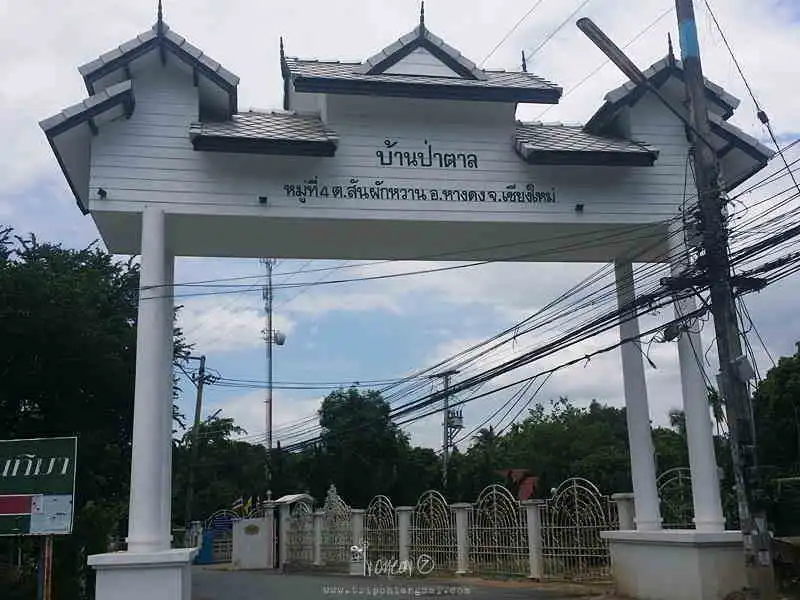
Getting There You can travel by motorcycle, private car, or public transport. From the Airport Intersection, head toward Hang Dong for about 7 km (around 10–15 minutes). After passing the PTT gas station, continue about 300 meters. Ban Pa Tan Village is on the left-hand side before the Samoeng intersection.
| place name | Ban Pa Tan (the “Amazing Smiling Clay Village”), Hang Dong District, Chiang Mai |
| location | San Phak Wan Subdistrict, Hang Dong District, Chiang Mai |
| key characteristics | A long-established village that still preserves Northern Thai traditions, featuring local clay-based terracotta crafts including bricks, clay pots, phang pratheep (traditional clay oil lamps), and contemporary works such as smiling figurines and smiling animal sculptures. |
| period / context | A living craft community continuing local wisdom (some published information states the clay craft has been passed down for more than 100 years). |
| key evidence / highlights | Terracotta crafts have been developed from traditional household use into decorative items and souvenirs, while remaining rooted in handmade production and local materials. |
| name origin / story | Also known as the “Amazing Smiling Clay Village” because its signature “smiling” terracotta sculptures have become the community’s iconic image. |
| open days | Daily |
| opening hours | 08.00–17.00 |
| travel | From the Airport Intersection, drive toward Hang Dong for about 7 km (10–15 minutes). Pass the PTT gas station and continue about 0.3 km. The village is on the left before the Samoeng intersection. |
| current status | Open as a handicraft community and learning destination. Recommended to contact in advance if you want a workshop or custom orders. |
| contact phone | 053-441-698 | 082-745-6164 | 053-131-532 |
| nearby attractions (approx. distance) | Kad Farang Village – 3 km – Tel. 053-430-552 Wat Intharawat (Wat Ton Kwen) – 7 km – Tel. 053-248-607 Baan Tawai Trade & Tourism Information Center – 10 km – Tel. 081-882-4882 Royal Park Rajapruek – 9 km – Tel. 053-114-110 Chiang Mai Night Safari – 10 km – Tel. 053-999-000 |
| popular restaurants nearby (approx. distance) | Khaomao-Khaofang – 8 km – Tel. 063-665-5838 Ohkajhu (Rajapruek–Hang Dong area) – 7 km – Tel. 052-080-744 Kneads to Dough – 8 km – Tel. 093-313-7780 Seichi Yakiniku (Hang Dong branch) – 9 km – Tel. 083-252-9269 MOOH House (Hang Dong) – 10 km – Tel. 053-936-000 |
| popular accommodations nearby (approx. distance) | Ratchapruek Lanna Boutique – 8 km – Tel. 053-114-006 North Hill City Resort – 10 km – Tel. 053-908-999 Veranda High Resort Chiang Mai – 18 km – Tel. 053-365-007 Lanna Resort & Spa – 19 km – Tel. 053-365-222 Kantary Hills Hotel, Chiang Mai – 14 km – Tel. 053-222-111 |
Frequently Asked Questions (FAQ)
Q: What is Ban Pa Tan best known for?
A: It is known for terracotta crafts made from local clay, including bricks, clay pots, phang pratheep (traditional clay oil lamps), and contemporary sculptures such as “smiling people/animals” that have become the community’s signature style.
Q: Why do villagers make pottery alongside rice farming?
A: Because the area has abundant clay, villagers used free time outside farming to turn clay into products for supplementary household income, which later developed into a community craft identity.
Q: How is Ban Pa Tan’s phang pratheep connected to Northern Thai culture?
A: Phang pratheep is used in faith contexts and merit-making traditions. Making these lamps is not only commerce, but also a way to preserve wisdom and cultural meanings woven into Lanna life.
Q: What should I buy as a souvenir?
A: If you want something practical, choose clay pots or functional vessels suitable for kitchen use. If you prefer decor and distinctive souvenirs, choose the “smiling” figurines and sculptures that reflect the village’s character.
Q: How can I get more from a visit than just shopping?
A: Spend time observing the clay process—shaping, drying, and firing—and talk with artisans about care and usage. This helps you understand the value of handmade work and see terracotta as part of living livelihood and culture.
Q: Where can I connect Ban Pa Tan with nearby places in a day trip?
A: It’s easy to link a craft-themed trip with Kad Farang Village, Wat Ton Kwen, Baan Tawai, Royal Park Rajapruek, and Chiang Mai Night Safari, all within the same zone and convenient to reach.
 Ban Pa Tan Map
 Category:
  Group:
  Tag: ●Ban Pa Tan●ban pa tan village ●amazing smiling clay village ●din yim ban pa tan ●hang dong pottery village ●chiang mai terracotta crafts ●lanna terracotta oil lamp ●clay pot chiang mai ●handmade terracotta sculptures ●hang dong attractions ●craft village chiang mai Last Update: 2 MonthAgo
Comment
 Nearby Attractions
| Keyword (Advance) |
 Region
|
 Muang Chiang Mai(
 Copyright 2012,