

 Home
Home Chiang Mai(










Nong Sariam Reservoir
Rating: 3.6/5 (15 votes)
 Search By
  Map
Map 
 Have Map
  No Map
Chiang Mai attractions
Attractions in Thailand
Open Days: Generally every day (this is a community agricultural water source and a local recreation area; please visit in a way that doesn’t disrupt how the area is used)
Opening Hours: Recommended 06:00 – 18:00 (mornings and late afternoons are cooler, great for walking and photos)
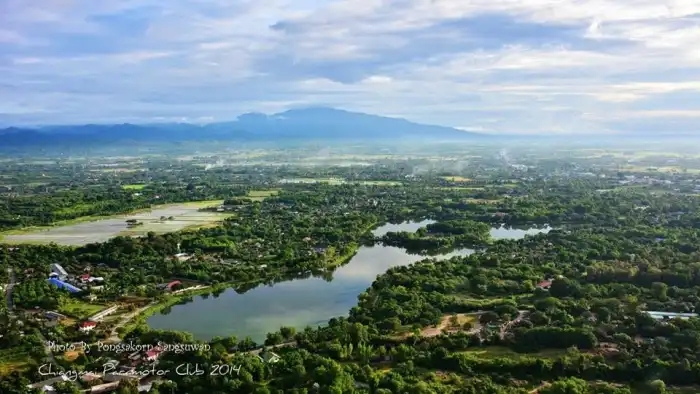
Nong Sariam Reservoir is a large natural pond in San Pa Tong District, Chiang Mai. It matters to the area for more than “a place to relax,” because it functions at the same time as an agricultural water source, a community fishing area, and a shared public space that has supported local sufficiency-based livelihoods for generations. Based on local accounts, Nong Sariem covers roughly 150 rai and has been improved by relevant government agencies and local administrative organizations to make it easier to access as a recreation spot—while still keeping its core identity as “a real working water source used by the community.”
Seen through a farming lens, Nong Sariem helps stabilize seasonal production around the area, especially in the dry season when water effectively becomes both cost and survival for agricultural households. From the fishing lens, it supports local food security, with fish and other aquatic resources tied to the everyday way of “finding food close to home,” a very tangible foundation of sufficiency living.
One reason Nong Sariem is widely talked about is its “original condition before development.” In the past, dense aquatic weeds reportedly covered the entire water surface so thickly that some people said it could even support a person’s weight—an almost uncanny natural sight. As development progressed, dredging and landscape improvements were carried out, and a road was built around the pond to make access and use more convenient. Today, the result is a large, open waterscape that suits slow walking, resting your eyes, light exercise, or simply sitting in the breeze without having to rush.
Historically, what makes Nong Sariem distinctive is that there is no clear written historical record commonly cited in the community. According to local elders, the story lives more as legend than documented history. But that legend is exactly what gives Nong Sariem a shared cultural memory—not just a body of water.
The legend says that long ago there was a village called “Sri Don Chai,” with around 100 households. People farmed and fished to make a living. Before the full-moon period in the 12th lunar month (known locally as “12 Peng”), the village head gathered residents to prepare for the traditional “salakapat” merit-making ceremony. That year, however, drought made food scarce. One villager suggested a fish-rich pond by the Ping River and claimed to have seen a giant albino eel as thick as a palm tree.
The next morning, the village head sounded the wooden alarm to call people to catch fish at the riverside pond for the ceremony. Each household sent representatives to help—except for a widow named Bua Khiao, because others shunned her as a widow. At the pond, villagers found the giant albino eel and dragged it back to Sri Don Chai village with vines, then divided it up to cook and eat. Widow Bua Khiao did not receive any.
That night, an ominous disaster struck: heavy rain, trembling earth, and the collapse of Sri Don Chai village. The land reportedly sank, leaving only the widow’s house standing. The remaining sandbar became known as “Don Mae Mai” (Widow’s Sandbar). While difficult to verify through documents, the legend reflects local beliefs about living with nature, respecting unseen forces, and how community relationships shape a long-term sense of ownership and meaning around a place.
Because Nong Sariem is both a water source and a community public space, the best way to visit is “with restraint.” Don’t litter, keep noise down, avoid disturbing local residents, and avoid activities that could affect water quality. If you come early morning or late afternoon, you’ll usually get cooler air and softer light—ideal for a slow walk around the pond and a real mental reset.
Getting There Nong Sariem is in Ban Ton Phueng, Yu Wa Subdistrict, San Pa Tong District, Chiang Mai. Take Highway 108 (Chiang Mai–Hot), pass the San Pa Tong District Office for about 3 km, then turn right into a small lane for about 300 meters to reach the site. It’s best to come by private car or rental car (generally, public buses do not pass directly to the entrance).
| Name | Nong Sariem |
| Location | Ban Ton Phueng, Yu Wa Subdistrict, San Pa Tong District, Chiang Mai |
| Area Characteristics | Large community pond (about 150 rai); agricultural water source, community fishing area, and recreation space |
| Story Highlight | Legend of “Sri Don Chai” village, a giant albino eel, and “Don Mae Mai” (local oral tradition) |
| Travel | Highway 108 (Chiang Mai–Hot), pass San Pa Tong District Office ~3 km, then turn right into a lane ~300 m |
| Nearby Tourist Attractions (Distance & Phone) | Royal Park Rajapruek (approx. 20 km) Tel. 053-114-110 Chiang Mai Night Safari (approx. 22 km) Tel. 053-999-000 |
| Popular Restaurants Nearby (Distance & Phone) | Lakeview Restaurant, San Pa Tong (approx. 6 km) Tel. 097-958-2451 Chez Marco Restaurant (near city/Hang Dong area) (approx. 25 km) Tel. 081-696-9508 |
| Popular Accommodations Nearby (Distance & Phone) | Rice Barn and Rooms (approx. 13 km) Tel. 081-556-3346 Buntan Sanctuary (approx. 14 km) Tel. 095-651-5166 Kao Mai Lanna Resort (approx. 15 km) Tel. 053-311-005 Suan Sati (approx. 16 km) Tel. 081-783-2171 Huean Oei Chantha (approx. 17 km) Tel. 093-416-3239 |
| Local Authority (For Area Information) | Yu Wa Subdistrict Municipality Tel. 053-355-312 |
Frequently Asked Questions (FAQ)
Q: What kind of trip is Nong Sariem best for?
A: It’s best for a slow, quiet visit—walking, taking photos, and enjoying a large community pond atmosphere while respecting that it’s also a working local water source.
Q: Why is Nong Sariem important to the local community?
A: It supports agriculture and community fishing, and it also functions as a shared public space that strengthens local livelihoods and food security.
Q: How is the “giant albino eel” legend connected to Nong Sariem?
A: It’s an oral tradition linked to the story of “Sri Don Chai” village and the origin of “Don Mae Mai.” While not clearly documented, it’s part of the area’s living cultural memory.
Q: What should visitors be careful about?
A: Don’t litter, keep noise down, respect residents and the water source, avoid activities that may affect water quality, and drive carefully on the small access lane.
 Nong Sariam Reservoir Map
 Category:
  Group:
  Tag: ●Nong Sariam Reservoir●nong sariem ●nong sariem san pa tong ●san pa tong attractions ●yuwa chiang mai ●chiang mai lake ●community reservoir chiang mai ●fishing spot chiang mai ●nature escape near chiang mai ●where to go san pa tong ●day trip san pa tong Last Update: 3 MonthAgo
Comment
 Nearby Attractions
| Keyword (Advance) |
 Region
|
 Muang Chiang Mai(
 Copyright 2012,