
lovethailand home >North Travel Attractions >Chiang Mai Travel Attractions >Muang Chiang Mai >Hai Ya > Wat That Kham
TL;DR: Wat That Kham is located at Hai Ya Subdistrict, Mueang Chiang Mai District, Chiang Mai Province, open Daily, hours 08.00 – 17.00.

Wat That Kham
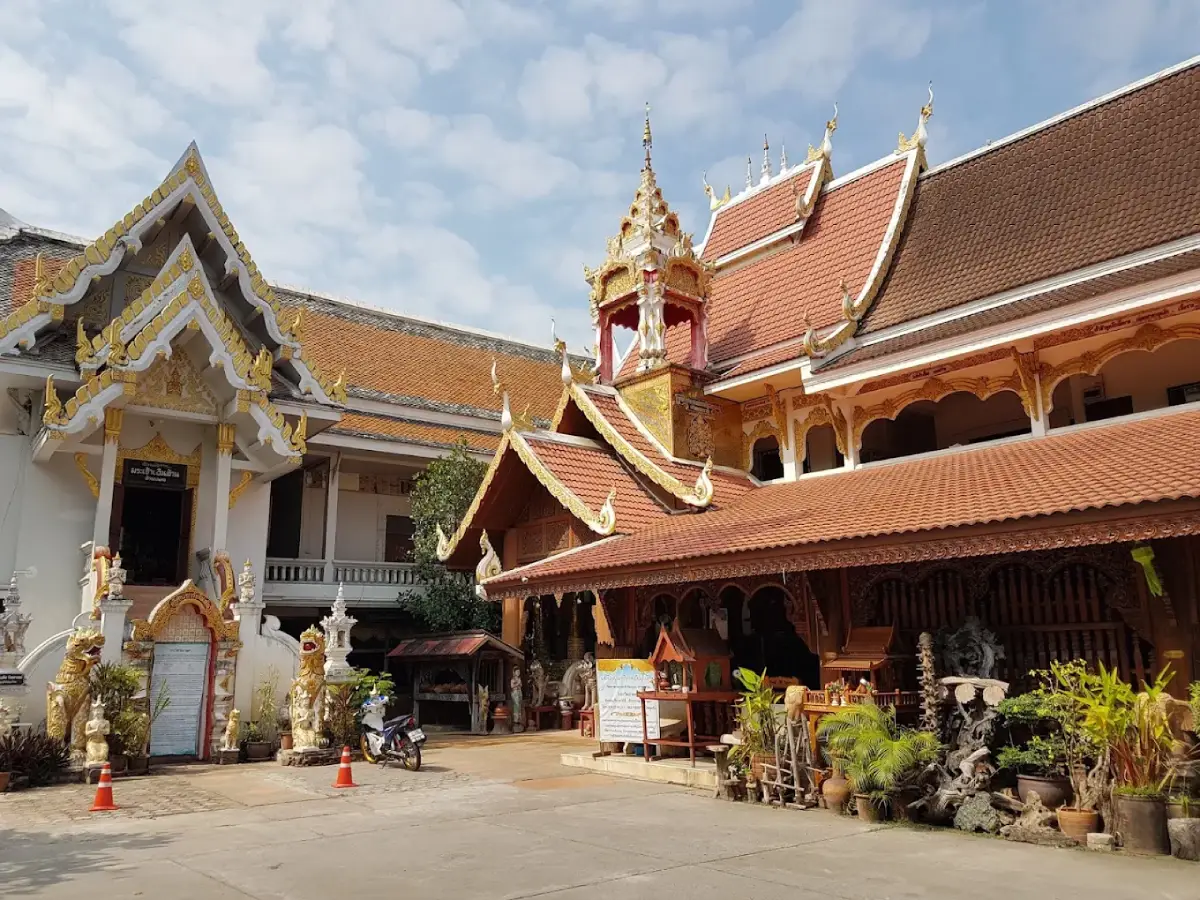
Open Days: Daily
Opening Hours: 08.00 – 17.00
Wat That Kham is an old Buddhist temple in Hai Ya Subdistrict, Mueang Chiang Mai District, Chiang Mai Province. It was formerly known as Wat Kudi Kham and was also called Wat Mai by local residents in earlier times. The temple is notable for its large bronze principal Buddha image in Chiang Saen style and for its raised Buddhist sanctuary area, where the viharn and stupa stand on an earthen mound about 3 meters high. Wat That Kham remains an active religious site where visitors can pay respect, make merit, and explore a quieter but historically meaningful side of Chiang Mai’s old city.
Wat That Kham is located in the Hai Ya area on the southern side of Chiang Mai’s old city. Although it is less widely promoted than some major temples inside the moat, it is one of the most rewarding temples for travelers who want to understand Chiang Mai beyond the usual landmark route. The temple’s former name, Wat Kudi Kham, and its old local name, Wat Mai, preserve layers of community memory that connect the temple with the long history of Hai Ya and the southern urban zone of Chiang Mai.
The location of Wat That Kham is historically important because the temple stands between the inner city wall and the outer defensive earthwork of old Chiang Mai. This position links the temple with the broader urban landscape around Chiang Mai Gate, Wua Lai Road, Kad Kom, and the old communities of Hai Ya. Wat That Kham should therefore be understood not only as a local temple, but also as part of the religious and settlement pattern that developed around the southern edge of the old city. Visitors who walk through this neighborhood can still sense the close relationship between temples, markets, craft streets, guesthouses, and long-established local communities.
The most important sacred object inside Wat That Kham is the large bronze principal Buddha image in the viharn. The image is admired for its Chiang Saen artistic characteristics and for the quality of its metal casting. Creating a large bronze Buddha image required substantial resources, skilled craftsmanship, and strong patronage. For this reason, historians have treated the image as an important clue that Wat That Kham may once have held a significant status in the religious landscape of old Chiang Mai. The Buddha image is not only a focus of devotion, but also a valuable piece of material evidence for studying Lanna Buddhist art.
In Hai Ya Subdistrict, the principal Buddha image of Wat That Kham is especially distinctive because it is made of bronze, while many other temples in the area have principal Buddha images made from brick and stucco. This difference gives Wat That Kham a special place among local temples. Even though there is no clear inscription on the base of the image giving the exact period of construction, its artistic style and historical context make the temple a meaningful site for anyone interested in Chiang Mai’s religious history, archaeology, and Buddhist sculpture.
Another defining feature of Wat That Kham is the raised Buddhist sanctuary area. The viharn and stupa were built on an earthen mound about 3 meters above the surrounding ground level. This elevated setting gives the main sacred zone a clear visual prominence and separates it from the surrounding area. The Buddhist sanctuary measures approximately 60 meters wide and nearly 100 meters long. In Chiang Mai, this type of temple layout is uncommon. Wat Ban Ping in Si Phum Subdistrict and Wat That Kham in Hai Ya Subdistrict are among the examples associated with this distinctive raised arrangement.
The name Wat That Kham points to the importance of the temple’s stupa, while the former name Wat Kudi Kham reflects an earlier layer of local naming. The name Wat Mai, used by villagers in the past, adds another layer of community identity. Together, these names show that the temple’s history is not only preserved in buildings and sacred images, but also in the language and memory of the people who have lived around it for generations.
Wat That Kham is also associated with Phra Khru Adunsilakit, the temple’s abbot and an important monk known for his work in preserving Lanna cultural knowledge. He has been recognized for his expertise in local history, traditional rituals, and Lanna Buddhist customs. His connection with Wat That Kham strengthens the temple’s role as a living center of religious practice, cultural memory, and local knowledge rather than merely a place of worship.
The key areas to observe inside Wat That Kham include the viharn, the large bronze principal Buddha image, the stupa, and the elevated Buddhist sanctuary zone. The viharn is the main place for paying respect to the Buddha image and for quiet reflection. The stupa area reflects the temple’s name and its role in Lanna Buddhist devotion. The raised sanctuary zone helps visitors understand how the temple was planned and why its layout differs from many other temples in the city.
The atmosphere of Wat That Kham is calm, modest, and deeply local. It is suitable for travelers who prefer a slower temple visit rather than a crowded sightseeing stop. The temple sits close to the old city, but it still retains the character of a neighborhood temple. Visitors can spend time observing the temple layout, paying respect inside the viharn, and appreciating the way the temple remains integrated with the surrounding community.
For travelers interested in Lanna history, Wat That Kham offers a useful way to read Chiang Mai through its smaller temples. Its location between the inner and outer city walls connects it with the historical development of the southern city area. Nearby places such as Chiang Mai Gate, Wua Lai Road, Wat Sri Suphan, Wat Nantaram, and Kad Kom help complete the story of religion, trade, craftsmanship, and everyday community life in Hai Ya.
The best time to visit Wat That Kham is usually in the morning or late afternoon, when the atmosphere is quieter and the natural light makes the temple details easier to appreciate. Travelers who enjoy photography can capture the viharn, the stupa, and the old neighborhood setting. Since Wat That Kham is still an active Buddhist temple, visitors should dress respectfully, speak quietly, and avoid interrupting monks or local worshippers.
Getting There is convenient from Chiang Mai Gate, Wua Lai Road, or the southern part of the old city. Visitors can travel along Suriyawong Road and enter Suriyawong Soi 5. The temple is accessible by private car, local transport, or on foot from nearby accommodation in the old city’s southern quarter. Those driving should plan ahead for parking and traffic, especially on Saturday evening when Wua Lai Walking Street becomes busy. Wat That Kham can be combined easily with Wat Sri Suphan, Wat Nantaram, Chiang Mai Gate, Chiang Mai Gate Market, and Wua Lai Walking Street in a half-day cultural route.
The value of Wat That Kham lies in the balance between its quiet local atmosphere and its deeper historical significance. Visitors can see a bronze Buddha image of artistic importance, study an uncommon raised temple layout, and experience a temple that remains tied to the everyday life of the Hai Ya community. This makes Wat That Kham a worthwhile stop for travelers seeking a more detailed and culturally grounded experience of Chiang Mai.
Compared with Chiang Mai’s larger and more crowded temples, Wat That Kham offers a more intimate encounter with Lanna heritage. A visit does not need to be long, but it should be unhurried. Taking time to observe the elevated sanctuary, the viharn, the stupa, and the principal Buddha image allows visitors to understand why this temple is historically distinctive. Wat That Kham is suitable for solo travelers, couples, families, cultural travelers, and anyone planning a temple route around the southern side of Chiang Mai’s old city.
Wat That Kham is not only a place to pay respect to the Buddha, but also a place where the history of Chiang Mai can be read through sacred space, craftsmanship, and community memory. The bronze principal image, the stupa, the viharn, and the elevated mound all function as physical evidence of the temple’s importance. When these features are connected with the role of Phra Khru Adunsilakit and the historic Hai Ya neighborhood, the temple becomes a meaningful learning site for Buddhism, Lanna art, and local cultural continuity.
A visit to Wat That Kham therefore adds depth to any Chiang Mai itinerary. It allows travelers to move beyond the most familiar landmarks and discover a temple that preserves traces of royal patronage, local devotion, Buddhist craftsmanship, and urban history in one compact site. For those who want to understand Chiang Mai through its old temples and living neighborhoods, Wat That Kham deserves a place on the route.
| Name | Wat That Kham |
| Former Name | Wat Kudi Kham; formerly called Wat Mai by local villagers |
| Location | Hai Ya Subdistrict, Mueang Chiang Mai District, Chiang Mai Province |
| Address | Suriyawong Soi 5, Suriyawong Road, Hai Ya Subdistrict, Mueang Chiang Mai District, Chiang Mai Province |
| Coordinates | Latitude 18.77753, Longitude 98.98861 |
| Highlights | Large bronze principal Buddha image in Chiang Saen style and a raised Buddhist sanctuary built on an earthen mound about 3 meters high |
| History | An old temple in Hai Ya, Chiang Mai, historically associated with a significant religious status because of its large bronze principal Buddha image and uncommon raised sanctuary layout |
| Name Origin | The temple was formerly known as Wat Kudi Kham and was called Wat Mai by local residents; its current name is connected with the temple’s stupa |
| Distinctive Features | Located between the inner city wall and outer defensive earthwork, with a raised Buddhist sanctuary measuring about 60 meters wide and nearly 100 meters long |
| Important Buddha Image | Large bronze principal Buddha image with Chiang Saen artistic characteristics |
| Travel Information | Accessible from Chiang Mai Gate or Wua Lai Road via Suriyawong Road and Suriyawong Soi 5; suitable for travel by private car, local transport, or on foot from nearby accommodation |
| Current Status | Open to worshippers and visitors; the temple continues to host Buddhist religious activities |
| Open Days | Daily |
| Opening Hours | 08.00 – 17.00 |
| Main Areas / Zones | Viharn, bronze principal Buddha image, stupa, raised Buddhist sanctuary, and temple courtyard |
| Abbot / Caretaker | Phra Khru Adunsilakit |
| Nearby Tourist Attractions | 1. Wat That Klang, about 0.1 km 2. Wat Yang Kuang, about 0.2 km 3. Wat Dao Dueng, about 0.3 km 4. Wat Sri Suphan, about 0.6 km 5. Chiang Mai Gate, about 0.6 km 6. Chiang Mai Gate Market, about 0.6 km 7. Wua Lai Walking Street, about 0.7 km 8. Wat Chedi Luang, about 1 km |
| Nearby Restaurants | 1. Naderm Antique Shop & Cafe, about 0.1 km, Tel. 065-621-2156, 080-030-7625 2. Do re Tea, about 0.1 km 3. Kha Moo By Kru Noi, about 0.1 km, Tel. 062-252-4793 4. June Koff, about 0.2 km, Tel. 087-656-9588 5. Kai Tod Anong Kad Kom, about 0.3 km, Tel. 095-629-4697 6. Cham Traditional Coffee Chiang Mai Kad Kom, about 0.4 km, Tel. 084-363-7397 |
| Nearby Accommodations | 1. CM Memorial Hostel, about 0.1 km, Tel. 099-012-3392 2. The Mellow Pillow Hotel @ Chiang Mai Gate, about 0.2 km, Tel. 062-291-6886 3. BED Chiangmai Gate, about 0.4 km, Tel. 053-277-707 4. The Entaneer Poshtel, about 0.6 km, Tel. 053-111-623 5. Romena Grand Hotel, about 0.7 km, Tel. 053-449-095, 087-190-6661 6. iSilver Hotel, about 0.8 km, Tel. 053-277-211 |
Frequently Asked Questions (FAQ)
Q: Where is Wat That Kham located?
A: Wat That Kham is located in Hai Ya Subdistrict, Mueang Chiang Mai District, Chiang Mai Province, near Suriyawong Soi 5, Chiang Mai Gate, Wua Lai Road, and Kad Kom.
Q: What are the opening days and hours of Wat That Kham?
A: Wat That Kham is open daily from 08.00 to 17.00, making it suitable for a morning or afternoon temple visit.
Q: What was the former name of Wat That Kham?
A: Wat That Kham was formerly known as Wat Kudi Kham and was also called Wat Mai by local villagers in earlier times.
Q: What makes Wat That Kham historically important?
A: The temple is important for its large bronze principal Buddha image in Chiang Saen style and for its raised sanctuary layout, where the viharn and stupa stand on an earthen mound about 3 meters high.
Q: Why is the principal Buddha image at Wat That Kham significant?
A: The principal Buddha image is a large bronze image with Chiang Saen artistic features. Its material, size, and craftsmanship make it an important object for both worship and Lanna art study.
Q: What kind of trip is Wat That Kham suitable for?
A: Wat That Kham is suitable for cultural travelers, temple visits, Lanna history study, and half-day routes around Wat Sri Suphan, Wua Lai Walking Street, Chiang Mai Gate, and Chiang Mai Gate Market.
Q: How can visitors get to Wat That Kham?
A: Visitors can reach the temple from Chiang Mai Gate or Wua Lai Road by following Suriyawong Road to Suriyawong Soi 5. It is accessible by private car, local transport, or on foot from nearby accommodation.
Q: How should visitors behave at Wat That Kham?
A: Visitors should dress respectfully, keep their voices low, avoid disturbing monks or worshippers, and treat all temple areas as active religious spaces.
 Category: ●Places of Worship
 Group: ●Temple
Last Update : 2 MonthAgo
 Last Update : 2 MonthAgo
 Click to Access the Navigation Map GPS

 Muang Chiang Mai(121)Chom Thong(47)Mae Chaem(25)Chiang Dao(33)Doi Saket(68)Mae Taeng(85)Mae Rim(69)Samoeng(29)Fang(71)Mae Ai(59)Phrao(70)San Pa Tong(103)San Kamphaeng(66)San Sai(73)Hang Dong(73)Hot(32)Doi Tao(22)Omkoi(11)Saraphi(74)Wiang Haeng(15)Chai Prakan(28)Mae Wang(32)Mae On(22)Doi Lo(33)Galyani Vadhana(1)


