
lovethailand home >Eastern Travel Attractions >Trat Travel Attractions >Muang Trat >Cham Rak > Trat Mangrove Study Center
TL;DR: Trat Mangrove Study Center is located at Mangrove and small fishing community area in Trat Province, suitable to combine with Laem Makham Mangrove Forest and Laem Ngop District, open Daily, hours 05.00 – 19.00.
Trat Mangrove Study Center
Open Days: Daily
Opening Hours: 05.00 – 19.00
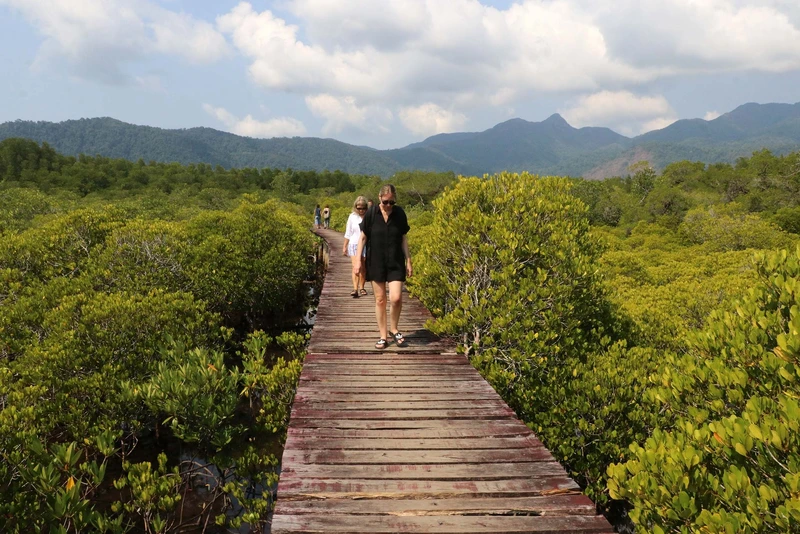
Trat Mangrove Study Center is an eco-learning destination in Trat Province where visitors can experience mangrove forest ecology, small-scale fishing life, coastal biodiversity, and local seafood culture in one place. The surrounding mangrove area is connected with a small fishing community where local fishermen bring fresh seafood for sale in the early morning, usually between 05.00 and 07.00. This makes the site more than a nature trail. It is a living coastal landscape where mangrove forests, fishing livelihoods, birds, aquatic animals, and local people remain closely connected.
The main appeal of Trat Mangrove Study Center is its role as a learning site for many mangrove plant species. Visitors can observe trees and plants commonly found in mangrove ecosystems, such as mangrove trees, Avicennia, Sonneratia, Xylocarpus, Excoecaria, and other salt-tolerant coastal plants. These plants are not only beautiful or unusual; they protect the coast, stabilize soil, reduce wave energy, trap sediment, and provide nursery grounds for young marine life.
For travelers who arrive early, the morning atmosphere is especially meaningful. Between 05.00 and 07.00, local fishermen bring fresh seafood from small-scale fishing activities. Depending on the season and the day’s catch, visitors may see fish, crabs, shrimp, shellfish, or other coastal seafood. This early-morning scene reveals the connection between healthy coastal ecosystems and local livelihoods. When the mangrove forest is healthy, marine life has shelter and breeding grounds, and the fishing community benefits directly.
Mangrove forests in Trat are important because they exist at the meeting point of land, brackish water, seawater, and fishing villages. This type of ecosystem supports many forms of life, including fiddler crabs, mudskippers, small fish, mollusks, insects, reptiles, and birds. A walk through the mangrove area allows visitors to observe the relationships between roots, mud, tides, animals, and people. It is one of the best ways to understand coastal ecology without needing advanced scientific knowledge.
Birdwatching is another highlight of Trat Mangrove Study Center. Several bird species can be observed in the area, including hornbills, kingfishers, zebra doves, and other coastal or wetland birds. Birds are useful indicators of environmental richness because they depend on food sources, nesting spaces, resting areas, and safe habitats. Visitors who enjoy birdwatching should come in the early morning or late afternoon, when the weather is cooler and birds are more active.
Hornbills are among the most impressive birds associated with the area. They are large birds with distinctive bills and are often regarded as indicators of healthy forests. Although hornbills are usually associated with inland forests and forested hills, sightings in coastal or mangrove-linked areas reflect the ecological diversity of Trat, where the sea, mangroves, lowland forest, and mountains are not far apart.
Kingfishers are also commonly associated with wetland and mangrove habitats. Their bright colors and quick movements make them exciting to observe, especially when they perch on branches or dive toward the water to catch prey. Other birds, including zebra doves and local wetland species, add life and sound to the mangrove environment. This makes the area suitable for beginners, families, students, and nature photographers.
Beyond birds and plants, the center helps visitors understand the ecological functions of mangroves. Mangroves reduce coastal erosion, filter sediment, support aquatic life, and create a natural buffer against strong waves. Many young fish, crabs, and shrimp use mangrove roots as shelter before moving into larger waters. This is why mangrove conservation is directly connected to food security and the income of small fishing communities.
Eco-travelers should allow at least 1 – 2 hours to explore the area properly. Early morning is ideal for seeing the seafood market atmosphere and enjoying cool weather, while late afternoon is suitable for walking, photography, and birdwatching. Visitors should move slowly, observe carefully, and avoid loud noise in areas where birds and wildlife are present.
Visitors should prepare for a natural outdoor environment. Comfortable walking shoes, drinking water, a hat, mosquito repellent, and sun protection are recommended. Birdwatchers may bring binoculars or a telephoto camera. While walking, visitors should stay on designated paths, avoid breaking branches, avoid touching wildlife, and never throw garbage into the mangrove area.
The fresh seafood sold in the early morning is part of the local identity of this place. Travelers who wish to buy seafood should arrive before 07.00, as the products depend on the day’s catch and may sell out quickly. Buying directly from small-scale fishermen helps support the local economy and gives visitors a more authentic taste of Trat’s coastal way of life.
For schools and educational groups, Trat Mangrove Study Center is a valuable outdoor classroom. It can be used to teach coastal ecology, biodiversity, conservation, local livelihoods, and the relationship between people and nature. Learning in the real landscape helps students understand environmental systems more clearly than classroom learning alone.
The center also fits well into a broader Trat travel route. Trat is often known for islands such as Ko Chang, Ko Kut, and Ko Mak, but its mangrove areas are equally important. Mangrove forests are the foundation of coastal life, supporting fisheries, protecting the shoreline, and maintaining ecological balance. A meaningful trip to Trat should include not only beaches and islands, but also fishing communities and mangrove learning sites.
Nearby eco-cultural attractions can be combined into a half-day or full-day route, including Black Sand Beach, Laem Makham Mangrove Forest, Ban Nam Chiao Community, Laem Ngop Pier, and Trat town. A good itinerary may begin with the early-morning seafood scene, continue with a mangrove walk, and then move on to nearby communities or coastal viewpoints.
Getting There from Trat town is convenient by private car, rental car, or local hired vehicle. The site can be included in a route toward Laem Ngop District and nearby mangrove attractions such as Black Sand Beach and Laem Makham Mangrove Forest. Travelers should check the route and tide conditions if they plan to observe fishing activities or photograph the area during the early morning.
Visitors should respect the local fishing community. Avoid entering working areas without permission, do not take close-up photographs of people without asking, and support local seafood sellers fairly. Early morning is working time for fishermen, so polite behavior helps maintain a positive relationship between visitors and the community.
Trat Mangrove Study Center is suitable for travelers who want to understand nature and local life in a deeper way. It offers mangrove plants, coastal wildlife, birds, small-scale fishing culture, and fresh seafood in the early morning. The site may appear simple, but it carries high ecological and cultural value. A visit here shows that mangrove forests are not just green areas by the sea; they are living foundations of Trat’s coastal communities.
| Name | Trat Mangrove Study Center |
| Location | Mangrove and small fishing community area in Trat Province, suitable to combine with Laem Makham Mangrove Forest and Laem Ngop District |
| Highlights | Mangrove plant learning, small-scale fishing community, early-morning fresh seafood, and birdwatching, including hornbills, kingfishers, and zebra doves |
| Distinctive Features | A coastal eco-learning area that connects mangrove forests, aquatic life, birds, and local fishing livelihoods |
| Main Areas / Zones | Fishing community area, early-morning seafood selling point, mangrove plant learning route, birdwatching points, coastal wildlife observation area, and nature photography spots |
| Caretaker | Local fishing community and local agencies responsible for mangrove areas in Trat Province |
| Current Status | Open as a nature learning and eco-tourism area |
| Open Days | Daily |
| Opening Hours | 05.00 – 19.00 |
| Fresh Seafood Time | 05.00 – 07.00 |
| Fees | No admission fee |
| Facilities | Nature study area, mangrove observation points, birdwatching spots, fishing community area, and early-morning seafood selling point |
| Travel Information | From Trat town, travel by private car, rental car, or local hired vehicle toward the coastal mangrove and fishing community area. The visit can be combined with Black Sand Beach, Laem Makham Mangrove Forest, and Laem Ngop District |
| Nearby Tourist Attractions | 1. Black Sand Beach, about 2 km 2. Laem Makham Mangrove Forest, about 2 km 3. Laem Ngop Pier, about 8 km 4. Laem Ngop Lighthouse, about 8 km 5. Ban Nam Chiao Community, about 10 km 6. Yuttanavi Memorial Monument at Ko Chang, about 8 km |
| Nearby Restaurants | 1. Tewtara, about 10 km, Tel. 080-575-3598, 039-593-669, 063-047-1204 2. Kaikon Seafood Trat, about 17 km, Tel. 064-574-9075 3. Pook Yen Ta Fo Noodle, about 15 km 4. Let’s Meat, about 15 km 5. Orchid Restaurant & Guesthouse, about 15 km |
| Nearby Accommodations | 1. BaanRimNam Resort Trat, about 15 km, Tel. 091-232-8848, 098-534-2833 2. Trat Center Hotel, about 16 km, Tel. 039-531-234, 086-749-8899 3. Trat City Hotel, about 16 km, Tel. 039-510-711-4, 086-327-8171 4. Avada Hotel Trat, about 19 km, Tel. 039-510-345, 082-006-1308 5. Orchid Guesthouse Trat, about 15 km |
Frequently Asked Questions (FAQ)
Q: What is interesting about Trat Mangrove Study Center?
A: Visitors can learn about mangrove plants, observe a small fishing community, buy fresh seafood in the early morning, and watch birds such as hornbills, kingfishers, and zebra doves.
Q: What is the best time to visit?
A: Early morning from 05.00 to 07.00 is best for seeing local fishing life and fresh seafood, while late afternoon is good for walking and birdwatching.
Q: Is fresh seafood really sold there?
A: Yes. Local fishermen bring fresh seafood for sale around 05.00 – 07.00, depending on the season and the day’s catch.
Q: Is the area good for birdwatching?
A: Yes. The area is suitable for birdwatching, with species such as hornbills, kingfishers, zebra doves, and other coastal birds.
Q: Is there an admission fee?
A: No admission fee is charged, making it suitable for families, students, nature lovers, and educational groups.
Q: What should visitors prepare?
A: Comfortable walking shoes, drinking water, a hat, mosquito repellent, a camera, and binoculars are recommended, especially for birdwatching.
Q: How can visitors get there from Trat town?
A: Visitors can travel by private car, rental car, or local hired vehicle and combine the trip with Black Sand Beach, Laem Makham Mangrove Forest, and Laem Ngop District.
Q: What nearby places can be visited after the mangrove center?
A: Nearby places include Black Sand Beach, Laem Makham Mangrove Forest, Laem Ngop Pier, Laem Ngop Lighthouse, Ban Nam Chiao Community, and Yuttanavi Memorial Monument.
 Category: ●Educational Places
 Group: ●Educational Gardens, Farm
Last Update : 4 MonthAgo
 Last Update : 4 MonthAgo
 Click to Access the Navigation Map GPS
Trat Mangrove Study Center Map
Recommend

 Art, Culture and Heritage
 Historical Sites and Monuments(1)
 Landmarks and Memorials(1)
 Art, Craft Centres, Tradition(3)
 Museums(2)
 Museum for Study(1)
Educational Gardens, Farm(2)
Museum for Study(1)
Educational Gardens, Farm(2)
 Places of Worship
 Temple(11)
 Mosque(2)
 Other Sacred Sites(2)
 Suburban Living
 Village, Community(6)
 Local Market(2)
 Nature and Wildlife
 National Parks and Marine Reserves(2)
 Mountain (Doi)(1)
 Dam, Reservoir, Lake(3)
 Waterfalls(15)
 River, Canal(1)
 Bays and Beaches(21)
 Islands(19)
 Other natural attractions(12)
 Entertainment and Agricultural
 Outdoor and Adventure Activities(1)
 Shopping
 Shopping and Night Market(1)


