
lovethailand home >Northeastern Travel Attractions >Khon Kaen Travel Attractions >Ban Phai >Hua Nong > Wat Sanuan Wari Phatthanaram
TL;DR: Wat Sanuan Wari Phatthanaram is located at Ban Hua Nong, Moo 1, Hua Nong Subdistrict, Ban Phai District, Khon Kaen Province 40110, Thailand, open Every Day, hours 08:00-17:00.
Wat Sanuan Wari Phatthanaram
Open Days: Every Day
Opening Hours: 08:00-17:00
Wat Sanuan Wari Phatthanaram in Khon Kaen Province is an old Buddhist temple in Ban Hua Nong, Hua Nong Subdistrict, Ban Phai District. It is best known for its small ancient Isan sim, or ordination hall, built of brick and plaster with Vietnamese-influenced archways. The exterior murals, known locally as hup taem, depict the Isan literary epic Sinsai or Sang Sinxay, while the interior murals depict the Vessantara Jataka. This temple is a valuable destination for travelers interested in Isan vernacular architecture, folk mural painting, Buddhist storytelling, and cultural travel in Ban Phai District.
Wat Sanuan Wari Phatthanaram is located in Ban Hua Nong, Hua Nong Subdistrict, Ban Phai District, Khon Kaen Province. It is one of the most culturally valuable temples in the district and an important site for understanding Isan vernacular architecture and folk mural painting. The temple is not famous because of monumental size or grand decoration. Its significance lies in a small ancient sim, or ordination hall, that preserves the work of local craftsmen, the storytelling tradition of village mural painters, and the spiritual imagination of an Isan community. For visitors who want to understand Khon Kaen beyond mainstream attractions, this temple offers a quiet but deeply meaningful cultural experience.
The temple was formerly known as Wat Chanuan or Wat Khanuan because a chanuan tree grew within the temple grounds. Over time, the name gradually changed in local pronunciation and became Sanuan, which is now the name used today. This story shows how place names in rural Thailand often grow from local memory, natural features, and everyday speech rather than from formal planning. Knowing the origin of the temple’s name helps visitors understand that Wat Sanuan Wari Phatthanaram is rooted in the life of its community.
Local historical information records that the temple was established around 1922 through donations from villagers. Vietnamese craftsmen are said to have played an important role as both master builders and mural painters. This explains why the sim has a distinctive architectural character. Its arched openings and façade details differ from many other Isan ordination halls. The building reflects not a single isolated tradition, but a local blend of Isan Buddhist architecture, village craftsmanship, and Vietnamese-influenced construction techniques that were adapted to the needs of the community.
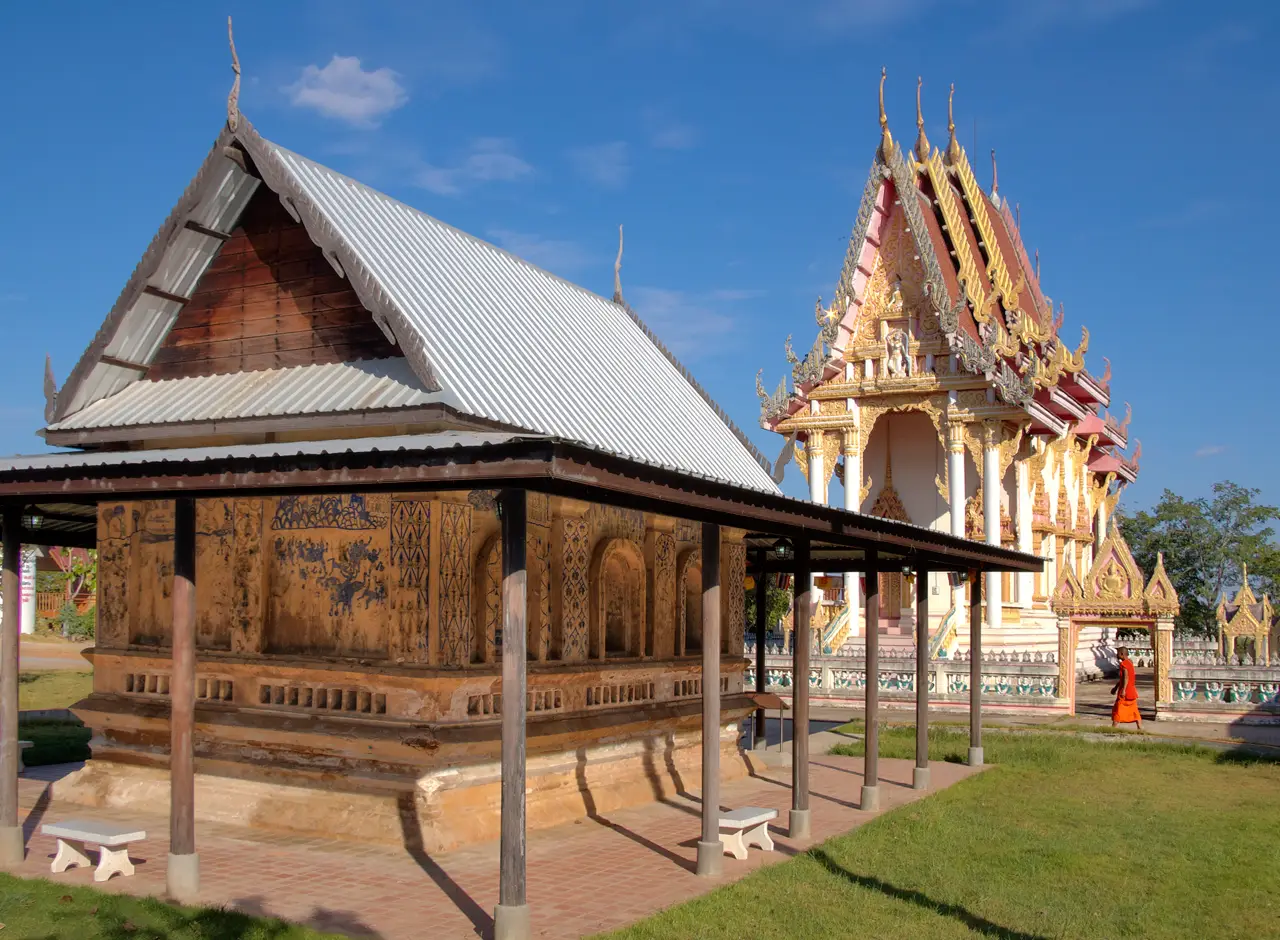
The ancient sim is a small brick-and-plaster structure with a rectangular plan. It is approximately 5 to 5.30 meters wide and about 7 to 7.50 meters long. It is a solid-style sim with only one main entrance on the eastern side. The building is raised from the ground, and boundary stones are placed around it in eight directions. Although the structure is modest in scale, it contains rich architectural and artistic information. It shows how a small village community could create a sacred Buddhist space using local labor, faith, and practical craftsmanship.
The most visually distinctive feature of the sim is its arched openings. The front façade has three arches: the central arch forms the entrance, while the two side arches frame window-like openings. The side walls also feature arched openings instead of conventional window panels. These arches give the building a unique rhythm and make the solid structure feel lighter and more open. The Vietnamese influence is especially visible in these curved forms. For architectural travelers, this is one of the key reasons to visit the temple.
The roof is a simple gable roof with local Isan wooden decorative elements. A surrounding roof extension shelters the walls and murals, supported by posts around the building. This practical design helps protect the mural surfaces from rain and sunlight. The building demonstrates how local craftsmen thought carefully about use, climate, and preservation. The result is a modest but thoughtful sacred building that still communicates the skill and devotion of the community that built it.
Inside the sim is a locally made stucco Buddha image in the posture of subduing Mara. The image sits on a simple traditional base. It does not have the highly polished refinement of royal temple sculpture, but it has the sincerity and directness of local craftsmanship. Because the interior space is small, visitors can feel a close and intimate relationship with the Buddha image. The upper sections of the interior walls are decorated with murals depicting the Vessantara Jataka, one of the most important Buddhist stories in Isan religious culture.
The Vessantara Jataka tells the story of the Bodhisattva’s final life before becoming the Buddha. It emphasizes generosity, sacrifice, patience, and compassion. In Isan culture, this story is strongly connected with Bun Phawet, or the local merit-making festival of the Great Birth Sermon. By painting the Vessantara Jataka inside the sim, the temple connects formal Buddhist worship with the moral teaching traditions of the community. Visitors are not simply looking at old paintings; they are seeing a visual form of Buddhist instruction that once helped people learn values and stories through images.
The exterior murals are the most famous artistic feature of Wat Sanuan Wari Phatthanaram. They depict the story of Sinsai, also known as Sang Sinxay, a major literary epic in Isan and the Mekong region. The story begins on the southern wall, continues to the western and northern walls, reaches the eastern wall, and then continues again to finish on the western wall. Walking around the sim therefore becomes a form of reading. Visitors must move slowly around the building, follow the painted scenes, and connect the story from one wall to another.
Sinsai is one of the most beloved literary works in Isan culture. It contains adventure, loyalty, family love, moral struggle, supernatural beings, and heroic action. The story includes humans, giants, animals, magical creatures, and imaginative landscapes. By painting Sinsai on the outside walls of the sim, the temple turned the building into a public storytelling space. In earlier times, even people who could not read written texts could learn stories and moral lessons through these painted scenes.
The value of the murals is not based on strict realism or academic perspective. Their power comes from emotion, line, color, freedom, and imagination. The folk mural painter did not follow the strict rules of royal court painting. Instead, the painter told stories in a freer local visual language. Some scenes may move across time quickly. Some episodes may be emphasized, skipped, or rearranged. Some details reflect the painter’s own imagination and knowledge of the world. This is why visitors should view the murals as living folk storytelling rather than as formal academic painting.
The composition of the murals also reveals the way stories were told in oral culture. Scenes are not always separated by rigid frames. Characters, events, and landscapes often flow across the wall surface. A single character may appear more than once in different positions to show movement through time. This visual method is similar to oral storytelling, in which a storyteller may expand one episode, skip another, or return to an earlier moment. The murals are therefore like an Isan tale that has been paused and preserved on the wall of the sim.
The colors used in the murals are simple but expressive. Blue, yellow, and earthy tones appear prominently, creating a direct and emotional atmosphere. The lines are lively and unpretentious. Characters often show strong gestures and clear emotional expression. Some scenes feel humorous, some dramatic, and some moral or supernatural. Visitors who already know Isan literature will enjoy the murals even more because they can connect each image with episodes from Sinsai and the Vessantara Jataka.
A good way to visit the sim is to begin by walking around the exterior walls slowly, following the story of Sinsai. After that, visitors can enter the interior to view the Vessantara Jataka murals and the principal Buddha image. This order helps reveal the relationship between the outside and the inside of the building. The exterior acts as a public storytelling surface for folk literature, while the interior emphasizes Buddhist teaching and sacred worship. In this way, one small sim becomes a temple hall, a community classroom, and a visual archive of Isan culture.
The sim has been registered as an ancient monument, confirming its cultural and historical importance. However, the building also faces conservation challenges. Moisture and salt damage have affected parts of the base and mural surfaces. Visitors should therefore be careful not to touch the murals, lean against the walls, climb on the structure, or place objects against the building. Respectful behavior is not only a matter of temple etiquette; it is also part of protecting a fragile cultural heritage site.
For general visitors, Wat Sanuan Wari Phatthanaram is best approached as a learning destination. It is not a place to rush through in a few minutes. Visitors should allow at least 45 minutes to one hour to walk around the sim, observe the murals, and absorb the atmosphere. Those who are interested in folk art, Buddhist literature, or Isan culture may want to spend even longer. The more carefully one looks, the more details appear.
Traveling to the temple is easiest by private car. From Khon Kaen city, take Highway 2, also known as Mittraphap Road, toward Ban Phai District for about 44 kilometers. Then turn left onto Highway 23 on the Ban Phai-Borabue route for about 10.5 kilometers, and turn left again onto Chaeng Sanit Road for about 1.7 kilometers to reach Hua Nong Subdistrict and Ban Hua Nong. The total distance from Khon Kaen city is about 60 kilometers. The route is suitable for a half-day or full-day cultural trip.
Travelers using public transportation can reach Ban Phai town or Ban Phai Railway Station, then continue by local transport or hired vehicle to the temple. Since the temple is located outside the town center, using a private car or hired transport is the most convenient option. Visitors who plan to continue to Wat Matchim Witthayaram, Wat Sa Bua Kaew, or other cultural sites should plan transportation in advance.
The best time to visit is in the morning or late afternoon, when the light is softer and the temperature is more comfortable. The temple is listed as open every day from 08:00 to 17:00. Visitors who want to photograph the sim should avoid harsh midday light where possible. Photography should be done respectfully, and flash should be avoided near old mural surfaces unless permission is clearly given.
Visitors should dress modestly and behave respectfully. Shoulders should be covered, and trousers or skirts should be suitable for a Buddhist temple. Speak softly, do not touch the murals, do not climb on the sim, and do not write on any surface. Because the murals and walls are old and fragile, careful behavior helps preserve the site for local people, students, researchers, and future travelers.
Wat Sanuan Wari Phatthanaram is an excellent destination for those following a route of Isan sim and folk murals in Khon Kaen. It can be combined with Wat Matchim Witthayaram, also known as Wat Ban Lan, and Wat Sa Bua Kaew in Nong Song Hong District. Travelers with more time can continue to Prasat Pueai Noi, another important historical site in the province. This type of route allows visitors to see Khon Kaen through art, architecture, literature, and local faith.
As an educational site, the temple is highly valuable. It can help explain Isan vernacular architecture, Vietnamese-influenced craftsmanship, mural storytelling, the Sinsai epic, the Vessantara Jataka, and the conservation of old religious buildings. Learning from the actual place gives a richer understanding than reading from a textbook alone. Students and cultural travelers can see how art, religion, community, and environment come together in one small building.
From a community perspective, Wat Sanuan Wari Phatthanaram proves that important cultural heritage does not always come from large royal temples or wealthy patrons. A small village temple built by local faith can become a nationally valuable heritage site because of its stories, craftsmanship, and continuity of use. The temple is therefore a strong example of community-based cultural value.
Visitors to Ban Phai can also enjoy local food and nearby accommodation. Ban Phai is an important town on Mittraphap Road and has restaurants, cafes, and hotels suitable for travelers. After visiting the temple, visitors can stop in Ban Phai town for Isan food, grilled chicken, noodles, or coffee before continuing to other destinations in Khon Kaen or neighboring provinces. The summary table below provides nearby places, restaurants, and accommodations with approximate road distances and verified phone numbers where available.
The strength of Wat Sanuan Wari Phatthanaram lies in its depth. At first glance, the sim is small and quiet. But when visitors take time to study the architecture and murals, the building reveals many layers: Buddhist faith, local storytelling, folk literature, village craftsmanship, Vietnamese architectural influence, and the community’s relationship with sacred art. It is a place where looking slowly matters.
In summary, Wat Sanuan Wari Phatthanaram is one of the most valuable cultural attractions in Ban Phai District, Khon Kaen Province. Its ancient Isan sim, Vietnamese-style arches, Sinsai murals, Vessantara Jataka murals, local stucco Buddha image, and peaceful community atmosphere make it an essential destination for travelers interested in Isan art and Buddhist heritage. For foreign visitors who want to experience Khon Kaen beyond ordinary sightseeing, this temple offers a rare and meaningful encounter with the heart of Isan folk art.
| Place Name | Wat Sanuan Wari Phatthanaram |
| Other Names | Wat Ban Hua Nong / Wat Chanuan |
| Location | Ban Hua Nong, Moo 1, Hua Nong Subdistrict, Ban Phai District, Khon Kaen Province 40110, Thailand |
| Highlights | Ancient Isan sim, Vietnamese-style archways, exterior Sinsai murals, interior Vessantara Jataka murals, and local Buddhist folk art |
| History / Period | The temple was established around 1922. It was formerly known as Wat Chanuan or Wat Khanuan, named after a tree within the temple grounds. The ancient sim is over 100 years old. |
| Key Evidence | Brick-and-plaster solid sim, rectangular plan, stucco Buddha image in the posture of subduing Mara, boundary stones in eight directions, Sinsai murals, Vessantara Jataka murals, and Vietnamese-style arch openings |
| Sim Size | Approximately 5-5.30 meters wide and 7-7.50 meters long; a compact three-bay Isan sim |
| Abbot / Caretaker | Phra Khru Phaisan Sarawimon |
| Buddhist Order | Mahā Nikāya |
| Temple Zones | 1. Ancient Sim / Old Ordination Hall Zone 2. Exterior Sinsai / Sang Sinxay Mural Zone 3. Interior Vessantara Jataka Mural Zone 4. Stucco Buddha Image Zone 5. Boundary Stone And Sim Surrounding Zone 6. Merit-Making Pavilion Zone 7. Temple Courtyard And Parking Area |
| Open Days | Every Day |
| Opening Hours | 08:00-17:00 |
| Admission Fee | Free Admission |
| Facilities | Parking area, merit-making area, pavilion, toilets, and walking area around the ancient sim |
| Coordinates | 16.039629, 102.704295 |
| Travel | From Khon Kaen city, take Highway 2 or Mittraphap Road toward Ban Phai for about 44 km, turn left onto Highway 23 on the Ban Phai-Borabue route for about 10.5 km, then turn left onto Chaeng Sanit Road for about 1.7 km. The total distance is approximately 60 km. |
| Nearby Tourist Attractions | 1. Wat Matchim Witthayaram / Wat Ban Lan, Approximately 11 Km 2. Matter Water Park Ban Phai, Approximately 15 Km, Tel. 082-625-8247 3. Wat Sa Bua Kaew, Nong Song Hong District, Approximately 35 Km 4. Prasat Pueai Noi / Phra That Ku Thong, Approximately 40 Km, Tel. 043-494-024 5. Non Mueang Ancient Town, Chum Phae District, Approximately 65 Km 6. Phra Mahathat Kaen Nakhon, Wat Nong Waeng, Approximately 55 Km 7. Bueng Kaen Nakhon, Approximately 55 Km |
| Nearby Restaurants | 1. So Jeng Restaurant Ban Phai, Approximately 13 Km, Tel. 043-274-031, 081-371-7164 2. Bamee Kuang Tang Ban Phai, Approximately 13 Km, Tel. 043-272-595, 081-872-6972 3. Bua Restaurant Ban Phai Khon Kaen, Approximately 14 Km, Tel. 043-274-922 4. Na Ban Restaurant Ban Phai, Approximately 13 Km, Tel. 086-363-4561, 081-467-9985 5. Kai Yang Mae Phong Si Ban Phai, Approximately 18 Km, Tel. 043-375-016 6. C&C Restaurant Ban Phai, Approximately 15 Km, Tel. 086-450-8688 7. Baan Mai Cafe Barbelone, Approximately 14 Km, Tel. 096-686-9964 |
| Nearby Accommodations | 1. Inpawa Boutique Hotel Ban Phai, Approximately 13 Km, Tel. 043-272-333 2. Pawa Place By Inpawa, Approximately 13 Km, Tel. 043-272-533, 096-296-4202 3. Jasper Hotel Ban Phai, Approximately 13 Km, Tel. 092-468-9342, 062-607-7166 4. Wanchai Hotel Ban Phai, Approximately 13 Km, Tel. 043-272-133 5. Rungrueang Hotel Ban Phai, Approximately 14 Km 6. Pawa Place Ban Phai Khon Kaen, Approximately 13 Km |
Frequently Asked Questions (FAQ)
Q: Where Is Wat Sanuan Wari Phatthanaram Located?
A: Wat Sanuan Wari Phatthanaram is located in Ban Hua Nong, Moo 1, Hua Nong Subdistrict, Ban Phai District, Khon Kaen Province, about 60 km from Khon Kaen city.
Q: What Are The Opening Hours Of Wat Sanuan Wari Phatthanaram?
A: The temple is open every day from 08:00 to 17:00. Morning and late afternoon are the most comfortable times to view the ancient sim and murals.
Q: Is There An Admission Fee?
A: No. Admission is free. Visitors can enter the temple, pay respect, and view the ancient sim and murals without an entrance fee.
Q: What Is Wat Sanuan Wari Phatthanaram Known For?
A: The temple is known for its ancient brick-and-plaster Isan sim, Vietnamese-style archways, exterior murals depicting Sinsai, interior murals depicting the Vessantara Jataka, a local stucco Buddha image, and boundary stones around the sim.
Q: What Story Is Painted On The Exterior Walls?
A: The exterior murals depict Sinsai, also known as Sang Sinxay, an important folk literary epic in Isan and the Mekong cultural region.
Q: What Story Is Painted Inside The Sim?
A: The interior murals depict the Vessantara Jataka, an important Buddhist story about generosity and sacrifice, closely connected with Isan religious traditions such as Bun Phawet.
Q: How Can Visitors Get To Wat Sanuan Wari Phatthanaram?
A: From Khon Kaen city, take Mittraphap Road to Ban Phai District, continue onto Highway 23 on the Ban Phai-Borabue route, then turn onto Chaeng Sanit Road toward Ban Hua Nong. The total distance is about 60 km.
Q: What Places Can Be Visited Near Wat Sanuan Wari Phatthanaram?
A: Nearby places include Wat Matchim Witthayaram, Matter Water Park Ban Phai, Wat Sa Bua Kaew, Prasat Pueai Noi, Phra Mahathat Kaen Nakhon, and Bueng Kaen Nakhon.
 Category: ●Places of Worship
 Group: ●Temple
Last Update : 3 MonthAgo
 Last Update : 3 MonthAgo
 Click to Access the Navigation Map GPS
Wat Sanuan Wari Phatthanaram Map
Recommend

 Art, Culture and Heritage
 Historical Sites and Monuments(7)
 Landmarks and Memorials(3)
 Art, Craft Centres, Tradition(2)
 Museums(4)
 Educational Places
 Museum for Study(2)
Temple(27)
Museum for Study(2)
Temple(27)
 Other Sacred Sites(5)
 Suburban Living
 Village, Community(3)
 Local Market(1)
 Nature and Wildlife
 National Parks and Marine Reserves(5)
 Mountain (Doi)(1)
 Dam, Reservoir, Lake(4)
 Waterfalls(8)
 Caves(9)
 River, Canal(10)
 Bays and Beaches(3)
 Islands(1)
 Other natural attractions(5)
 Entertainment and Agricultural
 Zoos and Aquariums(2)
 Animal camps and shows(2)
 Farms, Parks and Ecotourism(7)
 Waterpark(3)
 Travel Articles, Recipes
 Travel Review, Food Review(1)


