
lovethailand home >Central Travel Attractions >Phranakhon Si Ayutthaya Travel Attractions >Phranakhon Si Ayutthaya >Phai Ling > Wat Sam Pluem Chedi
TL;DR: Wat Sam Pluem Chedi, Phranakhon Si Ayutthaya attractions : Places of Worship, Other Sacred Sites.
Wat Sam Pluem Chedi
Open Days: Daily
Opening Hours: Open 24 hours (this is a historic monument in the middle of a roundabout; view from a safe point)
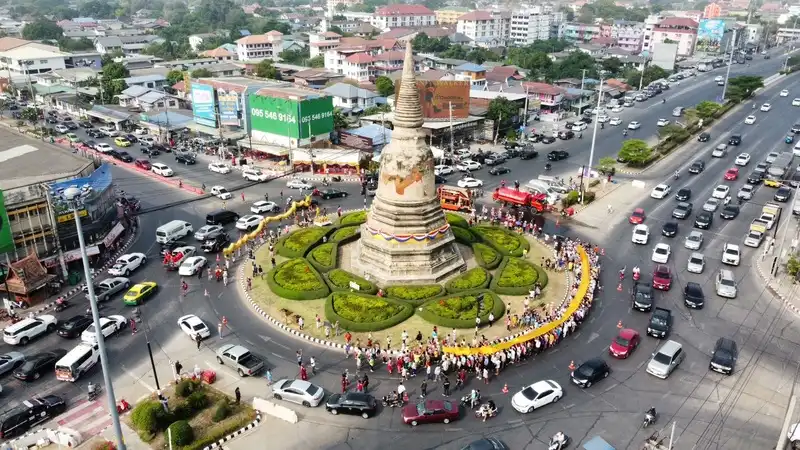
Wat Sam Pluem Chedi (Chedi Roundabout) is a small historic monument with a remarkably strong “sense of place” because it stands right in the middle of one of Ayutthaya’s key approach routes along Rojana Road, on the eastern side as you enter the city. Locals commonly call this spot the “Chedi Roundabout.” What you see today is a single round chedi rising above the traffic, functioning as a landmark that signals you are approaching the island city and Ayutthaya’s principal historic zone. Although the temple itself no longer survives, this chedi continues to serve as “spatial evidence” that the area once belonged to a religious complex, and it can tell a story of the old city without needing many words.
What makes Wat Sam Pluem Chedi especially intriguing is the fact that its construction history is not definitively confirmed. There is no clear documentary record identifying the founder or an exact year of construction, so understanding the monument relies largely on reading its architectural form, materials, building technique, and comparison with older chedis in the Ayothaya–early Ayutthaya tradition. Visibly, it is built of brick without plaster, with a rounded profile and a base proportion that aligns with early chedi types found in nearby areas. For this reason, it is often assumed that the chedi was built in the early Ayutthaya period, or at least belongs to a group of forms older than the middle to late Ayutthaya styles. Here, “old” does not only refer to age in time; it also refers to older construction logic that prioritizes the stability of brick mass and proportion, rather than the ornate stucco decoration favored in later periods.
From a traveler’s perspective, Wat Sam Pluem Chedi is best experienced as a “quick stop along the way” rather than a primary destination for an entire trip. Because it sits in the middle of a traffic roundabout, it is not a walkable park-like site or a temple compound with spacious grounds where you would spend a long time. Still, even a short stop can be meaningful, because it offers a clear glimpse of the city’s “layering” in a single frame: modern Ayutthaya and the city preserved in archaeological memory. Cars, hurried routines, and road signage coexist with an ancient brick chedi that feels strangely calm. This contrast is why the monument is often described as a “historic monument in the middle of the road,” and it has local nicknames that reflect the public’s shared feeling about the place—giving it a distinct character compared with Ayutthaya’s more famous temples that many people already know from postcards and mainstream travel media.
In terms of the city’s landscape, the chedi’s location is significant because it lies near routes that connect the outer areas to the old city zone. The fact that this monument has been retained in the center of the roundabout is therefore not merely “an accidental survival.” It also reflects a modern planning choice to preserve an important historical marker even while reshaping traffic circulation around it. This makes viewing Wat Sam Pluem Chedi different from visiting typical ruins where you can walk right up to the base. Visitors must manage distance for safety, usually observing from the sidewalk or a suitable stopping point and using their eyes to take in details rather than strolling around the structure. Ironically, this limitation often encourages people to pay closer attention to overall form and proportion.
Architectural details worth noticing include the rounded chedi silhouette that conveys weight and stability, the base that elevates the mass above ground level, and the exposed brick surface that has not been covered by smooth plaster—allowing you to see brick courses and the weathered texture shaped by time. Building without plaster means the structure depends on precise alignment and the compressive force of the masonry itself. The chedi’s endurance is therefore a quiet proof of ancient craftsmanship and a sophisticated understanding of weight and balance. Compared with later chedis decorated with elaborate stucco, you can sense the power of early-period “simplicity”—an aesthetic that tends to communicate through proportion and mass rather than through ornamental storytelling.
This is why any discussion of the chedi’s “history” should be handled carefully. We can generally say that multiple narratives exist. One interpretation, based on architectural form and construction technique, supports the view that it belongs to the Ayothaya–early Ayutthaya group. Another narrative is local memory that connects the chedi to events in the middle Ayutthaya period, sometimes associated with King Narai’s era, which functions more as community storytelling than as verifiable official documentation. For visitors, holding both layers in mind can be valuable, because it reveals how a single monument can live simultaneously in the world of archaeology and in the world of oral tradition—and how both worlds shape the meaning of a place today.
In the broader context of Ayutthaya, a “chedi” is not merely a religious symbol. It can be a community marker, a vessel of memory, and a sign of authority, faith, and legitimacy in a period when the city was expanding. A chedi located outside the island city or along an approach route may reflect community growth, the establishment of temples along travel corridors, and the relationship between agricultural hinterlands and the political center within the island city. Even though we see only one chedi today, the former “Wat Sam Pluem” as a temple would once have had more components—an ordination hall, assembly hall, monastic dwellings, courtyards, and a residential monastic zone—but time and urban change have left a single surviving trace that remains clearly visible.
Visiting Wat Sam Pluem Chedi therefore suits travelers who enjoy reading a city from small points, because the site invites you to connect past and present with imagination. Picture the area before there was a modern roundabout or a wide road. This may once have been a lived-in corridor with footpaths, cart tracks, waterways, or connections to other temples. The presence of a chedi implies a nearby spiritual center within walking distance for local residents. In Ayutthaya society, temples also served as places for rituals, education, community support, and kinship networks. The fact that only the chedi survives feels like the preservation of a temple’s “heart” even after the broader physical compound has disappeared.
For photography, the best viewpoints are usually from sidewalks or angles where you can frame the chedi fully without risking proximity to traffic. Photos here tend to capture the chedi against a backdrop of roads and moving vehicles, producing a distinctive “contemporary Ayutthaya” mood rather than the classic historical-park atmosphere. If you want the fuller old-city feel, it works well to stop briefly at Wat Sam Pluem Chedi and then continue to major island-city ruins such as Wat Mahathat, Wat Ratchaburana, or the Chao Sam Phraya National Museum. This combination gives a more complete trip narrative: a living city fragment alongside curated historic monuments.
The key point to emphasize is safety and appropriateness, because this is a historic monument in the center of a traffic roundabout. Visitors should view it only from safe points and should not step into the central island if there is no protected crossing. It is also best to treat the place with respect as a historic and formerly sacred site even if the surrounding temple no longer exists. When taking photos, avoid blocking pedestrians, do not stand in dangerous positions, and be especially cautious in late afternoon or at night.
For those interested in “Ayothaya” as the transitional phase before Ayutthaya reached full prominence, Wat Sam Pluem Chedi offers clues through an early architectural language that is not flamboyant but expresses ideas of sanctity and stability. Seeing ancient brickwork that has endured for so long can remind you that Ayutthaya is not only its famous postcard temples. Layers of history are scattered along approach roads, intersections, and everyday spaces that people pass without noticing. Stopping to look at a chedi in the middle of a roundabout is like “pausing your eyes” to recognize the old city embedded in the speed of the new—and once you notice it, you often begin to see the whole of Ayutthaya with more attentive detail.
Overall, if we summarize Wat Sam Pluem Chedi as an Ayutthaya attraction, it is not a long-stay destination. Instead, it is a meaningful connector within an itinerary: a marker that shows Ayutthaya is not only a destination but also a story you encounter on the way in. It is also a clear example of how a historic monument can coexist with a modern city in a challenging environment. Seeing it in person helps you understand the real relationship between preservation and everyday urban space—something difficult to grasp through reading alone.
Getting There From Bangkok, take the main routes into Phra Nakhon Si Ayutthaya Province. Once you enter Rojana Road and head toward Ayutthaya city center, you will notice Wat Sam Pluem Chedi at the “Chedi Roundabout” on the eastern approach before crossing into the island city zone. Plan to park only in permitted, safe areas, and view the chedi from the sidewalk or other safe observation points without stepping into traffic.
| Name | Wat Sam Pluem Chedi (Chedi Roundabout) |
| Address | Rojana Road (Chedi Roundabout area), Pratu Chai Subdistrict, Phra Nakhon Si Ayutthaya District, Phra Nakhon Si Ayutthaya Province, Thailand |
| Place Summary | A single round chedi monument at a traffic roundabout on a main approach road into Ayutthaya’s island city; ideal for a brief stop to read the city’s history from a small but meaningful point. |
| Key Features | A round chedi built of brick without plaster, aligned with early Ayothaya–Ayutthaya-period forms; uniquely positioned in the middle of a modern traffic roundabout. |
| Period | Generally assumed to be Early Ayutthaya (there are additional local narratives connecting it to later eras, but no definitive documentary evidence). |
| Key Evidence | Architectural form and brick-without-plaster technique consistent with early chedi groups in Ayutthaya, plus its role as a spatial marker indicating a former temple area now lost. |
| Name Origin | The name “Wat Sam Pluem” appears in local memory and place naming, reflecting a former temple presence even though only the chedi remains today (no official documentary origin is firmly confirmed). |
| Highlights | 1) A highly visible monument in the middle of a roundabout on the city approach route 2) An example of early brickwork without plaster for reading period through form and material 3) A single-point view of old-city and modern-city overlap 4) Best for history-minded travelers who enjoy brief stops with strong storytelling value. |
| Latest Steward | The Fine Arts Department (Ayutthaya region office) Tel. 035-242-501 |
| Open Days | Daily |
| Opening Hours | 24 hours (daytime viewing is recommended for safety) |
| Travel | From Bangkok, head into Ayutthaya via main routes. On Rojana Road toward the city center, you will see the chedi at the roundabout before entering the island city zone. Park only in permitted safe areas and view from sidewalks. |
| Current Status | Only the chedi remains; it is a roadside-roundabout historic monument best viewed from outside, with no typical temple grounds for on-site walking. |
| Fees | No confirmed fee information (external viewing). |
| Facilities | No site-specific facilities confirmed (traffic roundabout location). Use facilities within the island city zone or nearby service areas. |
| Nearby Tourist Attractions (Approx. Distance) | 1) Wat Mahathat – approx. 4 km 2) Wat Ratchaburana – approx. 4 km 3) Chao Sam Phraya National Museum – approx. 5 km 4) Wat Phutthaisawan – approx. 6 km 5) Ayutthaya Railway Station – approx. 4 km |
| Popular Restaurants Nearby (Approx. Distance + Phone) | 1) Pae Krung Kao – approx. 5 km – Tel. 088-649-1347 (or 035-241-555) 2) Baan Mai Rim Nam Ayutthaya – approx. 5 km – Tel. 035-242-248 (or 084-329-3333) 3) Baan U-Thong Riverside – approx. 5 km – Tel. 081-341-4595 (or 035-242-657) 4) Coffee Old City Thai Bistro – approx. 4 km – Tel. 089-889-9092 5) Abideen-Pranom Saima Roti (Roti Sai Mai) – approx. 6 km – Tel. 089-005-9948 |
| Popular Accommodations Nearby (Approx. Distance + Phone) | 1) Kantary Hotel and Serviced Apartments, Ayutthaya – approx. 5 km – Tel. 035-337-177 2) Classic Kameo Hotel & Serviced Apartments, Ayutthaya – approx. 6 km – Tel. 035-212-535 3) Krungsri River Hotel – approx. 4 km – Tel. 035-244-333 4) Ayothaya Riverside Hotel – approx. 4 km – Tel. 035-243-139 (or 090-969-9231) 5) sala ayutthaya – approx. 6 km – Tel. 035-242-588 |
Frequently Asked Questions (FAQ)
Q: Where is Wat Sam Pluem Chedi located in Ayutthaya?
A: It is on Rojana Road at the “Chedi Roundabout” on the eastern approach into Ayutthaya city, before entering the island city zone.
Q: Why does Wat Sam Pluem have only a single chedi remaining?
A: The temple compound is no longer visible today. Only the chedi remains as spatial evidence that the area once functioned as a temple and religious zone; urban change and time likely caused other elements to disappear.
Q: Which period was Wat Sam Pluem Chedi built in?
A: There is no definitive documentary record. Based on form and brick-without-plaster technique, it is often associated with Early Ayutthaya; additional local narratives connect it to later periods, but these are not document-confirmed.
Q: Can visitors walk close to the chedi?
A: It is not recommended because the monument sits in the middle of an active traffic roundabout. View it from safe points such as sidewalks without stepping into the road.
Q: What is the best time to visit?
A: Daytime or late afternoon is recommended for good light and clearer visibility of details, with safer conditions for viewing from pedestrian areas.
Q: Who should be contacted for information about the monument’s stewardship?
A: You can contact the Fine Arts Department (Ayutthaya region office) at Tel. 035-242-501 for stewardship-related information on historic monuments in the area.
 Category: ●Places of Worship
 Group: ●Other Sacred Sites
Last Update : 7 MonthAgo
 Last Update : 7 MonthAgo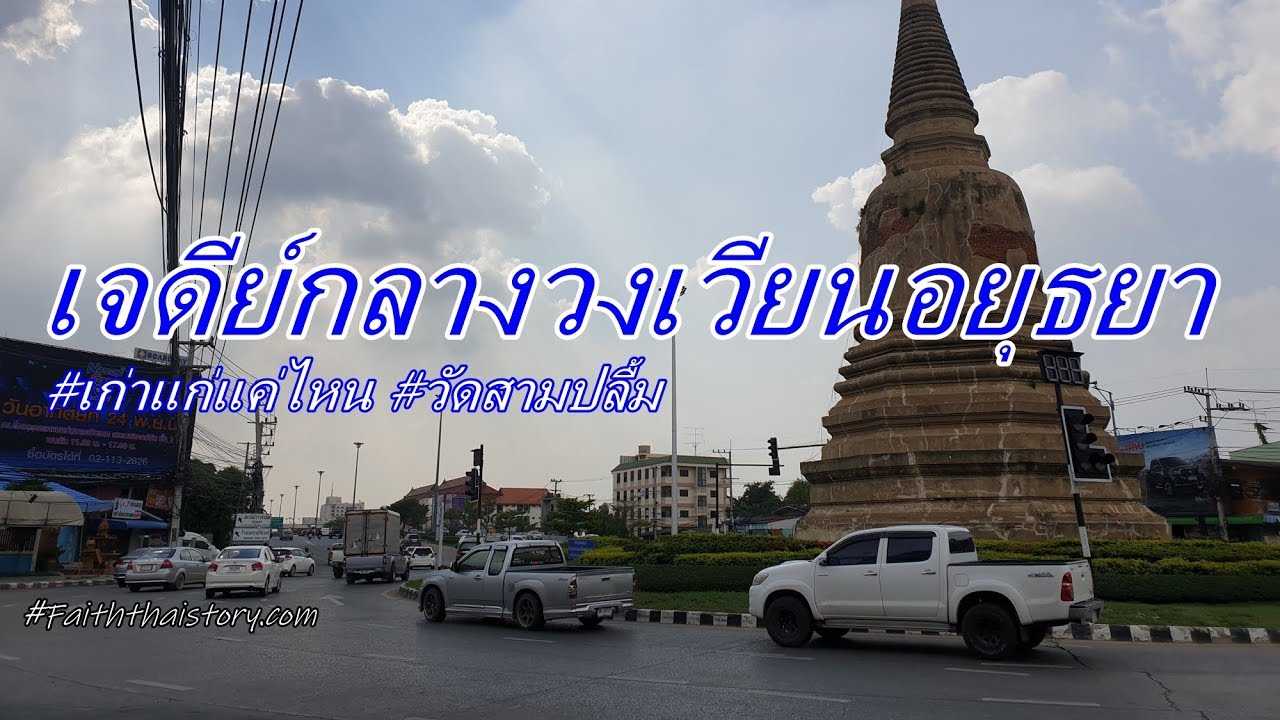
 Click to Access the Navigation Map GPS
Wat Sam Pluem Chedi Map
Recommend

 Art, Culture and Heritage
 Historical Sites and Monuments(7)
 Landmarks and Memorials(6)
 Royal Palace(4)
 Art, Craft Centres, Tradition(6)
 Museums(9)
 Educational Places
 Museum for Study(1)
 Educational Gardens, Farm(2)
 Training Center(1)
 Temple(133)
 Church(2)
 Mosque(2)
Other Sacred Sites(15)
Mosque(2)
Other Sacred Sites(15)
 Research and Development
 Royal Project(4)
 Suburban Living
 Village, Community(10)
 Local Market(7)
 Floating Market(3)
 Nature and Wildlife
 Dam, Reservoir, Lake(1)
 River, Canal(3)
 Islands(2)
 Other natural attractions(1)
 Entertainment and Agricultural
 Animal camps and shows(2)
 Farms, Parks and Ecotourism(4)
 Travel Articles, Recipes
 Travel Review, Food Review(2)


