
lovethailand home >North Travel Attractions >Phayao Travel Attractions > 40 Best Places to Visit in Phayao Northern Thailan..
TL;DR: 40 Best Places to Visit in Phayao Northern Thailand, open Daily Opening Hours: 08:00 – 18:00.

40 Best Places to Visit in Phayao Northern Thailand
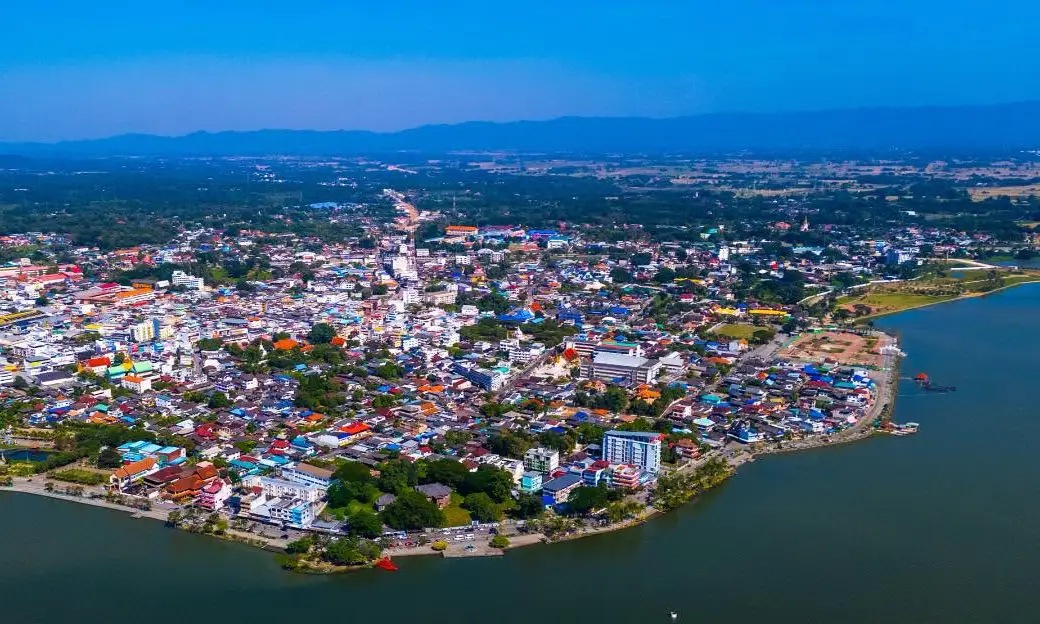
40 Best Places to Visit in Phayao: Must-See Attractions in Northern Thailand Phayao is an ideal destination for travelers who prefer a slower and more meaningful style of travel. The province combines Kwan Phayao, the scenic lake at the heart of the city, with ancient temples and stupas rooted in Lanna civilization, the misty mountains of Phu Langka, the naturally warm waterfall of Phu Sang National Park, and the living Tai Lue and Shan cultural heritage of Chiang Kham. If you have only 1 day, begin with Kwan Phayao, Wat Si Khom Kham, Wat Tilok Aram, and the King Ngam Mueang Monument. With 2–3 days, add Doi Butsarakham, Chiang Kham, and Phu Sang. Travelers with 4–5 days can extend the journey to Phu Langka, Pong, Chiang Muan, and the province’s more remote natural attractions.
Phayao Province lies in upper Northern Thailand and features a landscape of intermountain basins, high mountain ranges, watershed forests, rivers, and wetlands. The Ing River is one of the province’s most important waterways and has supported local communities for centuries. The view of Kwan Phayao spreading across the center of the city with mountains rising in the background has become one of the province’s most recognizable images.
Phayao has deep historical roots as the former city-state of Phukamyao, once an important political center within the network of ancient northern kingdoms. King Ngam Mueang was one of Phayao’s most significant rulers and was a contemporary of King Ramkhamhaeng of Sukhothai and King Mangrai of the Lanna Kingdom. This history gives Phayao far greater significance than that of a simple transit province, as temples, archaeological remains, inscriptions, and community traditions still preserve evidence of its former prosperity.
Kwan Phayao remains the center of modern city life, supporting freshwater ecology, fishing, recreation, local cuisine, and tourism. Visitors can walk along the lakeside, watch the sunset, take a boat to Wat Tilok Aram in the middle of the lake, enjoy local food, and continue to several important temples within the same day. The area is suitable for families, couples, senior travelers, photographers, and anyone looking for a calm Northern Thai atmosphere.
Beyond the provincial capital, Phayao is also culturally diverse. Chiang Kham District is especially important for its Tai Lue and Shan communities. Wat Nantaram is renowned for its distinctive wooden Shan-style viharn, while the Tai Lue Cultural Center at Wat Yuan preserves language, clothing, woven textiles, traditional houses, household objects, and community knowledge that continue to be practiced today.
Nature lovers will find mountain and watershed landscapes spread across several districts. Phu Langka Forest Park in Pong District is among the province’s most famous mountain and sea-of-mist destinations, while Phu Sang National Park is known for Phu Sang Waterfall, whose naturally warm water flows throughout the year. Chiang Muan also offers Doi Phu Nang National Park and several waterfalls that make the district worth including in a longer itinerary.
Religious heritage is another defining feature of Phayao. The province contains lakeside temples, mountaintop sanctuaries, sacred stupas, and temples representing the artistic traditions of different ethnic communities. Phra Chao Ton Luang at Wat Si Khom Kham is regarded as one of Phayao’s most revered Buddha images. Wat Analayo Thipphayaram on Doi Butsarakham combines Buddhist monuments with a peaceful forest setting, while Wat Phra That Chom Thong stands on elevated ground overlooking the Phayao basin and the lake.
Phayao’s traditions are deeply connected with Buddhism and Lanna culture. Important examples include the Paet Peng ceremony honoring Phra Chao Ton Luang and the candlelight procession by boat at Wat Tilok Aram on Kwan Phayao. These traditions clearly express the close relationship between local religious faith and the lake that has shaped life in the province.
Local food and souvenirs include freshwater fish from Kwan Phayao, Northern Thai cuisine, Tai Lue dishes, handwoven textiles, bamboo crafts, and community products from different districts. A rewarding way to explore Phayao is therefore to connect attractions with the surrounding communities: visit a temple and continue to a local market, explore cultural heritage and try regional food, or visit a natural attraction while supporting local services and community enterprises.
For practical trip planning, Phayao can be divided into several travel zones. Mueang Phayao is best for Kwan Phayao, temples, museums, and historical attractions. Chiang Kham is ideal for Tai Lue and Shan culture. Phu Sang combines a naturally warm waterfall with the Thai–Lao border area, while Pong and Phu Langka are best for mountains, mist, and nature-focused travel. Organizing the trip by zone reduces unnecessary backtracking and allows visitors to experience Phayao in greater depth.

1. Kwan Phayao (Phayao Lake) is the best-known landmark in Phayao Province and a body of water that brings together nature, history, fishing, local communities, religion, and everyday city life. Located in Mueang Phayao District, the lake is surrounded by lakeside roads, restaurants, public parks, boat piers, and several important temples.
Highlights: A large freshwater lake in the heart of the city, sunset views, traditional freshwater fishing, boat trips to Wat Tilok Aram, lakeside dining, and mountain scenery surrounding the Phayao basin.
The word “Kwan” is a Northern Thai term referring to a large wetland, marsh, or lake. Over time, the name became inseparable from Phayao’s identity. Kwan Phayao spreads beside the city and receives water from several streams before connecting with the wider Ing River basin, making it important both ecologically and economically.
Kwan Phayao is much more than a scenic viewpoint. It is an important freshwater fishing area that supports local households. Small fishing boats, local fishermen, and dishes prepared with fish from the lake reveal the close relationship between the city and its aquatic environment.
Morning is a good time for walking, exercising, watching light mist over the water, and observing local life as the city begins its day. Evening is especially popular because the setting sun reflects across the lake with the mountain ridges behind it, creating one of the most photogenic scenes in Phayao.
One of the most distinctive activities is taking a small boat from the lakeside pier to Wat Tilok Aram in the middle of Kwan Phayao. The ride is short but provides a very different temple experience from visiting by road. On important Buddhist holy days, the temple becomes the focus of Phayao’s famous candlelight procession by boat.
Kwan Phayao suits almost every type of traveler, including families, senior visitors, couples, photographers, and travelers who simply want to enjoy the city at a relaxed pace. It can easily be combined with Wat Si Khom Kham, the King Ngam Mueang Monument, Wat Phra That Chom Thong, and Wat Tilok Aram in a single day.
Getting There: From central Phayao, drive directly toward Chai Kwan Road or Tha Kwan Road along the lake. Travelers arriving by intercity bus can get off at Phayao Bus Terminal and continue by local transport to the lakeside area.
Map (GPS):Open Directions to Kwan Phayao

2. Wat Si Khom Kham, also widely known as the temple of Phra Chao Ton Luang, stands beside Kwan Phayao in Wiang Subdistrict, Mueang Phayao District. It is a third-class royal temple and one of the province’s most important religious centers, housing Phra Chao Ton Luang, the large Buddha image regarded as a spiritual symbol of Phayao.
Highlights: Phra Chao Ton Luang, the main viharn, Lanna Buddhist art, legends associated with ancient Phukamyao, the Cultural Exhibition Hall, and the Paet Peng ceremony honoring Phra Chao Ton Luang.
Phra Chao Ton Luang is a large gilded stucco Buddha image in the Mara-vijaya posture and is deeply revered by the people of Phayao and the wider Lanna region. Devotees travel from many provinces to pay respect, particularly during major Buddhist festivals and annual religious ceremonies.
Wat Si Khom Kham is closely associated with local legends surrounding Nong Iang and the Kwan Phayao area. Buddhist tradition, local belief, and the physical landscape around the temple are therefore closely intertwined, making the temple important both as a pilgrimage destination and as a historical site.
The temple compound also contains a cultural exhibition hall that helps visitors understand Phayao’s history, artistic heritage, archaeology, and local traditions. Travelers interested in more than a quick temple visit should allow enough time to explore both the sacred areas and the historical displays.
During the Paet Peng festival honoring Phra Chao Ton Luang, the temple becomes especially lively with religious ceremonies, merit-making, ritual bathing of sacred images, Lanna flags, and traditional cultural activities. It is one of the best periods for observing the continuing relationship between the temple and the people of Phayao.
From Wat Si Khom Kham, visitors can easily continue to Kwan Phayao, Wat Tilok Aram, the King Ngam Mueang Monument, and Wat Phra That Chom Thong. Together these attractions form an excellent half-day or full-day route around central Phayao.
Open Days: Daily Opening Hours: 08:00 – 18:00
Getting There: The temple is located beside Kwan Phayao in Wiang Subdistrict, Mueang Phayao District. It is easily reached from central Phayao by car, motorcycle, or local hired transport.
Map (GPS):Open Directions to Wat Si Khom Kham

3. Wat Tilok Aram is a historic Buddhist site located in the middle of Kwan Phayao. It is remarkable both for its Lanna history and for the journey required to reach it, as visitors travel by small boat from the lakeside to the temple site to pay respect to Luang Pho Sila.
Highlights: A Buddhist site in the middle of Kwan Phayao, Luang Pho Sila, historical inscriptions from the reign of King Tilokaraj, boat rides across the lake, and candlelight processions by boat on important Buddhist holy days.
The temple’s historical importance is connected with inscriptional evidence dating to the reign of King Tilokaraj of the Lanna Kingdom. This makes Wat Tilok Aram an important reminder of the spread of Buddhism and the development of ancient communities around Phayao.
After water management projects transformed Kwan Phayao into a larger reservoir, portions of the original temple area became submerged beneath the lake. Archaeological discoveries later restored awareness of the site’s importance and brought Wat Tilok Aram back into the religious and historical life of the province.
Luang Pho Sila is the principal sacred Buddha image associated with the site. Visitors reach the temple by rowboat or small local boat from the lakeside pier, enjoying broad views of the city, the lake, and the surrounding mountains along the way.
One of Phayao’s most distinctive religious traditions takes place here on Makha Bucha, Visakha Bucha, and Asalha Bucha. During the evening candlelight ceremony, boats slowly circle the Buddhist site in the middle of the lake, creating a scene found in very few other places in Thailand.
Allow at least 30–60 minutes for the boat journey, worship, and sightseeing. During heavy rain, strong wind, or poor weather, visitors should check with boat operators before departing.
Open Days: Daily Opening Hours: 07:30 – 17:00
Getting There: Travel to the boat pier on the shore of Kwan Phayao in Mueang Phayao District, then take a rowboat or local boat to the temple site in the lake. The journey is short.
Map (GPS):Open Directions to Wat Tilok Aram

4. King Ngam Mueang Monument stands in the Phayao municipal public park, also known as Somdet Ya 90 Park, near the road along Kwan Phayao. The monument commemorates one of the most important rulers of ancient Phukamyao and is a major historical symbol of the province.
Highlights: The statue of King Ngam Mueang, the history of Phukamyao, his relationship with King Mangrai and King Ramkhamhaeng, an important local place of respect, and its convenient location beside Kwan Phayao.
King Ngam Mueang ruled Phukamyao during a period when the city was prosperous and politically significant in Northern Thailand. He was a contemporary of King Mangrai of Lanna and King Ramkhamhaeng of Sukhothai, linking Phayao directly with the broader political history of the region.
For the people of Phayao, King Ngam Mueang is more than a historical figure. He remains a source of civic pride and local identity, and residents regularly visit the monument to pay respect and make offerings.
The monument stands in an open public area close to the lake, making it suitable for walking, relaxing, and connecting with other city attractions. It is also a useful first stop for travelers who want to understand Phayao’s historical background before exploring its ancient temples and museums.
Morning and evening are particularly pleasant times to visit because temperatures are lower. In the evening, visitors can continue directly to the lakeside for sunset views and dinner.
Getting There: The monument is located in the Phayao municipal park near the lakeside road in Mueang Phayao District. It is easily reached from the city center by car, motorcycle, or local hired transport.

5. Wat Analayo Thipphayaram is located on Doi Butsarakham at Ban San Pa Muang in San Pa Muang Subdistrict, Mueang Phayao District. This mountaintop temple combines Buddhist art, sacred monuments, forest, mountain scenery, and panoramic views of Kwan Phayao within a single large Buddhist park.
Highlights: A Buddhist park on Doi Butsarakham, Buddha images and stupas in several artistic traditions, Lanna, Sukhothai, Chinese, and Indian influences, views over Kwan Phayao, and the peaceful atmosphere of a forest temple.
Wat Analayo Thipphayaram was developed under Phra Panya Phisan Thera, also known as Luang Pho Phaibun Sumangkhalo, a respected meditation monk associated with Phayao. The mountain landscape was gradually developed into a large Buddhist park with sacred structures distributed across the slopes.
What distinguishes the temple is the way visitors move through statues, stupas, pavilions, Buddha images, and Buddhist artistic elements surrounded by forest. The experience combines religious devotion with the quiet atmosphere of the mountain environment.
From higher areas of the temple, visitors can look across Kwan Phayao and the city from a broad elevated perspective. On clear days, this makes Wat Analayo especially rewarding for photographers and travelers who want to see the Phayao basin from above.
The temple grounds are extensive and include significant changes in elevation. Senior visitors or anyone with limited mobility may prefer to select the main sites and use vehicle-accessible areas where permitted rather than walking the entire complex.
Wat Analayo can be combined with Kwan Phayao, Wat Si Khom Kham, Wat Phra That Chom Thong, and Ban Dok Bua Community. Allow at least half a day if you want to explore the temple without rushing.
Open Days: Daily Opening Hours: 08:00 – 18:00
Getting There: From central Phayao, travel toward Ban San Pa Muang in San Pa Muang Subdistrict, approximately 20 km from the city, then follow the mountain road up Doi Butsarakham to the temple. A private car is convenient.
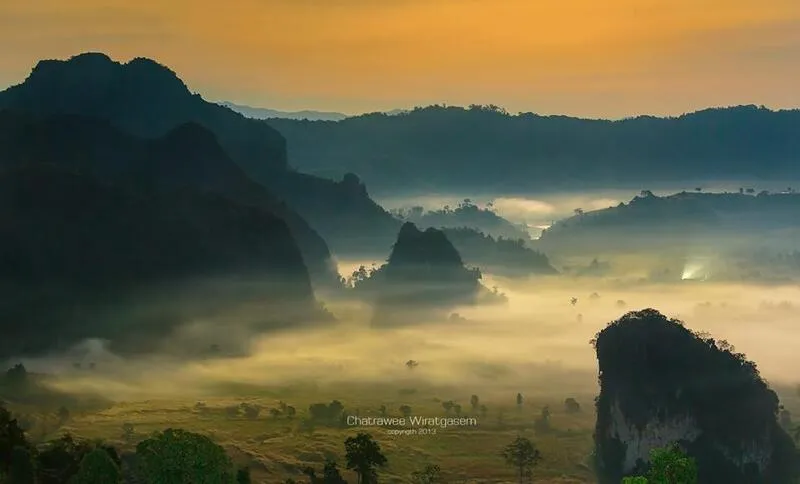
6. Phu Langka Forest Park is located in Pha Chang Noi Subdistrict, Pong District. It is one of Phayao’s best-known destinations for mountain scenery, sea-of-mist views, montane forest, and sunrise. The approximately 7,800-rai area supports a cool highland ecosystem and is noticeably cooler than the lowlands during much of the year.
Highlights: Phu Langka summit at approximately 1,720 meters above sea level, sea of mist, montane forest, old oak forest, wildflowers, Phu Langka Waterfall, Hin Yaeng Fa, Phu Lom summit, and sunrise and sunset viewpoints.
The Mien community refers to Phu Langka as “Fin Ja Bo,” a name associated with the idea of a sacred or heavenly mountain. The name fits the high mountain landscape, which is often wrapped in mist during cool-season mornings.
The forest includes montane evergreen vegetation, oak forest, and plants adapted to cooler conditions. The area is therefore suitable not only for mist viewing but also for birdwatching, botanical study, nature photography, and mountain walking.
Several natural attractions are found within the wider area, including rock fields, waterfalls, and minor summits. There are also traces connected with past periods of political conflict in the mountains, giving the landscape a historical dimension as well as a natural one.
Early morning through shortly after sunrise is the most popular time for sea-of-mist views. However, mist depends on humidity, temperature, wind, and weather conditions and cannot be guaranteed every day.
Visitors planning to use nature trails or reach higher viewpoints should prepare suitable footwear, drinking water, warm clothing, and check with responsible staff about current trail conditions because access may vary by season.
Open Days: Daily Opening Hours: 05:00 – 18:00
Getting There: From Phayao city, travel toward Pong District and continue into Pha Chang Noi Subdistrict. The final section follows mountain roads, so use a vehicle in good condition and allow more travel time than for lowland routes.

7. Phu Sang National Park is located in Phu Sang District and is one of the province’s most distinctive natural destinations along the route toward Ban Huak and the Thai–Lao border. Its best-known attraction is Phu Sang Waterfall, where naturally warm water flows throughout the year.
Highlights: Phu Sang Waterfall with naturally warm water of approximately 33–35 degrees Celsius, a single-tier limestone waterfall, shaded forest, easy access, and a route that continues toward Ban Huak and other attractions in the border area.
Phu Sang Waterfall is unusual because its water is naturally warm rather than cold like most mountain waterfalls. The water emerges from natural springs before flowing over a limestone cliff, creating a comfortable temperature for visitors throughout the year.
The waterfall is located close to the national park headquarters and does not require a long forest trek. Families, senior travelers, and visitors with limited time can therefore experience the natural setting relatively easily. Large trees around the waterfall provide shade and a pleasant resting area.
Beyond the waterfall, the park forms part of an important border forest and watershed system. Travelers may extend their visit to nature trails or other areas that are open to visitors according to current park conditions.
Phu Sang National Park can be combined with Ban Huak and other attractions in the Thai–Lao border zone, making it practical for a full-day trip without repeatedly returning to central Phayao.
The rainy season brings greener forest and stronger water flow but also more slippery surfaces. The cool season is especially comfortable for walking and relaxing because temperatures are lower.
Open Days: Daily Opening Hours: 08:30 – 18:00
Getting There: From Phayao city, travel toward Chiang Kham and Phu Sang districts, then follow the Phayao–Ban Huak route into Phu Sang Subdistrict. The park headquarters and waterfall are accessible by ordinary vehicles.
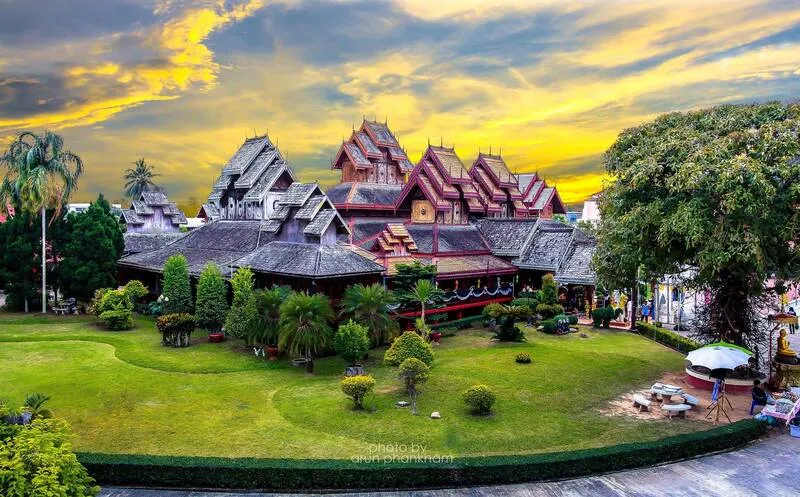
8. Wat Nantaram is located at Ban Don Chai in Yuan Subdistrict, Chiang Kham District. It is one of the most important temples of the local Shan community and one of Phayao’s most distinctive architectural attractions, particularly because of its magnificent wooden viharn influenced by Shan and Burmese artistic traditions.
Highlights: A wooden Shan-style viharn, multi-tiered roof, wooden shingles, colored-glass ceiling decoration, 68 gilded wooden pillars, intricate woodcarving, and a local museum.
Wat Nantaram was formerly known as “Wat Chong Kha” because the original temple building had a thatched roof. In the Shan language, the word “chong” refers to a temple, preserving evidence of the community’s cultural roots in Chiang Kham.
The wooden viharn is the temple’s outstanding feature. Its layered roof and decorative details reflect Shan and Burmese artistic influences that differ significantly from the more familiar Lanna temple style seen elsewhere in Northern Thailand.
Inside, numerous wooden pillars are lacquered and gilded, while the ceiling and architectural details incorporate colored glass, carved wood, and decorative craftsmanship created through the faith and support of the local community.
The temple also serves as a place for learning about the history of the Shan community in Chiang Kham. Local artifacts and museum displays help explain traditional life, belief, and the development of the community.
Wat Nantaram can be combined with the Tai Lue Cultural Center, Wat Yuan, and other cultural attractions in Chiang Kham, making it possible to see the cultural diversity of Tai Lue, Shan, and Lanna traditions within a single district.
Open Days: Daily Opening Hours: 08:00 – 18:00
Getting There: The temple is located at Ban Don Chai in Yuan Subdistrict near Chiang Kham Municipal Market. It is easily reached from central Chiang Kham by private car or motorcycle.
Map (GPS):Open Directions to Wat Nantaram
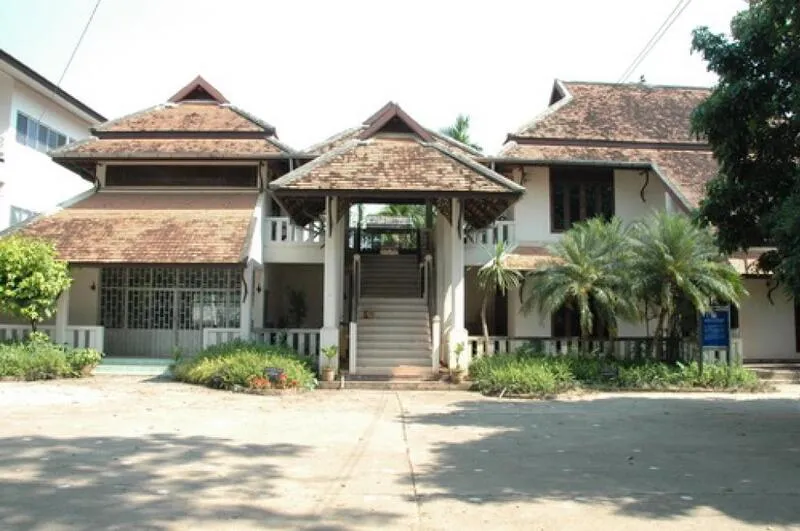
9. Tai Lue Cultural Center is located within Wat Yuan at Ban Yuan in Yuan Subdistrict, Chiang Kham District. It is an important learning center dedicated to preserving Tai Lue culture and helps visitors understand the community through clothing, handwoven textiles, traditional houses, tools, food, rituals, beliefs, and local knowledge.
Highlights: Traditional Tai Lue houses, woven textiles, traditional clothing, household tools, community life, rituals, beliefs, and opportunities to learn directly about living Tai Lue culture in Chiang Kham.
One of the center’s strengths is that Tai Lue culture is not presented in isolation from the community. The center is located within Wat Yuan and surrounded by neighborhoods where Tai Lue language, weaving, cuisine, religious practices, and traditions continue to be part of everyday life.
The Tai Lue are an ethnic group with a long history of migration and settlement across parts of Northern Thailand. Their identity is strongly expressed through language, clothing, weaving, vernacular architecture, Buddhism, and the close relationship between family, temple, and community.
Displays at the center explain everyday life through real objects, including clothing, household implements, weaving equipment, and traditional house arrangements. Visitors can therefore learn through tangible material culture rather than through written information alone.
Chiang Kham is well suited to a full-day cultural itinerary. Travelers can begin at the Tai Lue Cultural Center, continue to Wat Nantaram, and then visit local communities or restaurants to experience the coexistence of Tai Lue, Shan, and Lanna traditions.
Travelers interested in handicrafts should allow extra time to see locally woven textiles and community products. Buying directly from local producers helps support traditional knowledge and contributes income to the community.
Open Days: Wednesday – Sunday Opening Hours: 09:00 – 17:30
Getting There: The center is located inside Wat Yuan at 177 Moo 3, Yuan Subdistrict, Chiang Kham District. It can be reached easily from central Chiang Kham by car or motorcycle.

10. Wat Phra That Chom Thong stands on elevated ground in Wiang Subdistrict, Mueang Phayao District. The temple is an important religious landmark known for Phra That Chom Thong, its golden Lanna-style stupa, and its position overlooking the city and Kwan Phayao.
Highlights: Phra That Chom Thong, approximately 30 meters high, Lanna-style stupa architecture, 12 zodiac motifs around the base, views of Phayao city and Kwan Phayao, and easy connections with Wat Si Khom Kham and the lakeside.
The stupa rises from a series of square bases and features a Lanna-style bell-shaped body topped with a golden finial. Its overall form reflects the development of Buddhist art in Northern Thailand and the importance of sacred stupas as centers of local faith.
The base is decorated with repoussé metal panels featuring the 12 zodiac animals and traditional Thai motifs, adding another layer of artistic interest for visitors who enjoy studying Northern Thai craftsmanship.
The temple’s elevated location near Wat Si Khom Kham gives it both religious and scenic value. From the grounds, visitors can look across the city, Kwan Phayao, and the mountain ranges surrounding the Phayao basin.
Legends associated with Phra That Chom Thong are connected with Buddhist traditions and ancient Phukamyao, similar to several other important temples around Kwan Phayao. Visiting these sites together helps travelers understand the religious landscape of the former city-state.
The temple is suitable for pilgrims, senior visitors, cultural travelers, and photographers. Morning or late afternoon is more comfortable than midday, and Wat Si Khom Kham can be reached within a short drive.
Open Days: Daily Opening Hours: 07:00 – 18:30
Getting There: The temple is located on Phra That Chom Thong Road in Wiang Subdistrict, Mueang Phayao District, close to Kwan Phayao and Wat Si Khom Kham. Private vehicles can drive directly to the temple area.
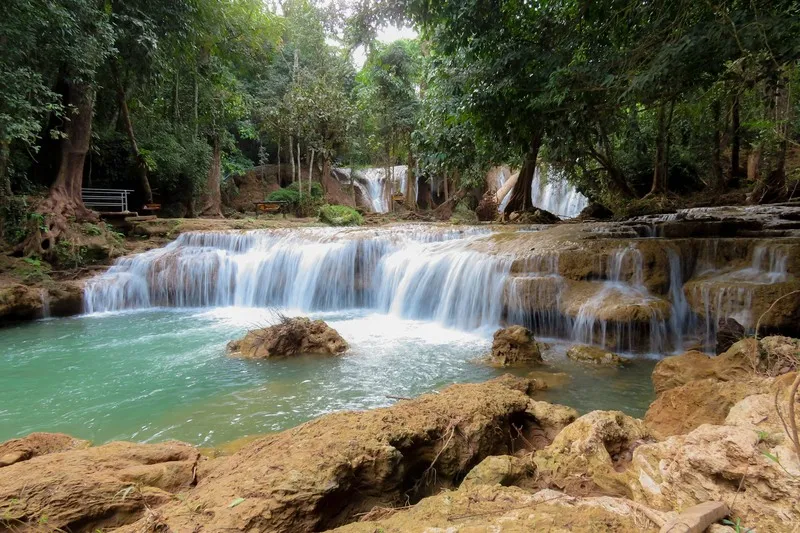
11. Doi Phu Nang National Park is a large protected forest area in Phayao covering parts of Chiang Muan, Pong, and Dok Kham Tai districts. Its landscape consists of complex mountain ranges, mixed deciduous forest, dry dipterocarp forest, streams, waterfalls, and habitats for many species of wildlife, especially the green peafowl, one of the park’s most recognizable natural symbols.
Highlights: Green peafowl, Than Sawan Waterfall, Tad Pu Kheng Waterfall, Huai Ton Phueng Waterfall, Kaeng Luang, natural forest, and ecotourism routes around Chiang Muan District.
One feature that distinguishes Doi Phu Nang National Park from many other protected areas is the opportunity to observe green peafowl in the wild, particularly around open areas near the park headquarters where the birds may come out to feed. Birdwatchers and wildlife photographers should remain quiet and avoid disturbing the animals.
The park contains both mixed deciduous and dry dipterocarp forest, and its appearance changes considerably with the seasons. During the rainy season, the forest becomes lush and streams and waterfalls carry more water, while the cool season offers more comfortable conditions for nature walks.
The national park also serves as a base for visiting several natural attractions around Chiang Muan, including Than Sawan Waterfall, Tad Pu Kheng Waterfall, and forest streams. A full-day route can therefore be planned around the park headquarters and nearby natural sites.
Families and visitors who do not want a demanding hike can focus on the headquarters area and easily accessible waterfalls. Those planning to enter deeper forest trails should check current conditions with park staff before setting out.
Morning is usually the best time for watching birds and wildlife. During the rainy season, visitors should bring footwear with good grip and rain protection because some trails can become slippery.
Open Days: Daily Opening Hours: 08:00 – 16:30
Getting There: From Phayao city, take Highway 1251 toward Dok Kham Tai and Chiang Muan, then continue toward Ban Mang and follow signs to Doi Phu Nang National Park headquarters. A private car is the most practical option for visiting several attractions in the area.

12. Than Sawan Waterfall is located at Ban Bo Bia in Ban Mang Subdistrict, Chiang Muan District, within Doi Phu Nang National Park. It is known for its green-blue water, year-round flow, and relatively easy access, making it suitable for travelers who want a forest waterfall experience without a long trek.
Highlights: Green-blue water, a waterfall approximately 30 meters wide and about 20 meters high in total, year-round flow, shaded forest, and convenient access from Doi Phu Nang National Park headquarters.
The waterfall is formed by water from several streams, including Huai Song Sop, Huai Pong, Huai Un, and natural springs around Bo Bia. These waterways combine before becoming Mae Pang and flowing across natural rock formations to create a broad curtain of water.
The surrounding forest contains large trees, ferns, and moisture-loving plants, keeping the area cool and shaded even during much of the day. It is a pleasant place for resting, nature photography, and enjoying the sound of flowing water.
Although the waterfall is easier to access than many remote waterfalls in the park, visitors should still be careful on slippery rocks, particularly during the rainy season. Avoid swimming in areas with strong currents or deep pools.
Than Sawan Waterfall can be combined with Doi Phu Nang National Park and Tad Pu Kheng Waterfall in the same day, making it one of the main stops on a nature-focused itinerary around Chiang Muan.
The rainy season through early winter is especially attractive because water levels are higher and the forest is at its greenest. The waterfall can still be visited in the dry season, although water volume changes naturally through the year.
Open Days: Daily Opening Hours: 08:00 – 16:30
Getting There: From Chiang Muan District, travel toward Ban Bo Bia in Ban Mang Subdistrict and enter the Doi Phu Nang National Park area. The waterfall is not far from the park’s main route and can be reached by vehicle followed by a short walk.
Map (GPS):Open Directions to Than Sawan Waterfall
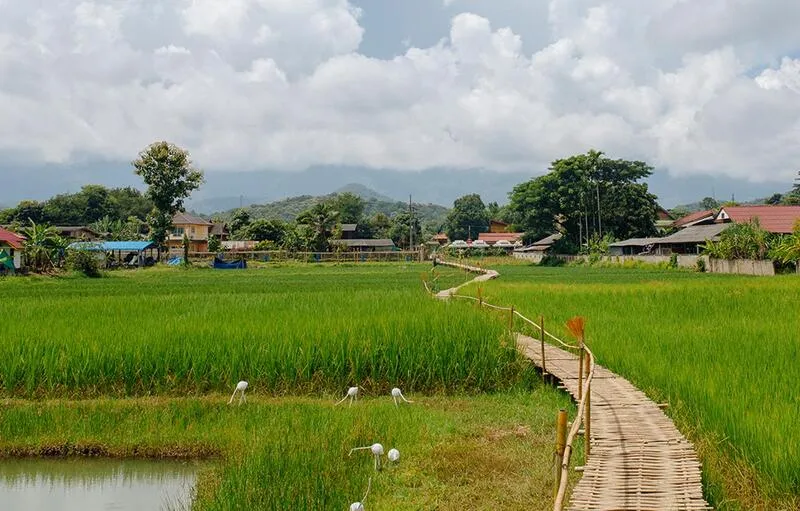
13. Ban Dok Bua Community, also known locally as Ban Bua, is located at Moo 4 in Ban Tun Subdistrict, Mueang Phayao District. The village is recognized for bamboo basket weaving, community resource management, and a self-sufficient approach to local development, making it an interesting stop for travelers who want to experience Phayao beyond conventional sightseeing.
Highlights: Bamboo basket production, traditional weaving techniques, community bamboo resources, sufficiency-economy practices, local resource management, and educational community activities.
Bamboo basket weaving at Ban Dok Bua is not merely a supplementary household craft. It has developed into an important part of the village economy, with baskets produced locally and distributed to markets in Northern and Central Thailand.
The community also cultivates and manages its own bamboo resources, reducing dependence on outside materials and creating a more continuous production system. This demonstrates how local resources can be turned into sustainable income through practical community management.
Visitors can learn about the complete production process, from preparing bamboo and splitting strips to weaving, finishing, and distribution. What appears to be a simple basket therefore reflects detailed knowledge of materials, craftsmanship, and local economic organization.
Ban Dok Bua is also used as a learning site for sufficiency-economy practices and community self-reliance. It is particularly suitable for students, educational groups, government organizations, community leaders, and travelers interested in local development.
The community can be combined with Wat Analayo Thipphayaram and Kwan Phayao because all are within Mueang Phayao District. Visitors interested in workshops, group demonstrations, or homestay activities should arrange their visit with the community in advance.
Getting There: From central Phayao, travel toward Ban Tun Subdistrict and Ban Bua at Moo 4. A private vehicle is the most convenient option, and the route can be linked with Wat Analayo Thipphayaram without returning to the city center.
Map (GPS):Open Directions to Ban Dok Bua Community

14. Mae Tam Reservoir is a royal-initiative reservoir in Mueang Phayao District that plays an important role in water storage, agriculture, domestic water use, and local recreation. The broad water surface, mountain backdrop, and relatively quiet atmosphere make it an appealing stop outside the main tourist areas.
Highlights: A large earth dam, approximately 1,820 meters long and 28 meters high, reservoir capacity of about 37 million cubic meters, mountain views, and a peaceful setting close to Phayao city.
The reservoir’s primary importance lies in water management. It helps reduce the effects of drought, supports agriculture, and strengthens water security for surrounding communities, making it a practical example of the relationship between natural resources and rural livelihoods.
The long earth embankment opens onto broad views across the reservoir and surrounding mountains. Morning and late afternoon are particularly suitable for appreciating the landscape and photographing reflections on the water.
Mae Tam Reservoir is not a highly commercialized attraction. Its appeal lies in its calm atmosphere, making it suitable for a short rest, photography, or a quiet break from busier sightseeing areas.
Travelers staying in Phayao city or near the University of Phayao can add the reservoir without requiring a major detour, and it can be combined with destinations around Mae Ka Subdistrict.
Late afternoon is especially pleasant because temperatures are lower and the light across the reservoir is attractive. Visitors should remain within public-access areas and avoid restricted irrigation zones.
Getting There: From Phayao city, travel toward Mae Ka Subdistrict and follow the local road to Mae Tam Reservoir. A private car is convenient, and the reservoir is not far from the University of Phayao area.
Map (GPS):Open Directions to Mae Tam Reservoir
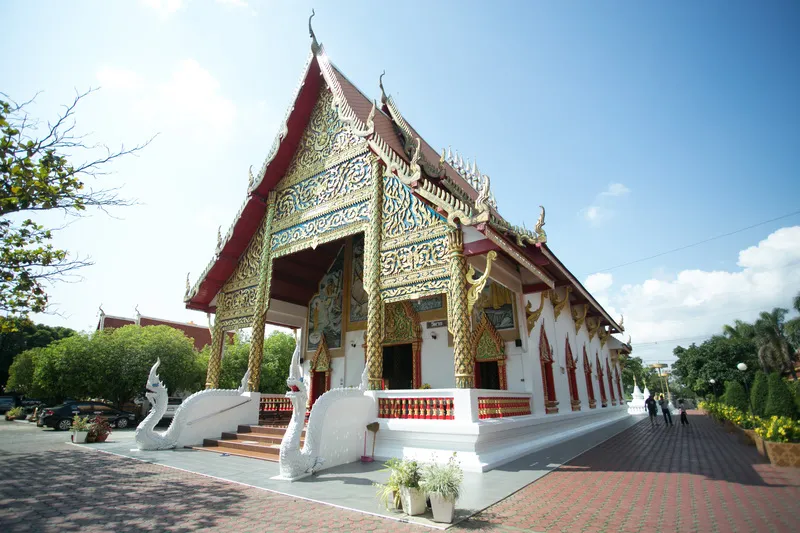
15. Wat Phra That Sop Waen is located in Yuan Subdistrict, Chiang Kham District. It is an important temple of the local Tai Lue community and one of Chiang Kham’s notable religious and cultural destinations, combining an ancient stupa, Lanna artistic elements, and spaces that preserve Tai Lue heritage.
Highlights: An ancient Lanna-style stupa believed to be more than 800 years old, a white chedi with a golden bell-shaped section, surrounding sacred walls, lion sculptures, a decorated bell tower, an old rain tree, and Tai Lue weaving traditions.
Phra That Sop Waen stands behind the viharn and remains an important spiritual center for the surrounding community. Its square base, white body, golden bell section, and gilded finial reflect the Lanna Buddhist architectural tradition found in the Chiang Kham area.
The name “Sop Waen” is associated with local geography. In Northern Thai usage, “sop” refers to a place where waterways meet, while “Waen” is linked to the local Waen River. The temple’s name therefore reflects the close relationship between settlement and waterways.
The temple compound also includes Tai Lue-style structures and activities connected with textile weaving, allowing visitors to learn about both religious life and community traditions in the same place. Elder community members continue to preserve cotton weaving and handicraft knowledge.
A large old rain tree adds shade and character to the temple grounds, making Wat Phra That Sop Waen attractive not only to pilgrims but also to cultural travelers and photographers interested in local architecture.
The temple can be combined with Wat Nantaram, Wat Yuan, and the Tai Lue Cultural Center in a single day, creating a comprehensive cultural route through Chiang Kham.
Open Days: Daily Opening Hours: 08:00 – 18:00
Getting There: From central Chiang Kham, travel into Yuan Subdistrict. The temple is located within a local community and is easily reached by car or motorcycle. It can be combined conveniently with Wat Nantaram and Wat Yuan.
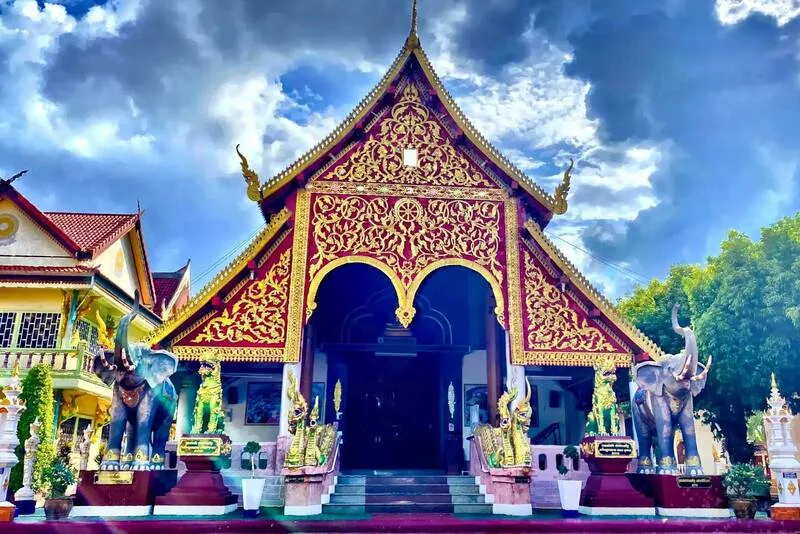
16. Wat Yuan is located in Yuan Subdistrict, Chiang Kham District. The temple is an important center of the Tai Lue community and brings together religion, ethnic history, traditional crafts, and cultural learning. The Tai Lue Cultural Center is located within the temple grounds.
Highlights: The Tai Lue Cultural Center, Tai Lue history connected with Xishuangbanna, woven textiles, traditional clothing, local crafts, and the continuing role of the temple as a center of community life.
In traditional Tai Lue society, a temple is not only a place for Buddhist rituals. It also serves as a meeting place, a center for transmitting knowledge, a space for practicing crafts, and a repository of collective memory. Wat Yuan therefore plays both a religious and social role.
The cultural displays explain Tai Lue settlement history, clothing, language, beliefs, and ways of life rooted in cultural traditions connected with Xishuangbanna. This gives visitors a deeper understanding of Chiang Kham than a temple visit alone would provide.
Textile weaving is one of the central elements of Tai Lue identity. Patterns, colors, and weaving techniques reflect both aesthetic values and practical knowledge passed through families. Travelers interested in handicrafts should allow time to examine the textiles and locally made products.
Wat Yuan is suitable for students, families, cultural travelers, and visitors interested in the ethnic diversity of Phayao. It can serve as a starting point before continuing to Wat Phra That Sop Waen and Wat Nantaram.
Because the cultural learning area follows specific opening days and hours, it is best to plan the visit accordingly if you want to see both the temple and the exhibits.
Open Days: Wednesday – Sunday Opening Hours: 09:00 – 17:30
Getting There: Wat Yuan is located within the community in Yuan Subdistrict, Chiang Kham District. It is easy to reach from the district center by car or motorcycle and lies on the same route as several other Tai Lue cultural attractions.
Map (GPS):Open Directions to Wat Yuan
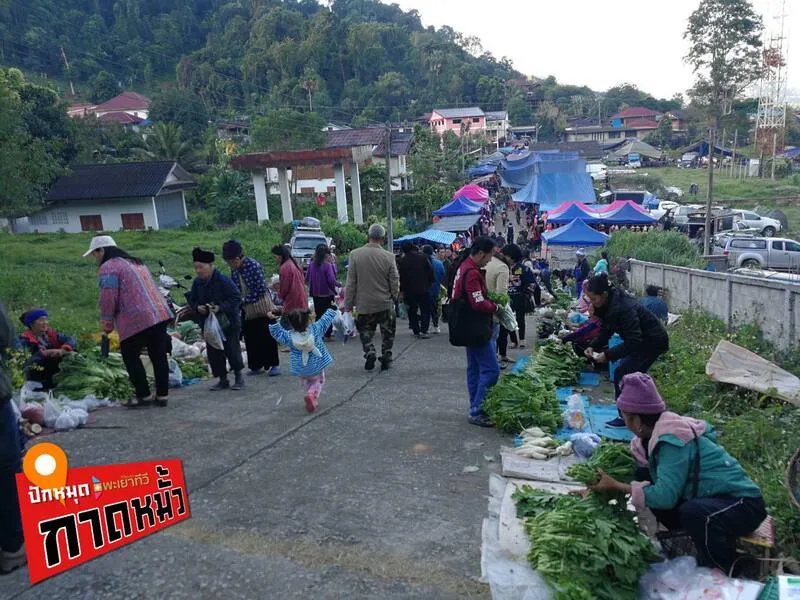
17. Ban Huak Thai-Lao Border Market is located in the Ban Huak border area of Phu Sang Subdistrict, Phu Sang District. The market reflects trade and everyday relations between Thai and Lao border communities and adds a cultural and economic dimension to a trip otherwise focused on the natural attractions of Phu Sang.
Highlights: A cross-border market, local products from Thailand and Laos, woven textiles, basketry, regional food, community products, and an authentic border-community atmosphere.
Ban Huak Market is more than a place for shopping. It is a small-scale trading space where people from both sides of the border exchange daily goods, dried foods, woven products, basketry, and seasonal community produce.
The atmosphere provides insight into Ban Huak’s role as an economic and cultural connection point. Visitors can observe trade patterns that remain closely linked to daily community life rather than being designed solely for tourism.
The main market days are traditionally held on the 10th and 30th of each month, with activity generally strongest from morning until around midday. Travelers who want to experience the market at its busiest should plan accordingly.
Ban Huak can be combined with Phu Sang National Park and other attractions along the border route, creating a one-day itinerary that combines nature, community life, and local culture.
Travelers intending to cross the international border should check the current status of the checkpoint, required documents, and official regulations before traveling, as border procedures can change.
Getting There: From Phu Sang District, follow the Phu Sang–Ban Huak route toward the border area. The market is located near the Ban Huak checkpoint. A private vehicle is the most practical option for combining the market with Phu Sang National Park.

18. Tad Pu Kheng Waterfall is located at Moo 6 in Ban Mang Subdistrict, Chiang Muan District, within Doi Phu Nang National Park. It is a relatively small waterfall but has a distinctive wide rock platform and water flowing gently down several shallow levels, making it attractive to visitors looking for a quieter natural setting.
Highlights: A rock platform approximately 20 meters wide, a natural area of roughly 2 rai, water from Mae Pang stream, small cascading levels, and a peaceful forest atmosphere.
The local word “tad” is commonly used for places where streams flow across rock shelves or rock faces. Tad Pu Kheng therefore consists more of a broad rocky surface with water spreading across several levels than of a single high vertical drop.
The surrounding area remains relatively natural, with trees and streamside vegetation providing shade. It is suitable for sitting quietly, listening to the water, and enjoying simple nature photography.
The waterfall is approximately 7 km from Doi Phu Nang National Park headquarters, making it practical to combine with green-peafowl observation and Than Sawan Waterfall.
During and shortly after the rainy season, water volume is higher and the forest is greener, but rocks become more slippery. Visitors should wear suitable footwear and avoid entering the water when currents are strong.
For travelers who prefer less crowded places, Tad Pu Kheng Waterfall adds variety to a Chiang Muan itinerary and offers a different landscape from Than Sawan Waterfall.
Open Days: Daily Opening Hours: 08:00 – 16:30
Getting There: From Doi Phu Nang National Park headquarters, travel roughly 7 km south into Ban Mang Subdistrict. Check road conditions with park staff, particularly after heavy rain.

19. Champathong Waterfall is located in Ban Tam Subdistrict, Mueang Phayao District, within Doi Luang National Park. It is a large natural waterfall with 7 levels and a relatively well-preserved watershed forest, making it suitable for travelers who enjoy forest walks and multi-tiered waterfalls.
Highlights: A 7-tier waterfall, especially attractive second and third levels, steep rock faces, natural pools, shaded forest, and nature trails within Doi Luang National Park.
The waterfall descends through steep rock formations and several levels, with each tier presenting a different view. The second and third levels are especially notable for their visible streams dropping from rocky cliffs into pools below.
The trail passes through forest containing large trees and native vegetation. Visitors experience flowing water, bird calls, and cooler humid air throughout the route.
This forest is part of Doi Luang National Park, which extends across Chiang Rai, Phayao, and Lampang provinces. It is therefore important not only as a tourist attraction but also as a watershed forest and biodiversity area in Northern Thailand.
Visitors who intend to walk to several waterfall levels should wear suitable footwear, carry drinking water, and assess their physical condition, as some sections are steep and pass through natural terrain.
The rainy season through early winter usually provides stronger water flow and greener forest. During periods of heavy rainfall, visitors should check national park announcements because trail and water conditions can change quickly.
Open Days: Daily Opening Hours: 08:00 – 16:30
Getting There: From Phayao city, travel toward Ban Tam Subdistrict in Mueang Phayao District and follow the road toward Champathong Waterfall in Doi Luang National Park. A private vehicle is recommended, especially during the rainy season.
Map (GPS):Open Directions to Champathong Waterfall
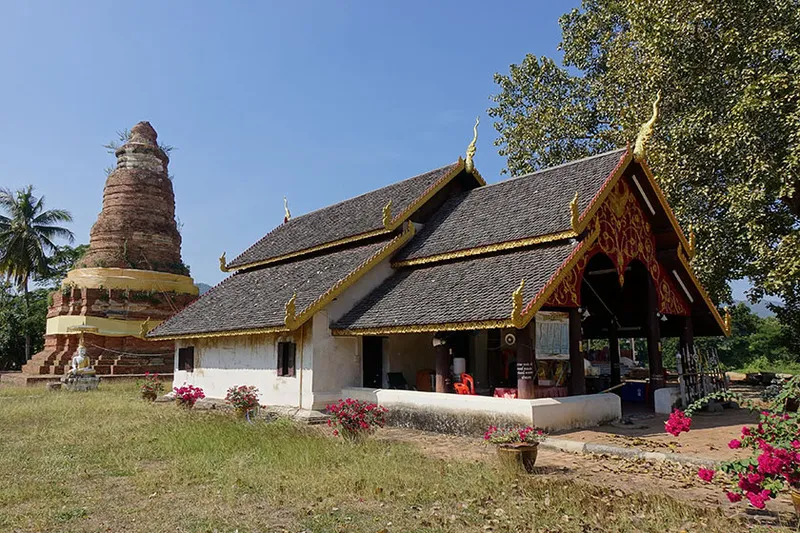
20. Wiang Lo Archaeological Site is located in Lo Subdistrict, Chun District. It is an important ancient settlement in the Ing River basin where visitors can still see traces of moats, earthen embankments, city walls, temple ruins, and numerous archaeological foundations representing the former prosperity of a Lanna community.
Highlights: An ancient settlement with a history of more than 900 years, city walls extending for approximately 2,750 meters, moats and earthen embankments, 4 city gates, temple ruins, sandstone Buddha images, and an important location within the Ing River basin.
Wiang Lo developed on relatively flat land near the Ing River, a location well suited to agriculture, water use, and transportation. The choice of location demonstrates how ancient communities incorporated both landscape and waterways into the planning of settlements.
Today, visitors can still identify sections of the moat, earthen embankments, and archaeological remains spread across the former city area. Visiting several separate points gives a better sense of the settlement’s scale and layout than viewing a single ruin.
Remains of temples, chedi foundations, archaeological objects, and sandstone Buddha images indicate that Buddhism played an important role in Wiang Lo during its prosperous period.
The site is particularly suitable for travelers interested in history, archaeology, students, and anyone studying Lanna urban planning. Allowing at least 1–2 hours provides a much better understanding of the site than a brief photo stop.
Chun District lies between Phayao city and the Chiang Kham–Phu Sang area, so Wiang Lo can also serve as a useful stop on a multi-day route, helping distribute travel beyond the provincial capital.
Getting There: From Phayao city, travel toward Chun District, then continue into Lo Subdistrict and Ban Wiang Lo. Archaeological remains are spread across several locations, so a private vehicle is convenient for moving between them.
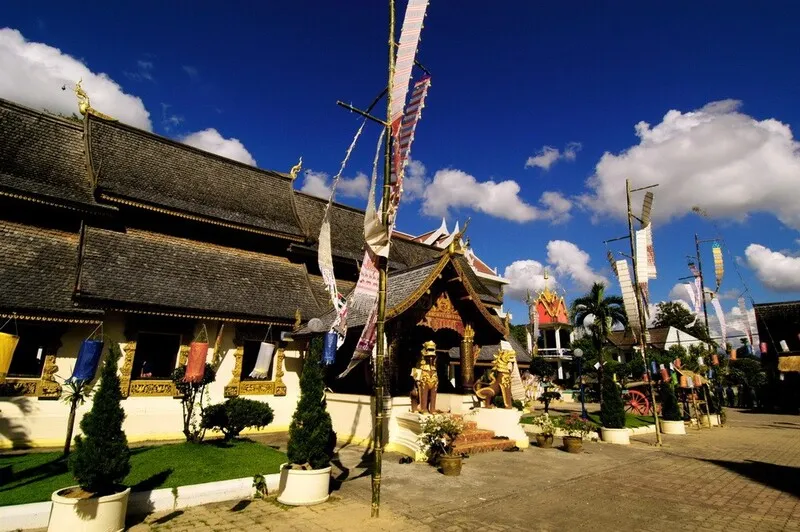
21. Wat Saen Mueang Ma is located at Ban Mang in Yuan Subdistrict, Chiang Kham District. It is an important Tai Lue temple that clearly reflects cultural roots connected with Xishuangbanna through its architecture, Buddhist art, local beliefs, and the traditions of Tai Lue communities that later settled in Chiang Kham.
Highlights: Tai Lue–Lanna viharn, wooden shingle roof, carved wooden gable featuring deva figures, naga stairways, guardian lions, folk murals, and a local cultural museum.
The viharn is the temple’s main architectural highlight and deserves close observation. Its layered roof, wooden shingles, carved gable decorations, and structural details clearly demonstrate the artistic preferences of Tai Lue craftsmen.
The murals inside the temple are also valuable because they communicate Buddhist stories and scenes of local life through the work of community artisans. They were not created merely as decoration but also served as visual teaching tools in earlier generations.
The temple also preserves local artifacts connected with Tai Lue society, allowing visitors to explore religion and culture together. Traditional utensils, clothing, handicrafts, and ritual objects help explain the everyday life and beliefs of the community.
The name “Saen Mueang Ma” is closely associated with the migration and settlement history of Tai Lue people in Chiang Kham, making the temple an important record of population movement and community formation rather than simply an old religious monument.
Wat Saen Mueang Ma can be combined with Wat Nantaram, Wat Yuan, the Tai Lue Cultural Center, and Wat Phra That Sop Waen in a single day, making it ideal for travelers who want a deeper understanding of Chiang Kham’s ethnic heritage.
Open Days: Daily Opening Hours: 08:00 – 16:00
Getting There: From central Chiang Kham, travel to Ban Mang in Yuan Subdistrict. The temple is located within the community and is easily reached by car or motorcycle.
Map (GPS):Open Directions to Wat Saen Mueang Ma

22. Wat Phra Nang Din is located at Ban Phra Nang Din in Wiang Subdistrict, Chiang Kham District. The temple is famous for its principal Buddha image, which is enshrined directly on the ground without a raised pedestal, giving rise to the name “Phra Nang Din,” meaning the Buddha seated on the earth.
Highlights: A principal Buddha image seated directly on the ground, local legends, long-standing community faith, and convenient access as part of a Chiang Kham temple itinerary.
The unusual position of the principal Buddha image immediately distinguishes Wat Phra Nang Din from other temples. Instead of being placed on a conventional raised altar, the image rests directly at floor level within the viharn.
Local legends explain that attempts to raise the image onto a pedestal were unsuccessful, and these stories have been passed down through generations. As a result, the image became a powerful spiritual symbol for the people of Chiang Kham.
The temple has a calm atmosphere suitable for worship, merit-making, and learning about local belief without the distractions of a large commercialized attraction.
Its location close to central Chiang Kham makes it easy to combine with Wat Nantaram, Wat Saen Mueang Ma, Wat Yuan, and Wat Phra That Sop Waen in a full-day religious and cultural route.
Visitors should dress respectfully and remain quiet inside the viharn because the temple continues to be used actively by local worshippers.
Open Days: Daily Opening Hours: 08:00 – 16:30
Getting There: The temple is located at Ban Phra Nang Din, Moo 7, Wiang Subdistrict, Chiang Kham District. From central Chiang Kham, follow Highway 1148 toward Nan for approximately 4 km; the temple is beside the route.
Map (GPS):Open Directions to Wat Phra Nang Din
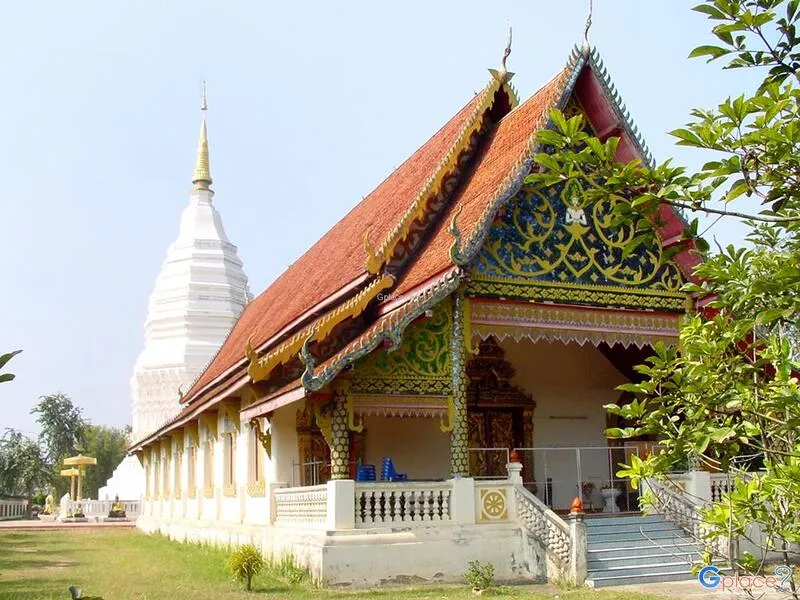
23. Wat Li is located at Ban Lai Ing in Wiang Subdistrict, Mueang Phayao District. This historic temple is especially important as a place for learning about ancient Wiang Phayao, the distinctive Phayao school of Buddhist art, sandstone Buddha images, and archaeological objects collected from abandoned temples in the old city.
Highlights: Wiang Phayao Museum, sandstone Buddha images, stone inscriptions, ceramics, archaeological objects from abandoned temples, and the history of ancient Phayao.
Wat Li is valuable not only as a functioning Buddhist temple but also as a site that helps visitors understand Phayao’s former urban civilization in a more systematic way. The museum preserves objects that explain the development of the city from ancient periods through the Lanna era.
Sandstone Buddha images are one of the defining characteristics of the Phayao school of art. Their material, carving techniques, facial forms, and proportions distinguish them from Buddhist images produced in other major artistic centers of Northern Thailand.
Inscriptions and archaeological objects preserved at the temple also demonstrate the former importance of Phayao in religion, administration, and regional connections with neighboring cities.
Travelers who visit Kwan Phayao should consider adding Wat Li to their itinerary because the museum provides historical context that makes the surrounding temples, archaeological sites, and lakeside landscape easier to understand.
Wat Li can be combined with Wat Si Khom Kham, the Phayao Cultural Exhibition Hall, the King Ngam Mueang Monument, and Kwan Phayao in a half-day or full-day city route.
Open Days: Daily Opening Hours: 09:00 – 15:00
Getting There: Wat Li is located at Ban Lai Ing in Wiang Subdistrict, Mueang Phayao District, not far from Kwan Phayao and the historic city area. It is easily reached by car or local transport.
Map (GPS):Open Directions to Wat Li

24. Phayao Cultural Exhibition Hall (Ho Watanatham Nithat) is located within Wat Si Khom Kham in Mueang Phayao District. It is a museum and learning center presenting Phayao from prehistoric times through ancient Phukamyao, the Phayao school of art, and the province’s modern communities and cultural traditions.
Highlights: Exhibitions on Phayao history, archaeology, stone inscriptions, Buddha images, the Phayao artistic school, community life, and knowledge connected with Kwan Phayao.
The Cultural Exhibition Hall is particularly useful for travelers who want to understand the province before exploring its archaeological and religious sites. Its exhibitions provide background that connects temples, historical figures, artifacts, and ancient settlements into a broader narrative.
Archaeological evidence and Buddhist art on display reflect the prosperity of ancient Phukamyao, including sandstone Buddha images that are characteristic of the local Phayao artistic tradition.
The exhibitions also explain how ancient settlement patterns developed into modern Phayao, making the museum more than a collection of old objects. It provides a broader interpretation of the province’s cultural development.
Because the hall is located within Wat Si Khom Kham, visitors can pay respect to Phra Chao Ton Luang and then continue directly to the museum. The 2 attractions work especially well together as part of a city itinerary.
The indoor setting makes the museum suitable for families, students, and senior travelers, particularly during hot weather or rain.
Open Days: Tuesday – Sunday Opening Hours: 08:30 – 16:30
Getting There: The Phayao Cultural Exhibition Hall is located inside Wat Si Khom Kham in Wiang Subdistrict, Mueang Phayao District. Use the same route as Wat Si Khom Kham and Kwan Phayao.

25. Mae Suk Reservoir is located in Mae Suk Subdistrict, Mae Chai District. This royal-initiative reservoir plays an important role in local water management and agriculture while also offering a quiet landscape of open water, rural scenery, and surrounding hills.
Highlights: An earth dam approximately 16.5 meters high and 108 meters long, reservoir capacity of about 0.520 million cubic meters, calm water scenery, and the rural atmosphere of Mae Chai District.
The reservoir was developed to reduce water shortages and support agriculture in Mae Chai. Its function is therefore closely connected with the everyday livelihoods of nearby farming communities.
The landscape combines open water, agricultural land, and surrounding hills. Morning and late afternoon provide the most comfortable conditions for photography and quiet sightseeing.
Mae Suk Reservoir is not heavily commercialized and does not offer a large number of tourist facilities. Its appeal lies in simplicity, open space, and the peaceful atmosphere of a local water-management landscape.
The reservoir can be used as a stop when traveling north from Phayao city toward Mae Chai, Chiang Kham, or Chiang Rai, adding variety to a longer road trip.
Visitors should remain within public-access areas and avoid entering restricted irrigation facilities or swimming in undesignated areas.
Open Days: Daily Opening Hours: 08:00 – 17:00
Getting There: From Mae Chai District, travel approximately 13 km toward Mae Suk Subdistrict. A private vehicle is the most practical option because there is no direct public transportation to the reservoir.
Map (GPS):Open Directions to Mae Suk Reservoir
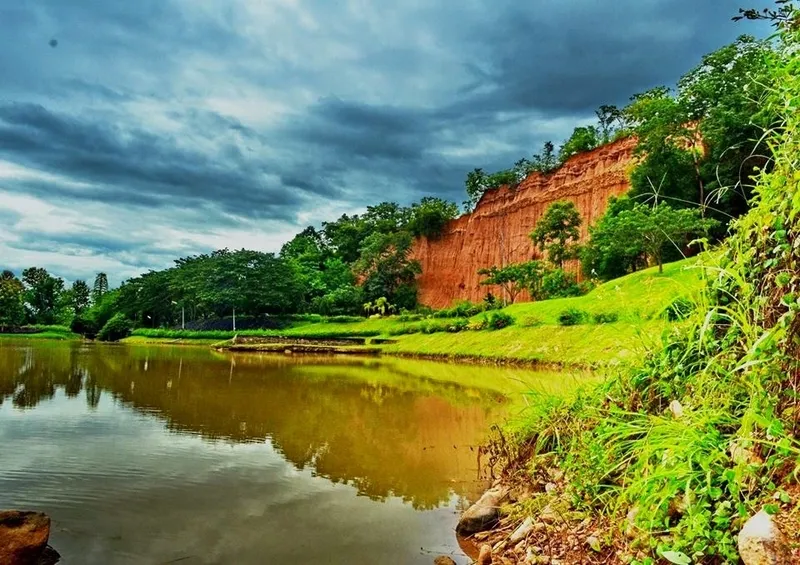
26. Fang Ta is located at Ban Chai Sathan in Chiang Muan Subdistrict, Chiang Muan District. This unusual natural formation was created by long-term erosion, producing tall earth cliffs, columns, grooves, and wall-like shapes that differ significantly from the mountain and forest scenery found elsewhere in Phayao.
Highlights: Natural earth cliffs, eroded earth columns and channels, formations extending for more than 200 meters in some areas, heights of approximately 25 meters, and distinctive geological scenery.
Fang Ta was formed through the long-term action of rain, flowing water, wind, and erosion on exposed soil layers. Over time, these processes created steep earthen walls and sculpted grooves resembling natural architecture.
The colors and textures of the cliffs change according to the direction and intensity of sunlight. Early morning and late afternoon are especially suitable for photography, while strong midday light can create harsh shadows.
Because the formations consist of eroded earth rather than solid rock, visitors should keep a safe distance from unstable edges, avoid climbing the cliffs, and stay away from cracked or overhanging sections.
Fang Ta can be combined with Chiang Muan-Kaeng Luang Dinosaur Forest Park, Phra That Phu Po, and other Chiang Muan attractions, creating a route that combines geology, history, and local culture.
The site is best suited to travelers interested in geomorphology, unusual natural landscapes, and photography rather than those looking for developed visitor facilities.
Getting There: From central Chiang Muan, travel to Ban Chai Sathan, Moo 4, Chiang Muan Subdistrict. A private vehicle is the most practical option for combining Fang Ta with other attractions in the district.
Map (GPS):Open Directions to Fang Ta
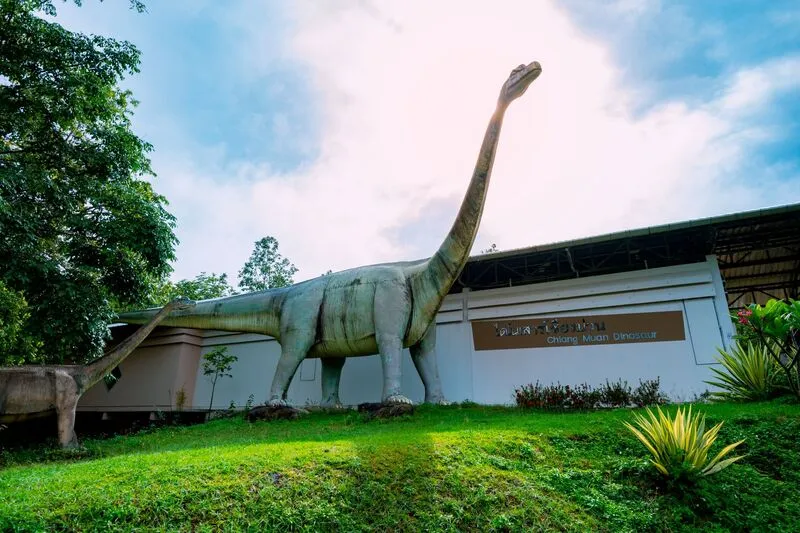
27. Chiang Muan-Kaeng Luang Dinosaur Forest Park is located at Ban Nong Klang in Ban Mang Subdistrict, Chiang Muan District. It is an important geological and paleontological learning site in Northern Thailand because dinosaur fossils discovered in the area have contributed significantly to the study of Thailand’s prehistoric past.
Highlights: Sauropod dinosaur fossil discoveries, the Chiang Muan Dinosaur Museum, geological learning, nature trails, Kaeng Luang, and the natural landscape along the Yom River.
Chiang Muan became important in Thai paleontology after dinosaur fossils were discovered in the area. Scientific investigation and excavation have provided valuable evidence about prehistoric environments in Northern Thailand.
The museum and learning facilities explain dinosaur species, rock layers, fossil formation, and the work of geologists and paleontologists, making the site especially suitable for families and school-age visitors.
Beyond the dinosaur story, Kaeng Luang on the Yom River contains large rock formations and attractive river scenery, allowing travelers to experience both geological heritage and natural landscapes in one area.
Allow at least 1–2 hours for the visit. The site can be combined with Phra That Phu Po, Fang Ta, and Wat Tha Fa Tai to create a full-day Chiang Muan itinerary.
For children, the site turns paleontology and geology into a more accessible subject by combining exhibits, reconstructed information, and the actual landscape where discoveries were made.
Open Days: Daily Opening Hours: 08:30 – 16:30
Getting There: The forest park is located at Ban Nong Klang, Moo 7, Ban Mang Subdistrict, Chiang Muan District. From central Chiang Muan, use a private vehicle and follow the local road to the park.
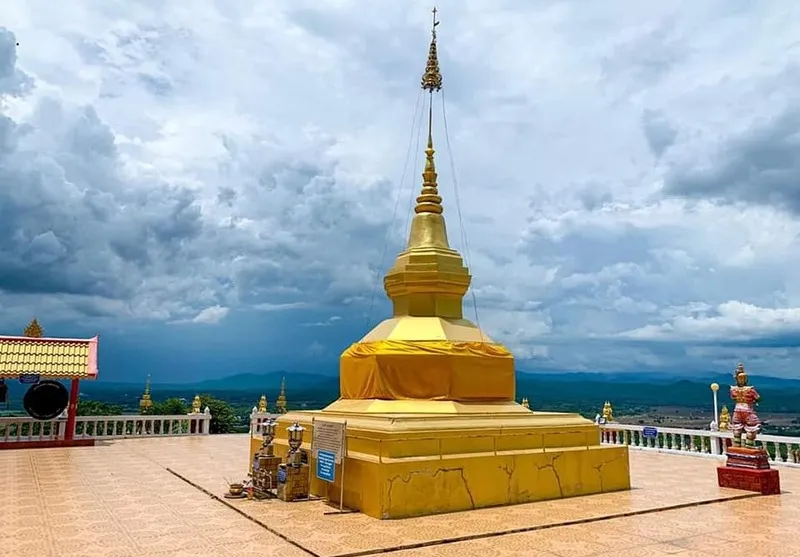
28. Phra That Phu Po is located at Ban Nong Klang in Ban Mang Subdistrict, Chiang Muan District, on elevated terrain overlooking surrounding mountains and communities. It is an important local Buddhist site and a respected spiritual landmark for the people of Chiang Muan.
Highlights: A sacred stupa on a mountain, Buddha images, sculptures of celestial beings, statues of respected northern monks, scenic views over Chiang Muan, and a peaceful hilltop Buddhist atmosphere.
The appeal of Phra That Phu Po lies in its combination of religious devotion and landscape. Visitors travel uphill before reaching the stupa and associated sacred structures surrounded by mountain scenery.
The grounds contain Buddhist sculptures and statues reflecting contemporary local belief, giving visitors more to explore than the stupa alone.
From the higher areas, the landscape of Chiang Muan can be seen across a wide area, particularly on clear days. This makes the site suitable for both worship and photography.
Phra That Phu Po can be combined easily with Chiang Muan-Kaeng Luang Dinosaur Forest Park because both are located in the Ban Nong Klang area, reducing travel time while providing a mix of natural, historical, and religious experiences.
Daytime visits are recommended, particularly in fair weather, as uphill roads may become slippery and visibility may be reduced during heavy rain or dense mist.
Getting There: From central Chiang Muan, travel toward Ban Nong Klang, Moo 7, Ban Mang Subdistrict, then follow the local road uphill to Phra That Phu Po. A private vehicle is the most practical option.
Map (GPS):Open Directions to Phra That Phu Po
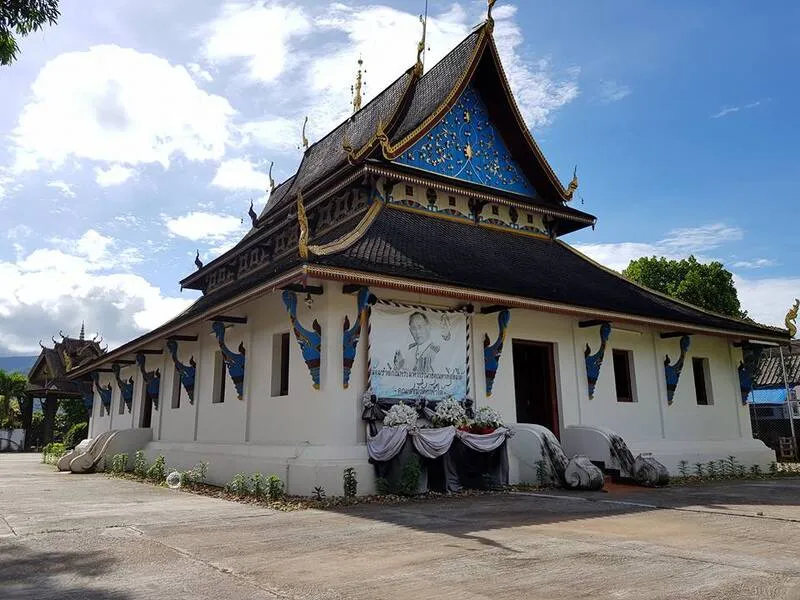
29. Wat Tha Fa Tai is located at Ban Fa Si Thong in Sa Subdistrict, Chiang Muan District. This historic Tai Lue temple was established in 1768 and is important for its religious heritage, migration history, and distinctive vernacular architecture.
Highlights: A low-profile Tai Lue viharn, a 3-tier wooden shingle roof, a teak principal Buddha image connected with Xishuangbanna, a lacquered and gilded pulpit decorated with colored glass, and the history of Tai Lue settlement in Chiang Muan.
The temple was established by Kru Tham Sena and Pho Thao Saen Atthi, leaders of Tai Lue migrants from Xishuangbanna. Wat Tha Fa Tai therefore serves as an important record of migration and the formation of Tai Lue communities in the Yom River basin.
The viharn has a relatively low form, masonry walls, and a 3-tier roof covered with wooden shingles. The lower roof has a hipped form on all 4 sides, while the upper section resembles a small pavilion or prasat, creating an architectural profile not commonly seen in other temples.
The principal Buddha image is carved from teak and seated in the Mara-vijaya posture. Its connection with Xishuangbanna gives it special meaning as part of the community’s cultural roots.
The pulpit inside the temple is decorated with stucco, lacquer, gilding, and colored glass, reflecting the craftsmanship and religious devotion that local residents have maintained over generations.
Wat Tha Fa Tai can be combined with Fang Ta, Doi Phu Nang National Park, and Chiang Muan-Kaeng Luang Dinosaur Forest Park to create a balanced cultural and nature itinerary.
Open Days: Daily Opening Hours: 08:00 – 17:00
Getting There: The temple is located at Ban Fa Si Thong, Moo 11, Sa Subdistrict, Chiang Muan District. It is easily reached by private vehicle from central Chiang Muan.
Map (GPS):Open Directions to Wat Tha Fa Tai
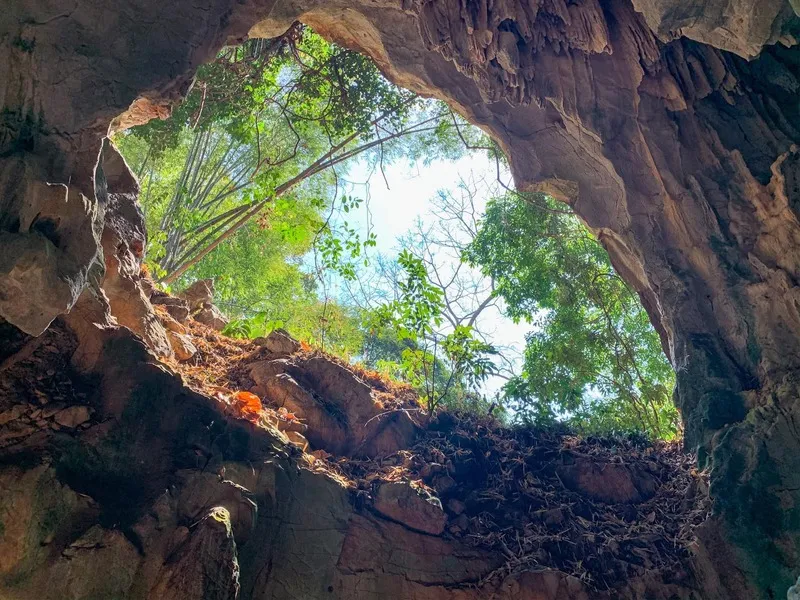
30. Tham Yai Pha Tang Cave is located at Ban Pha Tang in Khun Khuan Subdistrict, Pong District. This natural cave lies within a mountainous area and contains large chambers, stalactites and stalagmites, side passages, natural ferns, bats, and stories connected with local history.
Highlights: Large cave chambers, smaller side passages, stalactites and stalagmites, bat colonies, vegetation around the cave entrance, Buddha images inside, and historical associations with periods of political conflict.
The cave is located on a low mountain and requires a short uphill walk from the parking area. The approach is not as demanding as a high-altitude trek, but visitors should still wear suitable footwear for rock and soil surfaces.
Inside are large chambers and several smaller passages. Stalactites and stalagmites have formed over long geological periods, producing different shapes and textures throughout the cave.
The cave is also home to bats and other organisms adapted to dark and humid conditions. Visitors should avoid loud noise, unnecessary touching of cave formations, and disturbing wildlife.
Local history also associates the cave with periods of conflict involving communist insurgency, adding a layer of human memory to what would otherwise be purely a natural attraction.
Anyone wishing to explore deeper sections should check with local staff or residents, carry a flashlight, and avoid entering alone, especially during rainy weather when surfaces may be slippery.
Open Days: Daily Opening Hours: 08:00 – 16:30
Getting There: Tham Yai Pha Tang Cave is located at Ban Pha Tang, Moo 6, Khun Khuan Subdistrict, Pong District, approximately 20 km from central Pong. After parking, visitors must walk uphill to the cave entrance, so daytime travel is recommended.
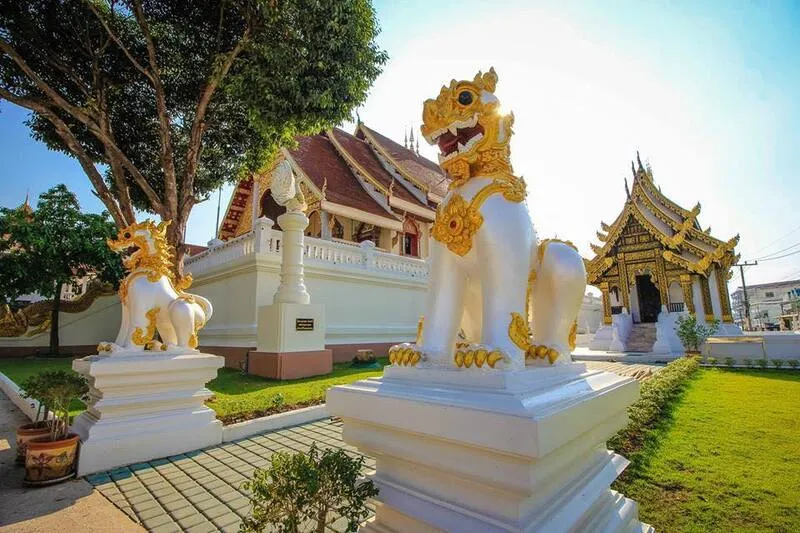
31. Wat Si Umong Kham, also locally known as “Wat Sung,” is located on Tha Kwan Road in Wiang Subdistrict, Mueang Phayao District. This historic temple is distinctive because several of its important religious structures stand on elevated foundations, making the complex visible from different parts of the city and the Kwan Phayao area.
Highlights: Phra Chao Lan Tue, Phra Chao Khaeng Khom, elevated temple structures and chedi, Lanna Buddhist art, and a convenient location near Kwan Phayao and the historic city center.
One of the first things visitors notice is the temple’s elevated layout. The main religious buildings and chedi rise above the surrounding community, giving Wat Si Umong Kham a distinctive silhouette and explaining the local nickname “Wat Sung,” meaning the high temple.
The temple houses important Buddha images including Phra Chao Lan Tue and Phra Chao Khaeng Khom, both of which have long been objects of local devotion. Their artistic characteristics also make the temple worthwhile for travelers interested in Phayao’s distinctive Buddhist art traditions.
Wat Si Umong Kham is located close to Kwan Phayao, Wat Li, the King Ngam Mueang Monument, and Wat Si Khom Kham, so it can easily be included in a route through the old city without requiring a long drive.
Morning or late afternoon is particularly suitable for visiting because the softer light helps reveal the proportions of the raised structures and architectural details more clearly than strong midday sun.
Open Days: Daily Opening Hours: 08:00 – 16:00
Getting There: The temple is located at 3 Tha Kwan Road, Wiang Subdistrict, Mueang Phayao District, within the municipal area and close to Kwan Phayao. It is easily reached by car, motorcycle, or local hired transport.
Map (GPS):Open Directions to Wat Si Umong Kham

32. Wat Pa Daeng Bunnak is located at Ban Pa Daeng in Tha Wang Thong Subdistrict, Mueang Phayao District. It is an important archaeological temple complex reflecting the prosperity of Phayao during the Lanna period, with stupas, inscriptions, sandstone Buddha images, ordination-hall remains, and traces of earlier temple structures preserved within the site.
Highlights: Wat Pa Daeng chedi, remains of a Sukhothai-influenced chedi, an old brick gateway, sandstone Buddha images, ancient building foundations, and historical evidence linking Phayao with wider Lanna political and religious networks.
The site is especially interesting because it preserves evidence of 2 earlier temples, the former Wat Bunnak and Wat Pa Daeng, which were later associated within the same religious complex. Visitors should therefore view the grounds as a group of interconnected archaeological remains rather than focusing on a single structure.
The artistic evidence at the temple reflects multiple influences, including Sukhothai and Lanna styles, demonstrating that Phayao was once connected with several important political and religious centers in Northern Thailand.
The site is also associated with historical narratives involving Phraya Yutthitthira, an important figure in Lanna history, adding another layer of political history to the archaeological remains.
Wat Pa Daeng Bunnak is located close to Phayao city and can be combined with Wat Li, the Phayao Cultural Exhibition Hall, and Ban Rong Hai Archaeological Site for a more complete historical itinerary.
Open Days: Daily Opening Hours: 08:00 – 17:00
Getting There: The temple is located at Ban Pa Daeng in Tha Wang Thong Subdistrict, Mueang Phayao District, approximately 1.5 km from the city center. It is easily reached by car or motorcycle.
Map (GPS):Open Directions to Wat Pa Daeng Bunnak
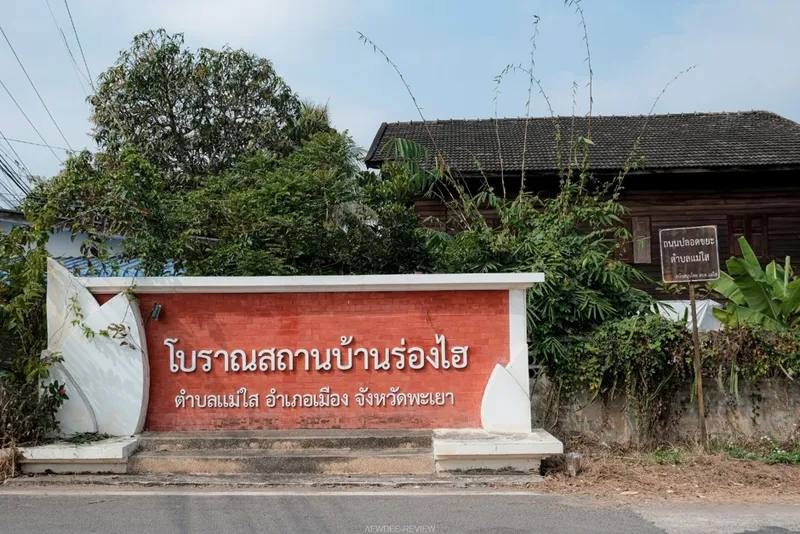
33. Ban Rong Hai Archaeological Site is located at Ban Rong Hai in Mae Sai Subdistrict, Mueang Phayao District. This important archaeological area near Kwan Phayao contains remains of religious structures, abandoned temples, chedi foundations, building bases, and traces of ancient communities spread across several locations.
Highlights: Lanna-period archaeological remains from around the 20th–21st Buddhist centuries, chedi and viharn foundations, ancient settlements near Kwan Phayao, and evidence of the historical relationship between Phukamyao and the lake.
Ban Rong Hai is significant because it demonstrates that the shores of Kwan Phayao supported substantial communities and religious sites long before the area developed into a modern tourist destination.
Archaeological remains across the site show the importance of Buddhism in Lanna society, including foundations of chedis, viharns, and other buildings that once formed part of temples and surrounding settlements.
For travelers who know Kwan Phayao mainly as a place for relaxation and sunset views, Ban Rong Hai adds an important historical layer by revealing how closely the lake was connected with earlier communities.
Most of the archaeological remains are outdoors, so morning and late afternoon are the most comfortable times to explore. Visitors should avoid climbing on old brick foundations or disturbing archaeological features.
Open Days: Daily
Getting There: From Phayao city, travel toward Mae Sai Subdistrict and Ban Rong Hai. The archaeological areas are located near Kwan Phayao, and a private vehicle is useful because the remains are spread across several points.

34. Mae Chun Reservoir, also known locally as Nam Chun Reservoir, is located in Chun Subdistrict, Chun District. It is an important water-storage facility serving irrigation, domestic use, agriculture, and drought mitigation, while the reservoir landscape also provides a peaceful setting for sightseeing.
Highlights: An earth dam approximately 23 meters high and 385 meters long, storage capacity of around 9.604 million cubic meters, mountain reservoir scenery, and the quiet atmosphere of Chun District.
The reservoir contributes to local water security by storing water for agricultural use and nearby communities, particularly during periods of low rainfall and the dry season.
From the dam area, visitors can enjoy broad views of the reservoir and surrounding mountains. Morning and evening are especially attractive for photography and relaxing beside the water.
Mae Chun Reservoir is not heavily commercialized. Its appeal lies in its quiet environment and local character rather than large-scale tourism facilities or organized activities.
The reservoir can be combined with Wiang Lo Archaeological Site and other attractions in Chun District, creating a route that includes history, community landscapes, and water resources.
Open Days: Daily
Getting There: From central Chun District, travel toward the Mae Chun Reservoir area in Chun Subdistrict. A private vehicle is the most convenient option, and visitors should remain within designated public-access areas.
Map (GPS):Open Directions to Mae Chun Reservoir

35. Huai Chomphu-Pha Thewada Reservoir is located in San Khong Subdistrict, Dok Kham Tai District. This nature destination combines a reservoir, forest, mountain trails, waterfalls, caves, seasonal sunflower fields, and adventure activities within the same wider area.
Highlights: Reservoir scenery, Pha Thewada cliff, forest trekking, abseiling activities, waterfalls and caves, seasonal sunflower fields during the cool season, and community-based ecotourism in San Khong.
The area offers different types of travel experiences. Visitors looking for a relaxed trip can enjoy the reservoir scenery, while more adventurous travelers can arrange trekking or abseiling around the cliff area through local operators or responsible community organizations.
The route to Pha Thewada passes through forest and mountainous terrain, so visitors should be physically prepared and use suitable equipment. Adventure activities should never be attempted without proper supervision or advance coordination.
From approximately November to February, sunflower fields may add color to agricultural areas around the route, making the cool season particularly attractive for nature and photography trips.
The wider landscape is connected with the forest ecosystem around Wiang Lo Wildlife Sanctuary. Visitors should therefore minimize noise, carry out all waste, and avoid disturbing wildlife.
Huai Chomphu-Pha Thewada Reservoir is better suited to a full-day trip than a short photo stop, especially for travelers planning to hike, join adventure activities, or explore seasonal landscapes.
Open Days: Daily
Getting There: From Dok Kham Tai District, follow Highway 1021 toward Chun, then turn toward Ban Cham Kai and San Khong Subdistrict. The reservoir is approximately 12 km from central Dok Kham Tai.

36. Ban Tham Forest Park is located in Ban Tham Subdistrict, Dok Kham Tai District. The area combines forested foothills, nature, and religious heritage, with Phra That Chom Sin serving as an important sacred site for local residents.
Highlights: Shaded foothill forest, Phra That Chom Sin, panoramic views over Dok Kham Tai, nature trails, and a peaceful environment that combines Buddhist worship with outdoor recreation.
The forest park occupies a foothill landscape where trees provide shade and cooler conditions than the surrounding open lowlands, making it suitable for walking and quiet relaxation.
Phra That Chom Sin is the area’s principal religious landmark. From the elevated grounds near the sacred site, visitors can look across parts of Dok Kham Tai District, combining religious value with scenic views.
The close relationship between forest and sacred space reflects a long-standing pattern in Northern Thai communities, where quiet mountain and forest environments were often selected for meditation and the construction of religious monuments.
Ban Tham Forest Park can be combined with Huai Chomphu-Pha Thewada Reservoir, creating a Dok Kham Tai itinerary focused on nature, landscape, and local faith.
Open Days: Daily Opening Hours: 08:00 – 17:00
Getting There: From Dok Kham Tai District, follow the Dok Kham Tai–Chiang Muan route toward Ban Tham Subdistrict for approximately 14 km. The forest park can be reached easily by private car.
Map (GPS):Open Directions to Ban Tham Forest Park
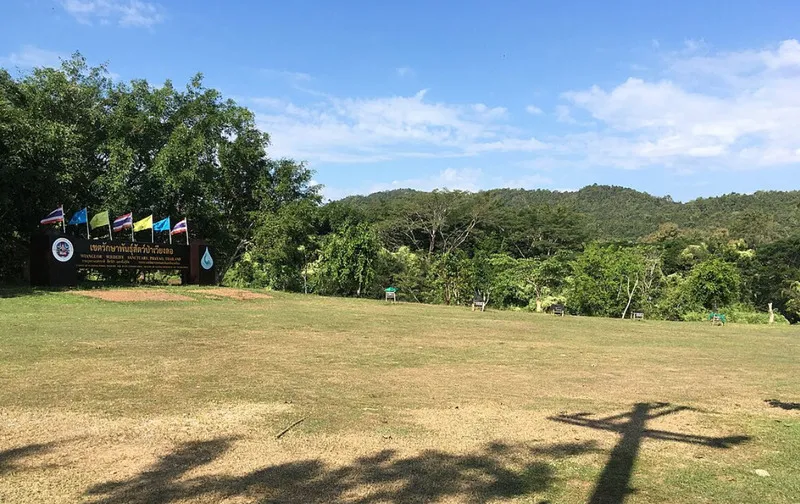
37. Wiang Lo Wildlife Sanctuary is a large protected forest area in Phayao covering parts of Chun, Dok Kham Tai, Pong, and Chiang Kham districts. The sanctuary covers approximately 231,875 rai, or about 371 square kilometers, and plays an important role in conserving wildlife, watershed forest, and ecosystems connected with the Ing and Yom river basins.
Highlights: Large protected forest, green peafowl, serow, barking deer, other wildlife, watershed ecosystems, biodiversity, and natural landscapes connected with the historic Wiang Lo area.
Green peafowl are one of the sanctuary’s most recognizable wildlife species. Their survival depends on a combination of open woodland, feeding areas, water sources, and undisturbed nesting habitats, making their presence an indicator of habitat quality.
The forest also performs important hydrological functions. It absorbs water during the rainy season, reduces soil erosion, and gradually releases water into streams during the dry season, supporting both wildlife and nearby agricultural communities.
Travel in a wildlife sanctuary is subject to stricter rules than ordinary tourist attractions. Visitors planning nature study, wildlife observation, or entry into protected forest areas should contact responsible officials and follow all access regulations.
Feeding wildlife, making excessive noise, driving too fast, or entering unauthorized zones should be avoided because these behaviors can disturb animals and create risks for both wildlife and visitors.
The sanctuary can be combined conceptually with Wiang Lo Archaeological Site and Mae Chun Reservoir, creating a Chun-area route that links history, ecology, and watershed landscapes.
Open Days: Daily Opening Hours: 08:30 – 16:30
Getting There: Main contact and access points are in the Chun District area, while the protected forest extends across several districts. Visitors planning to enter nature-study areas should confirm current routes and access rules with officials before traveling.

38. Chiang Kham Morning Market is a traditional local market near the Chiang Kham District Office and post office. It is an excellent place to begin the day with local breakfast dishes while observing everyday life before continuing to the temples and Tai Lue cultural attractions around Chiang Kham.
Highlights: Local breakfast food, regional vegetables and fruit, Northern Thai dishes, traditional snacks, soy milk, tea, coffee, community ingredients, and an authentic market atmosphere used by local residents.
The market differs from a tourism-oriented market because most vendors primarily serve the daily needs of Chiang Kham residents. Visitors can observe sellers preparing ingredients, local families buying food, and small breakfast shops opening early in the morning.
Food is one of the strongest reasons to visit. Options include Northern Thai dishes, Tai Lue food, fried snacks, sticky rice, prepared meals, local vegetables, and sweets. Trying several small dishes is a practical way to experience the area before beginning a full day of sightseeing.
The market also offers insight into Chiang Kham’s ethnic diversity. Tai Lue, Shan, and Lanna cultural influences can be seen in ingredients, prepared dishes, clothing, and the rhythm of everyday trade.
After breakfast, visitors can continue easily to Wat Nantaram, Wat Saen Mueang Ma, Wat Phra Nang Din, Wat Yuan, and Wat Phra That Sop Waen, making the market a practical first stop on a Chiang Kham itinerary.
Arriving early is recommended because some vendors begin closing as the morning progresses and the market gradually becomes quieter.
Open Days: Daily
Getting There: The market is located near Chiang Kham District Office and the post office. It is easily reached from accommodation in central Chiang Kham by car, motorcycle, or on foot if staying nearby.
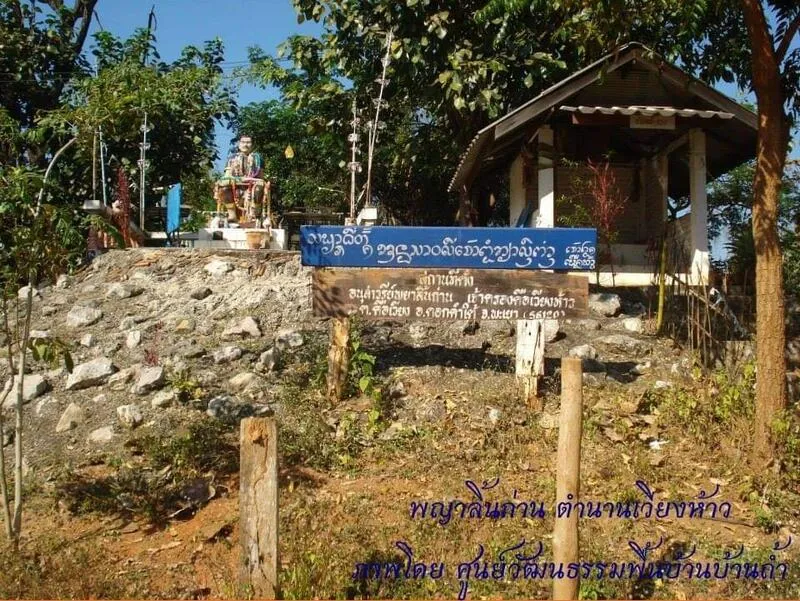
39. Wiang Hao is located at Ban Dong In Ta Nuea in Ban Lao Subdistrict, Mae Chai District. This ancient settlement is notable for traces of a circular moat and earthen embankments, together with a local legend concerning a fierce elephant known as “Pu Kam Nga Khiao.”
Highlights: Circular ancient settlement layout, moat and earthen embankments, the legend of Pu Kam Nga Khiao, traces of an old community, and local settlement history in Mae Chai District.
Wiang Hao does not contain large standing monuments or towering chedis like some better-known ancient cities. Its importance lies instead in the overall landscape, moat lines, embankments, place names, and local traditions that help reconstruct the former settlement.
From the ground and from aerial imagery, the outline of the ancient settlement can still be recognized, making Wiang Hao interesting for travelers who enjoy historical geography and early settlement patterns.
The legend of Pu Kam Nga Khiao adds a cultural dimension beyond archaeology. Local storytelling helps explain how communities preserved memories of the site and interpreted its identity through shared traditions.
The area may be associated with communities established before or during the expansion of Lanna cultural influence, making it more suitable for travelers interested in local history than for those looking only for visually dramatic ruins.
Wiang Hao can be combined with Mae Suk Reservoir and other attractions in Mae Chai District to create a northern Phayao route that includes both historical and natural landscapes.
Open Days: Daily
Getting There: The site is located at Ban Dong In Ta Nuea, Moo 11, Ban Lao Subdistrict, Mae Chai District. Daytime visits are recommended because the ancient moat and settlement features are easier to observe in good light.
Map (GPS):Open Directions to Wiang Hao

40. Phu Langka-Fin Jaboh is located in Pha Chang Noi Subdistrict, Pong District, along the Phi Pan Nam mountain range. This highland landscape combines montane forest, bamboo forest, grassland, rocky outcrops, sea-of-mist views, and broad mountain panoramas, making it an appropriate final destination in this list of 40 attractions across Phayao.
Highlights: High mountains along the Phi Pan Nam Range, 360-degree viewpoints, sea of mist, sunrise, montane forest, bamboo forest, grassland, and the scenic landscape of Pha Chang Noi.
The name “Fin Jaboh” is associated with the language and cultural traditions of Mien communities in the area and reflects the close relationship between local belief and the mountain environment.
The landscape consists of complex mountain ridges forming part of the Phi Pan Nam Range. Forests on these mountains are also important watershed areas connected with the headwaters of the Yom River, which supports communities and agricultural land across several northern provinces.
The sea of mist is the feature for which Phu Langka is best known. It is most common during the cool season or on mornings with suitable humidity and temperature conditions, but it cannot be guaranteed every day.
Some roads in the highlands require extra care, especially after rain or during dense fog. Travelers should use a vehicle in good condition and avoid excessive speed on steep slopes and sharp mountain bends.
Phu Langka-Fin Jaboh is especially suitable for nature travelers, photographers, hikers, and visitors who want more than a brief sightseeing stop. Staying overnight in the Pha Chang Noi area provides a better chance to experience sunrise, mist, and the quieter mountain atmosphere.
Open Days: Daily Opening Hours: 08:00 – 17:00
Getting There: From Phayao city, travel toward Pong District and continue into Pha Chang Noi Subdistrict. The final sections of the route are mountainous and winding, so check vehicle condition and weather before departure.
Map (GPS):Open Directions to Phu Langka-Fin Jaboh
| Travel Category | Recommended Attractions |
| Major Phayao Landmarks | 1. Kwan Phayao 2. Wat Si Khom Kham 3. Wat Tilok Aram 4. King Ngam Mueang Monument 5. Wat Phra That Chom Thong |
| Nature And Mountains | 1. Phu Langka Forest Park 2. Phu Sang National Park 3. Doi Phu Nang National Park 4. Phu Langka-Fin Jaboh 5. Ban Tham Forest Park 6. Tham Yai Pha Tang Cave 7. Wiang Lo Wildlife Sanctuary |
| Waterfalls | 1. Than Sawan Waterfall 2. Tad Pu Kheng Waterfall 3. Champathong Waterfall 4. Phu Sang Waterfall inside Phu Sang National Park |
| Reservoirs And Waterfront Attractions | 1. Kwan Phayao 2. Mae Tam Reservoir 3. Mae Suk Reservoir 4. Mae Chun Reservoir 5. Huai Chomphu-Pha Thewada Reservoir |
| Temples And Sacred Places | 1. Wat Si Khom Kham 2. Wat Tilok Aram 3. Wat Analayo Thipphayaram 4. Wat Phra That Chom Thong 5. Wat Nantaram 6. Wat Phra That Sop Waen 7. Wat Yuan 8. Wat Saen Mueang Ma 9. Wat Phra Nang Din 10. Wat Li 11. Phra That Phu Po 12. Wat Tha Fa Tai 13. Wat Si Umong Kham 14. Wat Pa Daeng Bunnak |
| History And Archaeology | 1. King Ngam Mueang Monument 2. Wiang Lo Archaeological Site 3. Wat Li 4. Phayao Cultural Exhibition Hall 5. Wat Pa Daeng Bunnak 6. Ban Rong Hai Archaeological Site 7. Wiang Hao 8. Chiang Muan-Kaeng Luang Dinosaur Forest Park |
| Tai Lue And Shan Culture | 1. Wat Nantaram 2. Tai Lue Cultural Center 3. Wat Phra That Sop Waen 4. Wat Yuan 5. Wat Saen Mueang Ma 6. Wat Tha Fa Tai 7. Chiang Kham Morning Market |
| Community And Local Life | 1. Ban Dok Bua Community 2. Chiang Kham Morning Market 3. Ban Huak Thai-Lao Border Market 4. Tai Lue Cultural Center |
| Geology And Unusual Landscapes | 1. Chiang Muan-Kaeng Luang Dinosaur Forest Park 2. Fang Ta 3. Tham Yai Pha Tang Cave 4. Wiang Lo Archaeological Site |
| Best For Families | 1. Kwan Phayao 2. Wat Si Khom Kham 3. Wat Tilok Aram 4. Phu Sang National Park 5. Chiang Muan-Kaeng Luang Dinosaur Forest Park 6. Phayao Cultural Exhibition Hall 7. Chiang Kham Morning Market |
| Best For Photography | 1. Kwan Phayao 2. Wat Tilok Aram 3. Wat Analayo Thipphayaram 4. Phu Langka Forest Park 5. Fang Ta 6. Huai Chomphu-Pha Thewada Reservoir 7. Phu Langka-Fin Jaboh |
| Best For Adventure | 1. Phu Langka Forest Park 2. Phu Langka-Fin Jaboh 3. Tham Yai Pha Tang Cave 4. Huai Chomphu-Pha Thewada Reservoir 5. Doi Phu Nang National Park |
| Mueang Phayao Zone | Kwan Phayao, Wat Si Khom Kham, Wat Tilok Aram, King Ngam Mueang Monument, Wat Analayo Thipphayaram, Wat Phra That Chom Thong, Ban Dok Bua Community, Mae Tam Reservoir, Champathong Waterfall, Wat Li, Phayao Cultural Exhibition Hall, Wat Si Umong Kham, Wat Pa Daeng Bunnak and Ban Rong Hai Archaeological Site |
| Chiang Kham–Phu Sang Zone | Wat Nantaram, Tai Lue Cultural Center, Wat Phra That Sop Waen, Wat Yuan, Ban Huak Thai-Lao Border Market, Wat Saen Mueang Ma, Wat Phra Nang Din, Chiang Kham Morning Market and Phu Sang National Park |
| Chiang Muan Zone | Doi Phu Nang National Park, Than Sawan Waterfall, Tad Pu Kheng Waterfall, Fang Ta, Chiang Muan-Kaeng Luang Dinosaur Forest Park, Phra That Phu Po and Wat Tha Fa Tai |
| Pong–Pha Chang Noi Zone | Phu Langka Forest Park, Tham Yai Pha Tang Cave and Phu Langka-Fin Jaboh |
| Chun–Wiang Lo Zone | Wiang Lo Archaeological Site, Mae Chun Reservoir and Wiang Lo Wildlife Sanctuary |
| Dok Kham Tai Zone | Huai Chomphu-Pha Thewada Reservoir and Ban Tham Forest Park |
| Mae Chai Zone | Mae Suk Reservoir and Wiang Hao |
| 1-Day Phayao City Itinerary | Kwan Phayao → King Ngam Mueang Monument → Wat Si Khom Kham → Phayao Cultural Exhibition Hall → Wat Phra That Chom Thong → Wat Tilok Aram → Sunset at Kwan Phayao |
| 1-Day Chiang Kham Itinerary | Chiang Kham Morning Market → Wat Nantaram → Wat Saen Mueang Ma → Wat Yuan → Tai Lue Cultural Center → Wat Phra That Sop Waen → Wat Phra Nang Din |
| 1-Day Chiang Muan Itinerary | Chiang Muan-Kaeng Luang Dinosaur Forest Park → Phra That Phu Po → Fang Ta → Wat Tha Fa Tai → Doi Phu Nang National Park → Than Sawan Waterfall |
| Phayao 2 Days 1 Night | Day 1: Kwan Phayao → Wat Si Khom Kham → Phayao Cultural Exhibition Hall → Wat Phra That Chom Thong → Wat Tilok Aram Day 2: Chiang Kham → Wat Nantaram → Tai Lue Cultural Center → Phu Sang National Park → Ban Huak |
| Phayao 3 Days 2 Nights | Day 1: Phayao city and Kwan Phayao Day 2: Chiang Kham–Phu Sang Day 3: Pong–Phu Langka or Chiang Muan–Doi Phu Nang depending on your travel style |
| Visiting All 40 Attractions | Allow approximately 6–8 days and divide the trip into Mueang Phayao, Mae Chai, Chun–Wiang Lo, Chiang Kham–Phu Sang, Pong–Phu Langka, Chiang Muan and Dok Kham Tai zones to reduce unnecessary backtracking. |
| Best Time To Visit Phayao | November to February is generally the best period for an overall trip because temperatures are cooler and conditions are favorable for mountain viewpoints and mist. The rainy season is especially suitable for waterfalls and lush forest scenery. Always check weather conditions before traveling to mountain or nature areas. |
| Getting Around Phayao | A private car or rental car is the most convenient option for traveling between districts, especially Pong, Chiang Muan, Phu Sang and remote mountain attractions. Local hired transport can be used for short trips within Phayao city. |
| Local Food And Souvenirs | Freshwater fish from Kwan Phayao, Northern Thai food, Tai Lue cuisine, Tai Lue woven textiles, bamboo crafts from Ban Dok Bua Community, Chiang Kham community products and local goods from traditional markets. |
| Important Travel Advice | National parks, caves, waterfalls, wildlife sanctuaries, abseiling activities and border areas may change access conditions according to weather, season or official announcements. Check the latest information before traveling. |
Frequently Asked Questions (FAQ)
Q: What are the best places to visit in Phayao for a first-time traveler?
A: Start with Kwan Phayao, Wat Si Khom Kham, Wat Tilok Aram, the King Ngam Mueang Monument and Wat Phra That Chom Thong. If you have more time, add Chiang Kham, Phu Sang and Phu Langka.
Q: How should I spend 1 day in Phayao?
A: If you have only 1 day, focus on Phayao city. Visit Kwan Phayao, the King Ngam Mueang Monument, Wat Si Khom Kham, the Phayao Cultural Exhibition Hall and Wat Phra That Chom Thong, then take a boat to Wat Tilok Aram and finish with sunset beside Kwan Phayao.
Q: How many days do I need in Phayao?
A: Around 2–3 days is enough for Phayao city, Chiang Kham and Phu Sang. If you also want to visit Phu Langka, Chiang Muan, Dok Kham Tai and more remote districts, allow approximately 5–8 days.
Q: What is the best time of year to visit Phayao?
A: November to February is generally the most comfortable period because temperatures are cooler and mountain conditions are favorable. The rainy season is especially attractive for waterfalls and green forests.
Q: Where can I see a sea of mist in Phayao?
A: Phu Langka Forest Park and the Phu Langka-Fin Jaboh area in Pong District are among the best-known locations. Mist depends on humidity, temperature, wind and weather conditions and cannot be guaranteed every day.
Q: Do I need to take a boat to Wat Tilok Aram?
A: Yes. Visitors travel by small boat from the shore of Kwan Phayao to the Buddhist site in the lake. The journey is short and is one of Phayao’s most distinctive travel experiences.
Q: What makes Phu Sang Waterfall different from other waterfalls?
A: Phu Sang Waterfall is fed by naturally warm spring water with a temperature of approximately 33–35 degrees Celsius. The water flows over a limestone cliff and the waterfall is easy to reach from the Phu Sang National Park headquarters area.
Q: What should I visit in Chiang Kham?
A: Chiang Kham is especially good for cultural travel. Recommended places include Wat Nantaram, the Tai Lue Cultural Center, Wat Yuan, Wat Saen Mueang Ma, Wat Phra That Sop Waen, Wat Phra Nang Din and Chiang Kham Morning Market.
Q: Are there dinosaur attractions in Phayao?
A: Yes. Chiang Muan-Kaeng Luang Dinosaur Forest Park is an important paleontological learning site in Northern Thailand and is associated with dinosaur fossil discoveries in Chiang Muan District.
Q: Is Phayao suitable for families?
A: Yes. Kwan Phayao, Wat Si Khom Kham, Phu Sang National Park, the Phayao Cultural Exhibition Hall and Chiang Muan-Kaeng Luang Dinosaur Forest Park are relatively accessible and offer both sightseeing and educational experiences.
Q: Which places are best for history lovers?
A: Recommended historical attractions include the King Ngam Mueang Monument, Wat Li, the Phayao Cultural Exhibition Hall, Wiang Lo Archaeological Site, Wat Pa Daeng Bunnak, Ban Rong Hai Archaeological Site and Wiang Hao.
Q: Does Phayao have a border attraction?
A: Yes. Ban Huak Thai-Lao Border Market in Phu Sang District offers insight into cross-border trade and community life. Travelers intending to cross into Laos should check the latest checkpoint status and official entry requirements before traveling.
Q: Do I need a private car to travel around Phayao?
A: A private car is not essential if you only visit central Phayao, but it is highly recommended for Chiang Muan, Phu Langka, Phu Sang, Dok Kham Tai and other attractions outside the city because public transportation is limited.
Q: What are the best souvenirs from Phayao?
A: Popular local products include Tai Lue woven textiles, bamboo crafts from Ban Dok Bua Community, Northern Thai and Tai Lue food products, Chiang Kham community goods and items sold in local markets.
Q: How many days are needed to visit all 40 attractions?
A: Around 6–8 days is recommended. Divide the trip into Phayao city, Mae Chai, Chun–Wiang Lo, Chiang Kham–Phu Sang, Pong–Phu Langka, Chiang Muan and Dok Kham Tai to reduce driving time and avoid unnecessary backtracking.
 Category: ●Travel Articles, Recipes
 Group: ●Travel Review, Food Review
Last Update : 2 WeekAgo
 Last Update : 2 WeekAgo
Recommend

 Art, Culture and Heritage
 Historical Sites and Monuments(4)
 Landmarks and Memorials(4)
 Art, Craft Centres, Tradition(1)
 Museums(2)
 Places of Worship
 Temple(39)
 Other Sacred Sites(5)
 Research and Development
 Royal Project(1)
 Suburban Living
 Village, Community(2)
 Local Market(4)
 Nature and Wildlife
 National Parks and Marine Reserves(7)
 Mountain (Doi)(2)
 Dam, Reservoir, Lake(11)
 Waterfalls(8)
 Caves(5)
 River, Canal(3)
 Other natural attractions(5)
Travel Review, Food Review(1)


