
lovethailand home >North Travel Attractions >Phayao Travel Attractions >Chiang Kham >Yuan > Wat Saen Mueang Ma
TL;DR: Wat Saen Mueang Ma is located at Ban Mang, Yuan Subdistrict, Chiang Kham District, Phayao Province, open Daily, hours 08.00 – 16.00.
Wat Saen Mueang Ma
Open Days: Daily
Opening Hours: 08.00 – 16.00
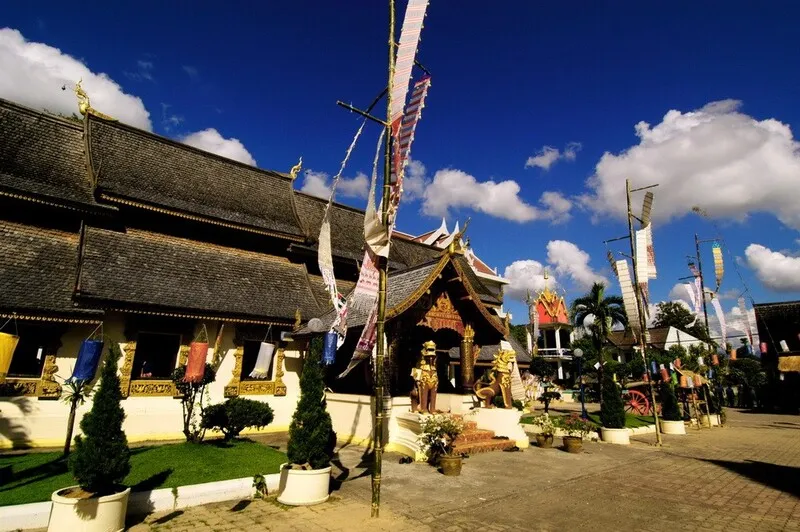
Wat Saen Mueang Ma is located in Ban Mang, Yuan Subdistrict, Chiang Kham District, Phayao Province. It is one of the most important Tai Lue cultural temples in Chiang Kham and one of the most meaningful places for travelers who want to understand the links between Phayao, Lanna, Tai Lue culture, and Sipsongpanna in southern China. The temple is known for its Tai Lue-style viharn, wooden shingle roof, carved wooden gable, naga staircase, guardian lion statues, folk mural paintings, hanging tung banners, bilingual Thai-Chinese signs, and a local museum preserving the memory of the Tai Lue community.
For travelers exploring Chiang Kham, Wat Saen Mueang Ma is not simply a beautiful temple. It is a living cultural landmark that reflects migration, settlement, faith, identity, and craftsmanship. A visit here allows travelers to pay respect to the Buddha image, admire Tai Lue architecture, study folk murals, learn about the meaning of tung banners, and understand the story of Ban Mang, a community whose name is connected with Mang village in Sipsongpanna, China.
The name of Wat Saen Mueang Ma is linked to the name of Ban Mang and the older cultural memory of Mang in Sipsongpanna. The temple was formerly known as “Wat Mang” before later becoming Wat Saen Mueang Ma. This name preserves the memory of the community’s origin and shows how local people maintained a connection with their ancestral homeland even after settling in Chiang Kham. The temple therefore stands as a cultural bridge between Tai Lue communities in Thailand and those in Sipsongpanna.
Wat Saen Mueang Ma was built in Tai Lue artistic style. It is associated with the early Rattanakosin period, and local information records that it was built in 1787. The temple received its consecrated boundary on February 3, 1951 and belongs to the Mahanikaya Buddhist order. It is currently led by Phra Khru Sunthorn Wutthisan as abbot. The temple was registered as a national historic site in 1984, confirming its value as both a community temple and an important cultural heritage site.
The viharn is the most visually striking feature of the temple. Its roof is covered with wooden shingles and descends in graceful layered forms. The low, sloping roofline gives the building a calm and elegant character that fits well with Tai Lue architecture. The roof structure, wooden details, and carved decorative elements reveal the close relationship between craftsmanship, climate, local materials, and Buddhist faith.
The front gable is decorated with carved wooden designs, including a figure of a praying deity surrounded by ornamental patterns. These carvings are not merely decorative. They represent auspicious beliefs, protection of the sacred space, and the refined skill of local artisans. The carved wooden gable is one of the reasons Wat Saen Mueang Ma is so highly valued by visitors interested in northern Thai and Tai Lue architecture.
The entrance staircase is shaped with naga forms, an important Buddhist and local symbol often associated with protection and passage into sacred space. At the side entrance, a pair of lion statues guards the doorway. The naga and lion elements together create a strong sense of sacred boundary, reminding visitors that the viharn is not only an architectural attraction but also an active religious space.
Inside the viharn, the mural paintings are among the most valuable features of the temple. These murals were created by local artisans and depict the everyday life of the Tai Lue people. Rather than focusing only on formal religious scenes, the paintings show ordination ceremonies, merit-making, Songkran water celebrations, rural life, clothing, houses, community customs, and other traditions. They serve as a visual archive of Tai Lue life in Chiang Kham.
The murals deserve slow observation. Each scene reveals how Buddhism, community life, seasonal festivals, and family traditions were woven together. Visitors can see how the temple functioned as the center of the village, how merit-making shaped social relationships, and how festivals such as Songkran reflected both joy and religious meaning. For foreign travelers, these murals are especially useful because they communicate cultural life through images rather than long explanations.
Inside the temple, visitors will also see tung banners. In Lanna and Tai Lue belief, tung banners are often offered as a way to dedicate merit to the deceased. They are believed to symbolically serve as a pathway or ladder to the heavenly realm. This belief reveals the continuing relationship between the living and the dead, between family and ancestors, and between Buddhist merit-making and community memory.
The temple’s Thai and Chinese signs are also meaningful. They reflect ongoing contact between Tai Lue communities in Thailand and those in Sipsongpanna. These signs show that the temple’s identity is not limited to a single local village. Instead, Wat Saen Mueang Ma belongs to a wider cultural network that crosses borders through language, religious practice, kinship, and memory.
The Tai Lue people originally lived in Sipsongpanna and have maintained long relationships with Lanna communities. Their language, culture, and religious practices share many similarities with Lanna traditions, while still preserving a distinct Tai Lue identity. Tai Lue communities are often found near rivers in northern Thailand, including Nan, Chiang Rai, Chiang Mai, Lampang, Lamphun, and Phayao. Chiang Kham is one of the most important Tai Lue cultural areas in Thailand.
Ban Mang in Yuan Subdistrict is important because both the village name and the temple name preserve the community’s memory of origin. Wat Saen Mueang Ma is therefore more than a religious site. It is a center of cultural memory where the name of the old homeland, the community’s ethnic identity, and Tai Lue craftsmanship are all kept alive within the present-day Thai social context.
The Ariyalangkaran Memorial Museum, established in 1991 within Wat Saen Mueang Ma, adds another layer to the visit. The museum displays objects and stories related to Tai Lue life, including traditional house models, household items, tools, and objects connected with daily necessities. It also presents materials related to the royal duties of King Rama IX, who visited Phayao Province many times. The museum helps visitors understand the temple not only as a place of worship, but also as a local learning center.
The museum grew from the efforts of former abbots who collected and preserved local objects. This shows the important role of monks and temples in protecting community memory. Without such preservation, many everyday objects and cultural details could easily disappear over time. Wat Saen Mueang Ma therefore functions as a temple, museum, archive, and cultural classroom at the same time.
Travelers interested in Tai Lue culture should also visit the Tai Lue Cultural Center at Wat Yuan, located about 500 meters north of Wat Saen Mueang Ma. The cultural center presents the history and identity of the Tai Lue people in greater detail, including migration, language, dress, houses, and traditions. Visiting both places together gives a deeper understanding of Tai Lue Chiang Kham.
Wat Saen Mueang Ma is conveniently located near Chiang Kham Bus Station, making it easier to access than many other cultural sites in the district. Travelers arriving by bus can continue by local transport or a short hired ride. Those traveling by private car can follow the Chiang Kham-Phayao road into Ban Mang, Yuan Subdistrict. Because the temple is located within a community area, it is practical to use it as a starting point for a cultural route around Chiang Kham.
Getting There from Chiang Kham town is straightforward. Head toward Ban Mang in Yuan Subdistrict near Chiang Kham Bus Station. The temple can be reached by private car, motorcycle, or local hired vehicle. From Phayao city, drive toward Chiang Kham District and continue into the municipal and Yuan Subdistrict area. Local residents know the temple well, and map navigation to Wat Saen Mueang Ma or Ban Mang is generally convenient.
Visitors should allow at least 1 hour for the temple, especially if they want to appreciate the viharn, murals, and museum. Morning is the best time to visit because the weather is cooler and natural light makes the wooden roof, carved gable, and mural details easier to see. Photographers should take time to view the viharn from the front, side, and interior to capture the full character of the Tai Lue architecture.
As Wat Saen Mueang Ma remains an active Buddhist temple, visitors should dress modestly and behave respectfully. Inside the viharn, avoid loud conversations and be mindful of people who may be praying or making merit. Photography should be done with care, especially near sacred images and museum objects. Respectful travel helps preserve the relationship between visitors and the local community.
Artistically, Wat Saen Mueang Ma is a strong example of Tai Lue and Lanna architectural blending. The wooden shingle roof, carved gable, naga staircase, lion guardians, murals, and tung banners all work together to create a distinctive sacred atmosphere. Its beauty is not based on size, but on detail, meaning, and the continuity of traditional craftsmanship.
Historically, the temple shows that Tai Lue identity is not only a matter of the past. It continues through language, ritual, art, community memory, and cross-border cultural relationships. The presence of Thai and Chinese signs reminds visitors that Tai Lue cultural connections with Sipsongpanna remain meaningful. The temple’s identity is therefore alive, not frozen as a museum object.
Wat Saen Mueang Ma can be combined with Wat Phra That Sop Waen, Wat Nantaram, the Tai Lue Cultural Center at Wat Yuan, Wat Phra Nang Din, and the 2324 Memorial Museum. Together, these sites create a strong cultural itinerary for Chiang Kham, covering Tai Lue, Tai Yai, Lanna, Buddhist devotion, wooden architecture, mural painting, and local history. For travelers with 1 day in Chiang Kham, Wat Saen Mueang Ma is one of the best places to begin.
Wat Saen Mueang Ma is therefore one of the must-visit cultural temples in Chiang Kham, Phayao Province. It brings together sacred architecture, Tai Lue identity, community memory, folk art, and local heritage in a compact and accessible setting. A visit here shows that Phayao is not only about Phayao Lake or the provincial capital, but also about the deep cultural life of communities in Chiang Kham that continue to preserve their heritage with quiet dignity.
| Name | Wat Saen Mueang Ma |
| Location | Ban Mang, Yuan Subdistrict, Chiang Kham District, Phayao Province |
| Address | 113 Ban Mang, Moo 4, Chiang Kham-Phayao Road, Yuan Subdistrict, Chiang Kham District, Phayao 56110, Thailand |
| Coordinates | Latitude 19.5217182, Longitude 100.3018187 |
| Highlights | Tai Lue-style viharn, wooden shingle roof, carved wooden gable, naga staircase, lion guardians, Tai Lue lifestyle murals, tung banners, and Wat Saen Mueang Ma Folk Museum |
| History | Associated with the early Rattanakosin period. Local information records that the temple was built in 1787, received its consecrated boundary on February 3, 1951, and was registered as a national historic site in 1984. |
| Name Origin | The name is linked to Ban Mang and Mang village in Sipsongpanna, China. The temple was formerly called Wat Mang before becoming Wat Saen Mueang Ma. |
| Distinctive Features | Tai Lue-Lanna viharn with wooden shingles, carved gable, praying deity motif, naga staircase, guardian lions, folk murals, and Thai-Chinese signs within the temple area |
| Travel Information | From Chiang Kham town, head to Ban Mang in Yuan Subdistrict near Chiang Kham Bus Station. The temple is accessible by private car, motorcycle, or local hired transport. |
| Current Status | Active Buddhist temple, Tai Lue art site, national historic site, folk museum, and community cultural learning center |
| Open Days | Daily |
| Opening Hours | 08.00 – 16.00 |
| Fees | No admission fee |
| Facilities | Parking area, worship area, viharn, folk museum, temple courtyard, and Tai Lue cultural learning area |
| Main Areas / Zones | Tai Lue-style viharn, main Buddha image, murals, tung banners, Ariyalangkaran Memorial Museum 1991, and community merit-making areas |
| Abbot / Caretaker | Phra Khru Sunthorn Wutthisan |
| Main Contact Number | 0-5445-1399, 086-118-1779 |
| Official Website / Official Page | Wat Saen Mueang Ma, Yuan Subdistrict, Chiang Kham District |
| Nearby Tourist Attractions | 1. Tai Lue Cultural Center at Wat Yuan, about 500 m 2. Wat Nantaram, about 1 km 3. Wat Phra That Sop Waen, about 2 km 4. Wat Phra Nang Din, about 4 km 5. 2324 Memorial Museum, about 5 km |
| Nearby Restaurants | 1. Live Cafe, about 2 km, Tel. 087-680-0854 2. Pa Ko Chiang Kham 1994, about 1 km 3. Kim Hiang Restaurant, about 1 km 4. Lap Mo Yo Lue Restaurant, about 2 km 5. Hotel De One Dee Cafe, about 3 km, Tel. 091-060-9928 |
| Nearby Accommodations | 1. Chiang Kham Ruk Khun Hotel, about 1 km, Tel. 097-389-8998 2. Phu View Place, about 2 km, Tel. 083-519-6445 3. Chiang Kham Grand Villa, about 3 km, Tel. 084-811-5585 4. Hotel De One Dee, about 3 km, Tel. 062-614-4964 5. I Waree Resort, about 4 km, Tel. 065-994-4191 |
Frequently Asked Questions (FAQ)
Q: Where is Wat Saen Mueang Ma located?
A: Wat Saen Mueang Ma is located in Ban Mang, Yuan Subdistrict, Chiang Kham District, Phayao Province, near Chiang Kham Bus Station.
Q: What is Wat Saen Mueang Ma known for?
A: It is known for its Tai Lue-style viharn, wooden shingle roof, carved wooden gable, naga staircase, guardian lions, Tai Lue lifestyle murals, and local folk museum.
Q: What is the origin of the temple’s name?
A: The name is linked to Ban Mang and Mang village in Sipsongpanna, China. The temple was formerly known as Wat Mang before becoming Wat Saen Mueang Ma.
Q: How is Wat Saen Mueang Ma connected with Tai Lue culture?
A: The temple was built in Tai Lue artistic style and preserves Tai Lue identity through architecture, murals, Thai-Chinese signs, tung banners, and community heritage displays.
Q: What are the opening hours of Wat Saen Mueang Ma?
A: The temple is open daily from 08.00 to 16.00.
Q: Is there an admission fee?
A: No. There is no admission fee for visiting the temple.
Q: Is there a museum inside Wat Saen Mueang Ma?
A: Yes. The Ariyalangkaran Memorial Museum 1991, also known as Wat Saen Mueang Ma Folk Museum, displays objects and stories related to Tai Lue life and local community heritage.
Q: What nearby attractions can be visited with Wat Saen Mueang Ma?
A: Nearby attractions include the Tai Lue Cultural Center at Wat Yuan, Wat Nantaram, Wat Phra That Sop Waen, Wat Phra Nang Din, and the 2324 Memorial Museum.
Tel : 054451399
 Tel : 054451399
 Category: ●Places of Worship
 Group: ●Temple
Last Update : 5 MonthAgo
 Last Update : 5 MonthAgo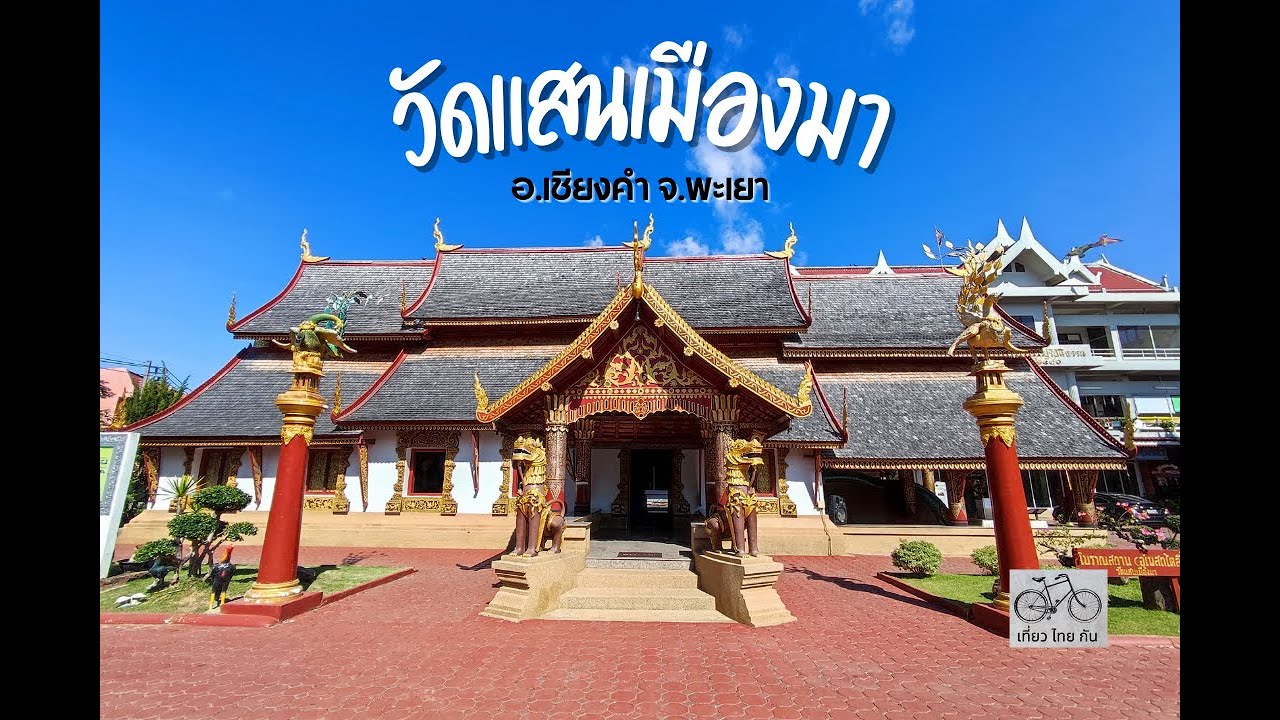
 Click to Access the Navigation Map GPS
Wat Saen Mueang Ma Map
Recommend

 Art, Culture and Heritage
 Historical Sites and Monuments(4)
 Landmarks and Memorials(4)
 Art, Craft Centres, Tradition(1)
 Museums(2)
Temple(39)
Museums(2)
Temple(39)
 Other Sacred Sites(5)
 Research and Development
 Royal Project(1)
 Suburban Living
 Village, Community(2)
 Local Market(4)
 Nature and Wildlife
 National Parks and Marine Reserves(7)
 Mountain (Doi)(2)
 Dam, Reservoir, Lake(11)
 Waterfalls(8)
 Caves(5)
 River, Canal(3)
 Other natural attractions(5)
 Travel Articles, Recipes
 Travel Review, Food Review(1)


