
lovethailand home >North Travel Attractions >Phayao Travel Attractions >Muang Phayao >Ban Tun > Ban Dok Bua Community
TL;DR: Ban Dok Bua Community is located at Village No. 4, Ban Tun Subdistrict, Mueang Phayao District, Phayao Province, open Daily, hours Daytime Visits Recommended; Advance Contact Is Recommended For Study Visits Or.

Ban Dok Bua Community
Open Days: Daily
Opening Hours: Daytime Visits Recommended; Advance Contact Is Recommended For Study Visits Or Homestay Stays
Ban Dok Bua Community in Phayao Province, also widely referred to as Ban Bua, is a model community in Ban Tun Subdistrict, Mueang Phayao District. It is especially well known as a successful bamboo basket weaving village, producing bamboo baskets and related handicrafts that are sold across northern Thailand and distributed to several areas in central Thailand. What makes Ban Dok Bua remarkable is not only the volume of its basket production, but also the way the community has planned its natural resources, occupational groups, learning bases, and tourism activities in a systematic and sustainable manner.
The success of Ban Dok Bua is rooted in bamboo. Local people have planted and managed bamboo areas to support their basket-weaving occupation, with around 500 rai of bamboo serving as an important raw-material base. This planned approach gives the community a stable supply of bamboo, reduces dependence on outside sources, helps control production costs, and supports household livelihoods. As a result, Ban Dok Bua has become a strong example of how a rural community can use local resources, traditional skills, and collective management to build a resilient community economy.
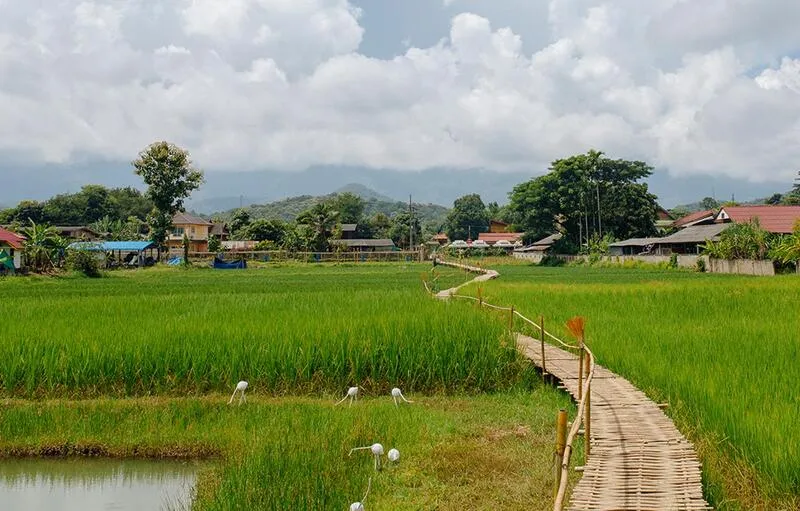
Ban Dok Bua is located in Village No. 4, Ban Tun Subdistrict, Mueang Phayao District, not far from Phayao city and major nearby attractions such as Wat Analayo Thipphayaram, Kwan Phayao, and other cultural destinations around the provincial center. This convenient location makes it suitable for half-day community visits, educational study trips, and homestay experiences. The charm of the village lies in its simple atmosphere, rural houses, bamboo areas, farmland, local craft activities, and people who continue to preserve community-based ways of working.
Ban Dok Bua is recognized as a sufficiency economy model village and a community learning destination. Its strength has been developed over many years through organic farming, water management, forest conservation, bamboo planting, bamboo-weaving occupational groups, learning bases, homestay management, and the ability to receive study groups from different parts of the country. The village is therefore not only a place where bamboo baskets are made; it is a community learning center where visitors can understand how rural development, natural resources, local wisdom, and tourism are connected.
The core of the community’s identity is its ability to turn local resources into value. Bamboo has long been part of Thai rural life. It can be used for houses, tools, containers, fences, household objects, and handicrafts. At Ban Dok Bua, bamboo is not used casually or without planning. It has become the foundation of a community occupation. Local bamboo supports the production of baskets, chicken coops, containers, furniture, household items, and adapted bamboo products. The bamboo forest of around 500 rai therefore represents natural capital, economic capital, and cultural capital at the same time.
The bamboo baskets of Ban Dok Bua reflect local craftsmanship that has been developed to meet real market demand. Bamboo baskets are widely used in agriculture and trade, especially for carrying vegetables, fruits, field crops, and other products. Their strengths are durability, ventilation, light weight, and the fact that they are made from natural materials. Local artisans use skills such as splitting bamboo, shaving strips, preparing weaving materials, shaping the basket, forming the structure, reinforcing the rim, and checking the strength of each product before it is used or sold.
The basket-making process begins with selecting suitable bamboo. The bamboo must be mature enough to be strong, but not too old and brittle. It is then cut, split, shaved, and prepared into strips of the right size. This stage requires experience because good bamboo strips must be even, flexible, and resistant to cracking. Once the strips are ready, artisans shape the basket, weave the pattern, strengthen the rim, and finish the product. Every step reflects patience, hand skill, and an understanding of the material.
Bamboo weaving in Ban Dok Bua combines individual craftsmanship with a community production system. Elderly villagers can contribute through tasks that require experience, younger people can learn and assist in certain stages, and both men and women take part according to their skills. Basket weaving is therefore not just a craft; it is a household-based economic system that connects different generations. When orders come in, the community can use local labor, knowledge, and raw materials to respond flexibly.
The success of Ban Dok Bua comes from long-term thinking. Planting bamboo to support the basket-weaving occupation shows that the community has planned its raw materials in advance rather than relying only on harvesting from natural forests. This approach reduces pressure on the environment, helps maintain the resource base, and gives the community a continuous supply of materials. It also reflects the principles of the sufficiency economy: moderation, reasonableness, resilience, knowledge, and ethics in daily life and community development.
Ban Dok Bua is also a popular study-visit destination for government agencies, educational institutions, community groups, and travelers interested in local development. The village offers several learning bases, such as bamboo basket weaving, organic farming, water management, forest conservation, organic rice production, and homestay management. Visitors can learn about the community as a whole, from natural resources and household occupations to culture, local economy, tourism, and collective management.
The community learning center serves as a central point for welcoming tourists and study groups. Activities and learning bases can be arranged according to the type of visitors, including Thai travelers, international guests, students, and community development groups. Those interested in bamboo weaving can observe the basket-making process and bamboo product production. Those interested in the sufficiency economy can learn about resource management. Travelers who want to experience local life can stay in homestays, walk through the village, and enjoy local food according to the activities prepared by the community.
A visit to Ban Dok Bua allows travelers to see a real model community rather than simply reading about one in a report. Walking through the village, visitors may notice many elements that make the community strong: houses connected to agricultural areas, streams and natural spaces, bamboo groves as raw-material sources, household-based weaving activities, homestay groups, and local residents who are proud to explain the story of their village. These details help visitors understand how community development works in everyday life.
The history of Ban Bua includes local stories about early settlement. The area was once forested, and early families moved in to build homes, farm, and raise animals because the land was fertile and suitable for living. The name “Ban Bua” is connected with local memory and early residents, and it has continued to be used as the village name. Although some details belong to oral tradition, the story reflects the relationship between people, forest, water sources, and settlement in the past.
Ban Dok Bua has a landscape that is suitable for learning about coexistence with nature. The community includes forest areas, rice fields, streams, and agricultural land. Villagers have developed water-management and forest-restoration practices over time. These efforts have helped the village become known as a community that applies the sufficiency economy in practical ways. The bamboo groves are not only a raw-material source for weaving, but also help retain moisture, reduce soil erosion, and support the local ecosystem.
Planting bamboo to support basket weaving is a strong example of renewable resource management. Bamboo grows quickly, produces new shoots continuously, and can be used in many ways. With proper cutting and replanting, bamboo can serve as a sustainable material. Ban Dok Bua shows how a community can turn a natural resource into income without destroying its resource base. This is one of the reasons the village is often discussed as a model for sustainable local development.
In addition to practical baskets, local artisans have developed bamboo weaving into many other forms, such as baskets, household items, souvenirs, and adapted bamboo products. This adaptation is important because the traditional market for bamboo baskets may change as transport systems and modern packaging evolve. By developing souvenirs and contemporary bamboo products, the community can preserve its weaving knowledge while creating new opportunities for younger generations in design, marketing, and storytelling.
Ban Dok Bua is therefore a community that combines traditional wisdom with modern adaptation. Basket weaving remains a strong foundation, but community development has expanded into homestays, educational tourism, group activities, and the identity of being a sufficiency economy model village. These developments help diversify income and give visitors more reasons to come, learn, stay, and support local products.
As a tourism destination, Ban Dok Bua is best suited for travelers who enjoy community learning, handicrafts, sustainable development, and local ways of life. It is not designed as an entertainment attraction or a large commercial destination. Its atmosphere is simple, peaceful, and authentic. Visitors can walk through the village, observe bamboo weaving, talk with local residents, learn about bamboo use, and stay in homestays to experience rural Phayao more closely.
Staying in a homestay at Ban Bua is one of the best ways to understand the community in depth. A homestay is not only a place to sleep; it is an entry point into local life. Guests may experience local food, conversations with host families, walks through agricultural areas, weaving demonstrations, and the quiet rhythm of the village. This type of stay is especially suitable for study groups, families, students, and travelers who want a meaningful community-based travel experience.
Ban Bua Homestay has been associated with community-based accommodation for tourists and study groups. Public information indicates that the community has several homestay houses and can welcome group travelers. Staying in the village allows the visit to be less rushed because guests can experience the evening and morning atmosphere of the community. It also helps distribute income directly to households, making tourism more beneficial to local residents than a short stopover.
One of the main activities in Ban Dok Bua is learning about bamboo basket weaving. Visitors can observe the steps from bamboo preparation and strip-making to weaving, shaping, and finishing. Study groups may be able to join hands-on activities or speak with local craftspeople depending on the program arranged by the community. This activity is particularly valuable for those who want to understand the relationship between natural materials and human skill.
Another important learning theme is organic farming and community resource management. Ban Dok Bua is also known for organic rice and sufficiency-based ways of life. Walking through agricultural areas helps visitors see that bamboo weaving is not separate from farming; both are part of the household economy. During the rice-growing season, visitors may see active agricultural life in the fields. Outside the main farming season, bamboo weaving becomes especially important as an additional source of income.
Ban Dok Bua is also interesting for its community organization. Many study groups come to learn how a modest-sized village became nationally recognized. The answer lies in community leadership, participation, resource planning, occupational groups, visitor management, and learning from real experience. A strong community does not depend only on natural resources; it also needs cooperation systems that allow those resources to be used effectively and fairly.
Culturally, Ban Dok Bua reflects a northern Thai rural way of life connected with rice, bamboo, water, forest, and household work. Bamboo weaving is not only an occupation but also a culture of hand skill, patience, and careful attention. When family members weave baskets or produce bamboo items together, knowledge is passed on through practice. Children and younger people may begin by helping with simple tasks before learning more complex skills. Preserving bamboo weaving therefore means preserving knowledge held in the hands of local people.
For general travelers, Ban Dok Bua can be arranged as a convenient half-day trip from Phayao city. Visitors can travel to the community in the morning, visit the weaving base and learning center, stop for food or drinks in a local cafe, and then continue to Wat Analayo Thipphayaram, Kwan Phayao, Wat Si Khom Kham, or other attractions in the provincial center. This route is suitable for travelers who want a short trip near the city but with meaningful community, culture, and nature content.
For a full-day itinerary, visitors can begin at Ban Dok Bua in the morning and spend more time learning about weaving and community life. After that, they can stop at a local cafe or restaurant in Ban Tun, then visit Wat Analayo Thipphayaram in the afternoon to see Buddhist architecture and views toward Kwan Phayao. The day can end with sunset at Kwan Phayao in the city. This route offers three dimensions of Phayao: a model community, a religious site, and the lakeside landscape.
Visitors who want to arrange a study trip or homestay should contact the community in advance. Community activities and learning bases require preparation, including local speakers, demonstration areas, food, host families, and activity schedules. Group travelers should inform the community about the number of participants, objectives, duration, and desired topics, such as bamboo basket weaving, sufficiency economy, organic farming, homestay management, or natural resource management. Advance contact helps the community prepare properly and gives visitors the best experience.
Getting There is most convenient by private car, rental car, or local hired vehicle. From Phayao city, head toward Ban Tun Subdistrict. The distance is not far compared with attractions in outer districts, making Ban Dok Bua suitable for a half-day trip. Travelers without private transport can use local transport from Phayao city, but should check the route and schedule in advance, especially if they plan to visit learning bases inside the village or stay overnight.
The route to Ban Dok Bua can be connected with several nearby attractions. Wat Analayo Thipphayaram is one of the most important nearby sites, suitable for worship and panoramic views of Kwan Phayao. Kwan Phayao is the province’s major lakeside landmark, while Wat Si Khom Kham is an important temple in Phayao city. When these places are combined in one itinerary, Ban Dok Bua becomes a community-learning stop that enriches the overall Phayao travel experience.
Restaurants and cafes in the Ban Tun area make community travel more convenient. Baan Ton Tao Coffee & Food at Ban Bua is one of the publicly listed places located in the community, offering a natural atmosphere suitable for a rest stop, drinks, food, and a village setting. Other cafes and local restaurants are available in Ban Tun and near Kwan Phayao, allowing travelers to choose according to their schedule and route.
Accommodation options include community homestays and hotels in Phayao city. For travelers who want to learn about Ban Dok Bua closely, Ban Bua Homestay is a suitable choice because it is located within the community and directly connected with local learning activities. Travelers who prefer hotel-style comfort can stay in Phayao city, such as Baanmagrood Phayao, Phayao Northern Lake Hotel, M2 Hotel Waterside, or B2 Phayao Boutique & Budget Hotel, and visit Ban Dok Bua as a day trip.
Buying bamboo products from Ban Dok Bua is a direct way to support the community. Visitors may find bamboo baskets, containers, household items, or souvenirs depending on availability. Each product reflects local materials and the hand skill of villagers. Purchasing from the community is therefore not only about taking home a souvenir; it helps support the market for bamboo weaving and encourages the continuation of local wisdom.
Visitors who take photographs or create travel content should be respectful. Ban Dok Bua is a real living community, not only a staged tourist site. Ask permission before photographing people, houses, or close-up production processes. Respect local working time and avoid disturbing household activities. Good community tourism must balance visitor learning with the privacy and dignity of local residents.
The best time to visit is during the daytime, especially from morning to afternoon, when it is easier to visit learning bases, walk through the village, and take photographs. Those who want to see bamboo weaving activities should contact the community in advance because production schedules may depend on orders, farming seasons, and local activities. Homestay visitors should also make arrangements before arrival so that the community can prepare accommodation, meals, and activities properly.
Useful items to bring include comfortable walking shoes, a hat or umbrella, a camera, a cloth bag for local products, and cash for community purchases or services. Some local shops or community services may not support all payment methods. Group visitors should coordinate meals, drinking water, and activity details in advance to make the visit smooth.
Ban Dok Bua is a good example of tourism that offers more than scenery. Visitors do not come only to see a peaceful village or buy souvenirs; they learn how a community uses local resources, builds occupations, manages the environment, and improves quality of life. The charm of Ban Dok Bua lies in the process behind its success, from planting around 500 rai of bamboo and weaving baskets to organizing occupational groups, homestays, and learning programs for visitors from across the country.
Culturally, Ban Dok Bua shows that local wisdom remains valuable in the modern world. Even with modern packaging and industrial materials, bamboo weaving still has meaning as a natural, practical, and environmentally friendly craft. With appropriate design and marketing, bamboo products can serve as household items, souvenirs, community products, and storytelling tools for the village at the same time.
For Phayao Province, Ban Dok Bua represents an aspect of tourism that should not be overlooked. Phayao is not only about Kwan Phayao, temples, or mountain scenery; it also has model communities where daily life and local wisdom are the main attractions. Visiting this village reveals Phayao through the lens of self-reliance, development, and coexistence with nature. It is a suitable route for travelers who want meaningful experiences and a deeper understanding of local communities.
In summary, Ban Dok Bua Community is an important bamboo basket weaving and handicraft village in Phayao Province. It is a sufficiency economy model community, a study-visit destination, and a community-based tourism site with strong content in occupation, culture, nature, and local management. Visitors can see how a small village has become nationally recognized by using a familiar resource such as bamboo and by working together systematically. This makes Ban Dok Bua a valuable destination for anyone interested in community tourism, local wisdom, and sustainable development in northern Thailand.
| Name | Ban Dok Bua Community, also known as Ban Bua |
| Location | Village No. 4, Ban Tun Subdistrict, Mueang Phayao District, Phayao Province |
| Address | Ban Bua, Village No. 4, Ban Tun Subdistrict, Mueang Phayao District, Phayao 56000, Thailand |
| Highlights | Important bamboo basket weaving village of Phayao, sufficiency economy model community, study-visit destination, and community homestay area |
| History / Background | Ban Bua developed from an agricultural and bamboo-weaving village into a nationally recognized sufficiency economy model community known for bamboo baskets and community learning bases |
| Name Origin | The name Ban Bua is connected with local settlement stories and has been used as the village name. Ban Dok Bua is commonly used in tourism and community-learning contexts |
| Distinctive Features | Around 500 rai of bamboo planted as raw material for weaving baskets, chicken coops, containers, bamboo household items, adapted products, and sufficiency economy learning bases |
| Recommended Activities | Watch bamboo basket weaving, learn bamboo handicraft skills, study sufficiency economy practices, explore organic farming, stay in a homestay, buy community products, and walk through the village |
| Travel Information | From Phayao city, head toward Ban Tun Subdistrict. Private car, rental car, or local hired vehicle is convenient. The community can be visited as a half-day trip and combined with Wat Analayo Thipphayaram and Kwan Phayao |
| Current Status | A model community, sufficiency economy learning center, bamboo handicraft production area, and community-based tourism destination for study groups and visitors |
| Open Days | Daily |
| Opening Hours | Daytime Visits Recommended; Advance Contact Is Recommended For Study Visits Or Homestay Stays |
| Fees | No general admission fee announcement found. Activity, study-visit, meal, or homestay costs should be checked with the community in advance |
| Facilities | Community learning center, bamboo weaving learning base, homestays, local cafe or food services, bamboo products, and areas for study groups by advance arrangement |
| Main Areas / Zones | Community learning center, bamboo basket weaving base, bamboo groves, organic farming areas, homestay houses, village houses, and local product sales points |
| Caretaker / Related Agencies | Ban Bua Community, Village No. 4, Ban Tun Subdistrict, together with bamboo weaving occupational groups, homestay groups, and Ban Tun Subdistrict Administrative Organization |
| Main Contact Number | Ban Tun Subdistrict Administrative Organization, Tel. 054-423-098 / Ban Bua Homestay, Tel. 081-950-5430, 053-717-952 |
| Official / Reliable Sources | Thailand Tourism Directory, Princess Maha Chakri Sirindhorn Anthropology Centre, Phayao provincial agencies, Ban Tun Subdistrict Administrative Organization, and community learning databases |
| Nearby Tourist Attractions | 1. Wat Analayo Thipphayaram, about 5 km 2. Kwan Phayao, about 10 km 3. Wat Si Khom Kham, about 11 km 4. Pho Khun Ngam Mueang Monument, about 11 km 5. Kwan Phayao Walking Street, about 11 km 6. Wat Tilok Aram In Kwan Phayao, about 12 km |
| Nearby Restaurants | 1. Baan Ton Tao Coffee & Food At Ban Bua, about 0 km, Tel. 094-719-2653 2. Ton Bua CAFE, about 3 km, Tel. 063-114-7984 3. Ban Bua Community Kitchen / Local Food Service, about 0 km 4. Local Restaurants In Ban Tun Subdistrict, about 3 km 5. Lakeside Restaurants Around Kwan Phayao, about 10 km |
| Nearby Accommodations | 1. Ban Bua Homestay, about 0 km, Tel. 081-950-5430, 053-717-952 2. Baan Ton Tao Homestay / Ban Bua Community Stay, about 0 km 3. Baanmagrood Phayao, about 11 km, Tel. 061-578-4771 4. Phayao Northern Lake Hotel, about 11 km, Tel. 054-411-123 5. M2 Hotel Waterside, about 12 km, Tel. 054-070-587 6. B2 Phayao Boutique & Budget Hotel, about 14 km, Tel. 054-070-070, 1328 |
Frequently Asked Questions (FAQ)
Q: Where is Ban Dok Bua Community located?
A: Ban Dok Bua Community, also known as Ban Bua, is located in Village No. 4, Ban Tun Subdistrict, Mueang Phayao District, Phayao Province. It is a model community and a well-known bamboo basket weaving village.
Q: What is Ban Dok Bua famous for?
A: The community is famous for bamboo basket weaving, bamboo handicrafts, around 500 rai of bamboo planted as raw material, and its role as a sufficiency economy model village that welcomes study groups.
Q: What can visitors do at Ban Dok Bua?
A: Visitors can watch bamboo basket weaving, learn about bamboo handicrafts, study sufficiency economy practices, explore organic farming, stay in a homestay, buy community products, and walk through the village.
Q: When can visitors go to Ban Dok Bua?
A: Visitors can go daily during the daytime. Advance contact is recommended for study visits, group activities, and homestay stays.
Q: Is homestay accommodation available in Ban Dok Bua?
A: Yes. Community homestays are available for tourists and study groups. Visitors should contact Ban Bua Homestay in advance to check rooms, activities, meals, and conditions.
Q: Is Ban Dok Bua suitable for study visits?
A: Yes. The community is highly suitable for study visits because it has learning bases on bamboo basket weaving, sufficiency economy, organic farming, bamboo resource management, homestays, and community organization.
Q: How do travelers get to Ban Dok Bua?
A: From Phayao city, travel toward Ban Tun Subdistrict by private car, rental car, or local hired vehicle. The distance is suitable for a half-day trip and can be combined with Wat Analayo Thipphayaram and Kwan Phayao.
Q: What nearby attractions can be visited after Ban Dok Bua?
A: Nearby attractions include Wat Analayo Thipphayaram, Kwan Phayao, Wat Si Khom Kham, Pho Khun Ngam Mueang Monument, Kwan Phayao Walking Street, and Wat Tilok Aram in Kwan Phayao.
 Category: ●Suburban Living
 Group: ●Village, Community
Last Update : 4 MonthAgo
 Last Update : 4 MonthAgo
 Click to Access the Navigation Map GPS
Ban Dok Bua Community Map
Recommend

 Art, Culture and Heritage
 Historical Sites and Monuments(4)
 Landmarks and Memorials(4)
 Art, Craft Centres, Tradition(1)
 Museums(2)
 Places of Worship
 Temple(39)
 Other Sacred Sites(5)
 Research and Development
 Royal Project(1)
Village, Community(2)
Royal Project(1)
Village, Community(2)
 Local Market(4)
 Nature and Wildlife
 National Parks and Marine Reserves(6)
 Mountain (Doi)(2)
 Dam, Reservoir, Lake(11)
 Waterfalls(8)
 Caves(5)
 River, Canal(3)
 Other natural attractions(5)


