
lovethailand home >North Travel Attractions >Phayao Travel Attractions >Chiang Muan >Ban Mang > Phra That Phu Po
TL;DR: Phra That Phu Po is located at Ban Nong Klang, Village No. 7, Ban Mang Subdistrict, Chiang Muan District, Phayao Province, open Daily, hours Daytime Visits Recommended.

Phra That Phu Po
Open Days: Daily
Opening Hours: Daytime Visits Recommended
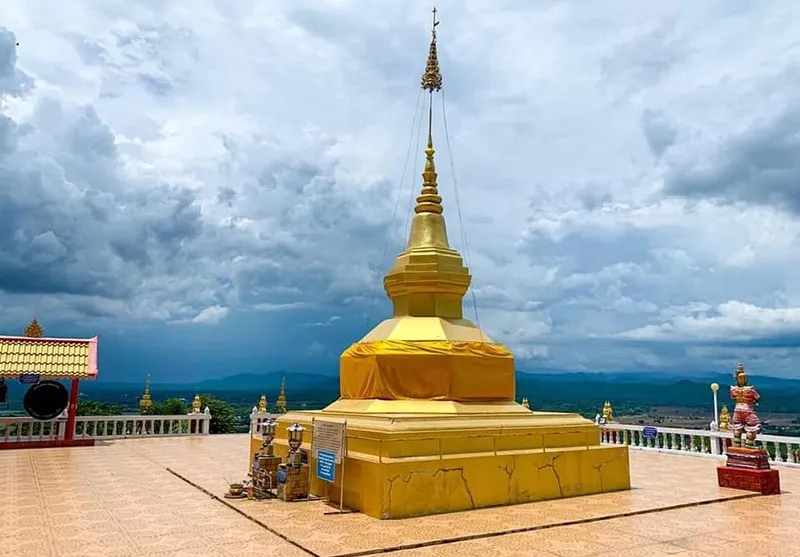
Phra That Phu Po in Phayao Province is an important Buddhist site in Chiang Muan District, located in Ban Nong Klang, Village No. 7, Ban Mang Subdistrict, Chiang Muan District, Phayao Province. The site stands on an elevated hill with a peaceful atmosphere and wide views over the surrounding landscape. It is regarded as one of the significant sacred landmarks of Chiang Muan, combining local Buddhist legend, community faith, hilltop scenery, and the quiet character of a rural northern Thai religious site.
Phra That Phu Po is suitable for travelers who want to pay respect to a sacred stupa, enjoy a panoramic viewpoint, and learn about a local legend connected with Buddhism in the Lanna cultural area. Its value does not lie only in the stupa itself, but also in the story behind the name “Phu Po,” the rural access route, the Buddhist sculptures around the site, and the calm atmosphere that reflects the faith of the local community. For visitors looking for a less crowded cultural destination in Phayao, this site offers a meaningful experience away from the main tourist routes.
The site is located in Ban Nong Klang, Village No. 7, Ban Mang Subdistrict, Chiang Muan District. The access route includes an unpaved road branching from the Ban Pong Sanuk–Ban Nong Klang road for about 1.5 km. For this reason, the most convenient way to visit is by private car, pickup truck, or a vehicle suitable for rural road conditions. During the rainy season, travelers should check the road condition before visiting, as the unpaved section may become slippery or difficult for some vehicles. In the cool and dry seasons, the route is generally more convenient and well suited to a hilltop visit during the morning or late afternoon.
According to local legend, the Buddha once traveled to this hill while spreading Buddhism in the area. Villagers, filled with faith, brought offerings and daily-use items to present to him. Among all the offerings, betel leaves were brought in especially large quantities until they formed a mound like a hill. The Buddha then said, “That is enough betel leaves,” which in the local northern dialect was remembered as “Pu Po Laeo,” meaning “the betel leaves are enough.” This phrase later became associated with the name “Phu Po,” and the sacred site became known as Phra That Phu Po.
The legend of “Pu Po Laeo” is central to the identity of Phra That Phu Po. It turns the site from a simple hilltop religious place into a cultural landscape where Buddhism, local language, and community memory come together. In Thai and Lanna culture, betel leaves have long been associated with welcome, respect, ritual, and hospitality. The image of villagers offering a large amount of betel leaves therefore reflects a form of community devotion based on familiar local objects rather than expensive offerings. This gives the legend a simple but powerful emotional quality.
The name “Phra That Phu Po” can be understood on two levels. On one level, it identifies a sacred site located on a hill. On another level, it preserves a phrase from the local northern dialect within the memory of the community. The words “Pu Po” or “enough betel leaves” may sound simple, but they carry deep cultural meaning. They connect faith, local speech, and oral tradition. Travelers who understand this story will see Phra That Phu Po as more than a viewpoint or photo spot; they will recognize it as a place where community identity has been preserved through legend.
Phra That Phu Po is considered a sacred landmark of Chiang Muan District and a spiritual center for local residents, especially communities in Ban Mang Subdistrict and nearby villages. Its importance does not depend only on age or physical structures, but also on the continued faith, maintenance, and religious activities associated with the site. It is part of the sacred landscape of Chiang Muan, a district known for its mountains, rural communities, Buddhist sites, and natural attractions. The stupa therefore plays both religious and cultural roles in the local area.
The area around Phra That Phu Po has the stupa as its spiritual center and includes many Buddhist sculptures and religious elements. Visitors may see Buddha images, guardian figures, celestial figures, devotional sculptures, and statues connected with Buddhist faith in northern Thailand. These elements create a strong visual impression and help communicate the story of faith to visitors. The overall atmosphere is more elaborate than a simple hilltop shrine, making Phra That Phu Po a recognizable landmark of Chiang Muan in recent years.
Another distinctive feature of Phra That Phu Po is its elevated location. From the hilltop area, visitors can look out over Chiang Muan and the surrounding landscape. The open space allows for wide views, fresh air, and a quiet setting suitable for reflection. In some seasons, especially cool-season mornings, mist may cover the lower landscape and surrounding hills, creating a peaceful scene. This combination of natural beauty and religious atmosphere is one of the reasons the site is meaningful for both pilgrims and cultural travelers.
Upon reaching the site, visitors can sense the contrast between the rural approach road and the open religious space at the top. The 1.5 km unpaved road from the Ban Pong Sanuk–Ban Nong Klang road creates a gradual transition from village life to a sacred hilltop area. In northern Thai Buddhist culture, ascending a hill or mountain to reach a sacred site often has symbolic meaning. It can suggest spiritual elevation, effort, and movement toward a place of merit and reverence.
Phra That Phu Po is identified in learning-resource information as a Buddhist monastic site, with Luang Pho Lek Kantawilo listed as the abbot or religious caretaker. His role is important in the care and development of the hilltop Buddhist area. The presence of Buddhist images, sculptures, and devotional spaces reflects continuing faith and modern community support. Visitors therefore encounter not only a legend from the past, but also an active religious site shaped by present-day devotion and caretaking.
The role of Luang Pho Lek Kantawilo is closely connected with the current appearance of Phra That Phu Po. The hilltop area has developed into a visible Buddhist landmark with many religious features, including Buddha images, sculptures, and spaces for worship. This development shows that Phra That Phu Po is not a forgotten legend or an abandoned site. It remains a living place of faith, cared for by religious leadership, local residents, and visitors who continue to travel there for merit-making and worship.
For travelers interested in temples and Buddhist places, Phra That Phu Po offers a different experience from temples in Phayao city. It has the character of a hilltop stupa within a rural community, with a more natural and local access route than fully developed tourist attractions. Visitors should prepare carefully, especially regarding transportation and weather. At the same time, this less-commercial atmosphere is part of the site’s charm. It gives travelers a stronger sense of local authenticity and community-based faith.
Within the broader context of Phayao Province, Phra That Phu Po expands the image of Phayao beyond its well-known city attractions such as Kwan Phayao, Wat Si Khom Kham, and temples in the provincial center. Chiang Muan District presents another side of the province: mountains, forests, rural settlements, local legends, and sacred hilltop places. Phra That Phu Po helps travelers see Phayao as a province with cultural depth outside the main urban route.
In terms of local history, Phra That Phu Po reflects how a community gives sacred meaning to a landscape. The story of the Buddha traveling to this hill belongs to local Buddhist tradition and devotional memory. Even when such legends are not read in the same way as official historical documents, they are highly valuable as intangible cultural heritage. They show how local people interpret a mountain, connect it to Buddhism, and pass that meaning from one generation to the next. Through repeated storytelling, an ordinary hill becomes a sacred hill.
The role of betel leaves in the legend also connects Phra That Phu Po with traditional Thai and Lanna lifestyles. In earlier times, betel leaves were widely used in daily life, hospitality, ceremonies, and acts of respect. The story of villagers offering so many betel leaves that they formed a hill therefore suggests abundance, collective devotion, and the use of everyday local objects as sacred offerings. The beauty of the legend is that it does not depend on precious treasures, but on something familiar and meaningful in village life.
The atmosphere at Phra That Phu Po is best experienced slowly. Visitors can begin by paying respect at the stupa, then walk around to observe the Buddhist sculptures, guardian figures, Buddha images, and other religious elements. After that, they can find a viewpoint overlooking the surrounding landscape. This kind of visit allows travelers to appreciate both the spiritual and scenic dimensions of the site. Morning and late-afternoon light can make the stupa, sculptures, and hilltop views especially attractive for cultural and landscape photography.
Although Phra That Phu Po is visually interesting and photogenic, visitors should remember that it is first and foremost a religious site. Dress respectfully, behave calmly, avoid climbing on the stupa or sculptures, do not disturb monks or worshippers, do not litter, and do not move or touch sacred objects inappropriately. This is a sacred place for the local community, not only a tourist viewpoint. Respectful travel helps preserve the atmosphere and value of the site.
The most suitable time to visit is during the daytime, especially in the morning or late afternoon. Because the access route includes an unpaved section and the site is located on a hill, it is safer to travel when visibility is good. Daytime visits also allow travelers to enjoy the viewpoint and take photographs more easily. During the rainy season, avoid visiting after heavy rain if road conditions are uncertain. During the cool season, the weather is more pleasant and the hilltop atmosphere is especially suitable for worship, sightseeing, and photography.
Getting There is most convenient by private car, pickup truck, or a vehicle suitable for rural roads. From Chiang Muan District, travel toward Ban Pong Sanuk and Ban Nong Klang, then continue along the unpaved access road for about 1.5 km to the Phra That area. From Phayao city, visitors should allow enough time because Chiang Muan is located some distance from the provincial center. A day trip is possible, but it is best to leave early and combine the visit with nearby attractions in Chiang Muan to make the journey worthwhile.
Travelers without a private vehicle may need to take public or local transport to Chiang Muan District and then hire local transport to the site. Arranging local transport in advance is recommended because Phra That Phu Po is not located directly on a main road and the final access includes an unpaved section. If the plan includes several attractions such as Kaeng Luang Dinosaur Forest Park, Doi Phu Nang National Park, Than Sawan Waterfall, or Ban Nong Klang community areas, hiring a vehicle or using a private car will make the trip more efficient.
The surrounding area of Chiang Muan offers several attractions that can be combined with Phra That Phu Po. Kaeng Luang Dinosaur Forest Park is known as a geological and fossil-related learning site. Doi Phu Nang National Park is suitable for nature lovers, while Than Sawan Waterfall offers a refreshing natural stop. Ban Nong Klang and nearby communities provide a glimpse of local life. Combining these places with Phra That Phu Po creates a route that includes faith, nature, geology, and community-based travel.
Kaeng Luang Dinosaur Forest Park is a good stop for families and travelers interested in natural history. Chiang Muan is known for fossil discoveries and geological stories that differ from many other tourist areas. When paired with Phra That Phu Po, the route offers both cultural and natural learning. Children and young travelers can learn about Buddhism, local legend, and natural science within the same trip.
Doi Phu Nang National Park and Than Sawan Waterfall are ideal for extending the journey from a sacred Buddhist site into nature. Doi Phu Nang features mountains, forested landscapes, and nature routes, while Than Sawan Waterfall provides a cool and shady place to rest. With a full day in Chiang Muan, travelers can visit Phra That Phu Po in the morning and continue to natural attractions later in the day, creating a balanced itinerary that is not too rushed.
Stopping at local restaurants in Chiang Muan after visiting Phra That Phu Po can make the journey more complete. Local dining options include Thai restaurants, coffee shops, and casual community eateries. Examples include Aun Ruean Restaurant, which has publicly available tourism and contact information, PunThai Coffee Chiang Muan, Huean Muan Suan Hug, Jungle Cafe Chiang Muan Branch, and local eateries such as Lab Lam Chiang Muan. Choosing local restaurants also supports the community economy and gives travelers a more direct connection with the area.
Accommodation in Chiang Muan includes small hotels, resorts, homestays, and budget-friendly local stays. These options are suitable for travelers who want to stay overnight and explore Chiang Muan without rushing. Examples include P&P House Hotel Chiang Muan, Dee Tor Jai Resort, Suan Siri Homestay, and other local accommodations in the district. Staying overnight makes it easier to visit Phra That Phu Po in the morning or during good light, while also allowing more time for nearby natural and cultural attractions.
For a one-day trip from Phayao city, it is best to leave early in the morning and head directly toward Chiang Muan. Visit Phra That Phu Po first, spending about 1–2 hours for worship, photography, and scenic views. After descending, have lunch in Chiang Muan town or at a local restaurant, then continue to Kaeng Luang Dinosaur Forest Park or Than Sawan Waterfall in the afternoon before returning. This route suits travelers with limited time who still want to experience both a sacred site and nature.
For a 2-day, 1-night itinerary, the trip can be more relaxed. On the first day, travelers may arrive in Chiang Muan late in the morning, visit local attractions, have lunch, and go up to Phra That Phu Po in the late afternoon for views and softer light. After staying overnight in Chiang Muan, the second day can include Doi Phu Nang National Park, Than Sawan Waterfall, or nearby communities before returning. This plan is better for travelers who want a deeper experience of Chiang Muan.
Visitors should prepare drinking water, a hat, an umbrella, suitable walking shoes, and a vehicle ready for rural road conditions. During the rainy season, check the weather and avoid hill access after heavy rain. Elderly visitors and children should be accompanied closely because the site is on a hill and some walking areas may be uneven. Good preparation will make the visit safer and more comfortable.
For photographers and travel-content creators, Phra That Phu Po offers many visual angles: the hilltop stupa, lines of Buddhist sculptures, guardian figures, Buddha images, the wide view of Chiang Muan, and the rural road leading to the sacred site. Photography should be done respectfully. Avoid inappropriate poses, do not disturb worshippers, and do not use angles that reduce the dignity of the religious place. The best images are those that convey both beauty and reverence.
Phra That Phu Po is also a good example of how a local community can develop faith into a learning destination and cultural attraction without losing the identity of the place. The simplicity of Ban Nong Klang, the unpaved hill access, the devotion of local people, and the care of the monastic site all contribute to its unique character. Travelers who visit with understanding will see that the value of Phra That Phu Po lies not only in the stupa or the view, but also in the legend, local language, community memory, and continuing Buddhist faith.
In terms of conservation, Phra That Phu Po should be cared for with balance between its role as a religious site and its growing role as a travel destination. Clear information about the legend, proper route maintenance, waste management, and preservation of the peaceful atmosphere are important. Travelers can help by not littering, not damaging structures, not writing on surfaces, not touching sacred objects inappropriately, and supporting local shops responsibly. Responsible travel helps keep Phra That Phu Po beautiful and meaningful for the future.
Phra That Phu Po is therefore a worthwhile destination for travelers who want to see a deeper side of Phayao. It offers a Buddhist legend rooted in local language, a sacred hilltop atmosphere, wide views of Chiang Muan, numerous Buddhist sculptures, and the quiet charm of a rural religious site. A visit here is not only an act of worship for good fortune, but also an opportunity to connect with the cultural memory of Ban Nong Klang and Chiang Muan District.
For travelers planning a trip to Phayao, Phra That Phu Po can make the itinerary more distinctive and meaningful. It is suitable for those who enjoy hilltop temples, sacred stupas, local legends, viewpoints, and peaceful routes away from heavy crowds. With proper preparation for the road, weather, and travel time, this site offers a rewarding experience of faith, scenery, and Lanna culture in Chiang Muan.
| Name | Phra That Phu Po |
| Location | Ban Nong Klang, Village No. 7, Ban Mang Subdistrict, Chiang Muan District, Phayao Province |
| Address | Village No. 7, Ban Nong Klang, Ban Mang Subdistrict, Chiang Muan District, Phayao 56160, Thailand |
| Coordinates | Latitude 18.8689, Longitude 100.2745 |
| Highlights | Sacred stupa of Chiang Muan District, hilltop viewpoint, Buddhist sculptures, and the local legend of “Pu Po Laeo” |
| History / Legend | Local legend says the Buddha visited this hill while spreading Buddhism. Villagers brought many betel leaves as offerings until the Buddha said “That is enough betel leaves,” remembered in the northern dialect as “Pu Po Laeo,” which became the origin of the name Phu Po |
| Name Origin | Derived from “Pu Po Laeo” in the northern Thai dialect, meaning “the betel leaves are enough,” based on the local offering legend |
| Distinctive Features | Hilltop stupa with Buddha images, celestial figures, guardian sculptures, northern monk statues, and panoramic views of Chiang Muan |
| Travel Information | From the Ban Pong Sanuk–Ban Nong Klang road, continue along an unpaved road for about 1.5 km. Private cars, pickup trucks, or vehicles suitable for rural roads are recommended |
| Current Status | An important Buddhist site and monastic place in Chiang Muan District, open for daytime worship and visits |
| Open Days | Daily |
| Opening Hours | Daytime Visits Recommended |
| Fees | No admission fee announcement found |
| Facilities | Worship area, viewpoint, photo spots, and open Buddhist-site grounds; visitors should prepare drinking water, a hat, an umbrella, and suitable outdoor footwear |
| Main Areas / Zones | Main stupa, worship area, Buddha images, celestial sculptures, Buddhist statues, and hilltop viewpoint |
| Abbot / Caretaker | Luang Pho Lek Kantawilo |
| Related Local Authority | Ban Mang Subdistrict Administrative Organization, Tel. 054-495-333 |
| Official / Reliable Sources | Ban Mang Subdistrict Administrative Organization, University of Phayao Learning Resource Database, Phayao Provincial Public Relations sources |
| Nearby Tourist Attractions | 1. Ban Nong Klang Community Area, about 2 km 2. Kaeng Luang Dinosaur Forest Park, about 18 km 3. Doi Phu Nang National Park, about 25 km 4. Than Sawan Waterfall, about 28 km 5. Chiang Muan District Center, about 15 km 6. Ban Mang–Ban Pong Sanuk Community Route, about 5 km |
| Nearby Restaurants | 1. Aun Ruean Restaurant, about 15 km, Tel. 064-269-2263 2. PunThai Coffee Chiang Muan, about 15 km 3. Huean Muan Suan Hug, about 16 km 4. Jungle Cafe Chiang Muan Branch, about 15 km 5. Lab Lam Chiang Muan, about 15 km 6. Chai Si Noodles near 7-Eleven Ban Mang Intersection, about 14 km |
| Nearby Accommodations | 1. P&P House Hotel Chiang Muan, about 15 km, Tel. 086-001-2011, 061-252-8615 2. Dee Tor Jai Resort Chiang Muan, about 15 km, Tel. 085-627-6422 3. Suan Siri Homestay, about 16 km, Tel. 096-772-5214 4. Ban Doi Homestay, about 20 km 5. Accommodations in Chiang Muan District Center, about 15 km |
Frequently Asked Questions (FAQ)
Q: Where is Phra That Phu Po located?
A: Phra That Phu Po is located in Ban Nong Klang, Village No. 7, Ban Mang Subdistrict, Chiang Muan District, Phayao Province. The access road includes an unpaved section of about 1.5 km from the Ban Pong Sanuk–Ban Nong Klang road.
Q: What is the origin of the name Phra That Phu Po?
A: The name comes from the local northern phrase “Pu Po Laeo,” meaning “the betel leaves are enough,” based on a legend in which villagers offered a large amount of betel leaves to the Buddha.
Q: Why is Phra That Phu Po important to Chiang Muan District?
A: It is regarded as a sacred landmark of Chiang Muan District, serving as a spiritual center for the local community and an important hilltop Buddhist site.
Q: When can visitors go to Phra That Phu Po?
A: Visitors can go daily, with daytime visits recommended for safety on the unpaved access road and for clearer views from the hilltop.
Q: Is there an admission fee for Phra That Phu Po?
A: No admission fee announcement was found. Visitors should prepare for an outdoor Buddhist site and help keep the area clean.
Q: Who is the caretaker of Phra That Phu Po?
A: Learning-resource information identifies Luang Pho Lek Kantawilo as the abbot or religious caretaker of the site.
Q: What type of vehicle is recommended for visiting Phra That Phu Po?
A: A private car, pickup truck, or vehicle suitable for rural road conditions is recommended because the final access road includes about 1.5 km of unpaved road. Avoid visiting during or immediately after heavy rain.
Q: What nearby places can be visited after Phra That Phu Po?
A: Nearby places include Kaeng Luang Dinosaur Forest Park, Doi Phu Nang National Park, Than Sawan Waterfall, Ban Nong Klang community area, and Chiang Muan District Center.
 Category: ●Places of Worship
 Group: ●Other Sacred Sites
Last Update : 4 MonthAgo
 Last Update : 4 MonthAgo
 Click to Access the Navigation Map GPS
Phra That Phu Po Map
Recommend

 Art, Culture and Heritage
 Historical Sites and Monuments(4)
 Landmarks and Memorials(4)
 Art, Craft Centres, Tradition(1)
 Museums(2)
 Temple(39)
Other Sacred Sites(5)
Temple(39)
Other Sacred Sites(5)
 Research and Development
 Royal Project(1)
 Suburban Living
 Village, Community(2)
 Local Market(4)
 Nature and Wildlife
 National Parks and Marine Reserves(6)
 Mountain (Doi)(2)
 Dam, Reservoir, Lake(11)
 Waterfalls(8)
 Caves(5)
 River, Canal(3)
 Other natural attractions(5)


