
lovethailand home >North Travel Attractions >Phayao Travel Attractions >Chiang Kham >Yuan > Wat Phra That Sop Waen
TL;DR: Wat Phra That Sop Waen is located at Yuan Subdistrict, Chiang Kham District, Phayao Province, open Daily, hours 08.00 – 18.00.

Wat Phra That Sop Waen
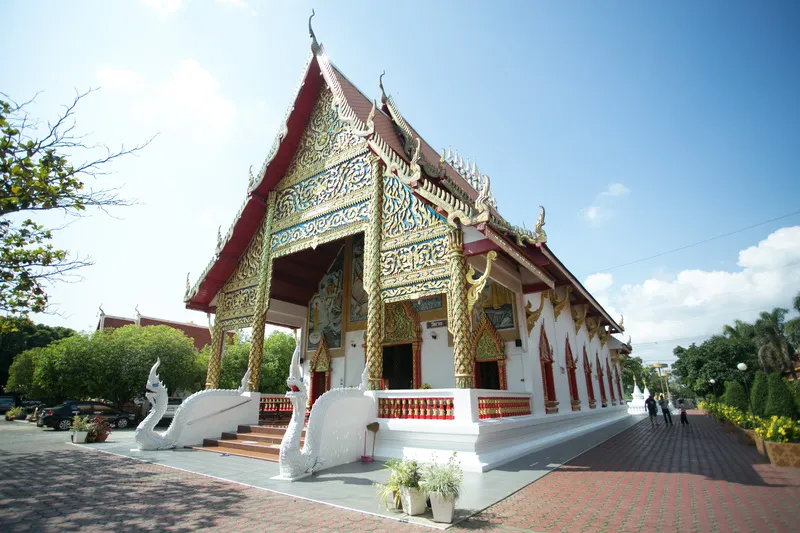
Open Days: Daily
Opening Hours: 08.00 – 18.00
Wat Phra That Sop Waen in Phayao Province is located in Yuan Subdistrict, Chiang Kham District. It is one of the most meaningful cultural temples in the Chiang Kham area, especially for travelers who want to understand Tai Lue heritage, Lanna Buddhist architecture, traditional weaving, and community-based cultural life. The temple is known for its ancient pagoda, a Tai Lue house, a local weaving center, and a huge rain tree that is more than 100 years old.
This temple is a rewarding stop for cultural travelers, history lovers, Buddhist pilgrims, photographers, families, and visitors interested in ethnic communities of northern Thailand. Within the temple grounds, travelers can pay respect to the old Phra That Sop Waen, explore the Tai Lue house, observe cotton weaving by elderly women from the village, and experience a temple environment that remains closely connected with the daily life of the local community.
The name “Sop Waen” comes from the geography of the area. In northern Thai usage, “sop” refers to a point where waterways meet. The temple is associated with the confluence of the Waen River and the Hong River, giving the temple its name. This connection with water is important because rivers shaped settlement, agriculture, local movement, and community life in Chiang Kham for generations.
Wat Phra That Sop Waen is a community temple under the Mahanikaya Buddhist order. It is located in a Tai Lue community and has long served as a spiritual center for local people. The temple was established in 1680 and received its consecrated boundary in 1897. The ancient pagoda, which is more than 800 years old, has been restored several times while preserving its Lanna-style form and its sacred role in the community.
Phra That Sop Waen stands behind the viharn. The pagoda is not large, but it carries deep religious significance because it enshrines sacred relics associated with the Buddha, including strands of hair and a jawbone relic. For local Buddhists, this makes the temple a highly respected place of worship. Visitors usually come to pay respect, make merit, and walk quietly around the sacred area.
The pagoda is built in Lanna style with a square base. Its main body is painted white, while the bell-shaped section is gold. The upper section is crowned with a golden tiered umbrella, and the pagoda is enclosed by a low boundary wall. Lion statues stand at the 4 corners, and additional lion figures mark the entrance. These guardian figures help create a sacred atmosphere and reflect the symbolic protection often seen in northern Thai Buddhist architecture.
The beauty of Phra That Sop Waen lies in its calm proportions and clean visual character. The white base and body of the pagoda make the golden bell and umbrella stand out clearly. In the morning or late afternoon, natural light gives the pagoda a peaceful glow, making it a good time for visitors to pay respect and take respectful photographs.
Near the front of the sacred area is a white bell tower decorated with stucco figures of swans and peacocks, along with small mirrored glass pieces. These details add a refined local character to the temple. Together with the pagoda, lion statues, viharn, and surrounding temple space, the bell tower helps create a distinctive atmosphere that blends Lanna Buddhist art with community craftsmanship.
One of the most interesting features of Wat Phra That Sop Waen is the Tai Lue house inside the temple grounds. This traditional house allows visitors to learn about the lifestyle of the Tai Lue people in a concrete and accessible way. It shows how domestic space, tools, textiles, and everyday objects reflect local wisdom, family life, and cultural identity. For foreign travelers, the house provides useful context for understanding Chiang Kham beyond temple architecture alone.
The weaving center inside the temple is another important highlight. Elderly women from the village continue to demonstrate traditional cotton weaving, allowing visitors to see the rhythm of the loom, the preparation of threads, and the patient process of creating woven cloth by hand. These textiles are not simply souvenirs. They represent community memory, inherited skill, and the quiet strength of local women who have helped preserve Tai Lue craft traditions.
Visitors can also purchase cotton textiles and handmade fabric products from the community. Buying these items supports local artisans and helps sustain the transmission of weaving knowledge. In this way, Wat Phra That Sop Waen functions as more than a religious site. It is also a cultural learning space, a craft preservation center, and a gentle community economy connected to heritage tourism.
Walking through the Tai Lue house helps travelers understand the daily life of the Tai Lue people in greater detail. The layout of the house, household objects, use of natural materials, and simple functional design all reflect local adaptation to climate, family needs, and cultural values. The Tai Lue people have a distinct language, clothing tradition, food culture, and ritual life. A visit to the Tai Lue house therefore adds an ethnic and cultural dimension to the temple experience.
In front of the temple, near the school area, stands a huge rain tree that is more than 100 years old. The tree is about 17 meters tall, with a trunk circumference of about 5.75 meters and a canopy spreading around 43 meters across. Its wide branches create a dramatic natural shade and make it one of the memorable landmarks of the temple area. Many visitors stop here for photographs or simply to rest under the old tree.
The rain tree is not only a natural feature. It is also part of the community’s living memory. Local residents, students, monks, and visitors have all shared the shade of this tree over time. Its wide canopy gives the area a peaceful character and adds another layer of charm to the temple. A visit to Wat Phra That Sop Waen should therefore include both the sacred pagoda and this remarkable old tree.
Wat Phra That Sop Waen offers several layers of experience in a compact area. The ancient pagoda is the spiritual core. The viharn and bell tower represent Buddhist art. The Tai Lue house preserves community lifestyle. The weaving center keeps local craftsmanship alive. The giant rain tree adds natural beauty and shade. Together, these elements make the temple a strong example of community-based cultural tourism in Phayao Province.
For photography, the temple offers many interesting angles. The white-and-gold pagoda, lion figures, decorated bell tower, Tai Lue house, weaving space, and rain tree all provide different visual stories. Morning light is suitable for soft architectural photographs, while late afternoon light gives more depth to the pagoda and tree canopy. Visitors should photograph respectfully, especially near worship areas and while local artisans are working.
Because Wat Phra That Sop Waen remains an active Buddhist temple, visitors should dress modestly and behave respectfully. Shoes should be removed before entering sacred buildings where required. When visiting the Tai Lue house or weaving area, visitors should be considerate of elderly artisans and ask permission before taking close-up photographs. Respectful travel helps preserve a positive relationship between visitors and the local community.
The temple is also suitable for families, students, and cultural study groups. It can be used as an outdoor learning site for northern Thai history, Lanna Buddhist art, Tai Lue identity, handwoven textiles, sacred relic traditions, and community heritage preservation. Unlike a quick sightseeing stop, this temple rewards visitors who slow down and pay attention to details.
Wat Phra That Sop Waen can be combined with several nearby attractions in Chiang Kham, such as Wat Nantaram, Wat Saen Mueang Ma, Wat Phra Nang Din, the Tai Lue Cultural Center at Wat Yuan, and the 2324 Memorial Museum. These sites together reveal the cultural diversity of Chiang Kham, where Tai Lue, Tai Yai, Lanna, and local historical memories coexist within a small district.
Getting There from Chiang Kham is straightforward. Take Highway 1021 toward the Chae Haeng intersection. Pass Khunakon Witthaya School, then continue about 300 meters after Phet Restaurant until you see the turnoff to the temple on the right. Turn in for about 200 meters. Wat Phra That Sop Waen is on the left, next to Chiang Kham Kindergarten School.
Travelers coming from Phayao city can drive toward Chiang Kham District and then use Route 1021 to reach the temple area. A private car or hired local transport is the most convenient option, especially for travelers planning to visit multiple cultural sites in one day. Starting in the morning allows enough time to explore the pagoda, Tai Lue house, weaving center, rain tree, and nearby attractions without rushing.
The main value of Wat Phra That Sop Waen is its close relationship between faith and community life. The ancient pagoda remains the spiritual heart of the temple. The Tai Lue house preserves ethnic identity. The weaving center supports elderly artisans and keeps craft knowledge alive. The large rain tree adds a natural landmark that has become part of local memory. These features make the temple a living cultural site rather than a static monument.
For travelers exploring Phayao, Wat Phra That Sop Waen shows that the province’s appeal extends far beyond Phayao Lake and the main city area. Chiang Kham has its own deep cultural identity, especially through Tai Lue heritage, sacred temples, traditional crafts, and local community life. A visit to this temple offers a quiet but meaningful encounter with northern Thai culture, Buddhist devotion, and the living heritage of a small district.
| Name | Wat Phra That Sop Waen |
| Location | Yuan Subdistrict, Chiang Kham District, Phayao Province |
| Address | Moo 1, Yuan Subdistrict, Chiang Kham District, Phayao Province, Thailand |
| Highlights | Ancient 800-year-old pagoda, Tai Lue house, traditional weaving center, giant rain tree over 100 years old, and Tai Lue community atmosphere |
| History | The temple was established in 1680 and received its consecrated boundary in 1897. It is an important temple of the Tai Lue community in Chiang Kham. |
| Name Origin | The name Sop Waen comes from the confluence of the Waen River and the Hong River near the temple area. |
| Distinctive Features | Lanna-style pagoda with a square base, white body, golden bell section, golden umbrella, boundary wall, lion statues, and a white bell tower decorated with swan and peacock stucco motifs |
| Travel Information | From Chiang Kham, take Highway 1021 toward the Chae Haeng intersection, pass Khunakon Witthaya School and Phet Restaurant, then turn right into the temple road for about 200 meters. The temple is on the left next to Chiang Kham Kindergarten School. |
| Current Status | Active Buddhist temple, sacred pagoda site, Tai Lue cultural learning space, and community attraction in Chiang Kham District |
| Open Days | Daily |
| Opening Hours | 08.00 – 18.00 |
| Fees | No admission fee |
| Facilities | Temple courtyard, worship area, Tai Lue house, weaving center, photo spots, and nearby community shops |
| Main Areas / Zones | Phra That Sop Waen Pagoda, viharn, bell tower, Tai Lue house, weaving center, and the large rain tree in front of the temple area |
| Abbot / Caretaker | Phra Athikan Krittachai Kantasilo, Phra Khru Wisut Chedtiyarak |
| Official Website / Official Page | Wat Phra That Sop Waen Chiang Kham Phayao |
| Nearby Tourist Attractions | 1. Wat Saen Mueang Ma, about 2 km 2. Wat Nantaram, about 3 km 3. Tai Lue Cultural Center at Wat Yuan, about 3 km 4. Wat Phra Nang Din, about 4 km 5. 2324 Memorial Museum, about 6 km |
| Nearby Restaurants | 1. Live Cafe, about 3 km, Tel. 093-168-6241 2. Lap Mo Yo Lue Restaurant, about 2 km 3. Pa Ko Chiang Kham 1994, about 3 km 4. Kim Hiang Restaurant, about 3 km 5. Hotel De One Dee Cafe, about 4 km, Tel. 091-060-9928 |
| Nearby Accommodations | 1. I Waree Resort, about 1 km, Tel. 065-994-4191 2. Phu View Place, about 3 km, Tel. 083-519-6445 3. Chiang Kham Ruk Khun Hotel, about 4 km, Tel. 097-389-8998 4. Chiang Kham Grand Villa, about 4 km, Tel. 084-811-5585 5. Hotel De One Dee, about 4 km, Tel. 094-616-4982 |
Frequently Asked Questions (FAQ)
Q: Where is Wat Phra That Sop Waen located?
A: Wat Phra That Sop Waen is located in Yuan Subdistrict, Chiang Kham District, Phayao Province, near Chiang Kham Kindergarten School and the Tai Lue community area.
Q: What is Wat Phra That Sop Waen known for?
A: It is known for its ancient pagoda over 800 years old, Tai Lue house, traditional weaving center, and a large rain tree over 100 years old.
Q: What sacred relics are enshrined in Phra That Sop Waen?
A: The pagoda enshrines sacred relics associated with the Buddha, including strands of hair and a jawbone relic.
Q: What does the name Sop Waen mean?
A: The name refers to the area where the Waen River and the Hong River meet near the temple.
Q: Is there a Tai Lue house inside the temple?
A: Yes. The temple has a Tai Lue house and a weaving center where visitors can learn about Tai Lue lifestyle and traditional cotton weaving.
Q: What are the opening hours of Wat Phra That Sop Waen?
A: The temple is open daily from 08.00 to 18.00.
Q: Is there an admission fee?
A: No. There is no admission fee for visiting the temple.
Q: What nearby attractions can be visited with Wat Phra That Sop Waen?
A: Nearby attractions include Wat Saen Mueang Ma, Wat Nantaram, the Tai Lue Cultural Center at Wat Yuan, Wat Phra Nang Din, and the 2324 Memorial Museum.
Tel : 054452133
 Tel : 054452133
 Category: ●Places of Worship
 Group: ●Temple
Last Update : 5 MonthAgo
 Last Update : 5 MonthAgo
 Click to Access the Navigation Map GPS
Wat Phra That Sop Waen Map
Recommend

 Art, Culture and Heritage
 Historical Sites and Monuments(4)
 Landmarks and Memorials(4)
 Art, Craft Centres, Tradition(1)
 Museums(2)
Temple(39)
Museums(2)
Temple(39)
 Other Sacred Sites(5)
 Research and Development
 Royal Project(1)
 Suburban Living
 Village, Community(2)
 Local Market(4)
 Nature and Wildlife
 National Parks and Marine Reserves(7)
 Mountain (Doi)(2)
 Dam, Reservoir, Lake(11)
 Waterfalls(8)
 Caves(5)
 River, Canal(3)
 Other natural attractions(5)
 Travel Articles, Recipes
 Travel Review, Food Review(1)


