
lovethailand home >North Travel Attractions >Phayao Travel Attractions >Chiang Muan >Ban Mang > Chiang Muan-Kaeng Luang Dinosaur Forest Park
TL;DR: Chiang Muan-Kaeng Luang Dinosaur Forest Park is located at Ban Nong Klang, Moo 7, Ban Mang Subdistrict, Chiang Muan District, Phayao Province, open Daily, hours 08.30 – 16.30.

Chiang Muan-Kaeng Luang Dinosaur Forest Park
Open Days: Daily
Opening Hours: 08.30 – 16.30
Chiang Muan-Kaeng Luang Dinosaur Forest Park in Phayao Province is one of the most important geo-tourism and natural learning sites in northern Thailand. Located at Ban Nong Klang, Moo 7, Ban Mang Subdistrict, Chiang Muan District, the area combines the discovery site of a sauropod dinosaur fossil, the Chiang Muan Dinosaur Museum, natural forest scenery, and Kaeng Luang, a large rocky rapid on the Yom River. For travelers who want to see a different side of Phayao beyond Kwan Phayao, temples, and local markets, this destination offers a rare combination of prehistoric science, forest landscape, river scenery, and community identity.
The Chiang Muan dinosaur is especially significant because it was the first dinosaur discovered in northern Thailand. Between 2002 and 2009, a survey team from the Department of Mineral Resources, led by paleontologist Warawut Suteethorn, explored and excavated fossils in Chiang Muan District. The team discovered 104 fossil bone pieces arranged in a north-south direction. This discovery placed Phayao firmly on Thailand’s dinosaur map and showed that northern Thailand also preserves important evidence of prehistoric life.
The fossil bones found at the site include cervical vertebrae, back vertebrae, caudal vertebrae, hip bones, and ribs. Scientific examination identified them as belonging to a sauropod dinosaur, a group of large plant-eating dinosaurs known for long necks, long tails, four-legged movement, and enormous body size. Sauropods are among the most recognizable dinosaurs in the world, but the Chiang Muan fossil is particularly interesting because some of its characteristics differ from sauropods previously found in Thailand.
Because of these differences, the Chiang Muan sauropod has been considered potentially distinct from other known Thai sauropods. The possibility that it may represent a new species gives the site high scientific value. A new dinosaur fossil does not only add another animal name to science; it also helps researchers understand dinosaur evolution, ancient environments, and the geographical distribution of dinosaurs in what is now Thailand. The 104 fossil bones are therefore natural records preserved in stone, carrying information from a world that existed far before human history.
The fossil site is in Ban Nong Klang, Ban Mang Subdistrict, Chiang Muan District, an area connected with hills, forest, and the Yom River. The fossils were found in red sandstone layers, and the age of the fossils has been estimated at no less than 130 million years. This gives visitors a powerful sense of time. The landscape they see today was once part of a very different prehistoric environment where large plant-eating dinosaurs lived, moved, fed, and died long before modern villages, roads, and towns existed.
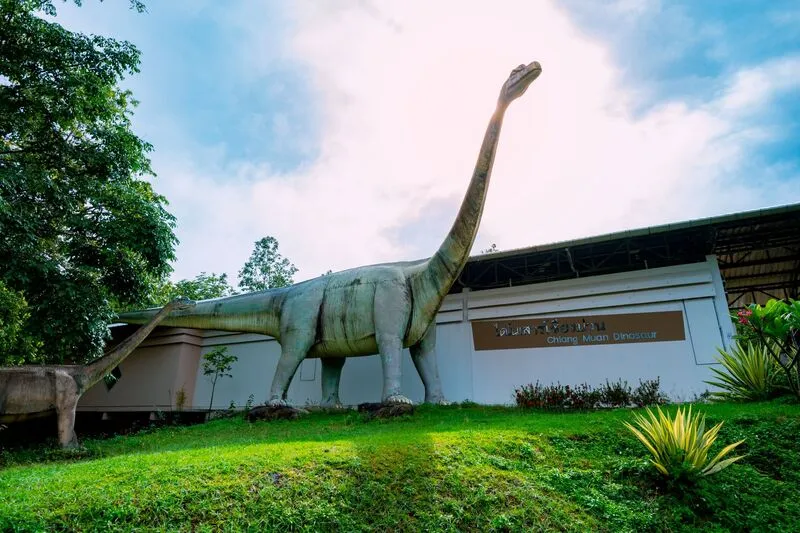
Inside the forest park, the Chiang Muan Dinosaur Museum presents information about the fossil discovery, the excavation process, sauropod anatomy, and the importance of the site. The museum helps make scientific information accessible to students, families, general travelers, and people interested in geology and paleontology. Displays, models, skeleton information, and interpretive materials help visitors understand the fossil story more clearly than reading about it from a distance.
One of the strengths of the museum is that it is located close to the actual discovery area. Visitors are not learning in a completely separate building far from the source; they are surrounded by the landscape that produced the fossils. Ban Nong Klang, Ban Mang, the surrounding forest, nearby rock formations, and Kaeng Luang all help provide context. This makes the visit feel more grounded and meaningful because the fossils are connected to real geology, real terrain, and real local communities.
For children and students, Chiang Muan-Kaeng Luang Dinosaur Forest Park is an excellent outdoor classroom. It introduces dinosaurs, herbivorous sauropods, fossil bones, excavation, sedimentary rock, geological age, and the work of paleontologists through a real place. Seeing a dinosaur learning site in northern Thailand helps make science more memorable. It also shows that scientific discoveries are not limited to famous museum cities; they can emerge from local landscapes and rural districts.
For general travelers, the destination is attractive because it combines learning and nature. After exploring the dinosaur museum, visitors can continue to Kaeng Luang, located nearby. Kaeng Luang is a large rock formation across the Yom River, with dry dipterocarp forest and mixed deciduous forest along both banks. It has long been a local recreation area for people in Chiang Muan. The natural atmosphere of rocks, flowing water, and forest gives the trip a relaxing balance after the museum visit.
Kaeng Luang adds another layer of interest to the dinosaur site. On one side, visitors learn about fossil evidence from millions of years ago. On the other side, they see the present-day Yom River flowing through the landscape. This creates a powerful contrast between deep geological time and living nature. The rocks and fossils speak of the ancient past, while the river, forest, and local visitors show how the landscape continues to evolve and support community life today.
During the rainy season, Kaeng Luang becomes more dramatic as the water level rises and the river atmosphere becomes stronger. In suitable conditions, rafting or water activities may be available through local operators. However, visitors should always check water levels, weather, and safety conditions before participating. Natural rivers can change quickly after rain. Avoid entering the water during strong currents, do not climb slippery rocks, and follow local safety advice carefully.
The surrounding dry dipterocarp and mixed deciduous forests enhance the landscape. Dry dipterocarp forest is usually more open and seasonally dry, while mixed deciduous forest contains a variety of trees that change with the seasons. Together with the Yom River, these forest types create a scenery of rock, water, trees, and light. Visitors interested in nature should take time to observe the trees, riverbank, rock forms, and seasonal changes, as they help explain the environmental character of Chiang Muan.
Chiang Muan is a small district with a quiet but distinctive identity. It may not be a large tourism center, but it contains important natural and cultural attractions. Chiang Muan-Kaeng Luang Dinosaur Forest Park acts as a gateway to this lesser-known side of Phayao. It links dinosaur fossils, the Yom River, Kaeng Luang, Mae Yom forest landscapes, and Ban Mang communities into one meaningful route. Travelers who know Phayao only through Kwan Phayao will discover a much deeper natural and geological story here.
A visit should take at least 1 to 2 hours for the museum, dinosaur displays, photo areas, and Kaeng Luang. Travelers who want to relax by the river, take photographs, or include family activities should allow half a day. A slower visit makes it easier to appreciate both the prehistoric story inside the museum and the natural atmosphere outside. The site rewards travelers who do not rush.
The best time for the museum is during the morning or afternoon before closing time. These hours provide enough light and allow visitors to continue to nearby attractions. For Kaeng Luang photography or nature viewing, early morning or late afternoon is generally more comfortable than midday heat. During the rainy season, visitors should wear shoes with good grip, watch for wet surfaces, and check the weather before traveling.
Because this is a fossil learning site, visitors should respect conservation rules. Do not touch, move, scratch, collect, or remove stones, fossils, or natural objects from the area. Fossils and rock layers are scientific evidence that must be protected for future generations. Inside the museum, avoid climbing on displays, touching restricted objects, or allowing children to handle exhibits inappropriately. Respectful behavior helps preserve the site’s educational value.
Scientifically, the Chiang Muan discovery expanded knowledge of dinosaur distribution in Thailand. Many famous Thai dinosaur sites are located in the northeastern region, such as Khon Kaen, Kalasin, and Chaiyaphum. The discovery in Phayao showed that northern Thailand also contains important dinosaur evidence. This adds another piece to the broader understanding of prehistoric environments in the region.
Sauropods were large herbivorous dinosaurs that required abundant plant resources and suitable habitats. The presence of a sauropod fossil in Chiang Muan invites visitors to imagine an ancient environment with vegetation, water sources, and open space large enough to support giant animals. Although the present-day landscape has changed greatly, the fossil remains and rock layers still provide a window into that prehistoric world.
For photography, the forest park offers several angles: dinosaur models, museum displays, fossil interpretation panels, river rocks, the Yom River, and forest scenery. A good photo story should include both the scientific and natural sides of the place. Wide shots of the area, details of interpretive signs, dinosaur displays, and the Kaeng Luang landscape can together show that this is not only a dinosaur photo stop, but a multi-layered learning and nature destination.
Families with children may find this site especially enjoyable. Dinosaurs naturally attract children’s attention, and seeing a real fossil-related site helps them understand that dinosaurs were real animals studied through evidence in rocks. Parents can use the visit to discuss time, extinction, fossils, geology, and conservation in a simple and engaging way. The river and forest area also gives the trip a relaxing outdoor element.
For nature travelers, Kaeng Luang provides a calm place to rest after the museum visit. Visitors can walk, sit by the river, listen to flowing water, and enjoy the forested surroundings. Having both a museum and a natural river landscape in the same area makes the destination suitable for mixed-interest groups. Some visitors may focus on dinosaurs, while others may prefer scenery and relaxation.
At the community level, the forest park helps strengthen Chiang Muan’s identity as a learning destination. The dinosaur discovery gives local communities a unique story to share with visitors and creates pride in the district. Tourism also supports nearby restaurants, cafés, accommodation, and local services. In this way, a scientific discovery becomes connected with local economic and cultural life.
A one-day itinerary can begin from Mueang Phayao or nearby districts, arriving at Chiang Muan-Kaeng Luang Dinosaur Forest Park in the morning. Visitors can explore the museum, take photos, and then continue to Kaeng Luang. After lunch in Chiang Muan, the route can continue to Doi Phu Nang National Park, Than Sawan Waterfall, Wat Tha Fa Tai, or Ban Sa Mine Viewpoint depending on time and interest. This plan combines science, nature, and local community travel in one day.
With more time, staying overnight in Chiang Muan allows a more relaxed experience. The district has small hotels, resorts, homestays, and nature-based accommodation. Travelers who enjoy quiet towns, slow travel, and local scenery may find Chiang Muan more rewarding as an overnight stop than a quick roadside visit.
Before visiting, prepare drinking water, sun protection, comfortable shoes, a camera, and a bag for carrying waste out. Although the site has basic facilities, responsible travel in a natural area requires preparation. Do not litter, do not make excessive noise, and be careful around the river and rocks, especially during rainy periods when surfaces can be slippery.
What makes Chiang Muan-Kaeng Luang Dinosaur Forest Park distinctive is the combination of fossil evidence and living landscape. Visitors do not only see a dinosaur model or a museum display. They also see the Yom River, forest, rocks, and local communities around the discovery area. The fossil story points back to deep time, while Kaeng Luang and the river reveal the continuing life of the landscape today.
Getting There is easiest by private car or motorcycle. The forest park is located at Ban Nong Klang, Ban Mang Subdistrict, Chiang Muan District, Phayao Province. From Ban Bo Bia Intersection, take Highway 1251 toward Chiang Muan District until reaching Ban Mang Intersection. Turn right for about 4 km, then turn right again near Ban Pong Sanuk and continue for about 4 km to reach Chiang Muan-Kaeng Luang Dinosaur Forest Park. Travelers starting from Mueang Phayao should allow enough time because Chiang Muan is some distance from the city and parts of the route pass through rural roads.
Chiang Muan-Kaeng Luang Dinosaur Forest Park is a worthwhile stop for anyone visiting Chiang Muan District in Phayao Province. It brings together the first dinosaur discovery in northern Thailand, the Chiang Muan Dinosaur Museum, Kaeng Luang, the Yom River, dry dipterocarp forest, mixed deciduous forest, and the quiet charm of local communities. A visit here shows that Phayao is not only a province of lakes, temples, and Lanna culture, but also a land with a deep natural history reaching back millions of years.
| Name | Chiang Muan-Kaeng Luang Dinosaur Forest Park / Kaeng Luang Dinosaur Forest Park / Chiang Muan Dinosaur Museum |
| Location | Ban Nong Klang, Moo 7, Ban Mang Subdistrict, Chiang Muan District, Phayao Province |
| Address | Ban Nong Klang, Moo 7, Ban Mang Subdistrict, Chiang Muan District, Phayao 56160 |
| Highlights | The first sauropod dinosaur fossil discovery in northern Thailand, Chiang Muan Dinosaur Museum, and Kaeng Luang on the Yom River |
| History / Period | Fossils were surveyed and excavated between 2002 and 2009 by a Department of Mineral Resources team led by paleontologist Warawut Suteethorn. The fossils are estimated to be at least 130 million years old. |
| Key Evidence | 104 fossil bone pieces arranged in a north-south direction, including neck bones, backbone, tail base bones, hip bones, and ribs |
| Dinosaur Type | A sauropod dinosaur: a large herbivorous dinosaur with a long neck, long tail, and four-legged movement, showing characteristics different from other sauropods found in Thailand |
| Name Origin | Named after the Chiang Muan dinosaur fossil discovery and Kaeng Luang, the natural rocky rapid on the Yom River near the discovery area |
| Distinctive Features | Dinosaur museum, fossil learning displays, dinosaur models, Kaeng Luang rocks, Yom River scenery, dry dipterocarp forest, and mixed deciduous forest |
| Travel Information | From Ban Bo Bia Intersection, take Highway 1251 toward Chiang Muan to Ban Mang Intersection, turn right for about 4 km, then turn right again near Ban Pong Sanuk and continue about 4 km to the forest park |
| Current Status | Open as a tourism and learning site for fossils, geology, dinosaurs, and nature in Chiang Muan District |
| Open Days | Daily |
| Opening Hours | 08.30 – 16.30 |
| Facilities | Chiang Muan Dinosaur Museum, fossil display area, dinosaur models, Kaeng Luang viewpoint, parking area, and rest areas |
| Main Areas / Zones | Dinosaur Museum Zone, Sauropod Fossil Display Zone, Dinosaur Model Zone, Kaeng Luang Zone, Yom River Zone, and surrounding forest area |
| Caretaker | Department Of National Parks, Wildlife And Plant Conservation, with the site located in Chiang Muan District, Phayao Province, and associated with protected forest management in the Doi Phu Nang National Park area |
| Main Contact Number | Kaeng Luang Dinosaur Forest Park Tel. 053-714914 / Ban Mang Subdistrict Administrative Organization Tel. 054-495-333 |
| Official Website / Official Page | Information from the Department Of National Parks, Wildlife And Plant Conservation, Ban Mang Subdistrict Administrative Organization, and Tourism Authority Of Thailand |
| Nearby Tourist Attractions | 1. Kaeng Luang, About 0 km 2. Yom River At Ban Nong Klang, About 0 km 3. Wat Tha Fa Tai, About 15 km 4. Ban Sa Mine Viewpoint, About 18 km 5. Doi Phu Nang National Park, About 35 km 6. Than Sawan Waterfall, About 38 km 7. Phra That Phu Po, About 28 km |
| Nearby Restaurants | 1. Aun Ruean Restaurant, About 12 km, Tel. 064-269-2263 2. Ban Tha Fa Cafe, About 15 km, Tel. 080-898-9662, 095-685-1965 3. Huan Muan Suan Hug, About 14 km 4. Larb Lam Chiang Muan, About 14 km 5. Jungle Cafe Chiang Muan Phayao Branch, About 15 km 6. PunThai Coffee Chiang Muan, About 15 km |
| Nearby Accommodations | 1. P&P House Chiang Muan, About 15 km, Tel. 086-001-2011, 061-252-8615 2. Deetorjai Resort Chiang Muan, About 16 km, Tel. 085-627-6422 3. Baan Suan Siri Homestay, About 16 km, Tel. 096-772-5214 4. Warinda Garden Resort, About 18 km 5. Suan Sarun Homestay Chiang Muan, About 20 km |
Frequently Asked Questions (FAQ)
Q: Where is Chiang Muan-Kaeng Luang Dinosaur Forest Park located?
A: It is located at Ban Nong Klang, Moo 7, Ban Mang Subdistrict, Chiang Muan District, Phayao Province. It is the first sauropod dinosaur fossil discovery site in northern Thailand.
Q: What type of dinosaur was found in Chiang Muan?
A: The fossil belongs to a sauropod dinosaur, a large plant-eating dinosaur with a long neck, long tail, and four-legged movement. Its characteristics differ from other sauropods previously found in Thailand.
Q: When were the Chiang Muan dinosaur fossils discovered?
A: The survey and excavation took place between 2002 and 2009 by a Department of Mineral Resources team led by paleontologist Warawut Suteethorn.
Q: What can visitors see inside the forest park?
A: Visitors can see the Chiang Muan Dinosaur Museum, fossil learning displays, dinosaur models, sauropod information, and Kaeng Luang on the Yom River.
Q: What are the opening hours of Chiang Muan-Kaeng Luang Dinosaur Forest Park?
A: It is open daily from 08.30 to 16.30.
Q: Why is Kaeng Luang interesting?
A: Kaeng Luang is a large rocky rapid on the Yom River, surrounded by dry dipterocarp forest and mixed deciduous forest. It is a local recreation area and a scenic natural stop near the dinosaur site.
Q: How do visitors get to Chiang Muan-Kaeng Luang Dinosaur Forest Park?
A: From Ban Bo Bia Intersection, take Highway 1251 toward Chiang Muan to Ban Mang Intersection, turn right for about 4 km, then turn right again near Ban Pong Sanuk and continue about 4 km to the forest park.
Q: What nearby attractions can be visited after the dinosaur forest park?
A: Nearby places include Kaeng Luang, Wat Tha Fa Tai, Ban Sa Mine Viewpoint, Doi Phu Nang National Park, Than Sawan Waterfall, and Phra That Phu Po.
 Category: ●Nature and Wildlife
 Group: ●National Parks and Marine Reserves
Last Update : 4 MonthAgo
 Last Update : 4 MonthAgo
 Click to Access the Navigation Map GPS
Chiang Muan-Kaeng Luang Dinosaur Forest Park Map
Recommend

 Art, Culture and Heritage
 Historical Sites and Monuments(4)
 Landmarks and Memorials(4)
 Art, Craft Centres, Tradition(1)
 Museums(2)
 Places of Worship
 Temple(39)
 Other Sacred Sites(5)
 Research and Development
 Royal Project(1)
 Suburban Living
 Village, Community(2)
 Local Market(4)
National Parks and Marine Reserves(6)
Local Market(4)
National Parks and Marine Reserves(6)
 Mountain (Doi)(2)
 Dam, Reservoir, Lake(11)
 Waterfalls(8)
 Caves(5)
 River, Canal(3)
 Other natural attractions(5)


